Banff’s Second Floor Retail and Why it Works

Date:

Share post:

I have good news and bad news.

The bad news is that I took a gnarly spill yesterday afternoon on the mountains. The nose of my snowboard got stuck in deep snow and I fell forward onto my shoulder and then compressed my back. I tore a shoulder ligament and possibly fractured two ribs. So snowboarding season is over for me this year.

The good news is that I now have more time to relax and enjoy the town of Banff, and then Revelstoke this weekend.

Banff is a beautiful town. It’s compact, walkable, and surrounded by snow capped mountains. How could you not love it?

One of the more subtle things that stands out for me though is the ubiquity of second level retail and restaurants. There’s a lot people in the (North American) real estate industry that will tell you that second floor retail just doesn’t work (you want ground floor). And indeed, it can be hard to pull off. As I’ve said before, getting retail right in general can be difficult.

But in Banff, many of the bars and restaurants are up top. Here are a few examples (there’s an Earls, Boston Pizza, and a Korean restaurant, respectively):

So why does it work here?

Given the town’s small footprint and location within Banff National Park, the market is supply constrained. That’s why Parks Canada imposes a number of restrictions on residency. They’re trying to ensure that the people who actually work in the community can find housing and it all doesn’t become second homes.
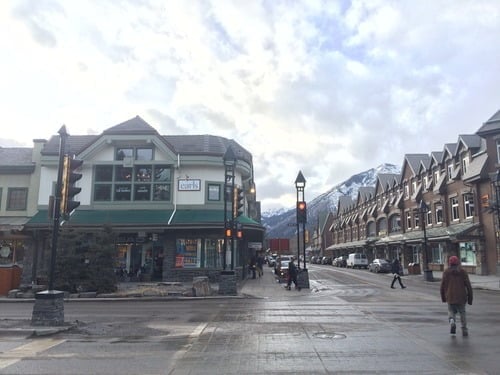
So my gut tells me that in order to get enough retail/commercial space to serve the area and its tourists, they had no choice but to go up. They simply ran out of ground floor space. Because if the town was able to instead sprawl outward, I suspect that’s exactly what it would have done. And then more ground floor space would have been created.

To be fair, most of the second floor examples I came across were bars and restaurants, which is arguably easier to pull off than straight retail. But it’s still something. 

If any of you are familiar with real estate and planning in Banff or just have a better hypothesis, I’d love to hear from you in the comment section below.

About the Author: Brandon Donnelly is a real estate developerinternet entrepreneur, and blogger based in Toronto. His passions are cities, design, real estate, and technology. 

He presently works at TAS, where he oversees the development of mixed-use condominium projects. He’s also cofounder of condo review site Dirt (thedirt.co). Prior to this, he worked in the development group of Morguard Investments on office and retail projects. Brandon has worked in real estate since 2007.

Brandon studied architecture and art history at the University of Toronto. He also has a master’s in architecture and real estate development from the University of Pennsylvania, and an MBA from the Rotman School

In his spare time, Brandon advises a non-profit called The Laneway Project. He also loves the gym, snowboarding, and Ontario wines.

About Architect This City: ATC is a daily blog for city builders written by an architect-trained, Toronto-based real estate developer. It was started in August 2013 and is rated by the Guardian Cities in the UK as one of the best city blogs in the world.

It covers everything from architecture and planning to real estate and technology. The posts are short and digestible, and are emailed out every morning at 6AM Toronto time. Subscribers are often architects, city planners, real estate professionals, entrepreneurs, policy makers, and other urbanists.

The mission of Architect This City is to promote the building of beautiful, sustainable, and globally competitive cities.

LEAVE A REPLY

Please enter your comment!
Please enter your name here

More From Retail Insider

RECENT RETAIL INSIDER VIDEOS

Advertisment

Subscribe to the Newsletter

Subscribe

* indicates required

RECENT articles

From The Desk: Canadian Retail Evolution Through Innovation, Expansion, and Experience

This week's retail news highlighted an industry balancing change and opportunity. From the end of a chapter in Canadian furniture manufacturing to major investments in luxury retail, experiential concepts, and new store openings, retailers continue to adapt to evolving consumer expectations and economic pressures.

The Hidden Cost of Grocery Promotions in Canada

Supplier-funded grocery promotions may be creating hidden costs throughout Canada's food supply chain. Sylvain Charlebois examines how these practices can affect prices over time.

Fuel boosts retail sales growth to $73 billion in April: Statistics Canada

The largest increase in retail sales in April was observed at gasoline stations and fuel vendors (+5.1%).

Palliser Sale Marks End of an Era for Canadian Furniture Manufacturing

Palliser Furniture's sale to MotoMotion ends more than 80 years of family ownership, raising questions about Canadian manufacturing, retailer relationships and the future of the iconic furniture brand.

Hermès to Open Standalone Store on Calgary’s Stephen Avenue

Hermès is planning its first standalone Alberta store on Calgary’s Stephen Avenue, exiting Holt Renfrew and reinforcing downtown Calgary’s growing luxury retail presence.

Empire Co. Ltd. CEO Charts Growth Strategy with Discount Focus

Empire Co. Ltd., a Canadian grocery retailer, is set to open 70 new stores, primarily in the discount sector, as part of CEO Pierre St-Laurent's growth strategy. The company is adapting to changing consumer preferences while managing its existing operations.

Alibaba.com data points to rise in solo founders as AI tools reshape startup landscape

71 per cent of more than 15,000 applicants to its CoCreate Pitch competition identified as solo founders, up from 40 per cent a year earlier.

AI increasingly shaping Canadians’ purchasing decisions, National Bank survey suggests

39 per cent of Canadians have used generative AI tools to support a purchasing decision in the past year.

Uncertainty outweighing tariffs as top concern for cross-border trade: Purolator survey

Businesses are already experiencing measurable financial impacts from tariffs.

Factor Meals accelerates nationwide expansion with new “state-of-the-art” Distribution Centre in Calgary

Initially launched in 2022 to serve Ontario, Quebec, and the Maritimes, the Calgary expansion allows Factor Meals to seamlessly scale its dietitian-approved, chef-crafted meal deliveries from coast to coast.

WeCook launches nationwide delivery with expansion into six new Canadian markets

The company said the expansion follows a period of rapid growth. It has grown by more than 1,000% since 2020, created over 600 jobs, and now delivers more than four million meals annually.

FIFA World Cup boosts brand opportunities in Toronto and Vancouver through out-of-home Advertising

Influx of people is creating a major opportunity for brands looking to reach large crowds, even without paying the steep costs associated with official FIFA sponsorships.

Adyen selected to provide payments technology for Aritzia

Adyen said it will process transactions in Aritzia’s physical locations, North American websites, and within its recently launched mobile app, supporting consistent payment experiences across channels. 

Daily Synopsis: Jun 18, 2026

Today's Retail Insider coverage highlights Canadian retail growth with new store openings by Zellers, Soch, Le Creuset, and No Frills plus Empire's robust sales and expansion plans.

Inside Zellers’ New Toronto Store as Crowds Turn Out for Opening Day

Retail Insider visited Zellers' new Toronto store on opening day, finding strong customer interest, value-focused merchandise, nostalgic touches and a modern standalone retail concept.

Empire Company sees sales reach $31.95 billion in Fiscal 2026, more growth planned for FreshCo brand

In fiscal 2027, the Company expects to open approximately 15 new FreshCo stores across Western Canada, Ontario and Atlantic Canada.

Caffeo unveils bold new look and expanded menu at Toronto’s 24/7 robotic cafe

The relaunch introduces a vibrant new visual identity and an expanded precision-brewed menu, elevating the experience for coffee lovers at the city's only 24/7 robotic café.

Strait of Hormuz Reopens, but Supply Chain Backlog Remains: Scandiweb (Opinion)

US and Iran announced a deal to reopen the Strait of Hormuz, but more than 800 vessels remain stranded and freight rates may take months to normalize.

Business Barometer: Small business owners continue to feel downcast in June: CFIB

Fuel costs remain the top cost constraint for 66% of small businesses, while weak demand continues to weigh on more than half (53%) of small firms.

Canadians Seek Connection and Community Through Retail: Study

A new HumanKind study suggests Canadians are increasingly prioritizing connection, community and meaningful experiences. The findings offer valuable insight into evolving consumer behaviour and the retail trends shaping Canada's marketplace.