

International luxury brands are increasingly opening stores in suburban Canadian shopping malls, as opposed to traditional urban street-front locations. It’s a recent phenomenon that is seeing Canadian retail becoming more ‘Americanized’. Canada is now home to several suburban shopping centres that feature luxury brands otherwise not located in urban cores, with the trend spreading from Toronto to other Canadian markets.
In Canada, freestanding luxury brand boutiques have traditionally conglomerated in the downtown cores of Toronto, Montreal and Vancouver. Toronto’s ‘Mink Mile’ (Bloor Street West between Yonge Street and Avenue Road) has been the city’s main luxury retail thoroughfare for decades, along with adjacent Yorkville and the shopping complex formerly called Hazelton Lanes. Montreal’s Sherbrooke Street West, housing Holt Renfrew, Tiffany & Co. and Escada, once featured freestanding luxury boutiques for names such as Yves Saint Laurent, Ungaro, Cartier, Sonia Rykiel, Davidoff, Versace and Georg Jensen. Downtown Vancouver’s Alberni/Burrard Street ‘luxury zone’ got its start in 1991 with the opening of Chanel at 755 Burrard Street, with the area centred around Alberni Street’s 1000 block now boasting some of the world’s top luxury brands such as Louis Vuitton, Prada and Hermes.
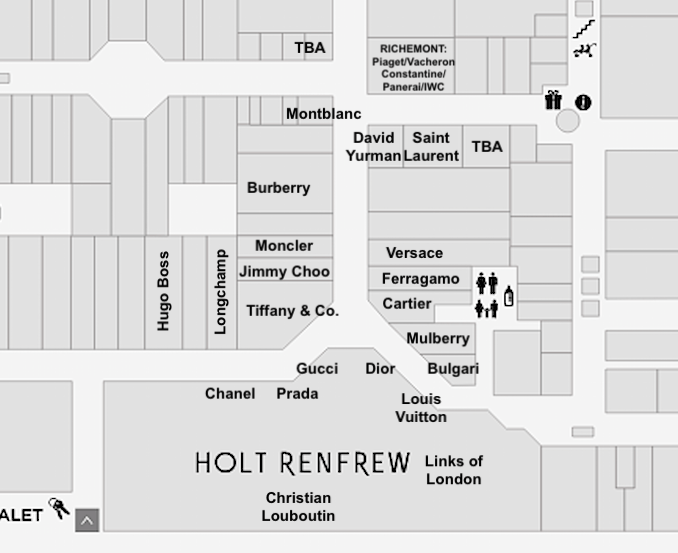

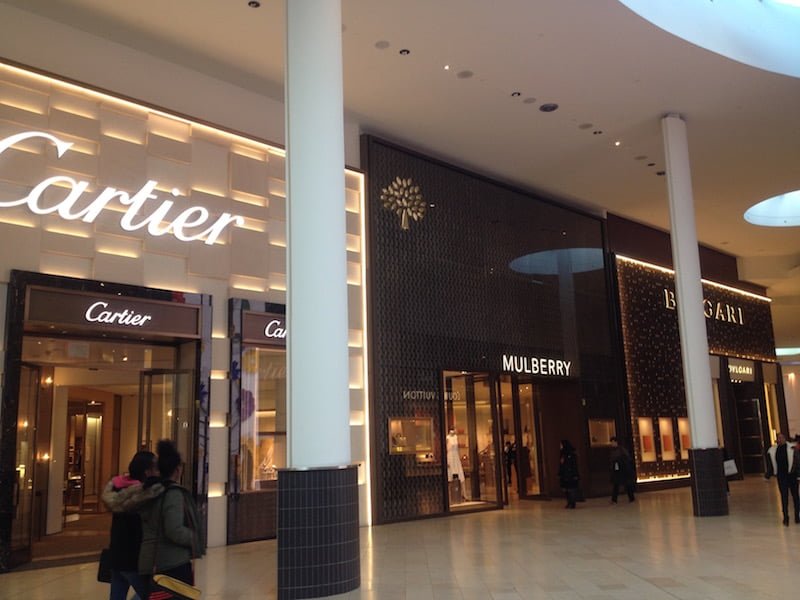
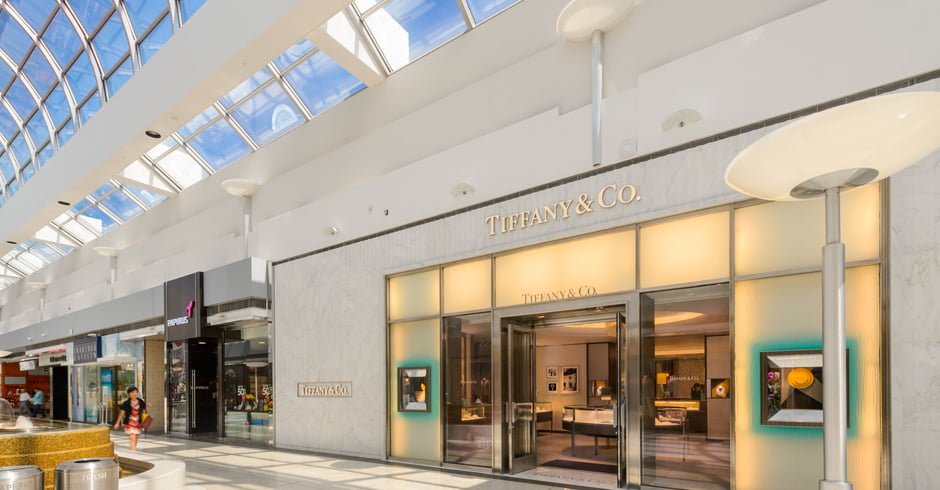
Although Canadian shopping malls have had upscale multi-brand stores for decades (Holt Renfrew used to operate smaller stores in several of Montreal and Toronto’s leading malls, while Harry Rosen dominated menswear nationally), mono-branded luxury stores didn’t really take off until April of 2009 when Tiffany & Co. opened a boutique at Toronto’s Yorkdale Shopping Centre. That marked the beginning of the mall’s ‘luxury wing’, which now boasts the highest concentration of luxury boutiques of any location in Canada. Under the direction of landlord Oxford Properties, Yorkdale has secured a ‘who’s-who’ of luxury stores, including freestanding locations for Jimmy Choo, Moncler, Versace, Cartier, Bulgari, David Yurman and others, as well as concessions in Holt Renfrew for Chanel, Prada, Louis Vuitton, Gucci, Dior and others. It’s estimated that the mall’s luxury boutiques now account for more than 30% of total sales, which is impressive considering that Yorkdale houses close to 300 stores.

Other Canadian shopping malls have also been adding luxury retailers to the mix, resulting in increased productivity. Vancouver’s Oakridge Centre, which has had a Hugo Boss and Max Mara presence for a number of years, also added Tiffany & Co. in late 2011. Calgary’s suburban CF Chinook Centre, going head-to-head with a downtown anchored by Holt Renfrew, added Burberry in 2010 and Tiffany & Co. in 2011 — followed by Canada’s first Nordstrom which opened in September of 2014. West Edmonton Mall, looking to draw high-end shoppers from downtown Edmonton, scored Tiffany & Co. in October of 2013 and it now plans to add a Yorkdale-like luxury wing to its Simons-anchored ‘Europa Boulevard’. The Greater Toronto Area also includes two malls looking to give Yorkdale a run for its luxury money. CF Sherway Gardens, where Saks Fifth Avenue opened a 143,000 square foot store in February, now boasts freestanding locations for De Beers, Links of London, Loding, Tiffany & Co. and Chopard. Mississauga’s Square One now has Canada’s largest Salvatore Ferragamo boutique as well as Wolford and Rolex, as well as a spectacular Holt Renfrew that opened over the summer. Holt’s features concessions for Tiffany & Co., Hugo Boss, Links of London and Gucci, with Moncler set to open its concession in the coming weeks. More luxury brands will open stores in these malls in 2017 and beyond, we’re told.

Luxury brands are locating closer to where affluent Canadian consumers reside, according to Retail Council of Canada’s Director of Education and Events, Kyle Tomlin. He theorized that given the increasing affluence within the catchment areas of malls such as Square One, CF Sherway and Yorkdale in the GTA, brands are securing space that’s more convenient, rather than opening in more traditional business core locations. It’s a sentiment shared by HRC Retail Advisory President Farla Efros, who also noted the advantages of climate controlled enclosed malls which are seeing both growing foot traffic as well as increasing productivity.
Luxury brands in suburban American malls are nothing new and in some cities, particularly those lacking substantial downtown retail (which, unfortunately, is now most American cities), suburban malls continue to dominate. In metropolitan regions such as Atlanta, Denver, Philadelphia, Houston and Detroit, luxury retailers are confined to upscale malls with names such as Lenox Square, Cherry Creek, King of Prussia, Houston Galleria and Somerset Collection. Sprawling metropolitan regions such as Los Angeles and New York City feature both urban and suburban luxury retail, though there are no Canadian regions that can compare in terms of population. The Chicago region is a unique case study in luxury retail, which may be compared to the Greater Toronto Area.
Metropolitan Chicago has a population of about 9.5 million over 28,000 square km. The ‘Greater Golden Horseshoe’, including 31,500 square km surrounding Toronto, has a population of about 9.3 million. Both cities feature downtown areas with considerable luxury brands — Chicago’s luxury retail is centred around the ‘Magnificent Mile’ of North Michigan Avenue and adjacent Oak/Rush/Walton Streets, while Toronto’s luxury retail focuses on Bloor Street West’s ‘Mink Mile’ and the adjacent Yorkville area.
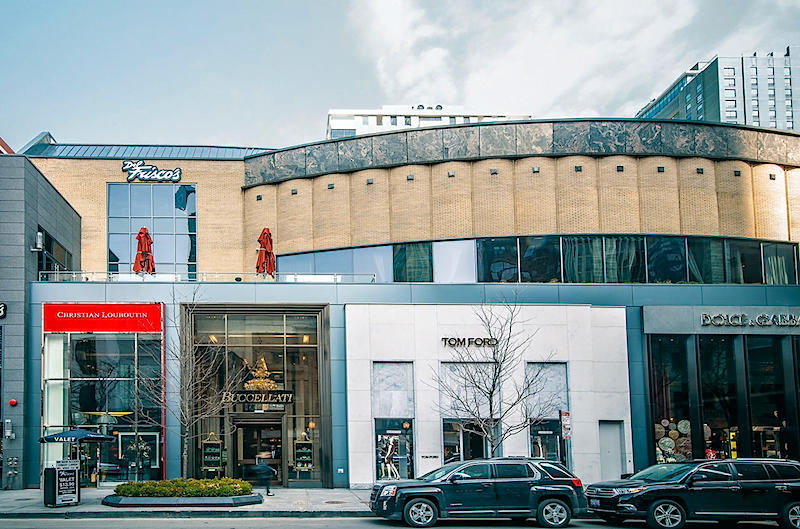
Both regions feature suburban malls with luxury retailers and, remarkably, Toronto may have become more ‘American’ than Chicago in terms of a retail luxury mix. While Chicago’s suburban luxury retailers are often second regional locations for stores already downtown, some of Toronto’s suburban luxury retailers only operate in the suburbs, bypassing traditional luxury addresses in the urban core.
The Chicago area has three large suburban malls that include luxury retailers. Oakbrook Center, west of Chicago, features freestanding locations for Louis Vuitton, Omega, Burberry, Tiffany & Co. and David Yurman, as well as a branch location for anchor luxury store Neiman Marcus. Northbrook Court, located in the city’s affluent north side, includes Armani Collezioni, Burberry, Louis Vuitton and Tiffany, all located near the mall’s anchor Neiman Marcus. Westfield Old Orchard, also on Chicago’s north side, features Tiffany & Co. as well as a franchised Rolex location. Its should be noted that every one of these luxury brands also operate stores downtown in Chicago’s Magnificent Mile area (Giorgio Armani, on Oak Street, is considered to be a ‘step above’ Collezioni).

Toronto, as discussed above, includes three leading malls each with several luxury retailers. CF Sherway Gardens and Square One can hold their own when compared to the Chicago malls mentioned above. CF Sherway’s luxury retailers De Beers and Chopard do not have locations downtown, though Chopard is available in some major jewellers. Square One managed to score Ferragamo before any freestanding downtown Toronto location, though sources say that a freestanding Yorkville unit is on the way. Yorkdale is the champion in terms of securing luxury retailers before downtown Toronto, with Bulgari, Saint Laurent, Versace, David Yurman Jimmy Choo, Moncler, Longchamp, John Varvatos and Jaeger Le-Coultre having their only freestanding Toronto locations at Yorkdale (though Moncler will open on Bloor next year). Swiss conglomerate Richemont Group will open at least five luxury boutiques at Yorkdale in 2017, and a soon-to-be revealed LVMH-owned luxury brand, currently with no freestanding locations in Canada, will open in the retail space next to Saint Laurent in 2017, as well.
Yorkdale has far surpassed any suburban Chicago mall in terms of luxury offerings, and has become one of the top luxury shopping destinations in North America. Yorkdale’s luxury store count is beginning to approach that of esteemed centres such as South Coast Plaza in California’s Orange County, Houston Galleria, The Mall at Short Hills near New York City, and even Miami’s Bal Harbour Shops, which is considered to be one of the world’s most prestigious and comprehensive luxury centres, with annual sales per square foot in excess of $3,000. The Retail Council of Canada is about to release a shopping mall study that will reveal updated numbers for Yorkdale, as well as Canada’s top 30 malls.
While Toronto’s luxury retail is spread over several areas including the suburbs, Vancouver’s luxury offerings continue to remain focused primarily downtown. The city’s downtown ‘luxury zone’ continues to attract international retail tenants, giving Toronto’s Bloor-Yorkville a run for its money in terms of number of luxury brands. That could change, however, as some luxury brands lament at the lack of exceptional retail space in Vancouver’s core, which is highly desirable and boasts some of Canada’s most productive retail spaces. Suburban landlords are taking notice and some are looking to attract luxury brands in a similar way as in Toronto. Ivanhoé Cambridge plans to overhaul Oakridge Centre, which attracts customers from a catchment area that boasts many very wealthy households. West Vancouver’s Park Royal is continuing to make improvements, with plans to add new tenants as renovations continue. Other Lower Mainland landlords have their sights on luxury retailers as well — Brentwood Mall, for example, which is being repositioned as ’The Amazing Brentwood’, has spoken to retailers such as Louis Vuitton, Burberry, Saks and Holt Renfrew, according to sources.
It remains to be seen if Canadian downtowns will continue to be strongholds of luxury retailing, or if suburban malls will step in and possibly even take over. While there’s a cachet to having a Bloor Street West or Burrard Street address, the high proven sales numbers at malls such as Yorkdale have luxury brands such as Bulgari and David Yurman choosing the suburbs over downtown. We’ll continue to monitor these retail trends into 2017 and beyond — information that we’ve received indicates that luxury brands are interested in both urban cores as well as leading suburban malls, and that Canadian luxury retail will include a mix of both in the coming years.


There is a leased Christian Louboutin men’s footwear and accessories corner-boutique.
It’s a terrific little shop. We didn’t want to clutter the floor plan with too many names but we’d definitely include it, otherwise.
Great article Craig. I believe there are numerous factors that also fall into a brands site selection. Parking ,proximity to residence , safety and of corse selection.
The new Opus Versante hotel set to open in Richmond, BC is supposed to house some luxury retailing too if I’m not mistaken. I’ve haven’t heard any recent updates but apparently it should open in 2017. I hope Retail Insider publishes articles regarding the tenants of its retail component
Thank you for the comment/info. If we’re able to get information about it, we’d love to report on it.
This article is really well done, this is so interesting. Please write more of these. It’s nice to get store announcements but pieces like this are a step above.
It feels like big cities in general are become too expensive, not just to live in, but shop in…at least from my point of view.
Toronto still has retailers such as Forever 21 and even Value Village — you can buy almost anything in Toronto, though mid-market retailers are being squeezed as retail polarizes.
AKA Luxury Becomes Bridge and Tunnel
This is a very troubling trend, and it would be good to see planning controls put back in place to limit suburban mall expansion. Ottawa did this in the 1980’s to protect the downtown retail area.
Some additional concerns:
1: I don’t think Canadian cities can sustain multiple locations of luxury stores in one city.
The stores are currently riding on a wave of luxury stores being popular with the masses. But this cannot go on, because it will either erode the cache the brands have, or people will stop buying, because they actually do not have the money to spend on these expensive brands.
As mentioned above, these luxury stores opening too many branches in one city removes the cache these stores have, and just makes them another store you can find anywhere. I have heard Louis Vuitton is purposely limiting new store expansion, because they have opened too many stores and their brand is not considered as high end as it used to be.
Canadian downtown retail zones have been resting on their laurels. For example, the Bloor-Yorkville BIA should have been working to make Bloor-Yorkville better compete with Yorkdale, and work to assemble the store spaces required to land new tenants in the downtown core.
Downtowns such as Toronto’s are home to many local high end shops, including many new ones. As suburban malls get more of the international luxury chains, downtown will be the place to get a truly unique luxury item that cannot be found in all corners of the world, and that is probably better made with attention to detail.
I know for myself, that if I am going to spend a good amount of money on a luxury item, I am more often than not doing it at a local store with unique items that are not mass produced.
2