

Toronto and Chicago share many similarities. Both cities have millions of residents and are located on the Great Lakes, and share similar climates and geography. What’s interesting is to analyze how luxury retail has clustered in both cities — Chicago is more centralized with luxury retail being in one street-front urban area, while Toronto’s luxury offerings are more spread out and in many instances, in enclosed shopping malls. The United States is known for malls being the place to go for luxury stores and therefore, Toronto could be said to be ‘more American’ than Chicago in that respect.
For the tourist seeking out luxury retail, Chicago is something of an easier choice in terms of clustering and general proximity of luxury stores. Chicago’s North Michigan Avenue, aka ‘The Magnificent Mile’, anchors the north side of the downtown core leading up to the city’s affluent Gold Coast neighbourhood. North Michigan Avenue is a mix of retailers that range from luxury brands such as Chanel and Rolex to big-box retailers such as Best Buy. Over the past decade, there’s been a noticeable shift in luxury brands moving onto and adjacent to Oak Street, which occupies the top-end of the Magnificent Mile stretch of retail which ends at the Drake Hotel and Lake Michigan. As of late, brands have been choosing Rush Street and Walton Street — Dior and Versace recently opened at that corner, for example, and in 2015, Giorgio Armani relocated the city’s standalone store from Michigan Avenue to Oak Street (in the former Emporio Armani space).
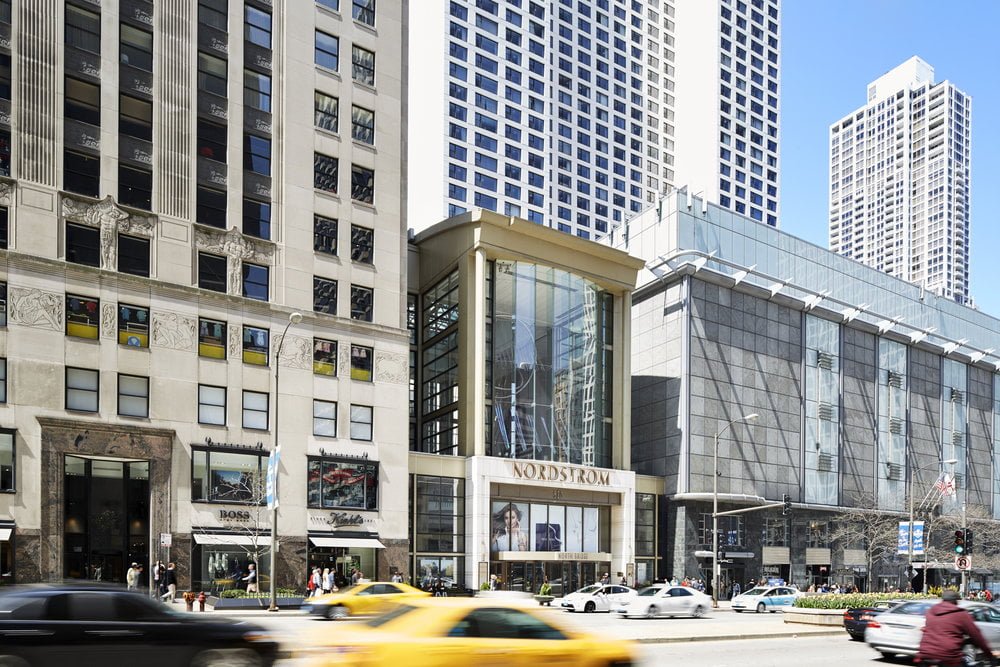
Chicago’s upscale department stores are also generally clustered in the area surrounding the ‘Magnificent Mile’. Neiman Marcus and Saks Fifth Avenue anchor the street’s intersection with Chicago Avenue, while Barneys New York and Bloomingdale’s are located further up near the Oak Street section of the Gold Coast. Nordstrom, which challenges the Vancouver location as the chain’s top producer, is located closer to The Loop (Chicago’s grand answer to Toronto’s Financial District) as part of the Shops at North Bridge complex.
Several suburban malls in the Chicago area feature a handful of luxury retailers and luxury department stores, though to a lesser extent than in years prior. Neiman Marcus operates stores at the Oakbrook Center west of the city as well as at the Shops at Northbrook in the north, while Bloomingdale’s and Nordstrom are anchors at the Old Orchard shopping centre in Skokie. All three malls feature a handful of standalone luxury brand boutiques (Tiffany & Co. is at all three, while Louis Vuitton operates standalone units at Oakbrook and Northbrook), though nothing in these malls compares to the selection of luxury stores found at Toronto’s Yorkdale Shopping Centre.

Toronto, as a comparison, has a surprising number of ‘luxury nodes’ for a city of its size. These operate with varying degrees of success, with Toronto’s Bloor-Yorkville and Yorkdale dominating, while others attempt to also cash-in on high-spending locals and tourists.
The Bloor-Yorkville area in downtown Toronto has been, for decades, the heart of the city’s luxury retail scene. Bloor Street West, the former Hazleton Lanes (now called ‘Yorkville Village’), and the Manulife Centre were three important addresses earlier on and more recently, Yorkville Avenue is being positioned to be Canada’s answer to Rodeo Drive in Beverly Hills. More luxury brands will move in as the area continues with a remarkable transformation.
When Tiffany & Co. opened at the Holt Renfrew-anchored Yorkdale Shopping Centre in 2012, it was the beginning of a movement that would see more than two-dozen luxury brands open standalone units and concessions in the centre. Many brands are now choosing to open at Yorkdale instead of in Bloor-Yorkville. It’s hard to blame them — Yorkdale has ‘proven numbers’ according to those in the industry, recognizing that the centre is Canada’s most productive shopping centre in terms of annual sales per square foot. The clustering is working. More wealthy shoppers are frequenting Yorkdale, and more luxury brands want to move into the centre to sell to them.
What’s resulted is a ‘split situation’ in Toronto where luxury stores such as Bulgari, David Yurman, Longchamp and even Ladurée can only be found at Yorkdale, at least for now. Some luxury stores are selling considerably more than initially anticipated and in many instances, brands are paying a percentage rent in addition to a base rent that is significantly enriching the landlord. Speculation persists that some of these stores might open downtown locations in order to offset these rents and split sales, though to date Yorkdale continues to have many stores not found elsewhere in the region.
The Greater Toronto Area has added several other ‘luxury nodes’ to the mix. The CF Toronto Eaton Centre has been courting wealthy shoppers as Cadillac Fairview continues to take the downtown mall more upscale, adding flagship Saks Fifth Avenue and Nordstrom stores to the mix (both opened in 2016). CF Toronto Eaton Centre also houses standalone locations for upscale brands such as Links of London, Hugo Boss, Sandro and Maje, going after some of the dollars that might otherwise head north to Bloor Street. Some speculate that the addition of higher-end brands at CF Toronto Eaton Centre has resulted in reduced foot traffic on Bloor Street, though that’s more anecdotal.
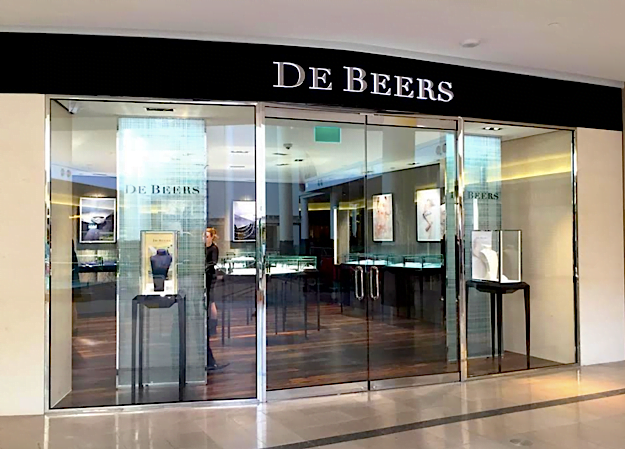
Two other GTA shopping centres are seeking to court wealthy shoppers with their expanding luxury offerings. CF Sherway Gardens, located near Toronto’s border with Mississauga, boasts standalone locations for De Beers, Tiffany & Co., Caudalie and Loding, as well as partner boutiques for Chopard and Montblanc. CF Sherway Gardens is also anchored by a luxury-heavy 143,000 square foot Saks Fifth Avenue store, as well as a more modest and smaller Nordstrom location.
Square One in Mississauga, not to be outdone, debuted an impressive looking luxury wing in the summer of 2016 which is anchored by a dramatic marble-clad 140,000-square foot Holt Renfrew store, housing concessions for brands such as Tiffany & Co. and Gucci. Salvatore Ferragamo (the largest in Canada), Rolex and Links of London all operate nearby. Landlord Oxford Properties is said to be courting other luxury brands to the centre, though some brokers are saying that the Greater Toronto Area is seeing “too many” luxury nodes for a market of its size, and are now focusing primarily on the ‘two Yorks’ — Yorkville and Yorkdale, with the latter winning out in many cases as brands bet on Yorkdale being more of a ‘sure thing’ in terms of foot traffic, not to mention year-round climate control.
As a result, Toronto is a harder city to shop for luxury consumers. For luxury consumers visiting from markets such as China, the Toronto market proves to be somewhat confusing in terms of having so many different luxury nodes. Most visitors are unlikely to visit all five ‘nodes’, and may instead spend their time either in the downtown core or up at Yorkdale. Given that both areas have stores that the other one doesn’t, visiting just one means missing out on other brands — something that isn’t an issue in a city such as Chicago, where almost all luxury stores can be found in the core.
In Europe, the high-end districts in most major cities are located in the downtown core, on highly manicured streets as well as in small urban plazas. Luxury nodes in Paris, London, Milan and Zurich are all overwhelmingly in their respective downtown cores, as with cities such as Chicago and Boston, for the most part.
In some respects, Toronto could be compared to Melbourne, Australia, which features two primary luxury shopping areas. Central Melbourne houses several key retail streets such as Collins Street, which houses some very impressive luxury flagships for some of the world’s top brands — some of which don’t even have stores in Canada yet. The city’s luxury department store, David Jones, is also in the core, a short walk away.
Melbourne’s Chadstone Shopping Centre is comparable to Toronto’s Yorkdale, with the Melbourne mall housing several first-to-Australia luxury stores for brands such as Valentino, Balenciaga and Givenchy. The stunning suburban shopping centre boasts sales well in excess of $1-billion annually, as does Yorkdale, and the mall also houses upscale anchors such as David Jones. One might look at the retail mix at Chadstone to get an idea of what might be opening at Yorkdale over the next couple of years — luxury brands that are expanding into malls often do so in a pattern, as is evident closer to home in markets such as the King of Prussia Centre near Philadelphia, and the Houston Galleria as examples.
The United States has many examples of luxury retail in suburban shopping malls and in some cities, the only substantial luxury retail offering is in a shopping centre that isn’t downtown. Houston is home to the Houston Galleria and nearby River Oaks District as an example — both boast a vast number of luxury stores, some of which aren’t even in Canada yet. Atlanta, Denver, Charlotte also feature high-end malls where most of their luxury retailers are contained.
In some respects, competition is good and back at home here in Canada, Toronto’s five ‘luxury nodes’ will all continue to compete to attract limited luxury shopping dollars. It will be interesting to watch over the next several years how the market plays out — some retailers are doing better in some locations than others, and there could be store closures and relocations if the GTA luxury market continues to polarize with its dominant centres. Toronto, as a city, might be best served to also invest further into its infrastructure and overall aesthetics — an international visitor we spoke with, who is very observant and well travelled, provided some negative feedback about Toronto, saying they’re unlikely to return. That means that there’s not only competition within the Toronto market for luxury retail nodes, but the city is now competing with attractive global cities for luxury tourist dollars. It’s something for civic leaders to consider moving forward, though the messaging often falls on deaf ears.




Nice comparison. I think Vancouver will eventually have 3 or 4 luxury nodes as well. Downtown (Pacific Centre and Alberni Street) and eventually Brentwood and Oakridge are guaranteed to have multiple luxury retailers. Gastown is also a trendy area with some upscale luxury players, especially in high end furniture and independent boutiques. Thankfully downtown/gastown, Brentwood and Oakridge are easy to get to by Skytrain so tourists and locals have easy access. This infrastructure advantage puts it ahead of Toronto as well for consumer access.
It really is a shame that Toronto has started going the American route with high end retail migrating to the suburbs.
Hopefully it does not take downtown retail hollowing out like in American cities, before Toronto realizes this uncontrolled retail growth in the suburbs it not sustainable.
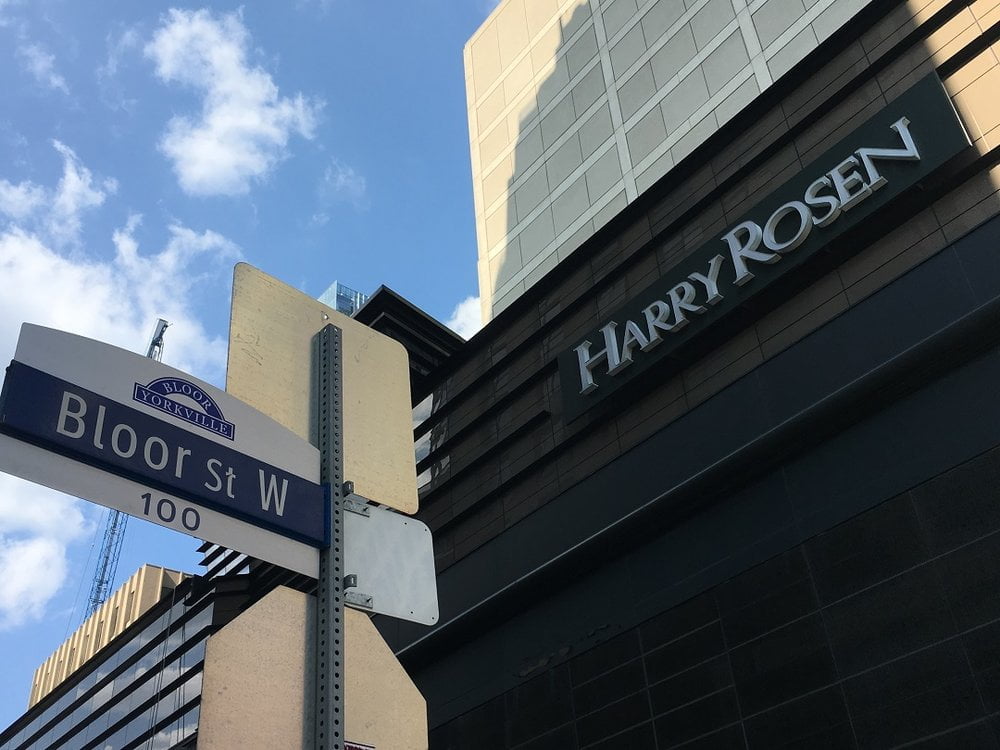
I think we will also see closures in the future. Toronto, for example, had many suburban branches of stores like Harry Rosen, that closed over the years.
Our region is just not big enough to support three or four branches of the same store. Especially when you consider much larger cities like London have only one branch of some of these worldwide luxury stores.
When it comes to high end shopping, I am more and more gravitating to downtown Toronto’s unique retail areas like Queen Street, and buying local luxury products made in Toronto.