A new e-book by Kronos, now available for download, discusses how organizations can use their HR systems and technologies to meet their ‘people’ goals while providing their employees with a great work experience. That helps attract the right candidates, develop and retain top talent, and drive engagement and productivity along the way.
It’s generally accepted that happier employees drive better results. According to a recent GlassDoor study, companies with great employee experiences outperformed the S&P 500 by 122%. The question becomes how to foster employee engagement in a tough market where skilled workers are hard to find and keep, and where their expectations of the workplace have changed drastically over the past decade.
John Frehse, senior managing director at Ankura Consulting, recently discussed how value is created in today’s economy, and the value we place on our employees. During the past four decades, there has been a steady decline in market value attributable to tangible assets, while there’s been a steady increase in market value attributable to intangible assets. He refers to this as the “GAAP Gap”.

Mr. Frehse went on to say that financial capital is abundant and carefully managed, while human capital is scarce and not managed carefully. That’s because equity markets have historically measured and rewarded good management of financial capital. CEOs were held in high regard for their clever management and allocation of financial capital, while today’s best CEOs are equally great at managing financial, physical and talent capital. This trend will accelerate as the GAAP Gap continues to widen, he says.
Attracting and retaining the right talent means valuing employees as much as, or perhaps more than, your tangible assets. It starts with a culture based on leaders making the value statement, and behaving like it is true — that is, a culture of empowering employees through tools that alleviate tactical everyday work and allows them to be more creative. That results in employees having control over their work life while managers are trusted to make decisions for their function and their employees.
All these elements together constitute an expansive change for many organizations, and one that can take time to instill. The question becomes: what can be done today?
Another study, by Brandon Hall Group, revealed that companies with an automated workforce management solution saw an increase in revenue of 10%. That is because an effective workforce management solution reduces the administrative burden for employees, managers and leadership alike. It allows them to be more focused on driving value while providing control over employees’ work life at daily key moments of interaction with the organization, to support them in feeling valued.
To drive revenue and thrive in the midst of the changes coming our way, companies need to place a renewed focus on the moments that matter to their employees. Accenture recently published a report that defined the moments that matter across three buckets.
First are the physical experiences such as the walls, the desks and the break-room. Second are the human experiences, including the culture within organizations and how employees interact with each other. And finally, there’s the digital experiences including tools and technologies that help them perform their jobs.
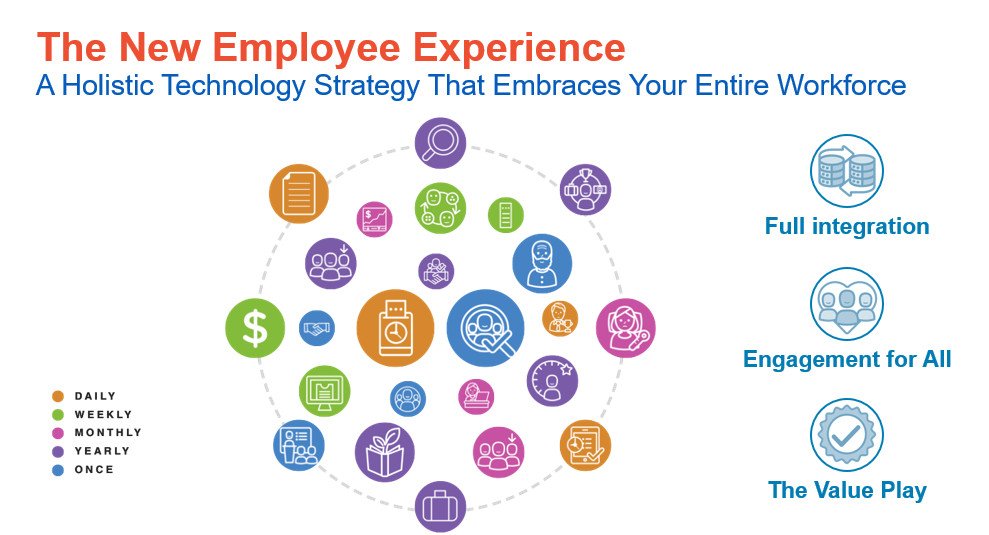
What are those moments that matter? They can be categorized across the entire employee journey into those that are universal for most companies, regardless of size or location. Those moments are tasks that employees are going to do both frequently and infrequently. They include moments such as applying for a job, onboarding, retiring and benefits. Reviews are very infrequent moments that may only happen once, or once a year, but they are key to an employee’s journey, especially when it comes to attracting talent.
Then there are the frequent moments such as clocking in or out, checking a schedule, getting paid and requesting a vacation. On their own, each one of those moments is important, but when you consider that employees are doing some of these things every single day, it’s critical that those moments be as simple and streamlined as possible, and can be undertaken anywhere, using technology that resembles what they use in their everyday life.
These moments can be defined by technology. The daily, weekly or otherwise frequent tasks are called ‘workforce management’, and include time and attendance, scheduling and leave. There are also the infrequent moments we call ‘human capital management’ that include hiring, benefits and performance management. These have yielded productivity and job satisfaction results, with ROI in as little as 15 months.
When we view all these key moments through the lens of managers and employees, they don’t really care which system does what. Today’s effective technology platforms integrate seamlessly to provide that experience for all.
Resource:
Read the eBook — Competing in an Era of Choice — for more information on how organizations can use their HR systems and technologies to meet their “people” goals and demonstrate that the things their candidates and employees value most have been thoughtfully incorporated into the work experience — including attracting the right candidates, developing and retaining top talent, and driving engagement and productivity along the way.
*Kronos has partnered with Retail Insider and this article is sponsored content. To work with Retail Insider, contact: craig@retail-insider.com