By Evan Fraser
Toilet paper shortages, profiteering from hand sanitizer and empty shelves in grocery stores.
Thanks to COVID-19, governments in most industrialized nations are preparing for shortages of life’s necessities. If they fail, riots over food may be inevitable. Some wonder if we are responding appropriately to COVID-19, and it’s clear that recent events expose a fundamental flaw in the global systems that bring us our daily bread.
We live in a wondrous age when global supply chains seamlessly link farmers and consumers using the principles of “just enough, just in time.” For years, companies have worked hard to keep inventories low, timing shipments to balance supply and demand using knife-edge accuracy.
In many ways, this system is a miracle. Low-cost food is one outcome. And if there’s a problem in one part of the supply chain, the global system is good at finding alternatives. (Mangoes from Asia gone bad? Try the mangoes from Central America!)
But with this abundance — and convenience — comes a hidden cost that COVID-19 has exposed: a loss of resilience. Our global food system depends on the tendrils of international trade to wrap the world in an ever more complex system of buyers, sellers, processors and retailers, all of whom are motivated to keep costs low and operations lean.
Building resilience
So when the supply chain system itself is thrown into question — as it is now thanks to COVID-19 — then the wheels threaten to come off the proverbial apple cart. COVID-19 shows that we need to wake up and realize that if we really want to be resilient, we need to build in more redundancies, buffers and firewalls into the systems we depend on for life.
In practical terms, this means we should be keeping larger inventories and promoting a greater degree of regional self-sufficiency.
These measures will help ensure that our communities don’t panic if the food trucks stop.
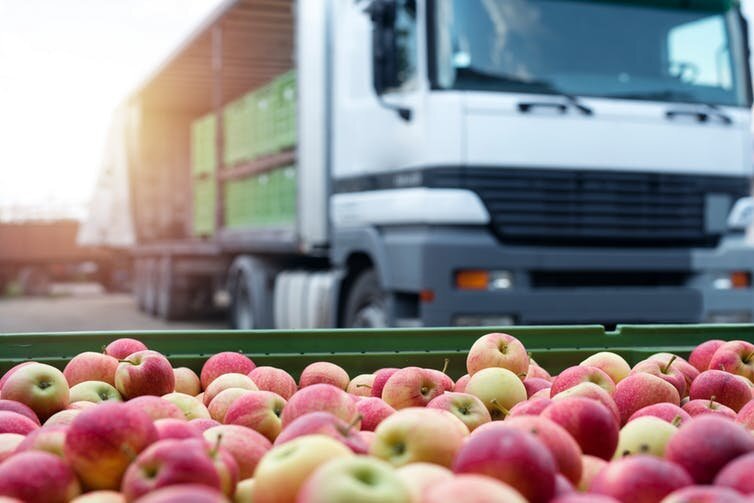
But while this may sound sensible, high inventories and more regional self-sufficiency are, in fact, antithetical to the “just enough, just in time” approach that drives most of our economy, even though no one’s suggesting we need to be completely self-sufficient of the time.
Take the systems that produce and distribute the corn, wheat and rice that fuel most of humanity’s calories. The latest United Nations report on the global grain system contains some bad news. Last year, the world ate more grains than it produced within the year, and our carry-over stocks (defined as the amount of food we have, globally, at the end of the year to see us through to the next harvest) are declining.
The good news is that this decline comes after a run of good years where farmers delivered one monumental harvest after another. So our carry-over stocks started last year in pretty good shape and this means we’ve currently got about four months of food stored. But there’s a downward trend regarding those stockpiles, and this is worrisome.
Climate change poses challenges
But what if Mother Nature doesn’t play nice with us this year?
Climate change, after all, is making food harder to produce. What if we face a major drought in Europe and Asia like we did in 2010 to 2011? Or another big Midwestern drought similar to the situation in 2012 and 2013? And what if COVID-19 doesn’t go away by summer?
If any of these things happen, we may not have the buffers to protect ourselves. And it won’t be toilet paper and hand sanitizer we need to worry about. It might be wheat, rice and corn.
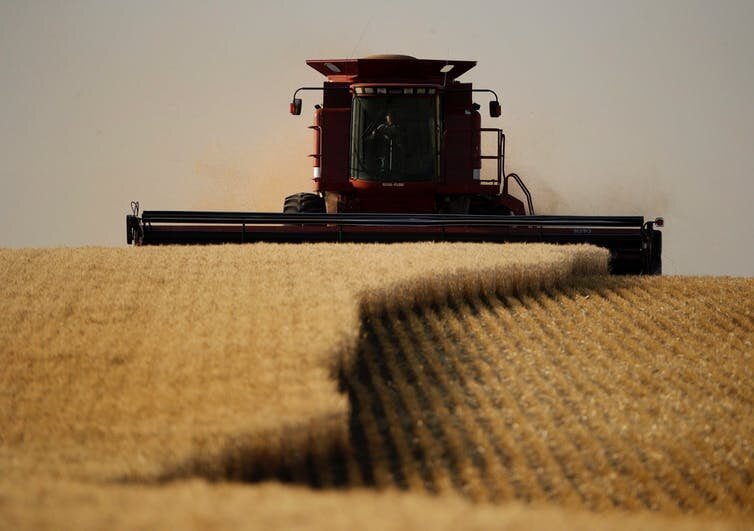
Today, conventional wisdom is that the average city in North America has a three-day supply of fresh food (dried, canned and other preserved food supplies will last a bit longer). This, according to some, means that we are all only ever “nine meals from anarchy.” Luckily, North American grocery stores have sophisticated supply chains so no one is seriously suggesting that the panicked purchasing of the last few days that has emptied shelves will persist. Nevertheless, the systems we depend upon are, in many ways, fragile and inherently vulnerable.
In all likelihood, COVID-19 will pass and most of us will only suffer economic setbacks from lost wages and disruptions linked with cancelled classes, travel and meetings. But in the aftermath, it’s important to ask whether we — as a society — will treat this as a moment to learn a bit about the fragility of the modern world.
Will we work collectively to put resilience alongside efficiency as a primary driver for the systems we depend upon each and every day to feed ourselves?
This article was originally published by ‘The Conversation’. Click here to view the original article.

Evan Fraser is a Professor, Director of the Arrell Food Institute and Tier 1 Canada Research Chair in Global Food Security, University of Guelph.