By Xiaodan Pan, Benny Mantin and Martin Dresner
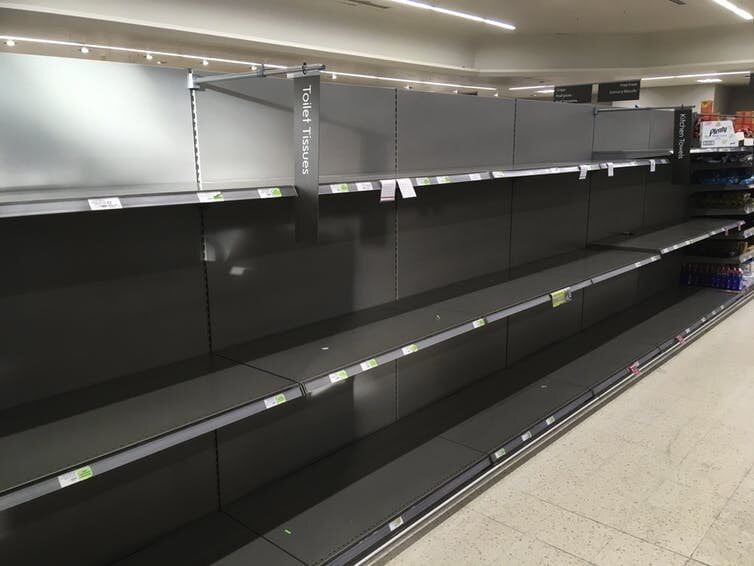
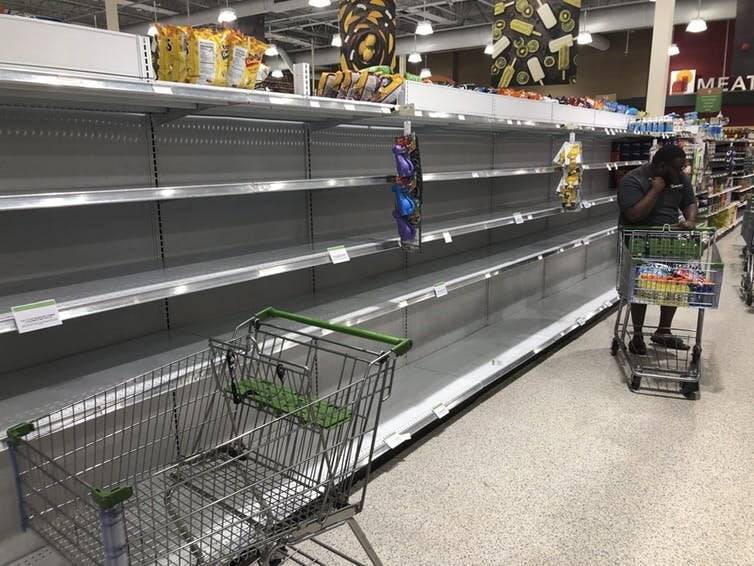
As the fear of the coronavirus spreads, consumers have been flocking to stores to stockpile emergency supplies, resulting in empty shelves as retailers can’t keep up with demand. This situation will likely intensify.
Our research on consumer stockpiling in emergency situations, and the response of retail managers to stockpiling behavior, has crucial information for retailers and policy-makers on how to plan for the coronavirus pandemic.
The psychology behind consumer stockpiling
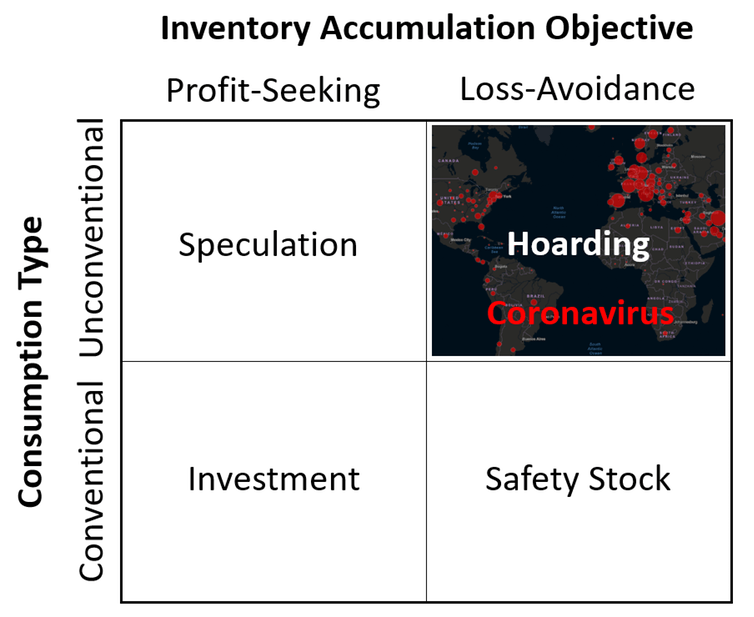
Consumers accumulate goods for various reasons: It can be for profit-seeking or loss avoidance purposes, and the goods may be meant for conventional consumption or unconventional use.
Consumer stockpiling in the face of the COVID-19 outbreak can be viewed as unconventional inventory accumulation, mainly meant to minimize a perceived threat of loss or fear of going without.
Consumer stockpiling can also be explained using commodity theory and prospect theory. Commodity theory proposes that the value of a product is positively related to its scarcity, so perceived shortages may stimulate stockpiling behaviour. Prospect theory describes how people are risk-averse when choosing between uncertain alternatives. To avoid potential losses in the face of uncertainty from the coronavirus outbreak, consumers may stockpile or hoard essential items.
Consequences of stockpiling
Consumer stockpiling has immediate and long-term effects on retail operations. At the early stage of an outbreak, retailers may increase product availability in anticipation of stockpiling behaviour. However, depending on supply readiness, stockpiling can soon lead to retailers selling out, with shortages persisting for several order cycles.
For example, our research on stockpiling by consumers in the path of hurricanes finds that stockpiling impacts in-store availability of bottled water even weeks after the hurricane has passed. Other researchers have found that retailers took considerable time to recover from product supply disruptions following the 2010 earthquake in Chile and the 2011 earthquake in Japan.
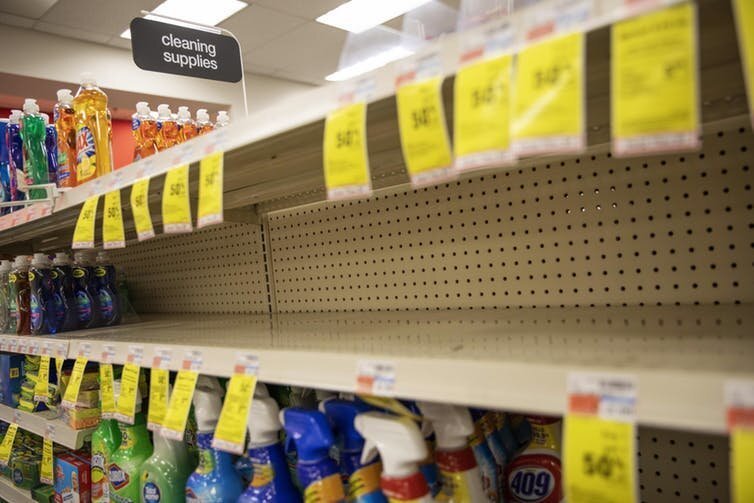
Consumers should be aware of rising prices when accumulating emergency supplies.
As retail stocks dwindle, prices rise for at least two reasons.
Firstly, because lower-priced products are sold out, consumers must purchase higher-priced alternatives, also known as the product substitution effect.
Secondly, sellers can capitalize on the imbalance of supply and demand and boost prices. Retailers may also hike prices because their suppliers have, thus driving up costs throughout the supply chain.
Overall, under the stress from the coronavirus, scarcity of supply may induce consumers to pay higher prices.
Different types of retailers
When it comes to consumer stockpiling, our study uncovers significant differences among retailers.
We find that drug stores are associated with the highest consumer stockpiling propensity prior to hurricanes. They carry a large array of essential items that consumers may stockpile in advance of emergencies, such as bottled water, prescriptions and personal hygiene products.
However, after the hurricane passes, consumers may find the best product availability in grocery stores and warehouse clubs. By contrast, discount and dollar stores are associated with the lowest availability of emergency essentials in the weeks after a hurricane.
When demand exceeds supply, distributors may allocate products to their best and most reliable retail customers, leaving low-margin retailers without stock.
In general, high in-store product availability is associated with fast inventory turnover and short processing lead times, characteristics of retailers with quick recovery capabilities.

As they stockpile essential products, consumers exhibit another interesting behaviour. They tend to purchase from national retailers with extensive retail networks. National retailers carry greater inventory across their networks, meaning they may respond to regional demand shocks by shipping in inventory from outside the affected regions.
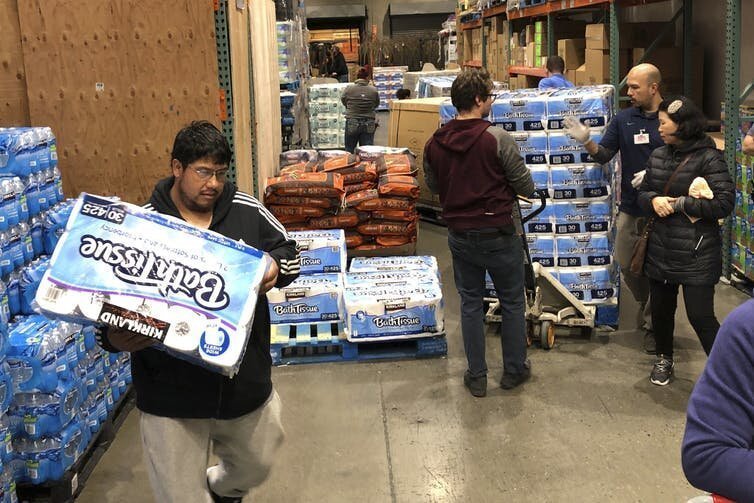
For example, using data from the United States, our research finds that as the national store network increases from about 600 to 7,300 stores across the country, consumer stockpiling propensity prior to hurricanes more than doubles. So a store from a chain with 7,300 stores experiences double the amount of consumer stockpiling relative to its operations in normal time compared to a store from a chain with 600 stores.
However, shipping costs may limit a retailer’s inclination to accommodate regional shortages, so affected retail outlets from these national chains may sell out of needed products, even if other stores in the chain have excess inventory of the same goods.
Unique coronavirus challenges
Both retailers and local governments face challenges caused by consumer stockpiling when emergencies such as the coronavirus outbreak hit.
Compared to more predictable environmental emergencies such as hurricanes, the diffusion process of the coronavirus outbreak is difficult to forecast. The widespread outbreak of the coronavirus may also lead to global shortages on a larger scale than the hurricane events, thus making it more difficult for retailers to shift inventory around their networks to accommodate regional demands.
On the plus side, hurricane forecasts may only be made days in advance. The progression of the coronavirus can be measured in weeks or months, thus providing retailers and their suppliers with additional time to prepare for potential stockpiling behaviour.
Policy-makers may be able to influence both the supply and demand for critical products through public announcements and advisories, thereby altering stockpiling behaviour and retail stocking habits.
Retail supply chain managers can pay close attention to developments in the coronavirus outbreak, such as the number of diagnosed cases and the number of deaths, as they make stocking decisions. And consumers, especially older people, can be encouraged to stockpile supplies at the early stages of the coronavirus outbreak to avoid unnecessary trips outside the home when the virus spreads.
Overall, collaboration and communication among government officials, emergency organizations, retail managers and consumers can allow for better allocation of essential supplies amid the coronavirus outbreak.
This article was originally published by ‘The Conversation’. Click here to view the original article.

Dr. Xiaodan Pan joined the John Molson School of Business at Concordia University in 2018. She obtained her Ph.D. degree in Supply Chain Management from the University of Maryland (UMD).

Professor Benny Mantin is the Director of the Luxembourg Centre of Logistics and Supply Chain Management (LCL), at the University of Luxembourg, which is a member of the MIT’s SCALE network.

Martin Dresner received his Ph.D. in Policy Analysis from the Sauder School of Business at the University of British Columbia. His research focuses on two broad areas, air transport policy and logistics management.