Advertisement
Advertisement

Loblaws’ ‘Middle Mile’ Autonomous Vehicles and the Future of Grocery in Canada: Sylvain Charlebois

Date:

Share post:

Loblaws is partnering with Gatik, an autonomous vehicle provider from the United States, to launch the first autonomous food delivery fleet. This is a solution for the “middle mile”, which will assure links between distribution centres and stores. Consumers will not see autonomous vehicles driving up to their homes yet, but that day will surely come soon.

These cold-chain, capable, boxed vehicles which are not very large, have already been roaming Toronto’s streets for some time for another grocer. They even experienced last year’s winter, so Gatik is aware of potential perilous road conditions when operating its fleet. Captured data by Gatik will give the company the experience needed to make the supply chain more efficient.

What is driving this decision is clearly e-commerce. The “middle mile” is where gains can be exponential even though the last mile may be the costliest. This is the obscure part of the supply chain consumers do not see but are severely affected by. Food prices are more manageable when costs are under control. With this partnership, Loblaws will be able to move food from automated picking facilities multiple times a day to support their PC Express online grocery service in the Greater Toronto Area. The fleet will likely be expanded as this partnership is being presented as a long-term work-in-progress, if you will.

Online sales by grocers have increased almost 90% since October of 2019. For Loblaws, online sales growth is almost at 200% compared to last year. In food retail, online sales represent close to 3.3% of all sales compared to 1.7% last year, according to Nielsen. This is just incredible growth. With such a market shift, some supply chain adjustments are required. Unlike Sobeys, which is creating a unique and independent infrastructure to develop Voilà by Sobeys, Loblaws is opting to make its supply chain more cyber-friendly. Both approaches can work. With these initiatives, grocers gain the ability to make more money online, something they have hesitated to do for years. For a few years, grocers were dithering with the concept. With COVID-19, grocers are fully committed now. Moving forward, they will want us to buy more food online, and will get better at providing this service.
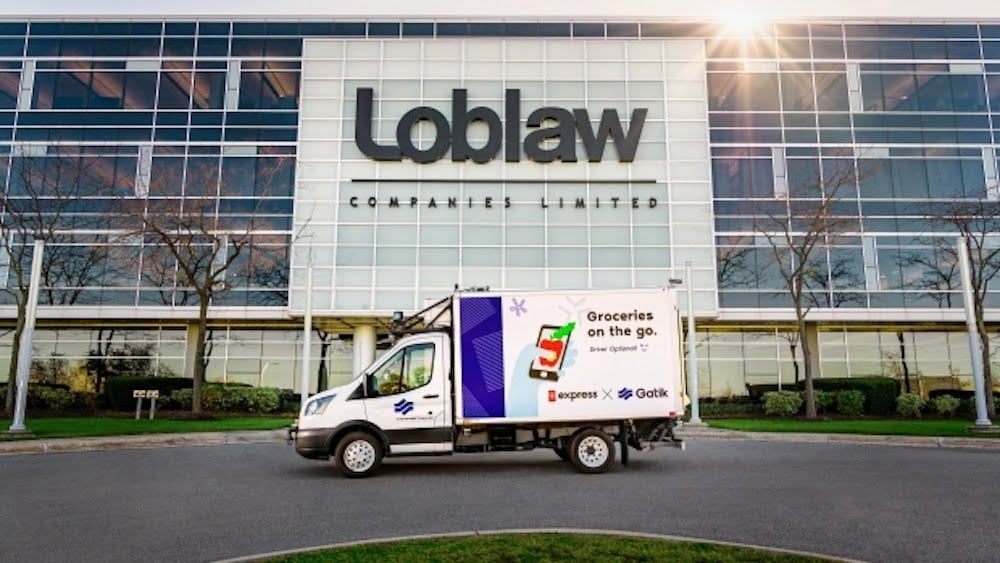
Loblaws autonomous vehicles outside Loblaws office. Photo: Loblaws

Vehicles operated by Gatik will not be entirely autonomous, however. All vehicles will have a safety driver as a co-pilot for now. Since consumers are connecting with these vehicles, the approval process will probably be faster, but neither Gatik nor Loblaws could say when the autonomous fleet would be driving around without any humans at all. It is essentially just a matter of time.

Eliminating humans from the food supply chain is an option which has gained currency throughout the pandemic. For one, jurisdictions around the globe managing routes have struggled and have had to think about restaurants, rest areas and how to keep truckers and staff safe while keeping the region food secure. Humans, as vectors for transmitting the virus, or any disease for that matter, are seen as a liability when a public health crisis occurs. Supply chains are increasingly becoming more automated, so Loblaw’s move with Gatik is anything but surprising.

This human-less food supply chain is an ideal for now, but Loblaws’ call is significant enough to allow most of us to dream. Given the economics of food distribution in Canada though, this innovation is unavoidable, and Loblaws appears to be out of the gate first, embracing what lies ahead. Digitizing the supply chain can only help grocers better serve the Canadian market. With such a vast country, with few people living in it, making the middle mile more efficient is key. It does not necessarily mean that Loblaws’, or any other grocer’s intent is to eliminate all human involvement in the handling of food throughout its operations. It will however seek different skills and knowledge to support its online ambitions. The sector needs strong employees, and always will. But as the sector morphs into an omnichannel beat of sort, employees will be expected to play different roles, and most of the work will have to be about data management, not handling food per se.

The last mile is an autonomous fleet’s next frontier, the most exciting one for the industry, and likely for us as well. Canadians may not be there yet, but grocers like Loblaw are signaling to the Canadian public that the horse has left the virtual barn.


LEAVE A REPLY

Please enter your comment!
Please enter your name here

More From Retail Insider

RECENT RETAIL INSIDER VIDEOS

Advertisment

Subscribe to the Newsletter

Subscribe

* indicates required

RECENT articles

Retail-to-Residential Conversions Gain Momentum in Canada

Retail-to-residential conversions are emerging as a potential solution to Canada’s housing shortage by transforming underused commercial sites.

Inside Canada’s Growing Liquidation “Binz” Store Economy

How liquidation “binz” stores in Canada reveal the afterlife of surplus retail goods as forecasting errors and returns feed a growing recommerce market.

Rising Carbon Pricing in Canada Strains Grocery Supply Chains

Opinion: Rising carbon pricing in Canada may increase transportation and logistics costs across grocery supply chains and food distribution networks.

From The Desk: Canadian Retail Reinvention amid Expansion and Rising Costs

This week’s Canadian retail landscape blends strategic expansions with cost pressures, highlighting physical growth and evolving shopping behaviours amid economic chal...

Daily Synopsis: Mar 13, 2026

Kingsgate Mall lease fight in Vancouver, reviving Roots, Ontario to allow some holiday openings, Montreal community gathers to honour murdered depaneur owner, Quebec separatist coffee shop opens in Montreal, and other news.

Changes to Temporary Foreign Worker Program applauded by business groups

Helping employers who are facing severe labour shortages.

Canada loses 84,000 jobs in February, unemployment rate increases: Statistics Canada

The largest declines were in wholesale and retail trade (-18,000; -0.6%).

Happy Belly Food Group targets up to 50 new restaurant openings as same-store sales remain strong: Sean Black interview

The company’s “core four” growth brands are Yolks, Rosie’s, Heal and iQ Food. New restaurant openings planned for this year will largely come from those concepts.

Small businesses call for stronger domestic energy supply amid global uncertainty: CFIB

An overwhelming majority (90%) of small businesses say governments should prioritize increasing Canada's energy production and capacity to better support the economy and ensure businesses have reliable access to the energy they need to operate.

The New Luxury Client in a Relationship Era

How The New Luxury Client is reshaping Canadian luxury retail through ritual, clienteling and emotional connection.

Bespoke Made Suits Opens Downtown Vancouver Showroom

Vancouver-based Bespoke Made Suits expands with an appointment-based tailoring showroom near the city’s Financial District.

Daily Synopsis: Mar 12, 2026

Cuba's fuel shortage impacts Canadian cigar stores, Manitoba asks Sobeys to scrap property restrictions, Ontario to allow shopping on 2 public holidays, alcohol in corner stores impact worker safety, redevelopment of former Sherwood Park Safeway, and other news.

73% of Canadians Now Shop Chinese Marketplaces

Survey finds 73% of Canadians shop Chinese marketplaces like Temu and Shein as monthly and weekly usage continues to grow.

Canadian hotel industry sees steady growth as leisure travel drives performance: Cushman & Wakefield

2025 ranked among the stronger years for hotel transactions over the past two decades, highlighted by several notable full-service and luxury hotel trades.

Article Expands Brick-and-Mortar Retail with Toronto Showroom

Vancouver-based furniture brand Article expands brick-and-mortar retail with a 9,600-square-foot Toronto showroom in King West, marking its second physical store.

Empire Company Limited reports Q3 financial results

Sales of $7,890 million, an increase of 2.1%.

Chatime focuses on strengthening brand leadership in Canada as expansion continues cautiously: Trinh Tham interview

Chatime currently operates about 100 locations across Canada, primarily in Ontario and British Columbia, and opened six new stores last year while preparing additional locations that are expected to come online this year.

VIDEO: 87% of Canadians feel financially trapped by rising living costs: Harris & Partners

85% report their overall monthly expenses have increased in the past 12 months

Butterly Trust Index Maps AI-Era Product Reviews

Butterly’s 2026 Trust Index shows how honest, balanced reviews influence AI-led discovery, and what Canadian brands and retailers can do next.

Abercrombie & Fitch Expands Canadian Store Network

Abercrombie & Fitch expands in Canada with new stores planned in Winnipeg, Ottawa, Calgary and London ON, and a reopened location at West Edmonton Mall.