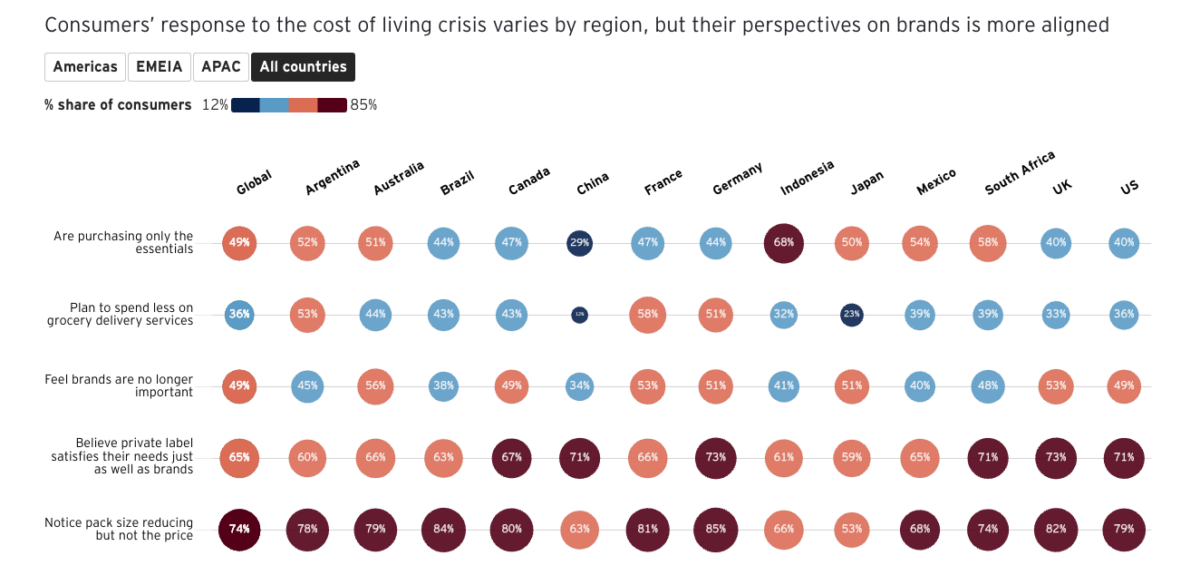
EY Canada’s Future Consumer Report found that almost half of Canadian consumers are turning away from brands in search of affordability.
Consumers are trying to remain resilient in the face of continued cost of living pressure, economic worries and social disruption. Increasingly, they’re adopting new technologies to help them shop, live and work differently — with a focus on making their lives more affordable.
Key findings from the report include:
- 49 per cent of Canadians say that brands are no longer important;
- Respondents are adopting tools to save time or money, but worry about the impact of technology
- 58 per cent of Canadians are taking action to reduce spending in many areas of their lives deemed non-essential;
- 43 per cent of consumers are comfortable with the use of artificial intelligence if the benefit is clear;
- Consumers said they are willing to leverage AI or share data in exchange for customized online shopping experiences (51 per cent), tailored advertisements (43 per cent) or promotions (63 per cent) and pre-populated shopping carts (41 per cent);
- More than half of shoppers would consider private labels for clothing, shoes and accessories
- 73 per cent now prefer to repair rather than replace their possessions.
“As companies accelerate the use of cloud to build data repositories so they can mine for insights, consumers are increasingly becoming aware that their data is prized and want to weigh the benefits of sharing data against the risks and the value they receive in exchange,” said Imran Ullah, EY Canada, Associate Partner, National Cloud Strategy Leader.

“How companies balance this exchange is an important part of consumer trust and engagement – this is why it’s critical to tune in to the way consumers think and feel about the digital innovations that are entering every aspect of their lives today.”
“With today’s economic uncertainties, Canadians are focusing on short-term lifestyle changes and reprioritizing individual needs,” said Monica Chadha, EY Canada Retail Leader. “They are adopting new technologies to help manage their day-to-day and inform their purchasing decisions.”

Ullah said Canadians are starting to identify value for items differently. They’re starting to create a different process around how do they think about and experience the purchasing process – and they’re associating value with certain items in a different way than in the past.
“If you see the connection to how Canadians are becoming more and more comfortable leveraging technology in their purchases, the report mentioned in Canada a 43 per cent adoption rate in terms of leveraging and being comfortable sharing data with retailers and also leveraging technology in the regular everyday buying experience,” he said.
“You probably saw this mindshift during COVID. All of a sudden we couldn’t go to the grocery stores. We couldn’t go shopping on a regular basis. Everything had to be pick up outside or shop online and pick up in certain spots. Or hand delivery services.
“So the real core definition of value is changing and that’s impacting brands because brands have not probably done a good enough job of differentiating themselves from the others. There’s some strong brands with great experience that have been doing it year over year in Canada. Those are still well recognized. But the ones that were probably a little bit more on the fringe, Canadian consumers are basically saying I’m finding different ways or different things to value.”

Ullah said the consumer is sharing the data. The brands now have the information on what consumers want and it’s just not the journey of buying the product itself.
“It’s everything around it,” he said. “We think about what was the process to buy the item, how did that look like. Is it fit for my needs? Is it fit for purpose? Is it cost sensitive? Does it fit within my budget? Does it have a value or a longevity to it? These are things that consumers are sharing with brands.
“So now brands have to turn around and say alright I’ve got new data, I’ve got information on my consumer base. How do I make my product or my experience better or provide a valuable experience back to the Canadian consumer?”
Ullah said the expectation from the consumer is higher and for brands to be able to compete they’re going to have to start investing more into technology.
“So we’re seeing more of a spend in new technology and there’s a couple of different ways to do it depending on the brand. If it’s a longer running brand, they may have a lot of technical debt that they need to get rid of and take money out of that to put towards new,” he said.
“And then there’s new verticals. There’s new brands that are popping up all the time . . . Shops that are really kind of capturing the market in certain areas. And they don’t have that legacy challenge. So all their investment is going into new technology. And what we’re seeing is it’s leveraging the cloud better because a lot of the services around AI, around data, data analytics, it’s easier to pull data in and run those large data sets on a cloud platform.”
Ullah said a lot of times the expectations of the Canadian consumer were high and they were just not being met.
“I think now that they’re shopping smarter, they’re leveraging technology and they’re like look if it’s a brand that doesn’t differentiate I’m not interested in buying it,” he said. “The consumer is willing to pay. That’s what we’re seeing but they’re now putting the pressure back on the retailers to do better. So the expectation is better quality of service, better experience, and they’re willing to pay for that.”

Canadians growing reliance on technology to manage their daily lives is also shaping purchase decisions and overall consumption, said the EY report. The data revealed that 51 per cent of people have socialized with friends and family over video platforms – a significant 10 per cent rise since June 2022. And 56 per cent now listen to audio streams – a big 18 per cent increase from June 2022.
“Emerging technologies also saw a sharp uptake, with 43 per cent of Canadians now revealing that they’re comfortable with the use of artificial intelligence (AI) technologies if it means an improvement to their purchasing experiences. Notably, consumers said they are willing to leverage AI or share data in exchange for customized online shopping experiences (51 per cent), tailored advertisements (43 per cent) or promotions (63 per cent) and pre-populated shopping carts (41 per cent),” said EY.
The latest edition of the EY Future Consumer Index said the rapid pace of technological change is going to transform the way people live and work, and will redefine the future consumer.
“Small, seemingly unconnected changes in many areas can result in sudden unexpected shifts in behaviors and attitudes. And new technologies can slowly insinuate themselves into a consumer’s daily life before anyone realizes,” said the report.
“Half of the consumers in our Index say they work for companies that are taking on large technology projects designed to create more value for investors, employees and consumers. One of the most significant drivers of change is AI, which will revolutionize the consumer experience, with new products and services, novel ways of accessing them, and entirely new modes of living and working on the horizon.”