The province of Ontario has increased its minimum wage to $16.55 per hour — unless workers are students under the age of 18, in which case their labour is only worth $15.60.
Québec and Manitoba eliminated their two-tier minimum wage in the late 1980s over concerns that the wage differential amounted to age discrimination and therefore violated Canada’s Charter of Rights and Freedoms. Ontario almost did as well 30 years ago. But the Ontario NDP government broke its promise, as I detail below.
The issue is personal for me. When I was 17 years old, I was hired by my hometown library. But a week into the job I was called into the head librarian’s office and told that they had made an administrative error. They would need to pay me the lower rate.
With that, my wages dropped from $4 an hour to $3.15. Over the next year, I worked for substantially less than other students hired at the same time and who were doing the same work. This is an experience not easily forgotten.
Age discrimination
A few years later, I did something about it. As the head of a provincial student group, Ontario New Democratic Youth, I launched a campaign on the issue in late 1989. As I wrote at the time:
“If the two-tiered system was based upon any other category (of difference), it would not be tolerated.”
We made the case that it was “unfair to value one person’s labour less than another’s simply on the basis of age.”
We then launched a Charter of Rights and Freedoms challenge on the issue of age discrimination with the help of Toronto labour lawyer Steven Barrett. A notice of application was submitted to the Supreme Court of Ontario in April 1990.
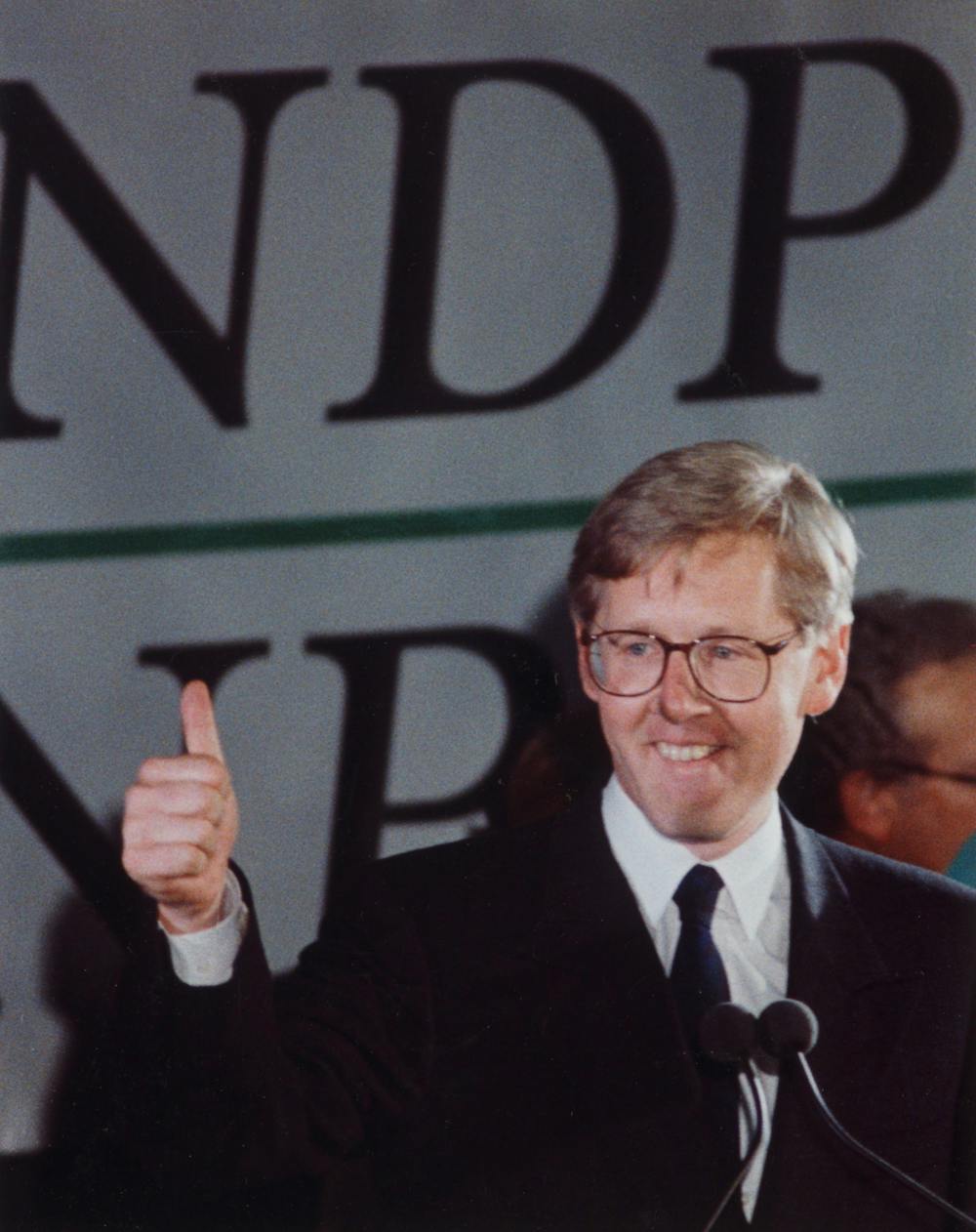
But then, most unexpectedly, the Ontario NDP won the election in September 1990 and Bob Rae became premier.
It seemed strange to us to continue the court challenge as our youth group was the party’s youth wing. Besides, the Ontario NDP had promised to eliminate the two-tier minimum wage in its election platform. It was also mentioned in the government’s first speech from the throne. So, we dropped the lawsuit.

The Ontario government reduced the student differential in 1991 to 45 cents an hour from 85 cents an hour, promising to eliminate it altogether the following year.
Bob Mackenzie, the NDP’s labour minister, even told the media at the time that the under-18 minimum wage “just cannot work in a society that promises equality and fairness. In fact, the existence of the student differential is currently before the courts in a challenge under the Charter of Rights and Freedoms.”
But then something changed, and the NDP decided to maintain the lower differential.
I have long wondered what happened.
Employer lobbying
Thirty years later, I am writing a book on how the NDP government responded to the industrial crisis. So, I decided to do some digging in the archives to find out why.
Thanks to Richard Allen, an NDP cabinet minister and historian who donated his records to McMaster University, I discovered that the Ontario Restaurant Association and other employer groups lobbied hard to convince the NDP cabinet to reverse itself.
According to archival material, they argued:
“The student minimum wage category should not be seen as discriminatory against young inexperienced workers, instead it should be viewed as an affirmative action initiative which assists young inexperienced workers in gaining employment.”
These were tough economic times and the youth unemployment rate was a dismal 18 per cent.

To find out more, I filed an access-to-information request and discovered that a decision was made in September 1991, the same month the NDP abandoned its longstanding promise to deliver public auto insurance, to hold off on eliminating the youth differential.
Instead, the Student Minimum Wage Consultation Group was formed with representatives of the four main employer groups in the hospitality industry, all with a strong vested interest in maintaining the youth differential, as well as two service-sector unions and an obscure student group nobody ever heard of.
The consultation group recommended keeping the differential.
Discriminatory differential
In its April 1993 cabinet submission on the subject, the Ministry of Labour conceded that the differential was discriminatory but recommended it was maintained anyway.
Here is how they worded it:
“Clearly, the student minimum wage does discriminate on the basis of age and student status. The student component does not appear to present any legal difficulties, but the age discrimination is a complex legal issue.”
It went on to say that “legal analysis concluded that if a Charter challenge were to be raised again there is a risk that the student differential could be found to violate the Canadian Charter of Rights and Freedoms on the basis of age discrimination.”

Thanks to us dropping our case, the ministry could advise: “There is no legal ruling directly on this issue and no current challenge.” The NDP cabinet therefore agreed with the warped line of reasoning that paying less to younger workers was a form of affirmative action.
Thirty years later, young people in Ontario are still paying the price: 95 cents an hour, to be precise.
By Steven High, Professor of History, Centre for Oral History and Digital Storytelling (COHDS), Concordia University
This article is republished from The Conversation under a Creative Commons license. Read the original article.