

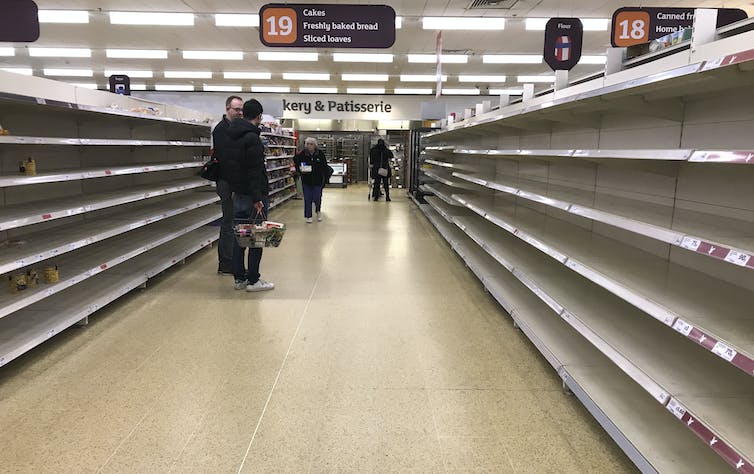
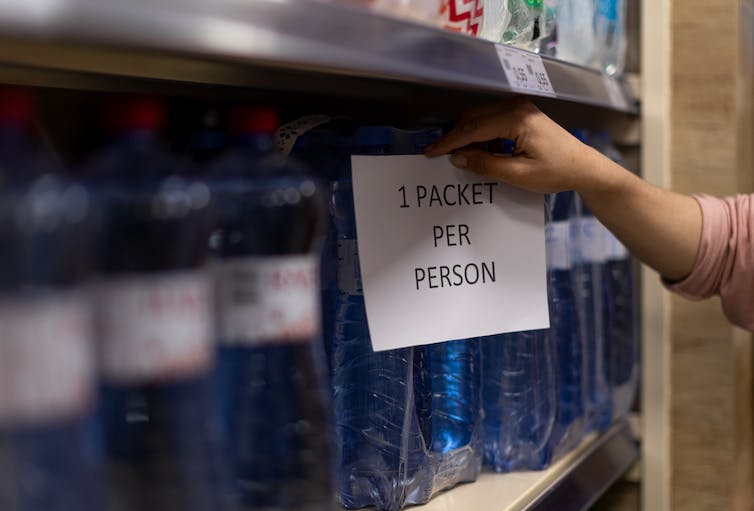
Fear can cause people to behave irrationally in times of uncertainty. During the pandemic, this took the form of panic buying as people flocked to stores to stock up on essential goods. Some even sought to profit off of shortages by price gouging toilet paper and hand sanitizer.
This phenomenon wasn’t just limited to a few countries or communities, either; it was a global occurrence that emptied supermarket shelves and caused significant disruptions in supply chains.
But what drives people to behave in such ways during times of crisis? Is it a basic survival instinct, a herd mentality influenced by social pressures or something more complex?
During the onset of the pandemic, we conducted a study aimed at understanding the complex web of factors that compel us to act or overreact in the face of uncertainty.
Psychological traits of consumers
We examined the following factors in our study: narcissism, psychological entitlement, status consumption, fear of embarrassment, and fear of missing out. Narcissism is a trait characterized by a heightened sense of self-importance and a lack of empathy for others.
Psychological entitlement refers to the belief that one is inherently deserving of special treatment or privileges. Status consumption is the tendency to purchase items that confer social prestige or dominance.
Fear of embarrassment is anxiety about being negatively judged by others. Fear of missing out is the worry over missing out on rewarding experiences that others are taking part in.
Unique types of consumers
Our study identified four distinct consumer groups, each with unique psychological traits that drove their purchasing habits.
1. Egalitarians. Egalitarians displayed low levels of narcissism and psychological entitlement compared to the other groups. They tend to have a more community-oriented and balanced approach to life. They likely have a strong belief in communal responsibility and fairness. Egalitarians are the type of individuals who volunteer at local food banks or participate in community clean-up events.
In terms of purchasing, egalitarians did not hoard as much as other groups. While others might hoard hand sanitizers, for example, an egalitarian might buy just one or two bottles and leave the rest for others in the community.
2. Conformists. Conformists are influenced by a moderate fear of missing out and a high fear of embarrassment. Conformists are the type of people who follow dress codes and rarely question authority.
When it comes to purchasing, conformists prioritized items that aligned with public health guidelines, like disposable masks. They are usually the first to buy masks in bulk when a new public health advisory is released.
3. Communal egoists. Communal egoists display moderate levels of narcissism and psychological entitlement. For example, this kind of person might organize a community event, but will insist on being the centre of attention during the event.
This group is particularly interested in food-related items like bottled water and snacks. A communal egoist might stock up on these products, not only for themselves, but with the intention of sharing with their neighbours in an effort to stand out.
4. Agentic egoists. Agentic egoists are characterized by high levels of narcissism and psychological entitlement. For example, an agentic egoist might cut in line because they believe their time is more valuable than others.
In terms of purchasing, agentic egoists are willing to spend more on items that directly benefit them. For instance, they might buy the last three bottles of an expensive, brand-name cough syrup, without considering that others might need it, too.
What this means for consumers
A significant lesson we’ve learned from the COVID-19 pandemic, and the subsequent global turmoil, is the importance of being ready for the unexpected.
If you’ve ever found yourself filling your shopping cart to the brim in a moment of panic, you’re not alone. But understanding who we are, why we make certain decisions and how we can be more considerate is the first step toward making better consumer choices.
Are you an egalitarian, thinking of the community while only buying what you need? Or perhaps you identify as a conformist, sticking strictly to items advised by health authorities? Recognizing these traits in ourselves can be a wake-up call, encouraging us to shop more responsibly, especially in times of fear and panic.
What this means for retailers
Understanding the traits of different customer groups isn’t just about boosting profits. It’s a way to guide businesses in serving communities ethically and effectively, especially in times of crisis.
For example, if most of your customers tend to follow the crowd (conformists), consider offering reliable public health information in your stores. If your clientele leans towards fairness (egalitarians), make fair distribution of essential items a core part of your community support strategy.
If you cater to individuals who focus on their self-interest (agentic egoists), think about the long-term impact of promoting high consumption and how to encourage responsible buying. If a large portion of your customers are community-focused (communal egoists), think about setting up ongoing community-sharing programs or donation drives.
As we reflect on the challenges we’ve faced, retailers have an opportunity to plan for a future where their actions benefit not only their business, but society as a whole. Enhancing our self-awareness enables us to handle chaotic circumstances more gracefully and make decisions that are advantageous for everyone in our vicinity.
This article is republished from The Conversation under a Creative Commons license. Read the original article.
By Seung Hwan (Mark) Lee, Professor and Associate Dean of Engagement & Inclusion, Ted Rogers School of Management, Toronto Metropolitan University and Omar H. Fares, Lecturer in the Ted Rogers School of Retail Management, Toronto Metropolitan University.








This analysis is too simplistic and leaves out the majority of consumers.!I probably most closely match the egalitarians but I’ve always shopped for bargains and normally have a full pantry stocked in winter because I don’t want to go outside as much when it’s cold. I hate grocery shopping. That’s why when I bought my last fridge I wanted a large freezer.
When the pandemic arrived I had a already had a four to six month supply of toilet paper. I buy a whole year’s worth of canned maple syrup when it goes on sale, stock the freezer with a month’s worth of the bread I use for toast in the morning when I have my monthly food delivery. Needless to say I have enough pasta in the pantry to last for weeks.
I know people even more ambitious about stocking up. They fish for pleasure in summer and winter, have big gardens and buy non-perishable items in bulk. You can spend the money you save buying fresh fruits, vegetables and baguettes right out of the oven at your local bakery.