

Retailers obsess over buying strategy.
They argue over assortment depth. They optimize their open-to-buy models. They analyze pricing ladders and promotional calendars in exhaustive detail. Yet when inventory underperforms, strategy seems to give way to reflex.
The instinct is rather predictable: mark it down, mark it down again, and finally consider liquidation when the margins are largely depleted.
That sequence feels disciplined. In many cases, it quietly destroys profitability.
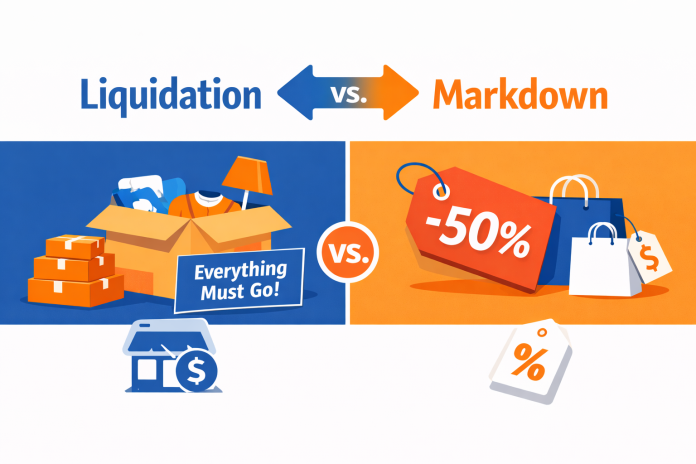
Markdown and liquidation are not interchangeable discount tactics. They are different strategic tools entirely. One is designed to optimize in-channel sales. The other is designed to protect capital and remove risk from the channel entirely. Retailers get into trouble when they treat inventory liquidation as a last resort rather than a parallel strategic option.
The Strategic Divide: Selling vs. Exiting
To understand the mistake, you have to separate two concepts that are often blended together.
Markdown is a strategy of selling. Liquidation is a strategy of exiting.
A markdown is based on the assumption that the product still belongs in the original retail channel. It assumes demand exists but needs price adjustment. Liquidation assumes the product no longer belongs in that channel. It prioritizes capital recovery and removal over in-store optimization.
The difference is more than semantic. It determines how capital flows through the business.
When a retailer clears out aged inventory through a cycle of repeated price reductions, they are making an implicit assumption that the product still has strategic value in-channel. But often this assumption is false.
The Financial Distortion No One Talks About
At first glance, markdown appears superior to liquidation because it produces more revenue per unit. That comparison is incomplete.
Most retailers measure markdown performance at the SKU level: margin percentage, sell-through rate, weeks on hand. What often goes unexamined is how markdown affects the rest of the assortment.
When customers walk into a store and purchase heavily marked-down merchandise, that spend does not exist in isolation. It replaces something else. Retail traffic is finite. A customer who spends $250 on clearance goods discounted 60 percent is unlikely to spend that same $250 on new arrivals carrying a significantly stronger margin.
Revenue may look healthy. Contribution declines.
This is margin displacement. Clearance inventory does not simply lower margins on specific SKUs. It shifts basket composition toward discounted goods. Over time, blended gross margin compresses, even if sales volume appears stable.
Add the physical implications. Clearance racks occupy prime floor space. Digital homepages feature markdown banners. Marketing energy moves toward aged products instead of newness. Markdown does not just reduce price. It reallocates attention, space, and margin opportunity.
Why Retailers Stay in Markdown Too Long
If the math is this clear, why do retailers over-rely on markdown? The answer is structural.
Markdown feels controllable. It remains inside the business. Pricing decisions, visual presentation, and timing are internal. Liquidation, by contrast, carries stigma. Many executive teams view it as an admission that the buy was wrong. Markdown still appears as retail revenue. Liquidation recovery may be accounted for differently, which affects internal optics.
There is also optimism bias. Merchants often believe one more reduction will unlock demand. Sometimes it does. Often it does not. Hope extends markdown cycles well beyond the point where they make financial sense.
When Liquidation Becomes the Strategic Choice
Liquidation is frequently misunderstood as giving up. It is often the more disciplined financial decision. It makes sense when product has aged beyond realistic demand windows, when multiple markdown rounds have failed to restore velocity, when clearance inventory is displacing higher-margin assortment, when working capital needs to be redeployed, or when brand positioning is at risk from excessive discounting.
Unlike markdown, liquidation removes products from the primary channel. That matters. Once aged inventory exits, it stops competing for attention. It stops conditioning customers to expect steep discounts. It frees up floor space for fresh storytelling and restores merchandising focus.
Per-unit recovery may be lower. Total contribution can be higher.
Execution Matters: Not All Liquidation Is Equal
One of the reasons that retailers are reluctant to liquidate is that of brand leakage. Poorly handled liquidation can result in product resurfacing in unintended channels, undercutting retail partners and disrupting pricing architecture. That concern is valid, which is why execution matters.
Established secondary market platforms such as B-Stock and Liquidity Services provide structured auction environments and controlled buyer access. Established companies like Overstock Trader and Total Surplus Solutions work with vetted buyer networks and controlled distribution channels to protect brand positioning while maximizing recovery. This structured approach is very different from simply dumping inventory into the market.
It’s important to only work with reputable firms that offer vetted buyer networks, geographic or channel controls, transparent bidding processes, clear documentation, and brand-sensitive distribution strategies. Liquidation becomes risky when it is unmanaged. It becomes strategic when it is structured. Retailers who partner with disciplined liquidation specialists are not abandoning brand integrity. They are protecting it while accelerating capital recovery.
The Time Value of Inventory
There is another factor often missing from this debate: time. Inventory aging is not neutral. Every additional week inventory remains unsold, capital stays tied up, storage and handling costs accumulate, trend relevance declines, and assortment flexibility decreases.
Retail operates on velocity. Slow capital rotation limits agility. If liquidation converts inventory to cash sooner and enables reinvestment in higher-performing goods, the net present value of that decision may exceed incremental markdown revenue. In fast-moving categories, speed often outweighs theoretical margin recovery.
Revenue Is Not the Same as Contribution
The most common mistake retailers make is anchoring to revenue instead of contribution. Consider two scenarios:
Scenario A: The extended markdowns create $1 million in revenue at heavily compressed margins.
Scenario B: Liquidation generates $600,000 in recovery. The floor space and capital saved result in $700,000 in new sales at full margin.
Scenario A may have greater revenue on paper. Scenario B may have greater profitability.
Retailers that focus only on per-unit recovery miss this broader equation. The goal is not to extract the highest revenue from each distressed SKU. It is to maximize total contribution across the assortment.
A More Disciplined Framework
Instead of defaulting to markdown first and liquidation last, retailers should evaluate both paths simultaneously. The relevant questions are whether meaningful demand is still present, whether price elasticity is strong enough to justify further reductions, whether clearance inventory is distorting margin mix, what the opportunity cost of occupied floor space actually is, and how quickly recovered capital could be redeployed.
If the math shows that continued markdown reduces overall assortment profitability, liquidation is not failure. It is a strategy. The highest-performing retailers treat inventory exit with the same rigor as inventory buying.
The Real Strategic Error
Retailers do not misunderstand markdown. They do not misunderstand liquidation. They misunderstand timing.
Markdown is powerful when used within a productive demand window. Liquidation is powerful when used before margin erosion accelerates. Stretch markdown too long and it becomes a margin leak. Delay liquidation too long and it becomes a distressed event rather than a strategic decision.
In volatile retail environments, a disciplined exit strategy is a competitive advantage.
Buying well matters. Selling well matters. Exiting well may matter most of all.

