

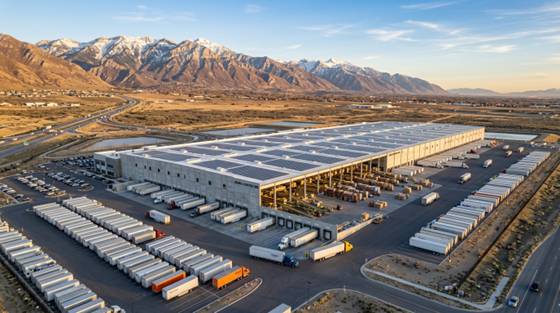
E-commerce now accounts for nearly one in four retail dollars spent in the United States — and the consumer who placed that order expects it on their doorstep within two days. That expectation, once a premium offering from large marketplaces, is now the baseline. Brands that can’t meet it lose to those that can.
For retail operators still fulfilling exclusively from coastal warehouses in Los Angeles or Seattle, the math is working against them. Shipping to customers in the Mountain West and Midwest from either coast burns through higher zone charges and slower ground transit times. Meanwhile, a growing cohort of retail brands has found a more efficient answer: positioning a third-party logistics partner in Utah. The state has quietly become one of the most strategically valuable fulfillment hubs in North America — and the case for it is built on infrastructure, geography, and hard numbers.
Why Utah Has Become a Premier Logistics Hub
Utah’s value to retail logistics starts with its geography. Positioned at the intersection of Interstate 15 and Interstate 80, a Salt Lake City fulfillment center puts brands within ground-shipping reach of Los Angeles, Las Vegas, Phoenix, and Denver — all within one to two days. According to industry data, 96% of the U.S. population is reachable within two days via ground from a Salt Lake City warehouse. For brands managing national distribution from a single node, that coverage is difficult to match.
Infrastructure investment reinforces the geographic advantage. The Utah Inland Port Authority has launched more than 12 project areas statewide, with a new $22 million public infrastructure district approved in June 2025 covering rail, road, and utility improvements that directly benefit 3PL operations across the state. Salt Lake City International Airport adds multimodal flexibility, serving as a significant air cargo hub for time-sensitive shipments.
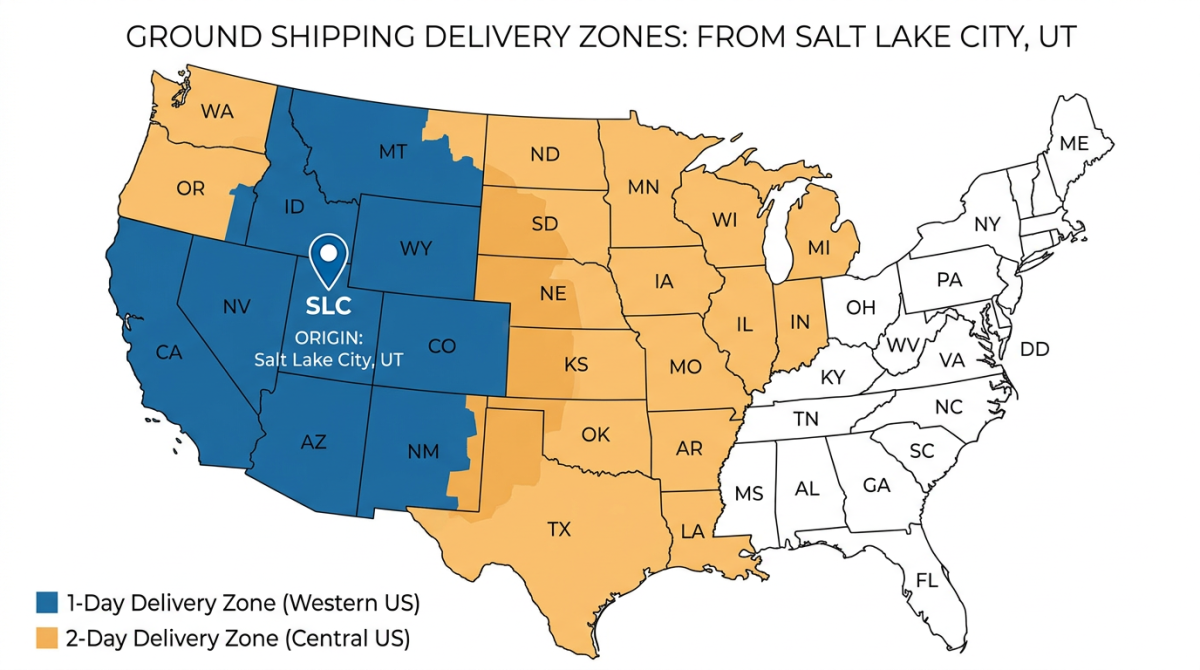
Map showing ground shipping radius from Salt Lake City with 1-day and 2-day delivery zones across the United States
Utah’s economic fundamentals are equally strong. The state’s GDP crossed $300 billion, growing at 4.6% — the highest rate in the nation — with unemployment at just 3.1%. Logistics-reliant industries contribute $78.2 billion annually to Utah’s GDP, representing 37% of total state output and supporting 547,000 jobs. That concentration of logistics activity creates a deep, experienced workforce for 3PL operators — an underrated factor when brands are evaluating service quality and operational reliability.
There is also a technology dimension. Utah’s “Silicon Slopes” tech corridor has shaped a culture of software adoption that extends into the logistics sector. Warehouse management systems, automation, and AI-assisted inventory tools are disproportionately common among Utah-based 3PL providers compared to national averages.
What a 3PL Actually Does for Retail Brands
A third-party logistics provider takes over the physical operations of getting products from manufacturer to end customer — warehousing, inventory management, pick-and-pack, shipping, kitting, and reverse logistics (returns). Brands hand off operational complexity and gain immediate access to shared infrastructure, negotiated carrier rate structures, and existing technology — without the capital expenditure of building or leasing their own warehouse.
The scale of the industry reflects how thoroughly this model has been adopted. According to IBISWorld’s 2026 analysis, the U.S. third-party logistics market is valued at $346.2 billion, with 68,728 businesses operating in the sector. More than 90% of Fortune 500 companies use at least one 3PL partner.
What separates capable providers from commodity ones is service depth. Quality 3PLs offer real-time warehouse management system (WMS) visibility, omnichannel fulfillment spanning direct-to-consumer, wholesale, and marketplace channels (Amazon, Walmart), kitting and light assembly, and documented order accuracy rates. As supply chain innovations continue reshaping modern retail, the tech stack a 3PL operates has become as important as its physical footprint.
What Retail Brands Should Look for in a Utah 3PL Partner
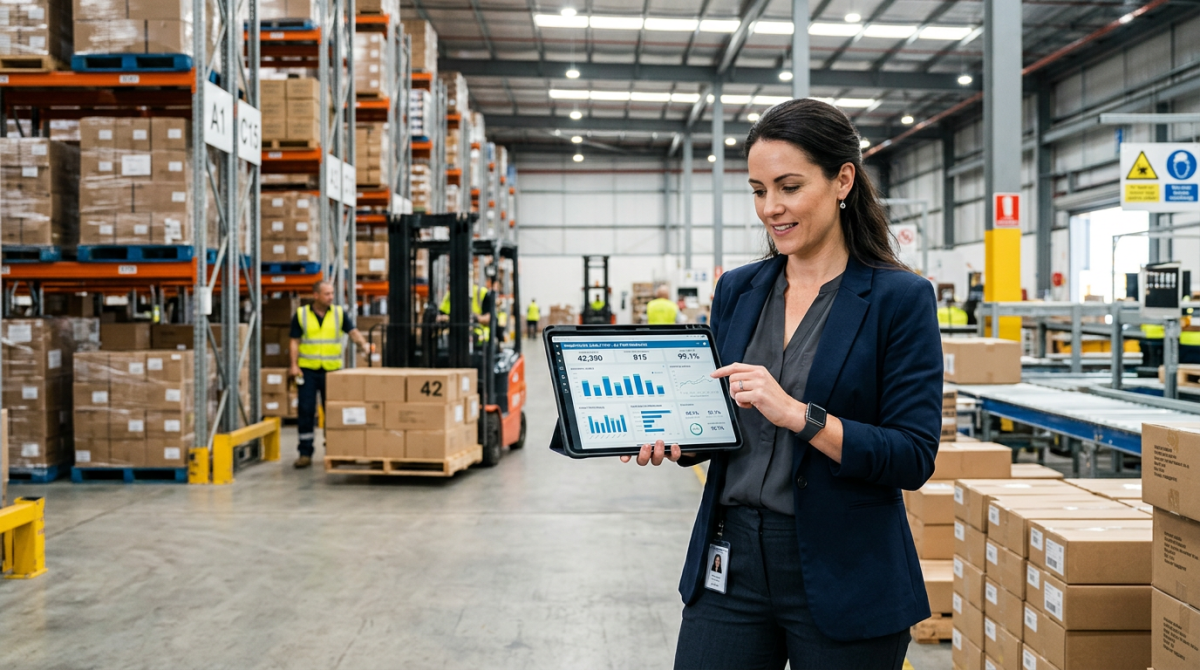
Business professional reviewing warehouse analytics dashboard on a tablet in a fulfillment center
Choosing a 3PL is a multi-year operational commitment. Brands that treat it as a transactional vendor search tend to pay for that approach later — in service failures, integration gaps, or inflexible contracts during peak season. The following criteria define what a credible evaluation process looks like.
- Location and zone coverage: Does the facility’s address actually improve your shipping zone profile for your customer base? A Utah warehouse helps brands serving Western and Central U.S. markets — but that benefit diminishes if your buyers are concentrated on the East Coast.
- Technology stack: Look for real-time WMS visibility, API, and EDI integration with your e-commerce platforms, and automated order routing. As AI reshapes retail supply chains, providers that haven’t adopted predictive inventory tools or machine-learning-assisted slotting are already operating at a disadvantage.
- Scalability: How does the 3PL handle Q4 volume spikes? Ask for documented performance data from prior peak seasons — not assurances, but metrics.
- Omnichannel capability: DTC orders, retail wholesale replenishment, and marketplace fulfillment should all operate from a unified inventory pool without separate SKU management or manual reconciliation.
- Accuracy and accountability: Documented order accuracy rates, shrinkage guarantees, and transparent reporting are non-negotiable. Ask for SLA terms in writing.
- Reverse logistics: Returns processing is table stakes for any retail brand operating in 2025. Verify the 3PL’s returns workflow before signing — and confirm how quickly returned inventory is restocked and made available.
For retail brands beginning their search in the Mountain West, working with a specialist in 3PL Utah operations means geographic advantage is already built into the partnership — but the evaluation criteria above still apply regardless of where a provider is based.
The Nearshoring and Tariff Tailwind Accelerating Utah 3PL Demand
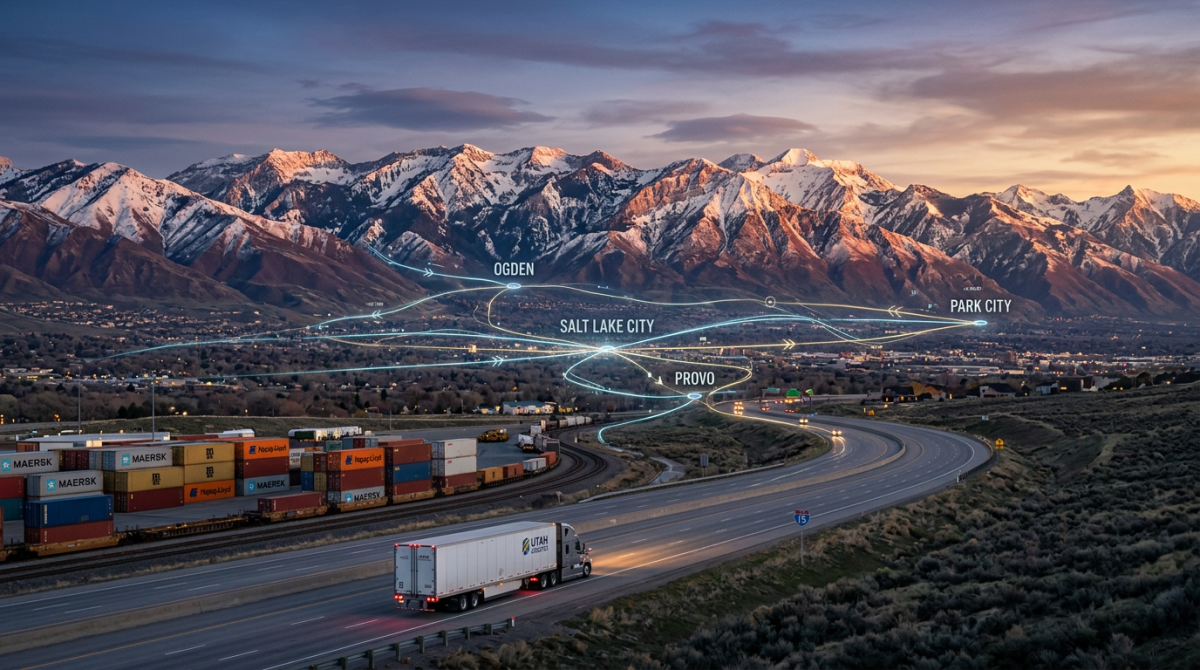
Utah mountain range skyline paired with a logistics and shipping visual, reinforcing regional identity
Macro forces are pushing brands toward domestic, regional fulfillment networks faster than the geography argument alone would. The Extensiv 2025 State of the Third-Party Logistics Industry Report found that 76% of shippers and 71% of 3PLs are actively moving toward more regional or domestic production networks — a direct response to tariff uncertainty, import disruption, and the resilience imperative that came out of recent global supply chain stress.
Utah benefits from this structural shift as a domestic, centrally-located alternative to coastal distribution. For brands re-evaluating their sourcing and import network visibility and looking to reduce reliance on single-origin fulfillment, a Mountain West 3PL anchor fits the portfolio logic of distributing risk across multiple domestic nodes.
The demand side reflects this. More than 70% of 3PLs reported order volume growth in 2025, with retail consistently ranking as the top sector served across the industry. 3PLs now serve an average of 3.6 industries, but retail volume continues to drive the expansion of physical capacity — including in Utah.
Smarter Fulfillment Starts with the Right Location and Partner
Utah’s case as a fulfillment hub is not a marketing narrative — it is a function of highway intersections, airport infrastructure, state-level capital investment, and a workforce shaped by one of the country’s most logistics-dense economies. For retail brands serving Western and national markets, the geographic math increasingly points to the Mountain West.
The brands that evaluate Utah-based 3PL partners now are positioning themselves ahead of a delivery expectation curve that continues to tighten. Two-day ground delivery was once a premium; it is now the minimum threshold for competitive retail. The fulfillment infrastructure to meet it reliably — at sustainable cost — is not built overnight. The time to establish that foundation is before the next peak season, making the gap obvious.

