

Long work hours, high demands, and constant decision-making may affect your health. Blood pressure fluctuates under stress, yet it’s easy to overlook both the stress itself and the host of side effects that accompany it. Tracking this simple metric at home or on the road gives you a clear view of how your routine affects your health. With consistent monitoring, you remain informed, spot patterns early, and make adjustments that support long-term performance.
In This Article
This article contains:
- The Growing Importance of At-Home Health Monitoring
- Advantages of Taking Your Blood Pressure at Home
- How to Ensure Accurate Home Blood Pressure Readings
- The Best Home Blood Pressure Monitors of 2026
- Choosing the Top Blood Pressure Monitors for Home Use
- FAQ
The Growing Importance of At-Home Health Monitoring
Health care now favors everyday tracking rather than occasional checkups. Blood pressure (BP) is a key metric to show your vascular and heart health. Instead of relying on a single reading at a clinic or doctor’s office, you can now build a more complete picture at home.
Organizations like the CDC emphasize that regular monitoring helps detect hypertension or high BP, which may not be apparent during a brief visit to your care provider. A single in-office reading can miss fluctuations caused by stress, time of day or recent activity — like a high-pressure business meeting you just attended. At-home tracking fills those gaps and provides health care providers with more useful data.
This approach also supports early awareness, as you can notice changes more quickly and bring them up in conversations with your doctor before they become serious. Over time, consistency makes your readings meaningful.
Thanks to advances in self-monitoring devices, taking your own BP during the day is much more convenient. Technology has made devices easier to use, faster to read, and better suited to routine settings. Accessibility helps people stay engaged with their own health.
Advantages of Taking Your Blood Pressure at Home
Taking your BP regularly helps you remain informed. There are several benefits to creating an arterial health monitoring routine.
Provides a More Accurate Overall Picture
Clinical readings can be influenced by your nerves, often called “white coat hypertension,” which is especially true if you feel uncomfortable going to a doctor. Some people experience the opposite, with normal numbers at the doctor’s office and elevated BP elsewhere.
Home monitoring reduces these variables. Multiple measurements across different times of day give a more balanced view of your typical BP.
Encourages Proactive Management
Seeing your numbers may be the reminder to breathe, think more calmly, and consciously take action to reduce your stress and thereby lower your BP. The awareness supports better daily actions and habits. People tend to stay more consistent with diet, exercise, and medication when they can see how those choices affect their readings.
Improves Treatment Efficacy
Doctors rely on data to evaluate whether a treatment plan is working. A single reading offers limited insight. A record of daily or weekly measurements gives a stronger foundation. This data helps guide adjustments to medication or lifestyle changes.
How to Ensure Accurate Home Blood Pressure Readings
Getting reliable results depends on consistency. Small adjustments can make a noticeable difference. Before taking a reading, avoid caffeine, exercise, and smoking for at least 30 minutes. It’s important to sit quietly for five minutes to let your body settle.
During the reading, sit upright with your back supported and your feet flat on the floor. Place the cuff on your exposed upper arm with the upper edge of the cuff just below your armpit. Stay still and avoid talking.
It’s best to take two or more readings a minute or so apart. The average of these is the result to record. This is a more accurate way to track patterns than relying on a single reading.
Understanding Hypertension and Blood Pressure Numbers
BP monitoring provides two numbers. The higher number is called systolic pressure and measures the force of contraction as your heart beats. The lower number, also called diastolic pressure, measures the force between beats when your heart rests.
These numbers fall into the following categories:
| Rating | Readings |
| Normal | Below 120/80 |
| Elevated | 120-129 systolic and below 80 diastolic |
| Hypertension stage 1 | 130-139 systolic and 80-89 diastolic |
| Hypertension stage 2 | 140 or higher systolic, over 90 or higher diastolic |
Tracking these ranges over time matters more than a single focused reading. Patterns provide context, which is why consistent monitoring and recording are so important. While home BP tracking doesn’t replace professional diagnosis, the readings can help inform that diagnosis because it provides your doctor with a clearer picture.
The Best Home Blood Pressure Monitors of 2026
With many different devices on the market, the gold standard remains the traditional BP cuff that takes readings on the upper arm, as it provides the most accurate data.
1. Beurer North America: Upper Arm Bluetooth Blood Pressure Monitor Premium 800
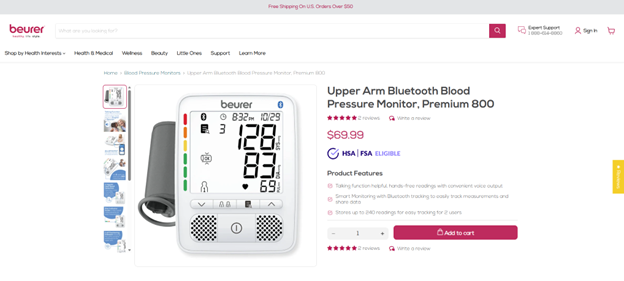
Beurer North America combines more than a century of precision German engineering with a focus on practical home health tools. Its BP monitors deliver consistent data while remaining simple enough to use in daily routines.
The brand emphasizes reliable functionality alongside precision. Large displays, intuitive controls, and clear indicators help you understand your readings without extra interpretation. That balance makes it easier to stay consistent over time.
Models are battery-powered, store data for multiple users, and finalize readings in about 30 seconds. The Premium 800 has an easy-to-read display and resting indicators for more precise measurements. For easy analysis, it features risk classification by using a color scale.
2. Omron Healthcare: Evolv Wireless Upper Arm Blood Pressure Monitor
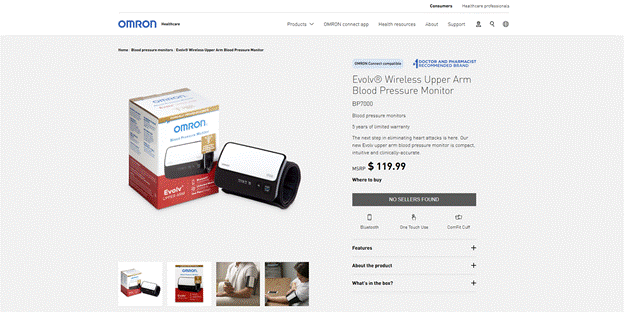
Omron Healthcare has built a strong reputation in medical devices, and the Evolv reflects its focus on modern design. The all-in-one cuff eliminates tubes and wires, making for a compact and streamlined experience.
The device connects to a mobile app that lets you store and track readings over time. That integration supports long-term monitoring without requiring manual logs. It’s battery-powered and has unlimited memory thanks to the app. Get your reading in about 30 seconds.
The one-piece wireless technology is convenient to use and much more compact for frequent travellers. The accuracy ensures you have reliable logs to help manage hypertension, while Bluetooth app syncing streamlines the process.
3. iHealth Labs: Track Blood Pressure Monitor
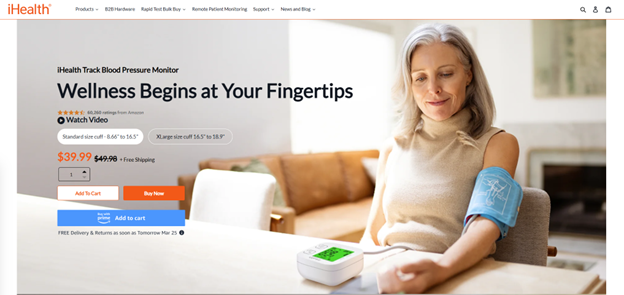
iHealth Labs focuses on accessibility and simplicity. Its devices appeal to users who want straightforward functionality paired with budget-friendly designs and digital tracking. The companion app stores readings and allows you to review trends over time. That setup works well for users who prefer managing health data on their phones.
It’s a doctor-recommended device that is FDA-approved, and sharing information with your health care provider is much easier than handwritten records. The device is battery-powered, and you have unlimited storage space through the app.
Reading time is about 30 seconds, and one-touch operation makes it easy to use. It’s a budget-friendly option that changes color based on your reading metrics, helping you take appropriate action to manage your blood pressure.
4. Oxiline: Pressure 9S Pro
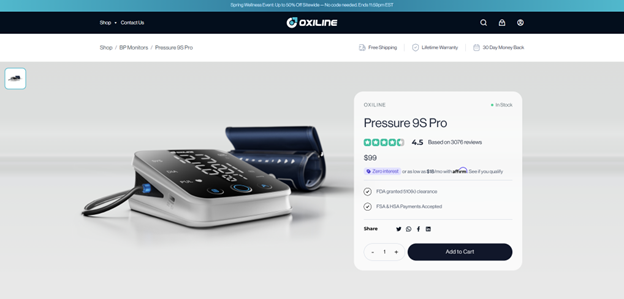
Oxiline positions itself as a provider of high-accuracy home devices. Its monitors focus on delivering consistent readings with advanced sensor technology. The design prioritizes clarity with large displays and color-coded indicators that make results easy to interpret.
The large numbers make frequent tracking easy. It’s fully portable, battery-powered, and stores up to 120 datasets. It’s FSA and HSA eligible, and affordably priced.
Get readings in 30 seconds through PressureSense technology. The backlit display and unique features, such as irregular heartbeat detection, make it a user-friendly option.
Choosing the Top Blood Pressure Monitors for Home Use
The devices on this list had to meet strict criteria regarding accuracy, ease of use, data tracking, and overall value. Each supports consistent monitoring without adding unnecessary complexity or discomfort.
FAQ
How often should I check my blood pressure at home?
Frequency depends on your health needs. Most people take readings in the morning and at night or according to a schedule recommended by their doctors. Consistency matters.
Are wrist monitors as accurate as upper arm monitors?
Upper arm monitors provide the most accurate readings, but wrist monitors can still be effective if used correctly, though they require more precise positioning.
Can a home monitor diagnose hypertension?
Home tracking provides valuable data, but diagnosis requires a health care professional. Doctors will interpret your readings, along with their own, to arrive at a full diagnosis.
Stay on Top of Your Health
As a busy professional who travels frequently and works in high-stress environments, you should invest in your health with a quality blood pressure monitoring device. Make home or mobile BP checks part of your daily routine to support conversations about health management with your doctor. Choose a device that’s comfortable and easy to use, then build your habit.

