

A machine which is not able to stop exactly is a liability. A machine that is incapable of engaging gears will lose products, wear out quicker, and expose operators to risks. The two parts that determine the two outcomes are the brake and the clutch.
Your load is connected to your motor through industrial brakes and clutches. The brake detains or halts movement at will. The clutch switches or unswervingly drives power to the motor. The two of them provide you with control over all the movements made by your machine.
What Are Industrial Brakes and Clutches?
A brake is a force exerted or a rotating shaft brought to a stop. That shaft is connected or disconnected to the source of drive by a clutch. In the majority of machines the two are combined, the clutch operating when it is necessary that power be given, the brake when it is not.
They are both operated by electricity or pneumatic means. You call them by a signal and they are back within a few milliseconds. No mechanical levels, no human intervention.
Where They Are Used
- Packaging Machines: Clutches operate at an opportune time. Brakes occupy the place between cycles.
- Printing and Paper Lines: The types of magnetic particles used to control web tension constantly do not jerk.
- CNC and Machine Tools: This is by electro-magnetic brakes which retain the spindle or axis during power outage.
- Conveyor Systems: Brakes are used to halt the belt immediately when sensors are activated to stop.
- Cranes and Hoists: When the power is off the load is frozen in place by power-off brakes as soon as the current is cut.
How Clutches and Brakes Power Industrial Systems
Manufacturing and Automation Systems
Clutches and brakes are widely used in conveyor systems and assembly lines to control motion and ensure smooth start-stop operations. They help maintain efficiency and reduce mechanical stress on equipment.
Printing and Packaging Industry
In printing presses and packaging lines, these components play a key role in maintaining proper tension and alignment. This ensures consistent output quality and prevents material wastage.
Textile Industry
Clutches and brakes are essential in spinning and weaving machines, where they help maintain uniform speed and fabric alignment. This improves product quality and operational stability.
Machine Tools and Robotics
In CNC machines and robotic systems, they provide precise torque control and accurate positioning. This allows for high precision in cutting, shaping, and automated tasks.
Energy and Heavy Equipment
For heavy-duty machinery and power systems, clutches and brakes handle high torque loads and deliver reliable braking performance. Their durability makes them suitable for continuous and demanding operations.
Types of Brakes and Clutches – Explained
Electromagnetic Brakes and Clutches
They are most widely used in the field of industrial automation. With DC 24V applied to the brake, a magnetic field causes the armature plate to slide the friction surface against and halts rotation. The clutch is inverted – with voltage the connector of the drive, with cutting the connector of the drive.
- Torque Range: 6 Nm-400 Nm This is the range of torque that suits your shaft load.
- Maximum speed: 1800 rpm that is applicable in the majority of regular motor uses.
- Response: Very fast. The magnetic field accumulates and fades within milliseconds.
- Installation: Small size, simple to fit on the shaft.
Best used: positioning systems, machine tool drives, conveyor stops and any operation that requires a hard, dependable engage or release.
Power Off Brakes
A power off brake works just the reverse of the normal electromagnetic brake. When set to zero, it sweeps together and when a voltage is applied, it relaxes. This causes it to be a safety device in default in case of power failure, the brake automatically activates and retains the load.
- Torque Range: 0.3 Nm to 8 Nm Minuscule stepper motor sizes and smaller servo axes.
- Voltage DC 24V: thermal and overload protection built in.
Safety: Operates on power loss no additional circuitry required to support fail safe.
Best: horizontal axes, servo and stepper motor shafts, any type of load that has to remain in place during a power outage.
Magnetic Particle Clutches and Brakes
The fine iron powder between the rotor and housing of units of magnetic particles is used. As DC current is passed through the coil, the powder chains and passes torque. Minimum current means minimum torque. The association is almost linear exact, smooth and modifiable at any given point between zero and maximum.
- Torque Range: 3 Nm to 400 Nm in single and hollow shaft designs.
- Maximum speed: 1500 to 1800 rpm according to model.
- Key Feature: Constant slip causes no damage in the heat the powder absorbs and energy dissipation.
- Tension Control: Tension control is used in printing, film handling and paper handling.
Best: winding and unwinding processes, printing presses, and any process that requires torque to be maintained continuously without interruption.
Pneumatic Clutches and Brakes
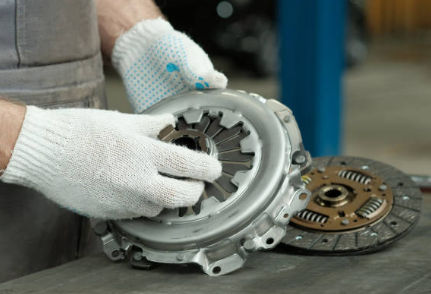
In the pneumatic types, compressed air at 0.6Mpa is applied to open the clutch or brake. A piston is forced by air pressure to hold friction discs together. Expel the air, expel the torque. Since the air pressure can be adjusted so can the torque output to as much as 400 Nm on the shaft mounted model.
- Torque Range: 50 Nm -400 Nm heavy-duty construction.
- Control: Adjust air pressure to fine-tune precise torque at any given point.
- Durability: No electric coil to burn out very long service life under heavy loads.
Electromagnetic vs. Magnetic Particle vs. Pneumatic – Which One Fits?
The three technologies solve different problems. Use this table to match the type to your application in one look.
| Feature | Electromagnetic | Magnetic Particle | Pneumatic |
| Control Method | Electric (DC 24V) | Electric (DC 24V) | Compressed air |
| Response Speed | Very fast | Fast | Fast |
| Torque Adjustability | Fixed torque levels | Continuously variable | Adjustable via air pressure |
| Slip Operation | No , hard engage/release | Yes , smooth slip | No |
| Tension Control | Not ideal | Excellent | Good |
| Shock on Engagement | Slight | None , smooth | Slight |
| Best For | Positioning, holding, stopping | Printing, paper, winding | Heavy-duty machinery |
If you need hard stops and precise positioning, go electromagnetic. If you need smooth tension control with no shock, go magnetic particles. If you are driving heavy machinery and already have compressed air on site, pneumatic is the right call.
How to Choose the Right Brake or Clutch
Step 1: Determine Your Torque Need.
Measure the shaft torque your motor gives and the load inertia you are loading. Select brakes or clutches with a static torque rating at least as much as your peak shaft torque. The under-rating leads to slip and early wear.
Step 2 : Choose the Right Type
Hove, Hard stop required: Electromagnetic brake.
- Fail-safe when losing power: Power off brake.
- Piezoelectric slip and tension control: Magnetic particle clutch or brake.
- Heavy load, compressed air supplied: Pneumatic clutch.
Step 3 : Check Shaft and Speed
All ATO electromagnetic and magnetic particle brakes and clutches work up to 1800 rpm. Models of magnetic particle hollow shaft are rated at 1500 rpm. Make sure that you order a motor speed that is within range.
Step 4 : Match the Voltage
Every electric model operates on DC 24V. When you have a different supply voltage on your control panel, then you will be required to have a step-down converter. A regulated air supply of 0.6 MPa is required in pneumatic models.
Sum Up
Brakes and clutches may not be seen as large parts of a machine, but they are very important in the performance of a machine. They determine the smooth and correct starting, stopping and positioning of a machine, which directly affects the performance and quality of the product. Selecting the incorrect component may result in overflow, loss of materials and unjustified equipment wear.
In manufacturing and automation, in heavy-duty equipment and machines, high quality clutches and brakes guarantee accurate torque control, stable movement and dependable operation. Electromagnetic, power-off, magnetic particle and pneumatic solutions are designed to satisfy varying operational needs and remain efficient and durable when used on a continuous basis.
Not only is it maintenance, but it is a strategic choice to ensure that machinery is safeguarded by investing in the right clutches and brakes, better management, and overall increased productivity. In cases where accuracy, performance, and stability are crucial, the correct solution means a more smooth operation and performance.

