

Picture this: You invest millions into a sleek new wearable, only for the first units to reach customers scuffed, dented, or wrapped in non-recyclable plastic. One bad unboxing can erase months of R&D as buyers broadcast every flaw.
That threat is growing fast. California’s SB 54 already demands that every single-use package sold in the state be recyclable or compostable by January 1, 2032—penalties included.
This guide decodes the new rules, spotlights eleven vetted suppliers, and serves up a quick-scan matrix so you can match the right partner to your timeline, sustainability goals, and budget.
Ready to protect your devices and your reputation? Let’s dive in.
How we built the shortlist
We cast a wide net. More than thirty packaging providers, from multinationals to two-person studios, went up on our research board.
Next, we asked a single litmus question: could this vendor serve an electronics operations manager who needs protective, brand-ready packaging in 2026? One “no” removed the name.
For every contender we ran a seven-factor scorecard, ten points each:
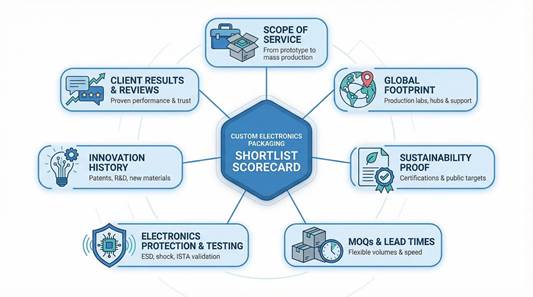
- Scope of service,
- Global manufacturing footprint,
- Sustainability proof (certifications and public targets),
- Flexible minimum order quantities and lead times,
- Electronics-specific protection or testing know-how,
- Innovation history (patents, APIs, smart sensors),
- Proven client results or third-party reviews.
Any firm that failed two criteria left the board. The final eleven didn’t just look large or flashy; they delivered proof. One replaced foam with molded pulp to meet California’s 2032 recyclability mandate, while another rolled out an API reorder flow that keeps a DTC headphone brand from ever running out of boxes.
We then sorted the winners into four segments. The goal isn’t to crown a single champion; it’s to help you spot the partner that fits your goals and growth stage, weeks faster than a solo Google hunt.
Packaging trends shaping 2024–2025
1. Sustainability and compliance pressures
Regulation is no longer a distant murmur; it is at the door, clipboard in hand. California’s SB 54 requires every single-use package sold in the state to be recyclable or compostable by January 1, 2032. Similar extended-producer-responsibility programs are rolling across Washington, Colorado, and the European Union, each adding fees or outright bans on hard-to-recycle plastics.
For electronics brands, the stakes double. Batteries, rare-earth magnets, and anti-static foams already face hazmat scrutiny. Now the outer box must hit eco benchmarks too. Ignore them and you risk fines, shipping delays, and a chorus of eco-savvy customers ready to switch brands.
The good news: materials science has sprinted ahead. Molded-fiber inserts now match the shock absorption once handled by EPS foam. Paper-based bubble wraps protect tablets without a gram of plastic. Even anti-static layers are moving to graphene-infused cellulose, keeping circuits safe while meeting curbside recycling rules.
Sustainability also reshapes product dimensions. When Apple removed chargers from iPhone boxes, competitors followed. Smaller cartons translate to fewer pallets, lighter airfreight, and a lower carbon ledger—savings procurement teams can tie to real dollars.
The takeaway is clear. Any packaging partner you hire in the next two years should arrive with two proofs: current eco certifications and a roadmap to meet 2030-style mandates. Anything less could turn your next launch into a costly compliance fire drill.
End-to-end partners: when you want one team from sketch to doorstep
Zenpack
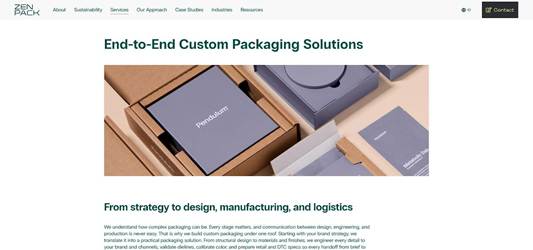
Zenpack custom electronics packaging website screenshot
Zenpack feels less like a supplier and more like an extension of your product crew. Founded by former industrial designers in San Jose, the firm set out to fix a pain they lived: brands juggling separate agencies for graphics, structure, and fulfillment. Now the loop—concept sketches, structural engineering, drop-test validation, mass production, and final kitting—runs under one roof.
Why it matters: electronics packaging lives at the intersection of aesthetics and physics. A stylish rigid box is useless if a lithium-ion battery punctures in transit. Zenpack’s engineers model shock, ESD, and humidity variables before a single dieline hits the press. The same team then manages production in California, Taiwan, or China, letting you toggle between speed and scale without retraining a new vendor mid-project.
Sustainability comes baked in, not bolted on. Every board grade is FSC certified, inks are soy based, and molded-pulp trays replace EPS foam whenever performance allows. For a recent wearable launch, switching to fiber inserts cut plastic to near zero and trimmed shipped volume by 12 percent, lowering landed cost.
Choose Zenpack if you rely on high-touch guidance and cannot risk a misstep between prototype and Black Friday shelf. Unit cost sits above a commodity printer, yet the insurance on design integrity and timeline often pays for itself in the first avoided reprint.
PakFactory
PakFactory sits at the intersection of online ease and hands-on service. You start with a web configurator that produces instant quotes and 3-D proofs. When specs grow tricky—say you need a rigid magnetic box with a die-cut foam cavity—an actual packaging engineer calls to sanity-check dimensions and suggest material tweaks. That blend saves time and keeps rookie errors off the press.
With headquarters near Toronto, North American brands gain a tariff-free shortcut. Production splits between vetted Canadian and U.S. plants for faster ground shipping, while overflow runs tap PakFactory’s Asia network to hold unit cost. Need 250 influencer kits next month and 25 000 retail boxes for holiday? The same dashboard tracks both jobs, so reorders feel as simple as adding items to a cart.
Quality shows up in the reviews. PakFactory lists more than three thousand brand clients and holds a 4.6-star rating on Google, where comments praise color accuracy and responsive support. Internally, the company audits partner factories against ISO 9001 and posts scores to your client portal, turning procurement approvals into a quick checkbox.
Pick PakFactory when you crave Amazon-style ordering speed yet still want a human to catch the mistakes algorithms miss. It is especially handy for Canadian electronics startups eager to avoid cross-border duties without losing design polish.
Tech-enabled low-volume platforms
Arka
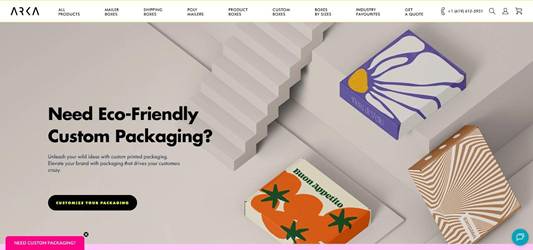
Arka custom box configurator website screenshot
Arka grew out of a Silicon Valley accelerator, and it shows. You design boxes in a browser, watch live pricing update as materials change, then click “order” and receive a UPS tracking number a few days later. No phone tag, no PDFs. For time-strapped electronics founders, that speed is survival.
Low minimums headline the offer. Order ten branded mailers for a reviewer drop and Arka prints without complaint. Behind the scenes, its API connects to Shopify, ShipBob, or your ERP, so automatic reorders fire when inventory dips. The workflow feels closer to code deployment than corrugated.
Sustainability sits in the default settings. Boards contain recycled fiber, inks are water based, and checkout includes a carbon-neutral shipping toggle. Founders gain an instant ESG talking point without extra planning.
Arka excels at straightforward styles—mailers, folding cartons, simple corrugate. Complex trays for a drone controller belong with a specialist further down this list. For the many gadgets that ride safely in a sturdy mailer, Arka turns packaging into a task you finish over lunch.
Packlane
Packlane popularised drag-and-drop box design long before rivals caught on. The interface feels like Canva for corrugate: upload artwork, pick finishes, spin a live 3-D preview, and press print. Minimum order is twenty-five units, perfect for beta runs, Kickstarter perks, or limited gadget drops where photogenic branding matters.
Speed seals the deal. Domestic printing means most orders ship inside two weeks, faster with rush service. When hardware teams race toward embargo day, that gap decides who appears in the first review videos.
Packlane stays in its lane. It nails graphics on standard box shapes but outsources complex inserts, so brands often pair Packlane with a protective specialist such as UFP or Zenpack. Many startups accept the trade-off because the outer box tells the story, while an off-the-shelf kraft insert cushions the device just fine.
Iteration is where Packlane shines. Revise a dieline at 11 pm, place the update, and fresh samples arrive while the next firmware build compiles. For founders who tweak colour codes and copy until the last minute, that agility feels priceless.
PackMojo
PackMojo, based in Hong Kong, turns Asia’s manufacturing capacity into a low-MOQ playground. Its promise is simple: premium, retail-ready boxes in runs as small as one hundred units. The team pools orders across vetted converters and fills idle press time, so you pay for output, not machine downtime.
International hardware teams value the logistics edge. When assembly occurs in Shenzhen, PackMojo trucks finished packaging next door, cutting freight legs and still matching Western colour standards. For brands shipping back to the United States or Europe, PackMojo pre-clears duties and prepares customs codes, helping cartons glide through ports without surprise fees.
Cost control follows. Unit prices undercut most domestic quotes past two hundred pieces, while FSC paper, soy inks, and plastic-free tray options keep eco goals intact. Lead time averages four to six weeks door to door, so plan accordingly.
For a Kickstarter-ready unboxing on a tight budget, PackMojo slots neatly between desktop printers and enterprise giants.
Protective-engineering and smart-packaging specialists
UFP Technologies
UFP tackles packaging like a bridge designer: calculate every force, build to survive it, then verify each joint. The Massachusetts lab houses drop towers, vibration tables, and climate chambers that replay the worst freight nightmares. After testing, proprietary foam inserts cradle boards, batteries, and lenses with millimetre precision.
That rigour stems from the company’s medical-device roots. ISO 13485 audits allow near-zero variance, and the same controls now guard VR headsets, avionics modules, and premium audio gear. UFP recently added molded-pulp capability, giving electronics brands a path to remove plastic without losing G-force protection. Few suppliers can swap EPS for fibre and document the change with shock graphs instead of marketing claims.
Choose UFP when transit failure is off the table. Unit cost sits above commodity foam, yet brands recoup the premium through fewer warranty claims and stronger reviews.
Pregis
Pregis built its reputation on air pillows and foam; its latest headline feature is intelligence. Through the IQ innovation hub, engineers embed low-profile sensors inside cushioning that log shock, tilt, and temperature events. If a high-value drone kit takes a six-foot hit in transit, the data reveals the moment and supports a carrier claim.
Sensors arrive with greener materials. Recycled-content air pillows, paper-based padded mailers, and carbon-neutral film lines help brands meet sustainability targets without extra steps on the packing line. Pregis technicians also audit fulfilment centres, then adjust machine settings to trim void fill and cut seconds from each pack cycle. The result is less material, fewer damages, and faster throughput, outcomes your finance team can chart.
Pregis fits operations leaders who want measurable damage reduction and continuous-improvement metrics. Pricing stays mainstream, yet the insight once reserved for enterprise trackers now lands inside every carton.
Global heavyweights with scale and sustainability muscle
Sealed Air
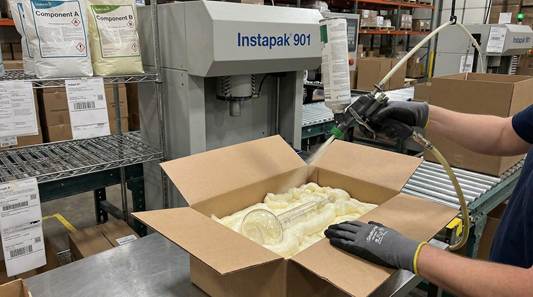
Sealed Air Instapak protective packaging website screenshot
Sealed Air invented Bubble Wrap in 1957 and has studied protection science ever since. Its Instapak foam-in-place machines form custom cushions around everything from 65-inch televisions to rack-mounted servers. Press a foot pedal, inject liquid foam, and thirty seconds later a contoured cradle locks each gadget in place, cutting damage rates and keeping high-volume lines moving.
Scale completes the pitch. With plants in more than one hundred countries, Sealed Air mirrors your production footprint. Launch a headset in Mexico and a thermostat in Poland, and the same consumables, equipment settings, and test data follow you.
The 2025 pledge is clear: every material sold becomes recyclable or reusable. Progress appears in plant-based air pillows, paper mailers, and Prismiq digital watermarks that sort films at recycling centres. Choose Sealed Air for Fortune-level reliability and automation power without compromising tomorrow’s sustainability scorecard.
DS Smith
DS Smith earned its name in corrugated, yet the real edge is design thinking at industrial scale. Step into a PackRight Centre—there are more than forty worldwide—and co-create with engineers who breathe paper mechanics. Within hours, they prototype a box that locks a smartphone in place using folded flutes, no foam required.
That craft meets plastic bans head-on. DS Smith already supplies one hundred percent recyclable packaging to Samsung and Philips, replacing polystyrene with sculpted cardboard that passes ISTA drop tests. The DISCS simulator recreates parcel bumps so failures surface long before production.
Circularity runs deeper. Company-owned recycling mills across Europe and the United States turn yesterday’s cartons into tomorrow’s print runs. When ESG teams request hard numbers, DS Smith delivers lifecycle data, not slogans. Pick DS Smith for aggressive plastic-free goals and rapid, collaborative design sprints at a competitive unit price.
Sonoco
Sonoco is the Swiss Army knife of packaging. Order molded-pulp trays for earbuds, corner posts for refrigerators, or contract pack-out that slips manuals and chargers into every box—one supplier covers it. More than three hundred plants worldwide specialise in paper, plastic, composite, and retail-ready displays.
Electronics teams lean on Sonoco’s packaging-services division when assembly lines run hot. Devices roll off the belt, move next door for pack-out, and leave the gate retail-sealed, shaving days during peak season.
Sustainability shows in the EnviroSense line, where paper corner blocks match polystyrene compression strength and slide into curbside recycling. Sonoco fits brands with wide catalogues that want a single partner to standardise quality, certifications, and supply-chain visibility.
Mondi
Mondi is a materials innovator first and a converter second. That mindset matters when replacing films, bubble wrap, or anti-static bags. In a Mondi TechLab, chemists test paper that stretches like polyethylene and coatings that block moisture yet remain fully recyclable. Electronics teams tap this bench to meet 2025 recyclability targets without risking product safety.
Consider the paper bubble wrap: embossed kraft locks air pockets to cushion routers and smart speakers while eliminating mixed-material waste. Pair it with a lightweight corrugated board that keeps edge-crush strength while using eighteen percent less fibre, and freight emissions fall to numbers any ESG report welcomes.
Mondi’s footprint leans European yet reaches North America through recent acquisitions, keeping lead times predictable on both sides of the Atlantic. Minimums start in the thousands, suiting established brands ready to roll sustainable breakthroughs across full product lines. Mondi excels when material science blocks your roadmap; chances are a paper, laminate, or biopolymer in pilot already solves the hurdle.
Side-by-side comparison
You have met each player one-on-one; now see how they stack up at a glance.
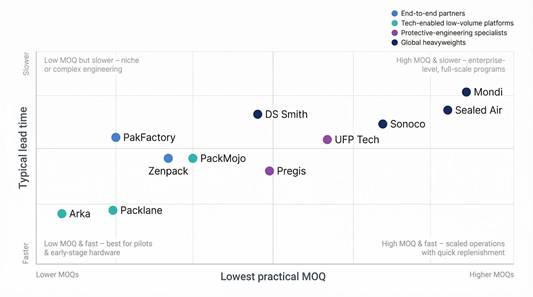
| Company | End-to-end services | Global footprint | Sustainability proof | Lowest practical MOQ | Typical lead time | Notable innovation | Electronics clients |
| Zenpack | Design to fulfilment | USA, Asia hubs | FSC papers, soy inks | Pilot runs (≈50) | 3–5 wks | Drop-test engineering | Fitbit, NVIDIA |
| PakFactory | Online portal plus engineers | Canada, USA, Asia | One hundred percent recyclable boards | 250 | 2–3 wks (NA) | Live 3-D quoting | Three thousand-plus brands |
| Arka | API-driven ordering | US print centres | Recycled boards, carbon-neutral shipping | 10 | <2 wks | Shopify reorder API | DTC gadget startups |
| Packlane | Digital print focus | US plants | FSC paper, water inks | 25 | 2 wks | Real-time 3-D preview | Crowdfunded tech |
| PackMojo | Vetted Asia converters | Ships worldwide | Recycled paper, soy inks | 100 | 4–6 wks | Pooled low-volume runs | Kickstarter hardware |
| UFP Technologies | In-house design and test labs | North America, EU | Molded fibre, ESD foams | 1 000+ | 6–8 wks | ISO 13485 foam science | Bose, Medtronic |
| Pregis | Materials with IoT sensors | NA, EU | Carbon-neutral films | 500 | 1–4 wks | Shock-recording cushions | Lenovo, bike OEMs |
| Sealed Air | Design, machinery, supplies | 100+ countries | 2025 recyclable pledge | 5 000 | 2–4 wks | Instapak, Prismiq QR | Dell, Amazon |
| DS Smith | PackRight co-design | 34 countries | One hundred percent recyclable range | 500 | 3–5 wks | DISCS drop simulation | Samsung, Philips |
| Sonoco | Design plus contract pack-out | 300+ sites | EnviroSense paper foams | 1 000 | 3–6 wks | Multi-material kits | HP, Sony |
| Mondi | Material R&D and converting | EU, NA, Africa | Net-zero 2050 target | 5 000 | 4–8 wks | Paper bubble wrap | Dyson, Apple (rumoured) |
Use this chart as a filter, not a grade sheet. Shipping two hundred prototypes next month? Check the MOQ column first. Chasing a plastic-free directive by 2027? Scan the sustainability proof. Two minutes here can save two weeks of vendor calls.
How to choose your packaging partner in five clear steps
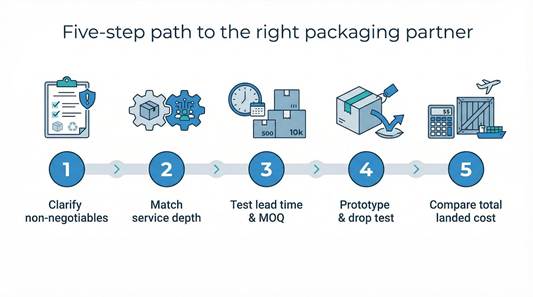
Step 1. Clarify the non-negotiables.
Create a one-page brief that lists protection level, eco targets, launch date, and budget range. If an ISTA 6 drop test or a one hundred percent recyclable bill of materials is required, state it plainly. Vendors quote faster and more accurately when your red lines are obvious.
Step 2. Match service depth to in-house skill.
If your team lacks structural designers, lean toward end-to-end shops like Zenpack or DS Smith that supply engineers and graphic artists. If you already own dielines and only require print capacity, a low-touch platform such as Packlane or PackMojo keeps overhead low.
Step 3. Pressure-test lead time and MOQ in writing.
Ask each finalist for two numbers: the quickest realistic schedule for a 500-unit pilot and the normal cadence for a 10 000-unit reorder. Discrepancies appear quickly. A vendor quoting six weeks for the pilot but four for reorders signals strong scale capacity; one that hesitates is a launch-date risk.
Step 4. Request a paid prototype pack.
Nothing beats holding the box. Pay for a final-form sample—graphics, inserts, and coatings included—and run a quick drop test yourself. This small spend often reveals print banding, weak corner crush, or insert mis-fits that glossy PDFs hide.
Step 5. Compare total landed cost, not unit price alone.
Add tooling fees, freight, duties, and potential damage claims to your spreadsheet. A PackMojo mailer may cost twenty cents less than a PakFactory equivalent, yet if it ships air from Asia and arrives five days later, expedited freight and buffer inventory erase the savings. Include every column before signing.
FAQ
Can I split my packaging between two suppliers?
Yes. Many electronics brands pair a graphic-box printer with a protective-insert specialist. Keep the bill of materials simple—two or three parts maximum—so tolerances align, and always test the full kit before scaling.
How long does a custom package take from idea to doorstep?
Plan for 8–12 weeks door to door. Design and quoting absorb the first two, prototyping another two, then production and freight the balance. Quick-print platforms like Packlane can compress the timeline to two weeks, but only for standard box styles.
Do I really require ISTA or MIL-STD testing?
If your product retails over USD 300 or contains fragile optics, electrostatic-sensitive boards, or lithium batteries, lab testing is inexpensive insurance. Vendors such as UFP and Sealed Air run these tests in-house, saving an extra lab fee.
What is the easiest eco win?
Swap foam or plastic trays for molded fibre. Most suppliers on our list offer a pulp option that meets the same drop specs, satisfies curbside recycling, and often trims freight weight.
Who handles Canadian bilingual labelling rules?
PakFactory and Sonoco operate facilities in Canada and print French/English layouts without extra turnaround. For United States-based suppliers, provide final bilingual artwork to avoid delays.
Conclusion
Follow these steps and the comparison table above shifts from helpful reading into a confident purchase order. Each supplier on this list solved a real electronics packaging challenge in the last twelve months, from SB 54 compliance to sub-fifty-unit prototype runs. Request samples, run your own drop tests, and let the data guide the final handshake.

