

By 2025, procurement in Canadian retail was changing faster than many companies expected. The new US tariffs revealed how dependent many Canadian retailers had become on cross-border trade after years of relatively stable relations. Canada hit back: 25% surtaxes on nearly CA$30 billion in US goods, a Buy Canadian Policy mandating domestic supplier priority, and now a CUSMA formal review starting July 1, 2026, adding fresh uncertainty for every procurement team in the country. Retailers are already feeling the pressure. As of March 2026, grocery prices had risen by 4.4% compared to the previous year, which is almost twice the national inflation rate. At the same time, Canada’s GDP growth is expected to reach only 1.1% this year. For retail chains already running on grocery margins of 3–5%, sourcing smarter and forecasting faster has moved from an operational goal to a board-level imperative.
The Real Problem Isn’t Data -It’s Visibility
Most retail chains aren’t short on data. Every scan at the till, every delivery note, every stock adjustment generates information. The problem is where that information ends up: scattered across POS systems, ERP databases, supplier portals, and individual spreadsheets that no one else can read.
In a stable trade environment, that fragmentation was an inconvenience. In this one, it’s a liability with a measurable cost.
When a buyer needs to decide whether to replace a US-sourced line with a domestic alternative, they need to know that supplier’s delivery reliability over the past six months, the margin impact of their short deliveries, and how their GMROI compares to others in the same category. If getting that picture takes two days of manual reconciliation across separate systems, the window for action has already passed. Competitors who can answer that question in minutes -and act on it -are pulling ahead.
Three gaps define where most physical retail operations are losing ground right now: supplier performance visibility, demand forecasting accuracy, and response speed. A category manager who can only see what a supplier delivered last quarter, using forecasting models built on historical averages that no longer reflect current consumer behavior, working from data that is already days old by the time it surfaces -that’s not a technology problem. It’s a decision-making problem that technology can fix.
For procurement and category teams looking to close these gaps, Datawiz BI offers a useful reference point: built specifically for retail chains, covering supplier analytics, demand forecasting, and real-time inventory visibility within a single decision-making layer. The difference between chains operating with that level of visibility and those still working across fragmented systems is no longer a competitive advantage; it is an operational necessity in a market that has fundamentally changed.
What is Datawiz?
Datawiz is an analytics platform for retail that helps you consolidate all your chain data in a single place. It integrates data from POS systems, ERP systems, and supplier information into a single, centralized data ecosystem. The platform is very easy to use, so all departments can interact with dashboards, charts, KPIs, and reports on a daily basis.
This is not a reporting tool that visualizes data you already understand. It is an analytical infrastructure that standardizes how data is defined, measured, and distributed across the entire organization. The practical result: no conflicting KPIs between departments, no manual reconciliation, no version control problem with spreadsheets.
What the Shift to Domestic Sourcing Actually Requires
The Buy Canadian Policy sounds straightforward on paper. In practice, onboarding a new domestic supplier while maintaining shelf availability, margin targets, and order accuracy is one of the more complex operational challenges a procurement team can face.
New suppliers come with unfamiliar lead times. Their fill rates are unproven. Their order accuracy hasn’t been stress-tested across regions. A chain that has spent years building confidence in a US supplier’s reliability now needs to rebuild that confidence quickly, with domestic partners who may be scaling up their own operations at the same time.
That’s only possible if the chain can track actual supplier performance in real time -not at quarterly review time, but continuously. Delivery stability, order accuracy, fill rates, return volumes, margin contribution: all of it, updated as it happens, for every vendor in the chainatawizwiz. Without that foundation, the shift to domestic sourcing becomes a leap of faith rather than a managed transition.
Why Store-Level Matters More Than Chain-Level
One of the most common gaps in retail analytics is the jump from chain-level reporting to actionable decisions. A chain-wide out-of-stock alert is useful. Knowing that the shortage is concentrated in three stores in a specific region, affecting a single SKU, with a predictable demand spike coming over the weekend, that’s what actually drives a procurement response.
Physical retail chains span wide geographies with very different local dynamics. A store in a price-sensitive suburban neighborhood moves through promotional lines at twice the rate of a downtown location. A region hit by an early cold snap needs seasonal replenishment weeks ahead of the national calendar. These signals don’t surface reliably from chain-level data. They require visibility down to the store and SKU level, updated in real time, so procurement teams can respond with targeted orders rather than blanket adjustments.
What to Look for in a BI System Built for Today’s Procurement Reality
For Canadian retail chains navigating a reshaped procurement landscape -one defined by tariff volatility, domestic sourcing mandates, and razor-thin margins -a modern BI platform has to do more than generate reports. It has to function as an operational decision layer. Here are the capabilities that matter most.
1. Unified data integration across the full supply chain
Procurement decisions fall apart when POS data, inventory records, ERP outputs, and supplier reports live in separate systems. A modern BI platform consolidates all of these into a single analytical model, ensuring that every decision, from reorder quantity to supplier negotiation, is made from a consistent, real-time set of metrics. For a Canadian chain managing dozens of supplier relationships across domestic and international sources, this kind of data unification is the foundation on which everything else is built.
2. Supplier reliability analytics
With the Buy Canadian Policy now reshaping sourcing priorities and many chains actively shifting away from US-dependent procurement, understanding each supplier’s true performance has become a strategic necessity. A capable BI system tracks delivery stability, order accuracy, stock return rates, and losses from short deliveries -and consolidates this into a supplier reliability profile for every vendor in the chain. This gives category managers and commercial directors the factual basis to renegotiate terms, adjust order volumes, or confidently onboard new domestic suppliers.
3. Demand forecasting and out-of-stock prediction
In an environment where grocery prices are 4.4% above last year, and consumer tolerance for empty shelves is low, accurate demand forecasting is a direct margin protection tool. A strong BI platform uses predictive modeling -drawing on sales history, seasonality, and category behavior -to anticipate out-of-stock situations at the store level before they occur. The practical impact is measurable: better-calibrated procurement orders reduce overstock by an average of 15% and cut lost sales from stock-outs by around 13%, while also eliminating the hundreds of SKUs per month that would otherwise require adjustment.
4. Real-time visibility down to store and SKU level
Canadian retail chains span wide geographies. A BI system that only surfaces performance at the chain level misses the local dynamics that drive procurement decisions. The right platform enables drill-down analysis by store, region, category, and individual SKU in real time, so procurement teams can identify precisely where supply is underperforming and respond with targeted orders rather than chain-wide adjustments.
5. Financial metrics embedded in supplier evaluation
Procurement is a financial decision, and supplier analysis should reflect that. A modern BI system incorporates post-payment terms, cost of capital, and GMROI (Gross Margin Return on Investment) directly into supplier reporting, allowing commercial teams to assess the full financial impact of each supply relationship -not just delivery performance. For Canadian chains renegotiating contracts amid new domestic sourcing requirements, this level of financial transparency is a significant advantage at the negotiating table.
6. Self-service analytics for non-technical teams
Procurement agility requires that insights reach the people making decisions -category managers, buyers, regional leads -without bottlenecks from IT or BI analysts. A platform with a drag-and-drop dashboard builder and intuitive interface allows commercial and supply chain teams to build, customize, and share reports without technical skills, reducing the time between data and decision to minutes rather than days.
How AI Is Reshaping Retail Procurement
For years, procurement in Canadian retail ran on experience, relationships, and spreadsheets. Category managers knew their suppliers, buyers trusted their instincts, and the system worked, because the environment was stable enough to forgive its gaps. But retail conditions have changed dramatically over the past few years.
Just ask
The simplest way to explain what conversational AI changes in procurement is this: instead of building a report, you ask a question.
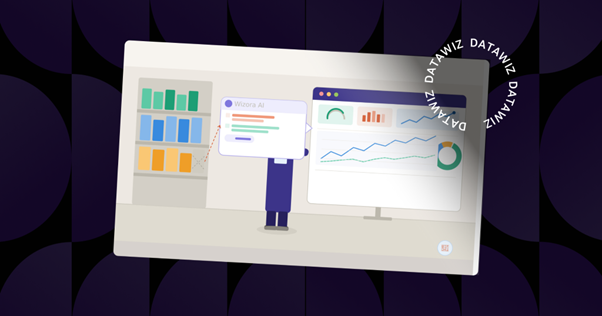
A supply chain lead can ask which stores are running low on which SKUs, which suppliers missed their fill rate targets this month, or which products are generating the most shrinkage losses -and get a clear, structured answer in seconds, pulled from live chain data. Wizora, the AI assistant inside Datawiz BI, works exactly this way. No filters to set, no analyst required, no waiting. Just a question and an answer you can act on immediately.
From hindsight to foresight
Traditional retail reporting tells you what happened: what sold, what ran out, what came back. By the time that information reaches a category manager, teams are often too late to respond effectively.
AI changes that process significantly. Instead of discovering stock issues after they happen, a buyer receives an alert on Wednesday that flags which SKUs are likely to hit a shelf gap by the weekend, along with a suggested replenishment action. The information itself is not new, but getting it earlier gives retailers much more room to react before margins are affected.
Smarter assortment decisions
Deciding which SKUs stay on the shelf, which get cut, and where the gaps are has always been one of the most time-consuming jobs in category management. AI helps teams make those decisions faster and with more context.
Modern BI platforms automatically surface which products are slowing down category turnover, which items customers consistently buy together, and where a domestic supplier could step in for a US-sourced line without affecting sales. What used to take an analyst several days now takes a category manager a few minutes.
Supplier performance you can actually act on
With Canadian chains actively replacing US suppliers with domestic alternatives, knowing which vendors are genuinely performing and which are quietly costing money has never been more important.
Datawiz BI tracks every supplier across delivery reliability, order accuracy, fill rates, return volumes, and margin contribution, updated continuously, not just at quarterly review time. When it is time to renegotiate a contract or onboard a new domestic partner, the conversation is based on facts, not impressions.
Store-level demand signals
Forecasting demand at the chain level is useful. Forecasting it at the individual store and SKU level is what actually drives better procurement decisions.
A store in Brampton serving a price-sensitive neighborhood moves through a promotional line at twice the rate of a downtown Toronto location. A region hit by an early cold snap needs seasonal replenishment weeks ahead of the national calendar. AI automatically picks up these local signals and adjusts procurement recommendations accordingly, so no regional manager needs to flag them manually.
Canadian retail has entered a new reality where trade tariffs, domestic sourcing mandates, and razor-thin margins leave no room for decisions made in the dark. The chains that win are those with real-time visibility across every supplier, every store, and every SKU, and the ability to act in minutes, not days. That’s exactly the kind of decision-making infrastructure Datawiz BI is built to deliver: a single platform that unifies POS, ERP, and supplier data, forecasts demand before shelves run empty, and gives procurement teams the factual foundation for every negotiation. If your business is still reconciling data manually, now is the time to find out what Datawiz can do for you.

