

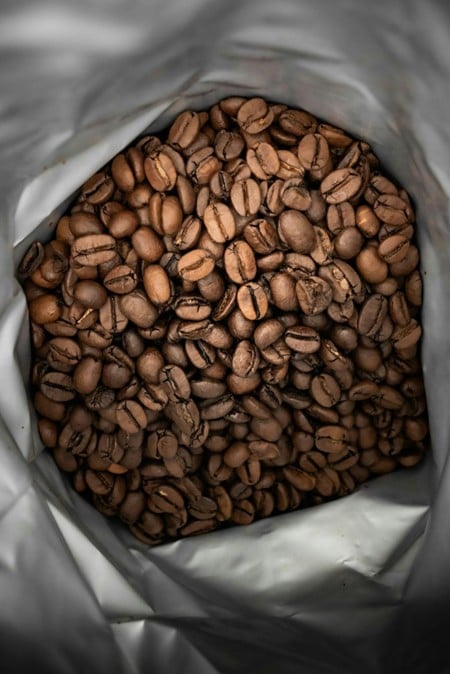
The math on a 5 lb coffee bag just makes sense. Lower per-pound price, fewer reorders, one delivery instead of several. It’s also convenient, and people are buying convenience everywhere else. Groceries arrive through DoorDash. Bills get paid from a phone in under a minute. Subscriptions handle everything from razors to dog food. Coffee fits the same pattern. Why reorder a 12-oz bag every couple of weeks when an organic 5lb coffee bag covers the household or office for weeks or months, depending on usage?
The reason most people hesitate isn’t the price. It’s whether the bag is actually a good buy: does the coffee stay good long enough to finish, is what’s inside worth the money, and which 5 lb option is the right one to commit to?
The answers depend on a few specific factors: how much coffee is consumed in a given household or office, how the bag is stored after it’s opened, and what’s actually inside it.
How Much Five Pounds of Coffee Actually Is
Five pounds of whole-bean coffee yields roughly 150 to 160 standard 8-oz cups, depending on the brewing method and dose.
For a single daily drinker who pulls a few espresso shots or brews a small pot, a 5 lb bag typically lasts 5 to 8 weeks, assuming roughly 3 to 4 cups per day. A two-person household running a drip pot or French press daily, with each person drinking two to three cups, comes out to about three to five weeks. A small office of six to ten people sharing a brewer typically finishes a bag within roughly one to five working weeks, depending on headcount and daily consumption.
Many specialty roasters recommend using opened whole-bean coffee within roughly two to four weeks for the best flavor. If projected consumption falls within that window, a 5-lb bag is the right size. If a 12-oz bag still has beans in it after a month, it isn’t.
For offices specifically, the bar most teams are clearing is low. A break-room upgrade from commodity ground to a specialty 5 lb whole bean changes how the workday feels. Add a grinder and a decent brewer, and the tone of the morning meeting shifts.
How Bulk Coffee Has Changed
For many buyers, bulk coffee used to mean large grocery-store cans or warehouse-club tins, often with limited sourcing detail. Roast dates rarely appeared on the packaging, and information about who grew the beans or the conditions under which they were grown was hard to come by.
That has changed.
Specialty roasters now offer 5-lb bags of the same coffee they sell in 12-oz portions. Traceable sourcing has filtered down into more accessible price points, though practices vary by roaster. Consumer demand for traceability has pushed transparency higher up the priority list. As a Forbes Business Council contributor recently argued, some food-and-beverage commentators see supply chain transparency as something consumers increasingly expect rather than as a differentiator.
According to reporting from Daily Coffee News, 59 of every 100 cups Americans drink are now classified as specialty, based on the National Coffee Association’s Spring 2025 data. That’s a near-inversion of the ratio from twenty years ago. A buyer who wants specialty-grade quality at bulk scale finally has options that didn’t exist when the only choice was a tin from the grocery aisle.
What to Look for in an Organic 5lb Coffee Bag
Here are five factors to consider when purchasing an organic 5 lb bulk bag.
A printed roast date. A best-by date is less useful than a roast date for judging freshness. Specialty roasters print the actual day the coffee was roasted because they have no reason to hide it. Commodity bulk coffee tends to omit roast dates because the coffee may have been sitting in a warehouse for months before shipping.
Whole bean rather than pre-ground. Pre-ground coffee loses aromatics and stales faster because grinding increases surface area. A 5 lb bag of pre-ground coffee sitting in a cupboard for several weeks is likely to taste flat. Whole bean keeps more of the bean structure intact until grinding, which is the only way to make a bulk purchase work over a month-plus drinking window.
Independent contaminant testing. Conventional coffee farming can involve pesticides, herbicides, and fungicides, and coffee can be susceptible to mycotoxins during handling and storage. The FDA notes that coffee can be susceptible to mold-produced mycotoxins, but many brands do not publicly publish third-party contaminant testing results. A small number do. For health-conscious buyers, that documentation is increasingly non-negotiable.
Sourcing that’s actually disclosed. “Premium blend” is not a sourcing claim. Country of origin, region, farm or cooperative, processing method, and a named certifying body are.
Packaging that protects the coffee. Be mindful of the packaging your coffee comes in. Look for a one-way valve that lets gas out without drawing in air, a foil lining that keeps light and moisture from reaching the beans, and a closure that reseals each time it’s opened.
How to Store a 5 lb Bag of Coffee So It Lasts
Portion immediately. When the bag arrives, divide the coffee into one-pound sub-portions before opening it more than once. Vacuum-sealed bags work. Wide-mouth Mason jars work. The point is to avoid opening and resealing the same 5 lb bag every morning for a month.
Freeze the portions not currently in use. Specialty coffee storage guidance commonly recommends freezing in airtight, portioned containers to slow staling. The portion being actively drunk lives in the pantry. The rest waits in the freezer.
Let frozen portions thaw fully before opening. Opening cold beans in a warm kitchen creates condensation on their surfaces, which degrades the coffee. A sealed portion pulled from the freezer the night before brewing avoids the problem entirely.
Store the active bag somewhere cool, dark, and dry. Not on the counter next to the stove. Not in a clear glass jar exposed to morning sunlight. Not in the refrigerator, where coffee absorbs odors from everything else inside.
Done this way, the final portions should taste much closer to freshly opened coffee than beans repeatedly opened and stored at room temperature.
The Best 5 lb Coffee Bag Picks Across Four Tiers
Bulk coffee comes in a wide range of prices and qualities. Here are the picks worth considering across four tiers, organized by what each one does best for a specific kind of buyer.
Best commodity-tier pick: Verena Street. A family-owned Iowa roastery offers a range of 5-lb whole-bean bags covering single-origin Colombia and Sumatra, espresso blends, flavored blends, and a Swiss Water Process decaf. Verena Street says its coffees are sourced from Rainforest Alliance Certified farms and roasted in small batches. Best for buyers who want a step up from grocery-store cans without paying specialty prices, and for offices where keeping a consistent supply matters more than chasing flavor notes.
Best mid-tier branded pick: Black Rifle Coffee. Just Black is a medium-roast, everyday blend available in a 5-lb format; check the current product page for the exact origin disclosure. Black Rifle offers most of its core line in a 5-lb format, including Murdered Out (dark), Silencer Smooth (light), and AK-Espresso (medium-dark). Sourcing disclosure is limited, and the brand does not publicly publish contaminant testing results. Best for buyers who already prefer the brand’s roast profile and identity, particularly veteran-friendly households and offices aligned with the company’s positioning.
Best specialty roaster pick: Stumptown Hair Bender. Hair Bender in a 5 lb bag is the signature blend that put Stumptown on the map. Stumptown publicly describes the blend components as sourced from Latin America, Indonesia, and East Africa, with flavor notes of citrus, dark chocolate, and raisin. Best for buyers who care about flavor complexity and want a coffee with genuine craft credentials.
Best health-focused, lab-tested pick: Purity Coffee. Most coffee brands stop at the farm. Purity keeps going. According to the brand’s published product information, every lot starts as specialty-grade Arabica scoring 80 or above on the Specialty Coffee Association scale and sourced from certified organic farms with documented supply chain practices, but it doesn’t go to the roaster yet. First, every lot is independently screened for pesticide residues, mold, mycotoxins, and heavy metals, and the testing documentation is made available for anyone who wants to read it. The roast itself is what Purity calls antioxidant-forward, calibrated to preserve naturally occurring chlorogenic acids and other beneficial compounds while reducing the formation of roasting byproducts such as acrylamide. The 5 lb bags are USDA Certified Organic and run $139 across the lineup. Options span light-medium, medium, and dark roasts, a Mountain Water Process decaf, and a two-thirds decaf for buyers moderating caffeine without giving it up entirely, with flavor notes ranging from chocolate and nuts to fruit-forward brightness. B Corp certified. Best for high-consumption households, offices, wellness clinics, and hospitality environments where buyers want documented verification of what’s in the cup, not just claims on the package.
What Research Shows About Coffee and Health
A study published in the European Heart Journal, conducted by researchers at Tulane University and Harvard’s T.H. Chan School of Public Health, followed more than 40,000 U.S. adults over a median of nearly a decade. The researchers found that morning coffee drinkers had a 16% lower risk of all-cause mortality and a 31% lower risk of cardiovascular disease mortality compared to non-coffee drinkers. Higher coffee intake was associated with lower mortality, specifically among morning drinkers. All-day coffee drinkers, by contrast, showed no significant reduction in mortality risk at any level of consumption.
The study didn’t compare roast levels, sourcing, or testing. It looked at coffee as a whole. The compounds linked to coffee’s health benefits, mainly chlorogenic acids and other polyphenols, are affected by how the beans are grown, what they contain, and how they’re roasted. A very dark-roasted, lower-transparency commodity coffee is not the same product as a carefully roasted, transparently sourced specialty coffee, even though both technically contain caffeine.
Making the Call
A 5 lb coffee bag is the right call when coffee is brewed every day, the blend is already a known favorite, and there’s a plan for properly storing the rest of the bag.
Match the bag to the consumption pattern. Look for a roast date, whole bean format, and transparent sourcing. If part of the reason for drinking good coffee is what it does for the body over time, independent testing and careful roasting are worth more than the price difference. The bag bought in bulk is the one that has been poured every morning for months. What’s in it adds up.
Portion it on the day it arrives. Freeze what’s not being used. When done correctly, a 5-lb bag makes the morning cup more consistent, convenient, and affordable, without any trade-offs.

