

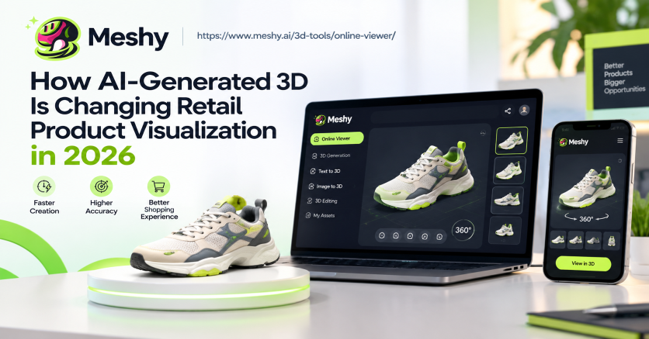
Retail product visualization is converting hastily in 2026. E-commerce manufacturers are moving past traditional product pictures and exploring interactive 3-D fashions, browser-primarily based previews, and augmented reality (AR) studies. Instead of displaying clients a product from only a few constant angles, shops can now create digital 3-d versions that customers can rotate, zoom, and once in a while area in their very very own environment.
AI-generated 3D is supporting making this system quicker and more on hand. A retailer can begin with product pictures and use AI gear to create web-ready 3D belongings without building each model manually from scratch.
From Product Photos to Web-Ready 3-d Models
Traditional three-D product modeling can require specialized software programs, experienced artists, and considerable production time. AI-based workflows are converting that system through permitting groups to apply current product imagery as a starting point.
With the proper references, AI can assist in generating a 3D illustration of products consisting of fixtures, shoes, customer electronics, accessories, packaging, and domestic goods. These fashions can then be subtle for on-line shops, advertising and marketing campaigns, AR reports, or other virtual packages.
Accuracy stays one of the most crucial concerns. A version desires to preserve the product’s recognizable shape, proportions, important layout elements, and visual info. AI generation is therefore most useful when combined with quality reference images and a review process that checks the final asset against the physical product.
Texture Fidelity Matters for E-Commerce
A visually astounding 3-d model is not enough if its materials and textures do not as it should constitute the product.
For retail, information together with fabric styles, leather-based surfaces, plastic finishes, metal components, hues, and branding can impact purchasing choices. AI-generated 3D workflows can help create textured assets that give shoppers a greater practical illustration of what they’re thinking about.
Retail groups have to nonetheless assess textures cautiously, in particular for products wherein shade accuracy and fabric look are important. The purpose isn’t always without a doubt to create a 3-D item, however to produce a virtual representation that works correctly as a product visualization asset.
Choosing the Right 3-D Formats
Web compatibility is another important part of AI-generated 3D workflows. Formats such as GLB and glTF are widely useful for delivering interactive 3D content on websites and digital platforms. USDZ also can be relevant when stores need to assist positive AR reports.
Choosing the right format depends at the storefront, viewer, AR platform, and technical requirements concerned. Before publishing a version, teams must confirm that the chosen format preserves the desired geometry, substances, textures, and animations.
Polygon Control and Compression Improve Performance
High-detail models can contain large numbers of polygons and heavy texture files. While this can improve visual quality, overly complex assets can increase loading times and create performance problems, especially for shoppers using mobile devices.
Polygon reduction and compression are therefore becoming important parts of the retail 3D workflow. Teams can create specified supply fashions after which generate optimized versions for web sites and storefronts.
The objective is to locate a practical stability among visible constancy and performance. A product model needs to look convincing at the same time as closing light-weight enough for smooth interplay.
Browser-Based Product Previews
Retailers also need simple ways to review and present 3D assets. A browser-primarily based online three-D viewer can make it simpler for groups to investigate models without requiring specialized 3-D software programs.
For instance, Meshy gives an online 3D viewer that may be used to preview 3-d fashions at once in a browser. This type of workflow can help teams overview geometry, materials, and standard presentation before integrating assets into an online storefront.
Browser previews are especially useful whilst designers, marketers, builders, and e-trade managers need to collaborate on the equal virtual asset without installing complex desktop packages.
Batch Workflows for Growing Product Catalogs
Large retailers may have thousands of products, making manual 3D production difficult to scale. AI can help streamline workflows by reducing the amount of repetitive modeling work involved.
Batch-oriented methods can permit teams to move more than one product property through levels which includes image education, 3D era, texture processing, optimization, great checking, and export. Automation turns into particularly valuable for shops that often upload new products or update seasonal collections.
However, best control needs to stay part of the workflow. Automated generation can accelerate production, but teams should review important products before publishing them to customers.
Storefront Compatibility Is Essential
A 3D asset only creates value if shoppers can actually use it. Retailers should consider how models will appear within their existing storefront technology, product pages, mobile experiences, and AR tools.
Before deployment, teams should test loading speed, device compatibility, interaction controls, image and texture quality, and fallback experiences for browsers that do not support specific 3D features.
A reliable online 3D viewer can also help teams test and share models before they are added to production environments.
The Future of Retail Visualization
AI-generated 3D is making interactive product visualization extra sensible for retailers of various sizes. Instead of treating 3-D as a specialized asset reserved for big manufacturers, groups can an increasing number of comprise it into ordinary e-commerce workflows.
The only technique combines AI generation with human overview, optimized geometry, correct textures, current three-D codecs, compression, and storefront checking out. As these technologies preserve to enhance, product pages can end up greater interactive and informative, giving customers additional methods to apprehend products before shopping.
In 2026, AI-generated 3-D is not truly replacing conventional product photographs. It is expanding the opportunities of virtual vending with the aid of turning static product references into interactive properties that may work throughout web sites, cell devices, and AR reviews.

