

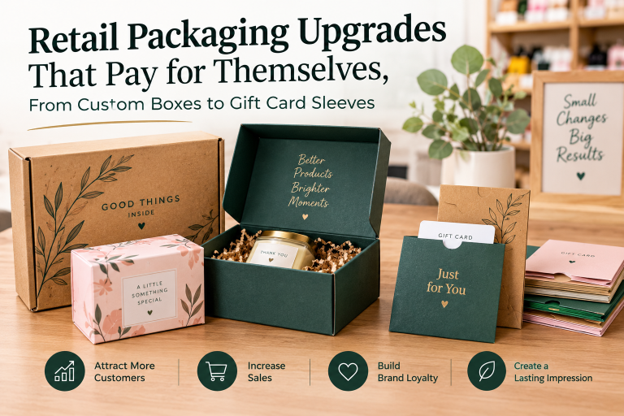
Independent retailers are under pressure from every side right now. Rent is up, shipping is up, and customers who shop online have learned to expect a parcel that looks as good as anything from a big chain. It is tempting to treat packaging as one more cost to trim. In practice, a handful of packaging changes do the opposite. They cut waste, reduce damaged orders and help sell more at the counter.
The trick is choosing the upgrades that return money rather than just looking nice. This article walks through the ones store owners and small online sellers mention most often, roughly in the order that they tend to pay back.
Stop Paying to Ship Empty Space
The fastest saving in most small businesses comes from the shipping box, not the product box. Carriers price a lot of parcels on dimensional weight, which means an oversized carton costs more to send even when the contents are light. Add the void fill needed to stop the product rattling around, and an ill-fitting box becomes an expense on every single order.
Right-sized boxes fix both problems at once. A box built to the product’s measurements needs little or no filler, packs faster at the bench and often drops a parcel into a cheaper shipping band. Many sellers find that the saving on postage and filler covers the extra cost of custom sizing within the first few shipments.
A quick way to see whether this applies to you is to pull a week of orders and note how many went out in a box that was more than a few centimetres larger than the product on any side. If it is more than a third, right-sizing is likely the best packaging money you will spend this year.
Buying Printed Boxes in Sensible Quantities
Printed boxes used to be an all-or-nothing decision with minimums in the thousands. That has changed. Several manufacturers now run printed boxes from about 100 pieces, which lets a small shop order a branded box for its best seller without filling a storeroom.
The better way to buy is in tiers. Order the box you use every day in a large enough run to get a good unit price, and keep seasonal or limited designs to short runs. Buying custom boxes wholesale for the core range and topping up with smaller orders for promotions keeps both cash flow and storage under control.
Board thickness is the other place where money leaks. Too thin and products arrive crushed, too thick and you pay for strength you don’t need. Manufacturers list paperboard by points and grams per square metre, and the common grades look like this.
| Board grade | Approximate weight | Typical use |
| 14 pt | 250 GSM | Light items such as cards and small accessories |
| 16 pt | 300 GSM | Everyday retail cartons |
| 18 pt | 350 GSM | Cosmetics, candles and gift items |
| 20 pt | 420 GSM | Heavier retail products |
| 24 pt | 460 GSM | Premium boxes that need a solid feel in the hand |
Ask the supplier for a sample in the grade you think you need, put your heaviest product in it and drop it from waist height a few times. It is a crude test, but it settles most arguments about board weight in five minutes.
When Plain Boxes Are the Smarter Buy
Not every box needs to be printed. For shipping cartons that customers open once and recycle, a plain box with a branded label, sticker or stamp often does the job for a fraction of the cost. It also gives a small business flexibility, because one plain carton can serve several products and the branding can change without reprinting anything.
Stock options such as blank cardboard boxes come in more forms than people assume. Mailer boxes, tuck-end boxes, two-piece boxes with lids, folding cartons and die-cut styles are all available unprinted, in single-wall or double-wall corrugated for heavier items. Minimums for plain boxes are commonly around 100 units, with discounted rates on bigger orders, and they can be made to custom dimensions so the right-sizing saving still applies.
Plain boxes make the most sense in a few situations.
- The box is a shipper, and the product inside already has its own printed packaging.
- The range changes often, so printed boxes would go out of date.
- Storage is tight and one box size needs to cover several products.
- A brand is still testing what its packaging should look like and doesn’t want to commit to print yet.
A good branded sticker on a clean kraft or white box looks deliberate. A plain box with a crooked shipping label and a strip of brown tape does not, so the small details still matter.
Gift Card Sleeves Turn a Plastic Card Into a Present
Gift cards are one of the easiest sales a retailer makes, but a bare plastic card handed across the counter feels like an afterthought. Customers buying a card as a present often hesitate because it looks too plain to give. A printed sleeve solves that for very little money, and it gives the card a place for the brand, a seasonal design and a short message.
Planning the run is where most shops go wrong. They print one design for December, run out in the second week and spend January handing cards over in envelopes. A better approach is to count gift card activations by month from last year, then split the order. One evergreen design goes in the largest quantity, one or two seasonal versions share the same dieline so only the artwork changes, and every version carries a blank box that staff can fill in by hand instead of printing one sleeve per value.
Ordering custom gift card sleeves in bulk for the evergreen design and short runs for the seasonal ones keeps the unit cost down without leaving the shop with stale stock. Minimums from one manufacturer start at 100 sleeves per design, which lets a small cafe or boutique test a holiday version without tying up cash, and production usually takes 4 to 6 business days after the proof is approved.
One practical warning. Standard sleeves are sized for a standard plastic card of about 3.375 by 2.125 inches, and thicker cards with a raised stripe, a wooden card or a cardboard card with a sticker can jam. Test one of your actual cards in a sample sleeve a dozen times before ordering in quantity, and leave a week of slack before your busiest gifting weekend.
A Simple Order of Priorities
Most small businesses can’t do every upgrade at once, and they don’t need to. Working through them in this order tends to give the quickest return.
- Measure what you ship and move to right-sized boxes for the most common orders.
- Switch shipping cartons to plain boxes with a branded label where printed boxes aren’t earning their cost.
- Put printed boxes on the products that sell best as gifts or carry the highest margin.
- Add gift card sleeves before the next big gifting season, with an evergreen design and one seasonal version.
- Review damage claims and returns after three months, and adjust board grades where products are still arriving hurt.
Measuring Whether an Upgrade Worked
Packaging changes are easy to judge by feel and hard to judge by numbers, so set a baseline first. Note the average shipping cost per order, the number of damaged deliveries per month, the hours spent packing and, for gift cards, how many were sold in the same period last year. Check the same figures after a full season.
Owners who do this are often surprised by where the gains come from. A right-sized box can save more on postage than a premium finish ever adds in sales, while a modest gift card sleeve can lift card sales at the counter more than any in-store sign.
The Upgrades Worth Making First
The best packaging spending for a small retailer is the kind that shows up on the bottom line. Fit the box to the product, print only where print earns its keep, use plain boxes where nobody keeps the carton, and give gift cards a sleeve worth handing over. None of it requires big minimums anymore, which means each change can be tested on a small run, measured over a season and scaled once it has proven itself.

