

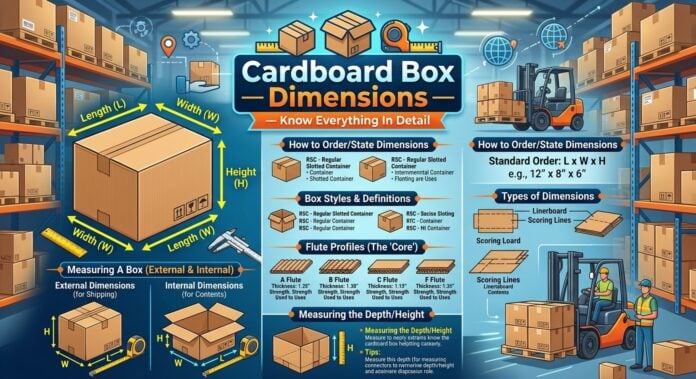
Selecting accurate container proportions dictates transit safety, shipping expenditures, and storage efficiency. Mastering dimensions empowers brands to safeguard goods while minimizing dimensional weight charges. Utilizing tailored custom packaging allows enterprises to streamline logistics operations, eliminate structural failures, and elevate brand presentation across competitive retail markets.
Demystifying Structural Measurement Practices
Accurate physical measurements form the foundation of effective cardboard box Packaging. Logistics specialists measure inner usable volume rather than external boundaries to guarantee a precise fit for enclosed products.
The Length, Width, and Depth Formula
When recording container dimensions in imperial units (inches), industry professionals follow a strict sequential order: Length (L) × Width (W) × Depth/Height (D/H).
- Length (L): Represents the longest horizontal dimension when viewing the opened container from above.
- Width (W): Measures the shorter horizontal side adjacent to the length edge at a right angle.
- Depth / Height (H): Calculates the vertical distance measured from the inner base panel up to the top opening flap score line.
Interior Versus Exterior Dimension Discrepancies
Confounding internal volume with external boundaries frequently causes dimensional discrepancies during transit. Exterior measurements include total board thickness, which expands the overall physical footprint and influences carrier pricing algorithms.
| Measurement Type | Structural Reference Point | Impact on Shipping & Storage | Ideal Calculation Purpose |
| Interior Dimensions | Internal usable space from inner wall to wall | Determines product fit and cushioning space | Item placement accuracy |
| Exterior Dimensions | Outer perimeter including total board thickness | Determines total courier billable volume | Vehicle loading efficiency |
| Dimensional Weight | Calculated volume-to-weight ratio | Determines freight billing tiers and surcharges | Carrier rate optimization |
Deciphering Corrugated Flute Profiles and Board Strength
The structural resilience of Cardboard shipping boxes depends heavily on internal corrugated fluting. Flutes act as shock-absorbing arches sandwiched between outer linerboards to resist external compression forces.
Common Flute Types and Performance Characteristics
| Flute Designation | Thickness (Inches) | Flutes Per Linear Foot | Primary Structural Benefit | Best Industry Application |
| A-Flute | 0.1875 inches | 33 ± 3 | Superior top-to-bottom compression | Fragile item cushioning |
| B-Flute | 0.1250 inches | 47 ± 3 | High puncture and crush resistance | Retail display containers |
| C-Flute | 0.1562 inches | 39 ± 3 | Versatile cushioning and stacking power | Standard freight transit |
| E-Flute | 0.0625 inches | 90 ± 4 | Excellent smooth printing surface | Die-cut consumer cartons |
| F-Flute | 0.0312 inches | 128 ± 5 | Micro-thin profile for luxury goods | High-end retail enclosures |
Wall Construction Formats
Corrugated board construction determines weight thresholds and stacking longevity during long-haul transport across varied climate conditions.
- Single-Wall Board: Features one fluted medium glued between two flat outer linerboards. Ideal for lightweight consumer products weighing under 40 pounds.
- Double-Wall Board: Combines two fluted mediums and three linerboards, delivering exceptionally high structural rigidity for heavier loads up to 80 pounds.
- Triple-Wall Board: Incorporates three fluted layers and four linerboards, frequently replacing traditional wooden crates for heavy industrial equipment transport.
Standard Shipping Sizes, Profiles, and Spatial Configurations
Standardized dimensions allow businesses to purchase cardboard boxes Wholesale at cost-effective volume pricing while streamlining automated freight arrangements.
Popular Container Profiles and Dimensions
| Profile Designation | Dimensions (L × W × H Inches) | Volume (Cubic Feet) | Weight Capacity | Primary Commercial Use |
| Small Shipping Cube | 8.0″ × 8.0″ × 8.0″ | 0.29 cu ft | Up to 20 lbs | Books, cosmetics, hardware |
| Medium Transit Box | 16.0″ × 12.0″ × 12.0″ | 1.33 cu ft | Up to 40 lbs | Apparel, kitchenware, electronics |
| Large Parcel Box | 20.0″ × 20.0″ × 15.0″ | 3.47 cu ft | Up to 65 lbs | Bedding, small appliances, toys |
| Extra Large Carton | 24.0″ × 20.0″ × 18.0″ | 5.00 cu ft | Up to 80 lbs | Bulk soft goods, sports equipment |
| Flat Mailer Box | 12.0″ × 9.0″ × 4.0″ | 0.25 cu ft | Up to 15 lbs | Documents, artwork, apparel items |
Customization Aesthetics: Colors, Shapes, and Branding

Modern logistics demands visually appealing presentation. Transitioning to Custom Printed cardboard boxes transforms routine transit containers into memorable unboxing channels that build brand equity.
Structural Shapes and Styles
- Regular Slotted Container (RSC): The standard shipping model where outer flaps meet at the center for quick tape sealing in fulfillment centers.
- Full Overlap Container (FOL): Outer flaps fully overlap across the total width, offering extra edge strength and superior stacking durability.
- Roll End Tuck Top (RETT): Popular for subscription mailers, featuring self-locking side walls, a tuck-in top flap, and a self-sealing strip for secure closures without tape.
- Telescopic Rigid Box: Features separate upper lid and lower base sections that slide together with a friction fit, creating a premium unboxing feel for luxury items.
Vibrant Palette and Finish Configurations
| Aesthetic Finish | Visual Palette Options | Surface Texture | Strategic Brand Perception |
| Natural Kraft | Earthy Brown, Unbleached Tan | Matte Organic | Eco-friendly, authentic, sustainable |
| Bleached White | Pure Crisp White, Off-White | Smooth Semi-Gloss | Clean, professional, clinical |
| Full CMYK Print | Unlimited Custom Colors | High-Gloss / Soft-Touch | High-end, vibrant, retail-ready |
| Spot UV & Foil | Metallic Gold, Silver, Gloss Clear | Reflective / Tactile | Ultra-luxurious, premium quality |
Calculating Dimensional Weight to Eliminate Carrier Surcharges
Logistics providers charge shippers based on dimensional weight (DIM weight) whenever a carton’s physical volume exceeds its actual scale weight.
The DIM Weight Calculation Process
- Calculate Cubic Volume: Multiply interior length by width by height (L × W × H in inches) to establish the overall cubic space.
- Apply Carrier Divisor: Divide total cubic inches by standard courier divisors (typically 139 for express air freight or 166 for domestic ground services). For example: (14″ × 10″ × 8″) / 139 = 8.05 lbs (billed as 9 lbs).
- Compare Weights: Contrast calculated dimensional weight against actual scale weight. Couriers bill based on whichever value is higher.
Practical Optimization Tips to Reduce Freight Costs
- Eliminate Empty Space: Select precise Cardboard box dimensions to avoid paying extra freight fees for empty air space.
- Use Custom Die-Cut Inserts: Anchor products securely inside custom-fit boxes, reducing the need for loose-fill packing peanuts.
- Standardize Box Sizes: Limit box inventory to 4–6 core sizes to streamline order packing workflows and lower bulk purchasing costs.
Material Sourcing and Sustainability Strategies
Modern organizations must balance structural strength with environmental responsibility. Choosing eco-friendly corrugated boards ensures regulatory compliance while appealing to environmentally conscious consumers.
Recycled Content Integration
Corrugated cardboard represents one of the most successfully recycled packaging materials globally. Manufacturers blend post-consumer recycled fibers with virgin pulp to achieve optimal tensile strength and surface printability.
- Post-Consumer Waste (PCW): Reclaimed paper products processed into sturdy inner fluting mediums.
- Virgin Kraft Linerboard: Fresh wood fibers used for outer surfaces to maximize tear resistance and vibrant color reproduction.
- Biodegradable Coatings: Plant-based barrier films replacing traditional polyethylene layers to facilitate effortless repulping during recycling.
Lifecycle Efficiency and Storage Optimization
Proper storage of flat, unformed corrugated blanks preserves structural integrity prior to assembly. High ambient humidity degrades starch adhesives, reducing box stacking strength by up to 50 percent.
- Environmental Climate Control: Store unformed cartons in temperature-regulated facilities with humidity levels maintained below 60 percent.
- Pallet Stacking Rules: Stack flat box bundles evenly on flat wooden pallets to prevent permanent warping or creasing along score lines.
- Inventory Rotation: Practice First-In, First-Out (FIFO) inventory management to ensure corrugated materials maintain optimal strength during production assembly.
By mastering cardboard box dimensions, corrugated board grades, structural styles, and custom printing choices, enterprises can minimize transit damage, eliminate carrier surcharges, and deliver exceptional unboxing experiences.

