

Canadian winters bring a unique set of challenges for outdoor enthusiasts. From snow-covered trails and early sunsets to winter camping and ice-fishing trips, reliable lighting can make a meaningful difference when visibility is limited. Choosing a flashlight for cold weather requires more than looking at brightness alone: battery management, ease of operation, runtime and safe handling all matter.
The Olight Seeker 4 Pro is a high-power flashlight designed for users who need versatile illumination for outdoor activities and everyday tasks. With a maximum output of 4,600 lumens, a beam distance of up to 260 metres and multiple brightness modes, it offers flexibility for different lighting situations. For Canadian users preparing for winter, understanding both its capabilities and its operating limits is essential.
1. Cold-Weather Performance You Can Trust
During Canadian winters, outdoor flashlight needs can change quickly. A short walk from a parking area may turn into a longer trek, while checking a campsite or finding equipment in low light can require more illumination than an ordinary pocket light provides.
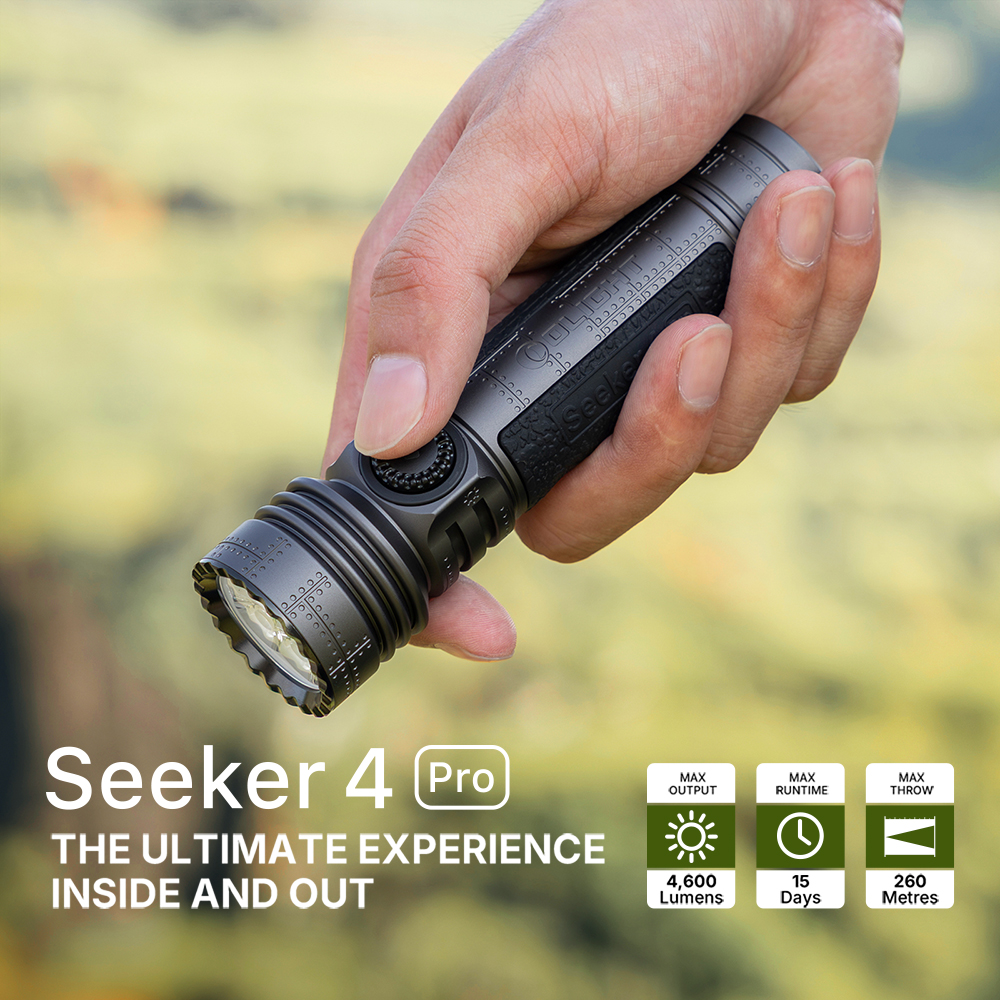
The Seeker 4 Pro offers a maximum output of 4,600 lumens and a beam distance of up to 260 metres, according to its manufacturer’s specifications. This combination can help illuminate a wider area around a campsite or provide a longer-reaching beam when checking the route ahead. Its adjustable brightness also allows users to choose a more suitable level for closer tasks, rather than relying on maximum output for every situation.
Another practical consideration is operation while wearing winter gloves. The Seeker 4 Pro features an enlarged metal side switch with rotational brightness adjustment, making it easier to change output without removing heavy gloves. That can be particularly useful when setting up equipment, checking a tent area or adjusting lighting during a cold-weather outing.
The flashlight is also rated IPX8 for water resistance, according to the product manual. This is a useful feature for outdoor equipment that may encounter wet conditions, although users should follow the manufacturer’s instructions for proper use and maintenance.
Product specifications: Olight Seeker 4 Pro User Manual
An important temperature note: The referenced Seeker 4 Pro manual lists an operating temperature range of 0°C to 40°C. It should not be presented as a flashlight rated for operation below 0°C. Canadian users should check the manual supplied with their specific model and follow its stated limits, especially when planning winter activities.
2. Battery Behaviour in Cold Weather
Cold weather can affect the performance of rechargeable lithium-ion batteries. For anyone preparing for an outdoor trip, battery planning is therefore just as important as choosing a sufficiently bright light. Health Canada provides guidance on the safe use and care of lithium-ion batteries.
The Seeker 4 Pro uses a 5,000 mAh, 3.6 V rechargeable lithium-ion battery and supports USB-C charging. Its included charging setup makes it convenient to recharge before heading out, while the battery-level indicators help users check the remaining charge.
For winter preparation, a few practical habits can help:
- Charge before departure: Start with a fully charged flashlight rather than relying on a partial charge.
- Plan around the operating-temperature range: The referenced manual specifies 0°C to 40°C. Do not assume that the flashlight is rated for sub-zero operation.
- Monitor the battery level: Check the indicators before leaving and during use when conditions allow.
- Consider the full trip: For longer outings, plan your lighting needs in advance and carry suitable backup lighting where appropriate.
USB-C charging is a convenient feature for users who already bring compatible charging equipment on trips. However, charging convenience does not change the flashlight’s specified operating-temperature range, and actual battery performance can vary with use and environmental conditions.
For winter preparation, the key is to choose equipment that suits the expected conditions and to follow its instructions, rather than assuming that a high-capacity battery alone guarantees reliable performance in extreme cold.
3. Visibility in Snow and Whiteout Conditions
Snow can make nighttime navigation more complicated. Falling snow, blowing flakes and reflective surfaces may affect how clearly a person can see the route ahead. A powerful light can help illuminate the surrounding area, but brightness alone does not guarantee better visibility in every condition.
The Seeker 4 Pro’s maximum output of 4,600 lumens gives users a high-output option when more illumination is needed. Its beam distance of up to 260 metres can also be useful when checking distant surroundings in suitable conditions. For closer tasks—such as locating gear, checking a trail marker or organising equipment—a lower brightness setting may be more comfortable and practical.
When using a flashlight in falling snow, consider directing the beam slightly downward instead of shining it straight ahead at eye level. Adjusting the angle and brightness can help reduce unnecessary glare from nearby snowflakes. In poor visibility, slow down, stay aware of the route and avoid relying on the flashlight as a substitute for appropriate navigation tools.
Canadian winter weather can change rapidly, and snow, wind and reduced visibility may create hazards beyond what a flashlight can address. Environment and Climate Change Canada offers guidance on cold-season weather hazards.
For outdoor users, the benefit of a versatile winter camping flashlight is not simply maximum brightness. It is the ability to adjust the light to the task, whether checking the immediate surroundings or illuminating a farther point in suitable conditions.
4. Seeker 4 Pro for Winter Camping and Ice Fishing
Winter camping and ice fishing often involve several different lighting needs. Users may need to organise equipment, locate supplies, check the area around a shelter or move between nearby activity zones after daylight fades. A flashlight with multiple brightness settings can help accommodate these changing tasks.
The Seeker 4 Pro provides several output levels, from a 4,600-lumen Turbo mode to lower settings for close-up tasks. Its 300-lumen Medium mode can be a practical option for general lighting, while lower output can help conserve power when only modest illumination is needed. The enlarged side switch and rotational dimming also make brightness adjustment more convenient when users are wearing heavier gloves.
For camping, the included holster offers a dedicated way to store and carry the flashlight. The product’s USB-C charging capability also supports preparation before departure, allowing users to check their equipment and recharge ahead of a planned outing.
For ice fishing, lighting is only one part of preparation. Conditions on frozen lakes can change, and ice thickness may vary across the same body of water. A bright flashlight should never be treated as proof that ice is safe to cross. Before heading out, consult local conditions and official guidance, including the Canadian Coast Guard’s ice safety information.
The Seeker 4 Pro is best considered as one component of a broader outdoor safety setup—not a replacement for suitable clothing, navigation equipment, emergency supplies or careful trip planning.
5. Comparing Runtime Modes for Long Trips
When selecting a rechargeable flashlight, maximum brightness is only one part of the decision. Runtime matters too, particularly when users need to manage their lighting over an extended outing.
The Seeker 4 Pro offers several brightness levels to suit different tasks. According to the manufacturer’s manual, its published output and runtime figures include:
| Mode | Published output | Published runtime |
| Turbo | 4,600 lumens | 2.5 minutes at full output, followed by lower output stages |
| High | 1,200 lumens | 135 minutes at the initial output stage, followed by lower output stages |
| Medium | 300 lumens | 11 hours |
| Low | 50 lumens | 60 hours |
| Moonlight | 5 lumens | 15 days |
These figures are manufacturer laboratory reference results; actual performance can vary with usage and environmental conditions.
These modes offer different trade-offs. Turbo provides a burst of very high output when a strong beam is needed, but it is not designed to maintain maximum brightness continuously. Medium may be more appropriate for routine campsite tasks, while Low and Moonlight are useful when only limited illumination is required and conserving power is a priority.
For users comparing flashlight runtime, the practical question is not simply which mode lasts the longest. It is which mode provides enough light for the task without using more output than necessary. Choosing a suitable setting and checking the battery before departure can help users plan their lighting more effectively.
Remember that the published runtime figures should not be interpreted as guaranteed performance in cold conditions. Follow the product’s specified operating-temperature range and plan for the conditions expected on your trip.
6. Final Thoughts for Canadian Outdoor Users
Canadian winters call for thoughtful preparation, especially when outdoor activities continue after daylight fades. A useful winter lighting setup should balance illumination, runtime, ease of operation and safe handling—not just headline brightness.
The Olight Seeker 4 Pro brings several practical features together: a maximum output of 4,600 lumens, a beam distance of up to 260 metres, multiple brightness modes, an enlarged metal side switch and USB-C charging. These features make it worth considering for outdoor users who want a versatile, high-output flashlight for camping, equipment checks and other lighting tasks.
At the same time, the specified operating-temperature range matters. The referenced manual lists 0°C to 40°C, so users planning Canadian winter activities should confirm the instructions for their exact model and ensure the expected conditions fall within its stated limits.
If you are comparing a Seeker 4 Pro option for your outdoor kit, review the full specifications and usage guidance before making a decision.

