

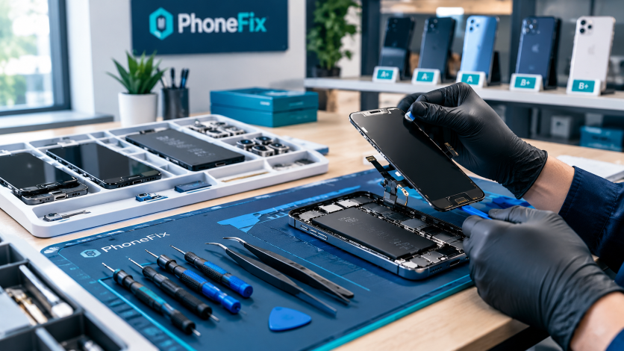
Its smartphone business isn’t just defined by the number of new devices being sold. People continue extending the life of their phones, new phones get more expensive, and refurbished phones continue to grow in popularity. As it has come time to repair, it has shifted from the side of the market to the center of the market. What does the smartphone aftermarket look like in 2026? What numbers are relevant? What can be done by repair shops, parts suppliers, and refurbishers with this information? This article explains this, provides an intuitive overview, and draws in data from a newly developed predictive analysis tool.
What the Smartphone Aftermarket Includes
The aftermarket is all aspects of a phone beyond its first sale. This includes replacement screens and batteries, chargers, cameras, labor, refurbished and used phones, trade-in phones, and accessories. One headline is not enough to cover all the segments with their different rules.
It is important when one reads market reports at this point. The study of refurbished phone sales is a study of something different than the study of repair parts. Only compare when the definition, region, and basis of revenues are similar. Combining them results in ‘overinflated’ or incorrect claims.
Why Slower New Phone Sales Help Repair
Global shipments of smartphones rose approximately 2% in 2025, with Apple accounting for 20% and Samsung accounting for 19% of the market share, reported Counterpoint Research. All that changed in 2026. The decline in shipments was 6 percent in the first quarter, and the firm’s outlook for May predicts a drop in shipments of 13.9 percent to approximately 1.08 billion units in the full year. Much of that decrease was because of memory shortages and the increased cost of components.
The other half of any story is told with prices. At the end of 2025, we saw the first time in 400 years that the global average selling price (ASP) rose to a new quarterly record, while all smartphone sales achieved a new quarterly record of 143 billion dollars (USD). If the phone is higher in price, then the price of the phones is better protected. It’s like a repair job when a 900-dollar handset has a broken screen. On the same crack of a 150-dollar handset, it seems like a reason to upgrade. When prices go up, it’s easy to push even more people towards repairing their stuff.
Aftermarket Segments at a Glance
The table below compares the main segments and the force driving each one in 2026.
| Segment | What it includes | Main driver in 2026 |
| Repair parts | Displays, batteries, cameras, connectors, speakers | Higher device prices and longer ownership |
| Repair services | Independent shops, brand service networks, mail-in repair | Better access to parts and documentation |
| Refurbished phones | Inspected, repaired, graded, and resold devices | Affordability of premium hardware |
| Trade-in and resale | Buyback programs and secondary marketplaces | Strong residual value on premium models |
| Accessories | Cases, chargers, screen protectors | Steady demand tied to device base |
Repair Parts Lead the Growth Story
According to the Business Research Company, the mobile device repair parts industry’s total turnover will be 20.67 billion USD in 2025, increasing to 23.45 billion USD in 2026 and to 39.18 billion USD in 2030. Those numbers apply to smartphone, tablet parts, and more. They provide information on a parts basis and not the whole aftermarket basis, so don’t quote them on total size.
The heart of this demand is two repairs. Phone Screen Replacement is one of the main categories of repairs, since phone displays bear the brunt of the knocking around and they break frequently as well. iPhone Battery Replacement is included because aging batteries would have an impact on any cell phone, while iPhones are very easy to sell as used mobile phones. Both the repairs are similar in nature. They want a device that runs well, and it doesn’t cost much compared to replacing the phone.
It’s quality rather than volume that is important now. Just because there is a large market for parts doesn’t mean they all perform the same. Brightness, color calibration, and touch response vary with displays. Battery capacity, safety circuits, and battery life are different between batteries. Part testing shops with documented failure rates and clear, well-publicized warranties will minimize repeat repairs and keep customers coming back.
Refurbished Phones Keep Gaining Ground
Refurbishment can directly contribute to the repair economy. According to Counterpoint, the global market for refurbished smartphones increased its total sales by 5% in 2024 and had Apple representing a 56% share, compared to 51% a year ago. In the first half of 2025, growth moderated slightly to 3%, but refurbished iPhone sales continued to grow 7%.
The graph illustrates the price elasticity of demand in the region. Transacted volumes for refurbished phones rose 13% YY and new smartphone volumes fell approximately 11% in the first half of 2026 in India. Volume for refurbished phones grew by 13% YoY, and new smartphone volume declined in the first half of 2026 in India. When a buyer is not willing to shell out the cash for a new flagship, they opt to purchase a used one that comes with a grade and warranty. As a growing refurbished market comes into existence, technicians’ jobs and parts suppliers’ orders increase as refurbished devices go through the testing and replacement of parts, cleaning, and grading processes.
Right to Repair Changes Access to Parts
With regulation, the market is now visible. The EU has had ecodesign regulations for smartphones and tablets in effect since June 20, 2025. The rules include items such as repairability rules, availability of spares, software support, etc. Manufacturers need to make critical spare parts available for at least a year after a model goes out of use in the EU, plus up to 7 working days for professional repairers to receive the parts. A repairability score is also prominently featured on the energy label, and repairers enjoy non-discriminatory access to software that supports their replacement parts.
The Independent Repair Provider program comes from Apple to the same end. It provides businesses with the true parts, services, manuals, and diagnostics for qualified out-of-warranty repair and replacement. A lot of rules depend on the region; suppliers should consider each country on its own rather than thinking of right to repair as a single standard all over the world.
Regional Differences Worth Watching
The high value of devices and powerful online distribution are what have made North America the largest region for repair parts in 2025 (according to The Business Research Company). Compared to other regions, the Asia Pacific market is predicted to grow at the highest rate and with a blend of both organized and independent retailers, countries in the region have a range of opportunities for business models. The U.S. is lagging behind Europe when it comes to parts access regulations. Used and refurbished premium phones are the most valuable as far as emerging markets are concerned because they are less expensive than new ones.
What Repair Businesses Should Do in 2026
There are clear actions for shops and suppliers in the data.
- Repair high-cost items where it makes more economic sense to repair an item than to replace it.
- Keep on hand the components that are most likely to be used down the road, and figure it out from your own inventory.
- Include warranty details and model compatibility, and testing information for every part
- Assume that repair or refurbishment are similar things and use the same parts and test equipment for repair as you would for refurbishment
- Develop skills for diagnosing, board-level repair, and microsoldering to allow technicians to differentiate themselves from the basic Skills.
Outlook for 2026 to 2030
The strongest trend does not involve a single product. The economics of keeping a phone in use are changing. New shipments face pressure from memory costs and weak demand, device prices stay high, refurbished markets offer cheaper access to premium hardware, and regulation improves access to parts in some regions. The parts forecast of 39.18 billion dollars by 2030 is a research estimate, not a guarantee, so plan around ranges instead of single figures.
Businesses that combine reliable parts, technical skill, testing, and fast fulfillment will outperform those that compete only on the lowest price.
Frequently Asked Questions
How big is the smartphone aftermarket in 2026?
No single authoritative figure covers repair services, parts, refurbished phones, and accessories together. Research firms define the market differently. The Business Research Company puts repair parts alone at 23.45 billion dollars for 2026.
Is the repair parts market growing?
Yes. The same research firm projects growth from 20.67 billion dollars in 2025 to 39.18 billion by 2030, driven by higher device prices and longer ownership.
Why do refurbished phones matter to repair shops?
Each refurbished phone needs inspection, repair, and quality grading. That work uses the same parts and skills as a repair shop, so refurbishment creates a second income line.
Does right to repair really improve parts access?
In some regions it does. The EU rules require critical spare parts to reach professional repairers within 5 to 10 working days and stay available for seven years.
Which parts do shops replace most?
Display assemblies and batteries lead, followed by camera modules, charging components, connectors, buttons, and speakers. Your own repair data gives a better guide than any global average.
Conclusion
The 2026 smartphone aftermarket rewards businesses that understand how people now treat their phones. Owners keep devices longer, buy refurbished when prices climb, and expect repair to be available and fair. Shops and suppliers that offer quality parts, honest warranties, and skilled technicians sit in the best position to grow.

