

A few years ago, I was working with a startup that was scaling quickly but struggling to keep up with operations.
Their internal team was buried in support tickets, late invoices, and messy handoffs between sales and customer success. The ops lead was so deep in fire drills he hadn’t touched the roadmap in weeks.
I stepped in to help fix things. We mapped the full process stack, from support queues to billing workflows, and identified three main areas that could be offloaded with the right workflows.
We brought in a BPO team to take over Tier 1 customer support, invoice processing, and CRM management.
Within six weeks, average response time dropped by 4%, invoice errors went to zero, and their sales reps finally had clean data to work from. More importantly, the leadership team had breathing room and a clear runway to focus on growth.
That’s the value of BPO when it’s set up right. The trick is finding a partner that can actually operate at that level. Here’s who’s doing it well in 2025.
Top 3 Picks: 2025’s Best BPO Companies
- Somewhere: Best for Scaling Remote Operations
- Elite global talent pipeline
- 6-month Perfect Hire Guarantee
- No retainers or upfront fees
- TaskUs: Best for Tech-Enabled Customer Experience
- Deep SaaS and startup experience
- Digital-first outsourcing model
- High-growth brand portfolio
- Helpware: Best for Multichannel Support Delivery
- Strong presence in the U.S. and Eastern Europe
- Custom team-building per client
- Omnichannel communication coverage
4. EverHelp: Best for AI-Powered Customer Support Outsourcing
Founded: 2021 | Headquarters: Warsaw
EverHelp is a young customer support outsourcing company that has quickly emerged as an industry leader, earning the 2026 Outsource Partner of the Year award and a spot on the Clutch 100 list of Fastest-Growing Companies. They provide global brands with AI-enhanced, multilingual, and brand-personalized support, leveraging deep customer insights to drive business growth beyond basic ticket handling.
By blending empathetic, 24/7 human-led service in 30+ languages with AI efficiency in 95+ languages, they deliver rapid response times and 83%+ CSAT scores. This high performance is driven by a stable workforce with a 90% retention rate and under 3% voluntary turnover.
Want a more detailed breakdown and 7 more top agencies? Keep reading.
How To Choose the Right BPO Partner (Before You Sign the Contract)
1. Define Whether You Need Muscle or Strategy
Every BPO firm will promise efficiency, but the reality is different. Some are execution-heavy, great for handling tickets, data entry, or transaction volume. Others lean strategic, offering feedback loops, process re-engineering, and operational insight.
If you only need task execution, you’ll pay less, but you won’t gain leverage. If you’re scaling fast or want to improve workflows, look for a partner who can sit at the table with your ops team.
For teams already operating out of a shared virtual office setup, the right BPO partner should feel like an extension of that environment, not a disconnected external vendor.
2. Probe Leadership Tenure, Not Just Agent Numbers
It’s tempting to choose based on scale, but headcount can be misleading. A 10,000-agent BPO might feel impressive until you realize their account managers cycle out every six months. In my experience, stability at the leadership and team-lead level matters more than raw size.
3. Test for Tech Fluency, Not Just Tool Familiarity
Plenty of BPOs advertise support for platforms like Zendesk or HubSpot, but there’s a big difference between “we’ve used it” and “we’re fluent.” Fluency means agents who can navigate workflows, create reports, and troubleshoot inside the tool without slowing down your internal teams. When evaluating vendors, don’t just ask if they use your systems.
The 10 Best BPO Companies in 2025
1. Somewhere: Best for Scaling Remote Operations
- Founded: 2009
- Headquarters: Dallas, Texas
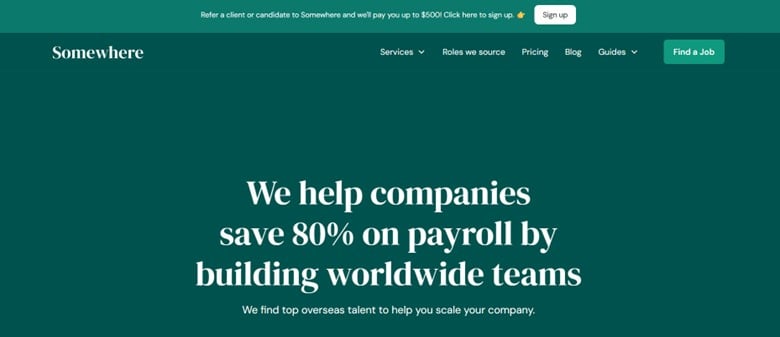
Why Somewhere is the best business process outsourcing company in 2025: Somewhere has built its reputation on helping scaling companies plug in high-quality remote talent without the friction that usually comes with outsourcing.
Most BPOs hand you a prepackaged team. Somewhere doesn’t. They run a selective hiring process with just a 0.5% acceptance rate. In other words, every person you get has already been tested for communication, problem-solving, and remote-first skills.
It’s a setup startups and mid-sized teams both like. No retainers or no upfront fees. You can scale up or down without getting locked into a fixed contract.
They also back every hire with a six-month Perfect Hire Guarantee, which is rare in the BPO space.
With strong coverage across LATAM, Southeast Asia, and Eastern Europe, Somewhere offers both cost efficiency and genuine operational leverage. For founders or operators who want outsourced support that feels like a seamless extension of their own team, Somewhere delivers.
2. TaskUs: Best for Tech-Enabled Customer Experience
- Founded: 2008
- Headquarters: New Braunfels, Texas
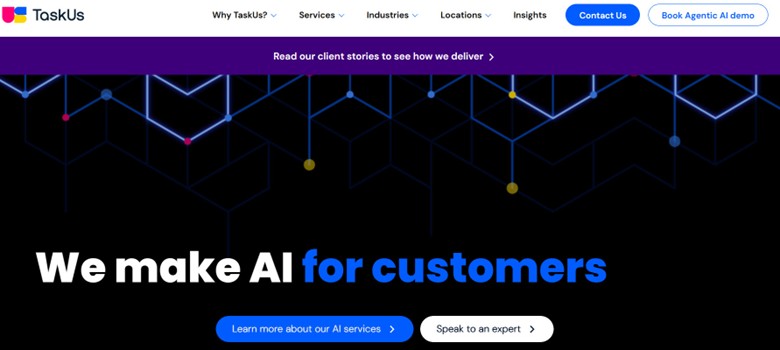
TaskUs is basically the go-to outsourcer for SaaS companies and high-growth brands. They’re built for primarily online businesses – handling customer support at scale, content moderation, and all kinds of technical work. All with automation and analytics baked in.
If you want a modern partner that actually understands tech, TaskUs is a relatively safe bet. They don’t just answer support tickets, they give you reports that show customer trends and help you improve your product.
3. Helpware: Best for Multichannel Support Delivery
- Founded: 2015
- Headquarters: Lexington, Kentucky
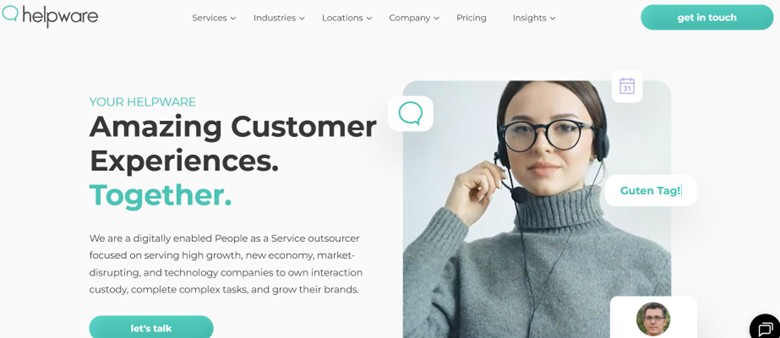
Helpware builds custom teams across the U.S., Ukraine, Mexico, and the Philippines. Their superpower is flexibility – you can mix in-house and outsourced staff to cover voice, chat, email, and social channels.
They’re a strong fit for companies that need support across all channels to feel like part of their brand. Weekly QA checks keep the tone and quality consistent across every channel.
4. Conectys: Best for Compliance-Sensitive Outsourcing
- Founded: 2004
- Headquarters: Bucharest, Romania
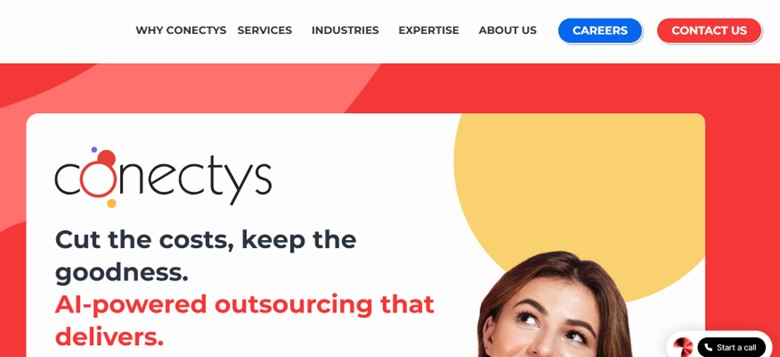
Conectys focuses on regulated industries like fintech, healthcare, and gaming. They operate in 10 countries, with multilingual teams trained to work in compliance-heavy industries.
If audits and various regulations are a big deal for you, Conectys brings the right mix of scale and control. Their QA systems and escalation protocols are built to hold up under external audits, which makes them a solid pick for risk-sensitive businesses.
5. SupportYourApp: Best for SaaS and App Support
- Founded: 2010
- Headquarters: Wilmington, Delaware
SupportYourApp handles customer and technical support for SaaS startups. Their teams are trained on tools like Intercom, Salesforce, and HubSpot, and they offer 24/7 multilingual coverage.
The big win is speed – they solve issues fast without sending everything back to your engineers. They also run structured onboarding programs for early-stage companies, so you can scale support without piling on headcount.
6. Transcom: Best for Enterprise Contact Centers
- Founded: 1995
- Headquarters: Stockholm, Sweden
Transcom has 30,000+ employees across Europe, Asia, and North America. They’re built for scale, managing large enterprise accounts with voice and digital support, technical services, and sales ops.
Their compliance systems and infrastructure make them a safe choice for enterprise outsourcing. They can also handle complex, multi-region rollouts with centralized reporting and local delivery teams. In other words, perfect for companies with global customers.
7. Flatworld Solutions: Best for Back-Office BPO

- Founded: 2020
- Headquarters: Princeton, NJ
Flatworld is focused on tasks like accounting, HR, data entry, and other repetitive back-end operations. They’re a good fit for companies that want to outsource routine workflows and keep costs predictable.
They’re known for transparent pricing and a focus on getting thins done. You can also customize service packages to match your exact process needs.
8. Invensis: Best for Scalable Support Teams
- Founded: 2000
- Headquarters: Bangalore, India
Invensis has 500+ clients in 20+ countries, covering customer support, helpdesk work, ecommerce operations, and data entry. They’re known for long-term relationships with their teams and scaling fast without losing quality.
Their onboarding and training make getting started easy, which is great for companies dealing with seasonal spikes or sudden growth.
9. Wing Assistant: Best for On-Demand Virtual Teams
- Founded: 2018
- Headquarters: Berkeley, California
Wing provides virtual assistants for startups and operators who need fast, task-level help. Their assistants handle things like sales research, scheduling, admin, and support, with U.S.-based managers keeping quality in check.
They’re a good fit if you want quick support without locking into a big outsourcing contract. You can spin up new assistant roles in under 48 hours, which makes Wing handy for teams with shifting workloads or urgent gaps.
10. Unity Communications: Best for Mid-Market Outsourcing

- Founded: 2009
- Headquarters: Gilbert, Arizona
Unity focuses on SMBs in healthcare, IT, and e-commerce. Their model blends U.S. based quality assurance with offshore delivery centers, giving clients local oversight plus global pricing.
They’re a solid option for companies too big for freelancers but not quite enterprise level yet. Unity also runs process audits and transition planning during onboarding, so you can shift workflows without slowing down daily ops.
Turning Outsourcing Into Leverage
The companies that get the most from BPO don’t treat it as a way to save money.
The startup I mentioned earlier didn’t just save money on customer support. They gained the ability to scale again. That’s the point of choosing the right BPO partner. Reclaiming time, stabilizing processes, and improving the customer experience without dragging down your core team.

