

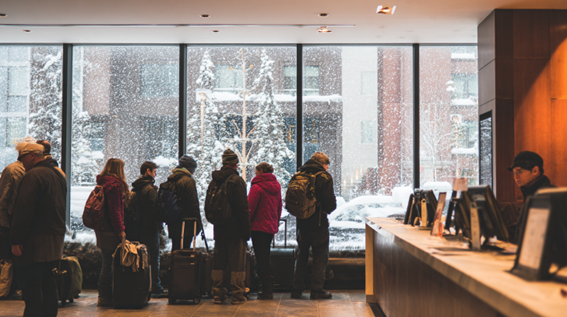
One of the many famous retail traditions that has gripped the majority of the western world by storm is the concept of Black Friday. Normally associated with the day after Thanksgiving 🦃, this pseudo-holiday is said to mark the beginning of the Christmas shopping season 🎁. Sales during this time period are likewise used as a means to measure the health of the economy. This is why the hotel industry can be seen as a direct reflection of consumer confidence. The good news is that things seem to be looking up throughout Canada 🇨🇦. Let’s examine the current state of affairs, the rationale behind Black Friday itself, and what the future may have in store.
The General Appeal of Black Friday 🛍️
Many of us will automatically assume that Black Friday is primarily concerned with retail sales. This makes a great deal of sense when we remember that these are the most frequently reported figures. However, it is important to remember that any trends across the retail community will also trickle down into other sectors; hotels representing one example.
Simply stated, people are always keen to discover new ways to save money 💰. While purchasing goods and services is obviously relevant here, the post-Thanksgiving weekend also represents one of the busiest travel times of the year (notwithstanding the gap between Christmas and New Year’s Day). This four-day weekend provides an excellent opportunity to take a break from everyday life ✈️, so hotels are eager to capitalise on the potential.
Among the brands leading the way this season, Barceló has managed to stand out by combining attractive seasonal rates with extra on-site perks such as free nights, resort credits and room upgrades. Its offers remain easy to access even for non-members, giving travellers the chance to experience premium stays at reduced prices during this busy period. Transparent conditions, flexible booking windows and real-time updates make it simple to secure a room before the best deals disappear — and the Barceló black friday hotel deals page is the ideal place to start your search.
The Principle of Supply and Demand ⚖️
Having said this, readers may be wondering how price reductions as high as 40 per cent will still enable hotels to enjoy a high profit margin. A quick review of supply and demand will clarify this perfectly reasonable question.
During slower times of the year (such as the early spring, and the height of the summer) 🌸☀️, hotel vacancies tend to increase. Consumers are back working their full-time positions, and they are less likely to be travelling for leisure-related purposes. When demand is low, prices will often tend to drop. Conversely, high demand often signifies that hotels can charge more for their accommodations. There is nonetheless an exception to this rule.
One of the few times of the year when sheer booking volumes dictate that properties can lower their rates, and still turn a profit. This actually makes perfect sense in terms of sheer numbers; demand alone can dictate a policy shift.
We also need to remember that providing discounts is an excellent way to remain competitive. Assuming that they have had a positive overall experience, guests will share this feedback with others; enabling hotels (particularly franchises) to supersede the competition. Word of mouth goes a long way in this day and age 🌐.
Black Friday as an Economic Indicator 📈
We mentioned that Black Friday sales can be used to examine the economic health of an entire economy, and Canada is a perfect example. A surge in demand signifies that customers are not simply looking for the latest deals on goods and services. It denotes that they also have the liquidity to travel significant distances; signalling what analysts refer to as a “bullish” economy 🐂. These observations can be backed up by real-world figures.
A recent study reported that the hotel investments totalled just over $2 billion dollars in 2024; equating to an increase of 17 per cent since 2023. Although many factors contributed to this rise, the conclusion is simple. It shows that consumers are confident in the Canadian economy, and they are less likely to tighten their budgets. Rate reductions of up to 40 per cent that have been attributed to Black Friday simply reinforce these observations.
Let’s use an analogy to clarify things even further. Imagine that you manage a large Canadian-based hotel chain. What conclusions would you draw from noticeably high occupancy rates? It would only be realistic to assume that the local economy is performing well. You might also be more likely to reduce your prices; assuming that you could still turn a profit within a specific period of time.
Does this Signal a Bright Future? 🌟
Now that we have come to understand the relationship between Black Friday and hotel vacancy rates, what conclusions can we draw? The first takeaway point is that the Canadian economy seems to be on the right track 🚀. Assuming that consumer spending continues to rise, this is great news when referring to long-term growth. Still, it is important to remember that downturns can still occur.
This is why hotels must keep a close eye on consumer demand, and adjust their strategies accordingly. Guests will remain confident that they are receiving quality services, and the properties themselves will be able to stay one step ahead of the competition — an important concern that goes far beyond economic conditions alone.

