

Instagram’s algorithm changed in 2025. Watch time ranks first, but comments still determine your reach. The platform weighs comment engagement heavily when deciding which posts to show your followers and push to new audiences.
Most creators struggle here. The average engagement rate dropped to 0.45% in 2025, down 28% year-over-year. The comment-to-likes ratio sits between 1:10 and 1:20 for most accounts. But accounts using strategic tactics see 200-300% more comments within 30 days.
This guide shows you exactly how to turn silent scrollers into active commenters. You’ll learn 14 algorithm-backed strategies, psychology-based prompts, and timing hacks that work right now.
Why Instagram Comments Matter More Than Likes in 2025
Instagram’s algorithm prioritizes three ranking factors: watch time, likes per reach, and sends per reach. Comments fall under a broader category called “relationship signals” that the algorithm uses to determine post visibility.
Here’s why comments outrank likes. When someone comments, they spend more time on your post. They type, think, and engage deeply. The algorithm interprets this as high-quality content worth showing to others. Likes require one tap. Comments require thought. That’s why many people buy custom comments on Instagram to boost their initial growth.
The first-hour engagement window determines everything. Instagram evaluates posts in the first 60 minutes after publishing. Posts that hit 200-250 views with strong comment engagement get algorithmic promotion. Miss this window, and your reach flatlines.
Quality beats quantity. The algorithm distinguishes between substantive comments (4+ words) and spam (emoji-only). A post with 15 thoughtful comments outperforms one with 50 generic emoji responses. Focus on conversations, not numbers.
Instagram Comment Engagement Benchmarks by Account Size
Understanding where you stand helps set realistic goals. Here’s how comment engagement breaks down by follower count:
| Account Size | Follower Range | Average Engagement Rate | Typical Comment-to-Likes Ratio |
| Nano Influencer | 1K-10K | 5.03%+ | 1:8 to 1:12 |
| Micro Influencer | 10K-100K | 2.5%-3.5% | 1:12 to 1:18 |
| Macro Influencer | 100K-1M | 1.5%-2.5% | 1:15 to 1:20 |
| Mega Influencer | 1M+ | 0.5%-1.5% | 1:20 to 1:30 |
Smaller accounts typically see higher engagement rates. If you’re below these benchmarks, the strategies in this guide will help you catch up.
1. Post Controversial or Opinionated Takes
Polarizing content drives comments. When you share a strong opinion, people feel compelled to agree, disagree, or add nuance.
Start posts with “Unpopular opinion:” followed by a debatable statement in your niche. For example, a fitness creator might say: “Unpopular opinion: Cardio is overrated for fat loss. Strength training burns more calories long-term.” This invites debate.
Frame it as a perspective, not an absolute truth. People comment when they can contribute their experience. Absolute statements shut down conversation. Opinionated takes invite it.
Test this formula: State your opinion in the caption, explain your reasoning in 2-3 sentences, then ask “What’s your take?”. This structure gives followers context while inviting them to share their views.
Avoid crossing into offensive territory. Controversial means debatable, not disrespectful. Stay within your niche’s accepted discourse boundaries.
2. Use Open-Ended Experience Questions
Generic prompts fail. “Tag 3 friends” or “Drop an emoji” generates low-quality engagement that hurts your reach.
Instead, ask about specific experiences. Compare these two captions:
Low-performing: “What’s your favorite food? 🍕”
High-performing: “What’s the worst meal you’ve ever cooked, trying to impress someone? Mine was burnt lasagna that set off the smoke alarm.”
The difference? Specificity triggers memory recall. When you ask a vague question, followers skip it. When you ask about a specific situation, their brain searches for a matching experience, and they share it.
Use this pattern: Share your story first, then ask theirs. Vulnerability creates psychological permission for others to be vulnerable. You go first, they follow.
High-Performing Question Frameworks
These five question types consistently drive comments:
- Worst-case scenarios: “What’s the biggest mistake you made when starting [topic]?”
- First-time experiences: “What surprised you most the first time you tried [activity]?”
- Problem-solving: “How did you overcome [common challenge in your niche]?”
- Preference with context: “Coffee or tea for late-night work sessions and why?”
- Story completion: “Finish this sentence: The moment I knew I’d succeed was when…”
Each framework requires followers to think, recall, and type. That’s what drives algorithm-friendly engagement.
3. Create Story Completion Prompts
Start a narrative and let followers finish it. This taps into human psychology; we hate incomplete stories.
Here’s how it works. Begin your caption with a compelling setup: “I started my business with $500, a laptop, and…” Then stop mid-sentence. Followers feel compelled to imagine or share how they’d continue.
Another approach: Share the beginning and middle of a story, skip the ending, and ask followers how they’d handle it. For example: “Client asked for a refund after using the product for 89 days. Our policy is 90 days. What would you do?”
This works because you’re crowdsourcing solutions, not just asking for opinions. People love sharing their decision-making process.
Test both formats. Some audiences prefer open-ended completion (“finish this sentence”), while others engage more with dilemma-based prompts (“what would you do”).
4. Share Behind-the-Scenes Vulnerability Content
Perfect posts get likes. Messy reality gets comments.
Share struggles, failures, and lessons learned. When you admit “I messed this up,” followers feel safe sharing their struggles too. This creates conversation.
Example: Instead of “Just hit $10K/month!” try “Hit $10K this month after three months of barely making $2K. Here’s what I was doing wrong…”. The second version invites people to ask questions and share their journey.
Keep the vulnerability specific and relevant. Don’t trauma-dump or overshare. Focus on professional challenges, creative blocks, or skill-building struggles your audience faces, too.
End with a question that invites shared experience: “What’s a milestone that took you longer than expected to hit?”. This shifts the conversation from you to them while keeping the theme.
5. Use “You vs Me” Dilemma Posts
Present two options and ask which your followers prefer. Simple, effective, comment-generating.
This works especially well in carousel posts. Slide 1: Introduce the dilemma. Slides 2-3: Explain option A. Slides 4-5: Explain option B. Final slide: “Which would you choose and why?”.
Carousels already perform better than single images. They get engagement rates between 0.55% and 10.15% depending on optimization. Adding a binary choice makes them even stronger.
Make the options genuinely debatable. If one choice is obviously better, people won’t engage. Examples that work:
- “Remote work with flexible hours or office job with mentorship?”
- “Master one skill or be decent at five?”
- “Launch fast with imperfections or wait until it’s perfect?”
The key is creating real tension between legitimate options. Each side should have valid arguments.
6. Optimize Your Caption Structure and CTAs
Where you place your question matters. Instagram truncates captions after 125 characters, showing a “more” button.
Place your hook and CTA in the first two lines or at the very end. The middle gets buried. Structure it like this:
Line 1-2: Hook or question
Lines 3-8: Value, story, or context
Final line: CTA or question (if not used at top)
Avoid these engagement-killing prompts:
- “Drop an emoji if you agree” (generates spam comments)
- “Tag 3 friends who need this” (attracts uninterested users)
- “Link in bio” without context (self-promotional)
- Generic “What do you think?” (too vague)
Instead, use experience-based CTAs:
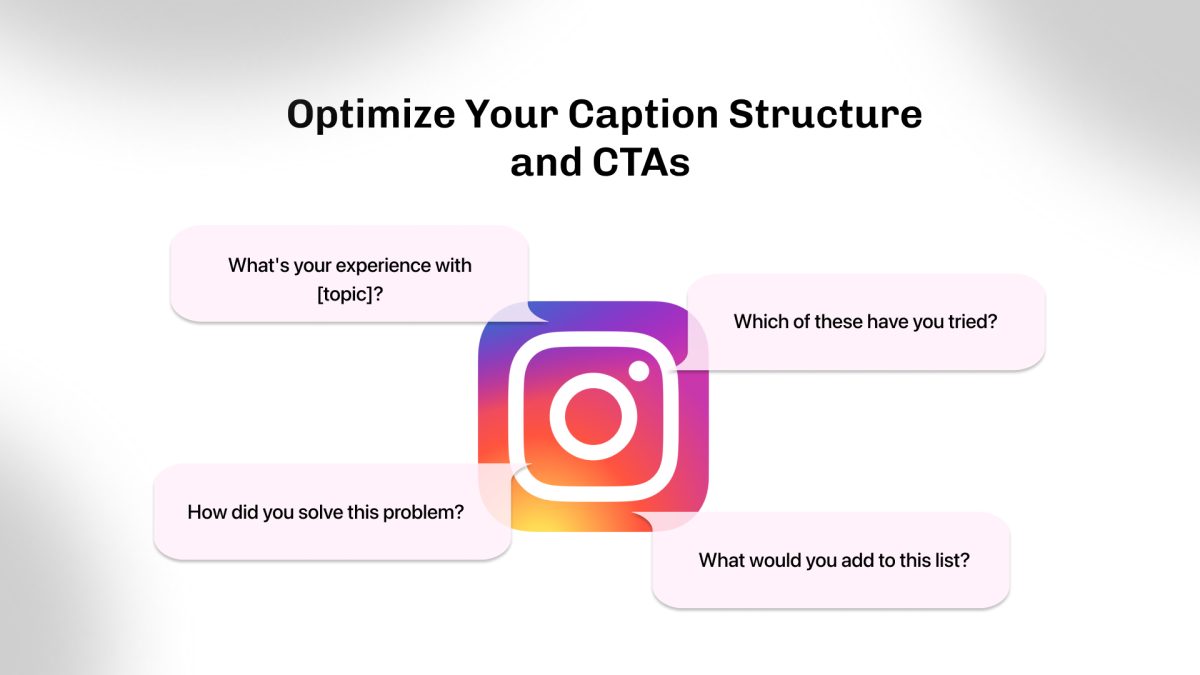
- “What’s your experience with [topic]?”
- “Which of these have you tried?”
- “How did you solve this problem?”
- “What would you add to this list?”
Each CTA should invite specific, thoughtful responses. Generic prompts get generic results or none at all.
High-Performing vs Low-Performing CTA Examples
See the difference in action:
| Low-Performing CTA | High-Performing CTA | Why It Works |
| “Thoughts? 💭” | “What’s the biggest challenge you’ve faced with this?” | Asks for specific experience |
| “Tag 3 friends” | “Who taught you this lesson the hard way?” | Creates meaningful tag context |
| “Follow for more tips.” | “What topic should I cover next?” | Crowdsources content direction |
| “Like if you agree ❤️” | “Do you agree or disagree with #3?” | Invites discussion, not just reaction |
| “Comment below ⬇️” | “What would you add to this list?” | Positions the audience as contributors |
The pattern: Specificity, experience, and contribution invitations outperform vague requests every time.
7. Format-Specific Comment Strategies
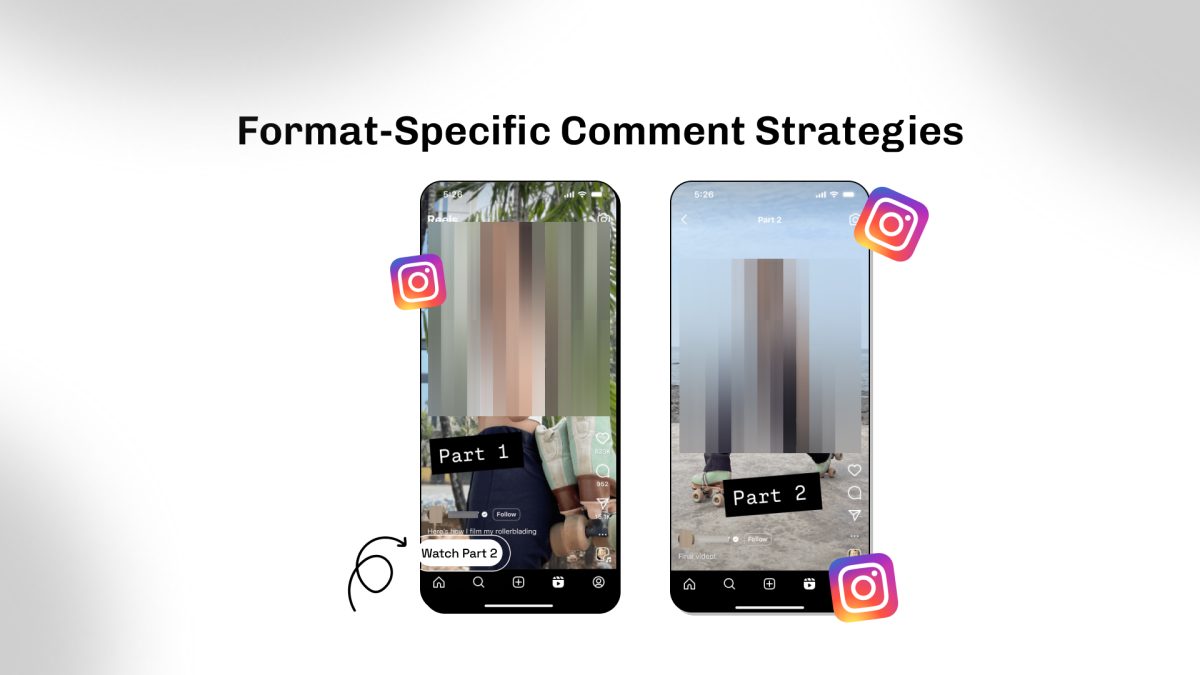
Different content formats need different approaches. Instagram’s algorithm ranks Reels, carousels, and single images differently.
Reels get the highest engagement rate at 2.08% for influencers. But watch time matters most here. Comments boost secondary reach after the initial watch-through drives distribution.
Carousel posts sit at 1.7% engagement and get 22-23% more saves than single images. They also generate significantly more comments because each swipe increases engagement signals.
Single photo posts average 1.17% engagement. They rely heavily on caption strength since there’s no swipe or watch time to boost algorithmic favor.
Here’s how to optimize each format for comments.
Reels: End with Voiceover Questions
Your last 3 seconds determine comment rates on Reels.
Don’t end with “Follow for more.” End with a question that requires an answer. Record a voiceover that says: “What’s your experience with this?” or “Which method works best for you?”.
The viewer just spent 15-30 seconds watching. They’re primed to engage. Give them a clear, specific prompt right as the video ends.
Test putting the question in text overlay too. Some viewers watch without sound. Cover both bases.
Carousel Posts: Save Questions for the Final Slide
Each carousel swipe tells Instagram the content is valuable. Build your CTA across multiple slides.
Structure: Slides 1-4 deliver value. Slide 5 asks the question. This ensures followers consume your content before you ask for engagement.
Carousels can produce 3.1 times more engagement than single images when optimized correctly. The final-slide CTA strategy maximizes that advantage.
Single Image Posts: Lead with Story, End with Question
Without swipes or watch time, your caption carries everything.
First 2 lines: Emotionally resonant hook or story opening. Middle section: Deliver value, share experience, or teach something. Final line: Experience-based question.
The story creates context. The question creates conversation. Don’t skip the setup to rush to the CTA.
8. sMaster the First-Hour Engagement Window
Instagram evaluates your post’s performance in the first 60 minutes. Hit 200-250 views with strong engagement, and the algorithm promotes your post. Miss this window, and organic reach dies.
Here’s how to win the first hour.
Post when your audience is most active. Check Instagram Insights under “Total Followers” → “Most Active Times”. Schedule posts for these windows.
Avoid oversaturated times. If your Insights show 8 PM as peak, but you know that’s when everyone in your niche posts, shift to 7:30 PM or 8:30 PM. You want active followers who aren’t drowning in content.
Reply to comments within 3 minutes. Fast responses signal “active post” to the algorithm. Target under 3 minutes for your first 5-7 commenters.
Pre-Engagement Tactics to Activate Your First Hour
Don’t just post and hope. Prime your engaged followers before hitting publish.
Send DMs to 5-10 loyal followers 5-10 minutes before posting. Message: “Just posted something I think you’ll find useful, would love your thoughts.” Keep it personal, not spammy.
Use your Close Friends list strategically. Post a teaser Story to Close Friends 15 minutes before your main post. Ask: “Posting about [topic] in 10 minutes, what’s your biggest question about this?”.
Close Friends engage 48% more often than regular followers, according to Meta’s internal data. This gives you a first-hour engagement boost from your most active community members.
While organic tactics should be your foundation, some creators use Instagram engagement services to build initial social proof that attracts genuine commenters, though this should complement, not replace, authentic community-building strategies.
9. Reply to Every Comment Meaningfully
The algorithm tracks comment depth, not just quantity. One 5-reply thread outranks five single-comment interactions.
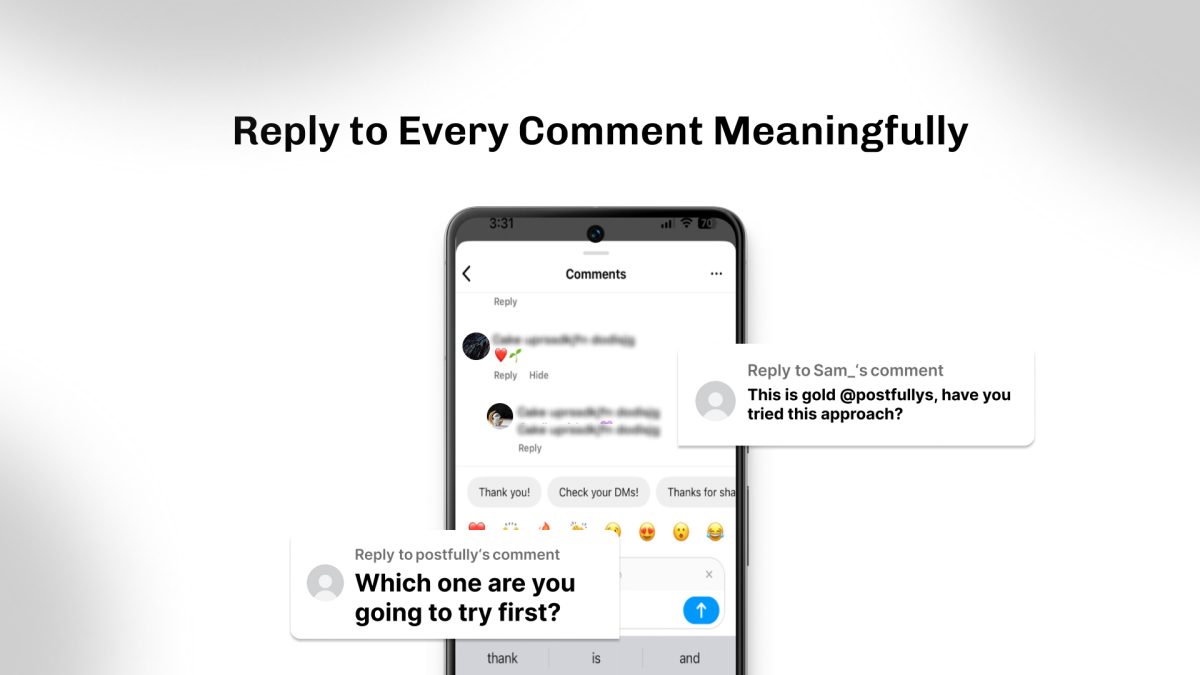
Ask follow-up questions in your replies. If someone says “Great tips!” respond with “Which one are you going to try first?”. This creates conversation threads that signal high-quality engagement.
Relationship signals are the algorithm’s top priority after watch time. Building back-and-forth conversations tells Instagram you have an engaged community worth promoting.
Target specific replies based on comment quality. Thoughtful 3+ sentence comments get detailed responses. Generic emoji comments get a like or brief acknowledgment. Invest where engagement is genuine.
Turn Comments into Community Conversations
Encourage peer-to-peer interaction between your followers.
When someone shares a great tip in the comments, reply: “sssss”. This gets followers talking to each other, not just to you.
Highlight insightful comments in your Stories. Screenshot a valuable comment, share it, and tag the commenter with “Great perspective from [username]”. This rewards engagement and shows others you read and value comments.
The goal isn’t just to reply to you. It’s building a community that talks to each other. That’s what the algorithm rewards most.
10. Practice Strategic Reciprocity
Comment on your followers’ posts before asking them to comment on yours.
Spend 10-15 minutes before you post, engaging with your audience’s content. Leave thoughtful comments on 10-20 posts from followers who consistently engage with you.
This works for two reasons. First, when you comment on someone’s post, they get a notification. They check your profile, see you just posted, and often engage. Second, the algorithm tracks your engagement patterns. Active commenters get more visibility.
Target your most engaged followers first. Check who comments regularly on your posts and prioritize their content. Build relationships with frequent interactors.
Comment quality matters here, too. Avoid generic “Great post!” remarks. Add specific observations: “The tip about [specific detail] is exactly what I needed, trying this today”.
Reaching the critical 200-250 view threshold in the first hour can be challenging for smaller accounts. Some marketers combine organic tactics with Instagram growth services to establish baseline visibility that attracts organic engagement.
11. Create Interactive Content That Demands Responses
Certain content types naturally generate more comments. Build these into your posting strategy.
Q&A sessions convert Story questions into feed posts. Collect questions via Story stickers, then create a carousel or Reel answering the best ones. Tag the people who asked in your caption.
Strategic giveaways work when entry requires thoughtful comments, not just tags. Example: “Win [prize] by sharing your biggest challenge with [topic] in the comments”. This attracts engaged followers who care about your niche, not freebie hunters.
High-Engagement Interactive Content Ideas
These seven content types consistently drive comments:
- Myth-busting posts: “3 things everyone gets wrong about [topic]” invites debate and correction
- Before/After transformations: Show progress and ask, “What transformation are you working on?”
- Day-in-the-life problem-solving: Share a real challenge you faced this week and ask for advice
- “Then vs Now” comparisons: Show your evolution and ask followers to share their journey
- AMA (Ask Me Anything) posts: Announce in Stories, answer in a carousel
- Crowdsourced advice: “Need your help: should I [Option A] or [Option B]?”
- Community challenges: Launch a 7-day challenge and ask for daily progress updates
Rotate these formats. Don’t overuse any single type, or your audience gets fatigued.
12. Optimize Hashtags and Discovery for Comment-Friendly Audiences
Hashtags still work. Posts with 1+ hashtags get 12% more engagement than posts without them.
But strategy matters. Mix popular hashtags with niche-specific ones. Popular hashtags get you initial visibility. Niche hashtags attract engaged communities who comment more.
Example for a fitness creator:
- Popular: #fitness #workout #gym (millions of posts)
- Niche: #homeworkoutmom #resistancebandworkouts #morningroutine (thousands of posts)
The niche hashtags attract people who care specifically about your content angle. They’re more likely to comment because the content directly addresses their interest.
Additional Discovery Tactics (H3)
Location tags increase discoverability in geographic searches. If your business has local relevance, always add location.
Tag relevant brands and creators when appropriate. This encourages them and their audience to engage. Don’t spam-tag. Make it relevant.
Instagram search now rivals hashtags for discovery. Use keywords naturally in your captions. The algorithm indexes caption text for search results.
13. Use Psychology-Backed Comment Triggers
Understanding why people comment helps you create better prompts.
Emotional resonance drives responses. Vulnerability, frustration, excitement, and surprise make people want to share their experience. Neutral, informational content gets likes. Emotional content gets comments.
Give psychological permission to share. Normalize the experience you’re asking about. Example: “We’ve all been there, panicked the night before a deadline. What’s your worst procrastination story?”. The “we’ve all been there” removes shame and invites sharing.
Position your audience as experts. People love demonstrating knowledge. Instead of “What do you think?” ask “What’s your expert advice for someone dealing with this?”. This reframes them as authorities, not just opinion-givers.
Present real dilemmas you’re facing. Crowdsource genuine decisions. “I’m torn between launching version A (faster) or version B (better). What would you prioritize?”. Authenticity creates engagement. Authenticity can’t be faked.
14. Avoid These Engagement-Killing Mistakes
Some tactics actively hurt your comment rates and overall reach.
Comment pods and engagement groups violate Instagram’s terms. The algorithm detects artificial engagement patterns and penalizes your account. Short-term gains become long-term reach death.
Buying comments creates generic spam that hurts credibility. Services that promise “free Instagram comments” deliver low-quality, obvious bot responses. Real followers notice and disengage.
Generic giveaways attract ghost followers who never engage after the contest. They tank your future engagement rate. Only run giveaways that require niche-specific entry criteria.
Ignoring the first-hour engagement window wastes your post’s potential. Posts that don’t gain traction in 60 minutes rarely recover. Post when you can actively engage for that first hour.
Self-promotion in the comments section looks spammy and inauthentic. Don’t reply to every comment with “Check my bio for…”. This discourages genuine conversation.
What Kills Comments vs What Drives Them
See the clear differences:
| Engagement Killers | Engagement Drivers |
| “Tag 3 friends” without context | “Tag someone who taught you this lesson.” |
| Emoji-only CTAs | Experience-based questions |
| Comment pods and fake engagement | Genuine reciprocal engagement |
| Posting and disappearing | Replying within 3 minutes |
| Generic giveaways | Niche-specific entry requirements |
| Perfect, polished content only | Behind-the-scenes vulnerability |
| Vague “thoughts?” prompts | Specific situational questions |
| Self-promotional replies | Conversation-building responses |
The pattern repeats: Authenticity, specificity, and genuine interest in responses always win.
Measuring Your Comment Success
Track the right metrics to optimize your strategy.
Comment-to-reach ratio matters more than total comments. A post with 50 comments and 500 reach (10%) outperforms one with 100 comments and 5,000 reach (2%).
Benchmark against the median: 0.61% engagement in 2025. If you’re above 2-3%, you’re doing well. Above 5%, you’re excelling.
Analyze comment quality, not just quantity. Count substantive responses (4+ words) separately from emoji spam. The algorithm does the same.
Key Metrics to Monitor
Track these four metrics monthly:
- Comment-to-reach ratio: Total comments ÷ total reach × 100
- First-hour comment velocity: Comments in first 60 minutes vs 24 hours
- Thread depth: Average replies per comment thread
- Question-type performance: Which prompt formats drive most responses
Test different approaches and double down on what works for your specific audience. A finance audience might engage more with dilemma posts, while a fitness audience prefers transformation showcases.
To maintain consistent engagement signals, consider leveraging Instagram automation tools that help you stay active when you can’t manually engage, ensuring the algorithm sees consistent interaction patterns.
Once you’ve optimized organic engagement, scaling with Instagram ads requires reliable Facebook Business Manager access, as Instagram ads run through Facebook’s advertising platform essential for turning engaged commenters into customers.
Start Getting More Comments Today
Instagram comments determine your reach in 2025. The algorithm prioritizes relationship signals, and comments signal deeper engagement than any other metric besides watch time.
Start with three tactics this week:
- Replace generic CTAs with experience-based questions
- Reply to every comment within 3 minutes for the first hour
- Engage with 10-20 follower posts before you publish
These three changes alone can boost comments 200-300% within 30 days. The key is consistency. Test different question frameworks, track what works, and refine your approach based on data.
Comments aren’t vanity metrics. They’re algorithmic currency. More meaningful comments mean more reach, more followers, and more impact for your content.

