

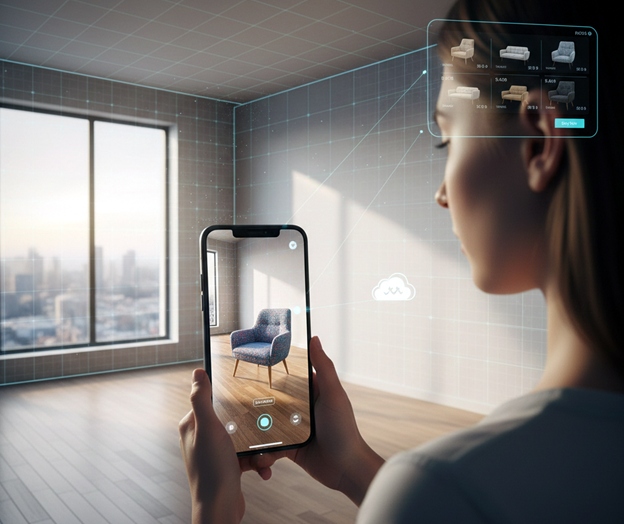
E-commerce has shifted from flat images to immersive product experiences. What once worked as a simple product thumbnail now feels limited for serious buyers. Brands investing in 3d renders services are moving beyond static visuals. At the same time, 3d renderings services are becoming the backbone of AR tools that let customers place products inside their own homes. This is how retail turns into virtual commerce. The so‑called “See in Your Room” feature is no longer a novelty. It is an expectation. When shoppers can rotate, scale, and position a product in their real environment, trust changes. High‑fidelity assets act as proof that the brand cares about accuracy. And in a crowded digital market, accuracy is currency.
The Technical Bridge: Why High-Quality 3D Models Are The Foundation Of AR
Augmented reality depends on performance. A model that looks stunning on a desktop render may fail on a smartphone. This is why 3d high-quality architectural rendering services focus on building low‑poly geometry while preserving surface detail. Polygon count must be reduced without losing form. Textures must stay sharp but optimized. Physically Based Rendering (PBR) materials enable objects to respond to real-world lighting conditions. When a digital sofa absorbs warm evening light or reflects a window highlight, it feels grounded. Professional teams delivering architectural 3d rendering services understand how to balance file size with realism. They prepare assets that load instantly and still show fabric grain, wood pores, and subtle shadow transitions. The result is speed without compromise.
Bridging The Imagination Gap With See In Your Room Features
One of the biggest barriers in online retail is the imagination gap. People struggle to picture how an object fits in their space. A static gallery cannot solve this problem. But a responsive 3D architectural visualization service can enable AR previews that bridge the gap between guesswork and certainty. When users drop a table into their dining room through a phone camera, hesitation fades. It becomes a digital version of trying before buying. Retailers notice the difference. Return rates shrink. Engagement metrics increase as customers spend more time interacting with products rather than scrolling past them. The interactive layer transforms passive browsing into active decision‑making.
Photorealism Vs. Real-Time Rendering: The Balancing Act Of 3d renderings services
Traditional renders are built for still frames. AR assets must move in real time. A photorealistic image requires heavy computation, whereas mobile AR does not. Teams providing architectural visualization services rely on techniques such as baked shadows and ambient occlusion to efficiently simulate depth. These methods give objects weight and presence. File formats such as USDZ for iOS and glTF for Android standardize how assets are displayed across devices. A consistent pipeline ensures that whether a user opens an app on a budget phone or a premium device, the product behaves the same. A reliable architecture visualization service plans this consistency from the start.
Core Advantages Of Integrating Professional 3D Assets In AR Retail
Investing in professional 3D assets is not cosmetic. It influences cost structure, marketing performance, and long‑term scalability. A specialized 3d architectural rendering company can align technical quality with measurable business outcomes. Below are the core advantages retailers gain by treating 3D as infrastructure rather than decoration.
1. Drastic reduction in return rates as customers can accurately gauge the scale, color, and fit of furniture or decor within their specific home environment before purchase.
2. Increased consumer confidence and emotional ownership, as the ability to interact with a virtual product creates a pre-purchase bond similar to an in-store trial.
3. Enhanced SEO and app engagement metrics, as 3D-enabled product pages typically see significantly higher organic traffic and lower bounce rates than traditional pages.
4. Future-proofing for the metaverse and spatial computing, ensuring that product assets are ready for hardware like AR glasses and mixed-reality headsets.
5. Streamlined marketing pipelines where a single high-quality 3D master model can be used for AR, social media animations, and traditional print catalogs simultaneously.
The Role Of Lighting And Environment Mapping In AR Fidelity
Lighting makes or breaks AR realism. Modern AR frameworks capture ambient light through the device’s camera and apply it to digital models. If a lamp is placed near a bright window, it must glow correctly. If a chrome surface exists, it must reflect the actual room. A professional 3D rendering company creates reflection maps and material layers that enable this behavior. These technical foundations ensure that reflections shift as the phone moves. Without proper environment mapping, objects float. With it, they belong.
Overcoming Scalability Challenges In 3D Asset Production
Creating one AR model is manageable. Creating thousands is complex. Retail catalogs contain variations in size, color, and configuration. A skilled 3d architectural visualization company develops standardized pipelines to maintain consistency. Automation through 3D scanning helps, but manual refinement is still necessary for premium products. A dedicated architectural rendering service coordinates scale accuracy, texture uniformity, and naming structures. Cloud rendering and centralized asset libraries now allow mid‑sized brands to scale without building internal studios. Consistency across a digital catalog protects brand perception.
Beyond Furniture: The Expansion Of AR Into Fashion And Small Goods
AR is not limited to sofas and cabinets. Watches, jewelry, and clothing are entering the same space. Rendering silk or gemstone sparkle demands extreme precision. Models must hold up under close inspection. Here, 3D architectural services adapt techniques from the built environment to smaller scales. Digital draping simulations replicate how fabric folds. Micro‑surface textures capture reflections from polished metal. When these details are missing, realism collapses instantly. When done correctly, virtual try‑on becomes convincing enough to influence purchase decisions.
Conclusion
Retail is moving toward spatial experiences. Augmented reality relies on high‑quality digital assets to function beyond a gimmick. The connection between rendering and AR is structural. Without precise modeling, careful lighting maps, and optimized formats, the illusion fails. As hardware improves, expectations rise with it. Brands that treat 3D as a long‑term investment will adapt faster. Retailers who integrate 3D rendering services deeply into their ecosystem will define how commerce feels over the next decade.

