

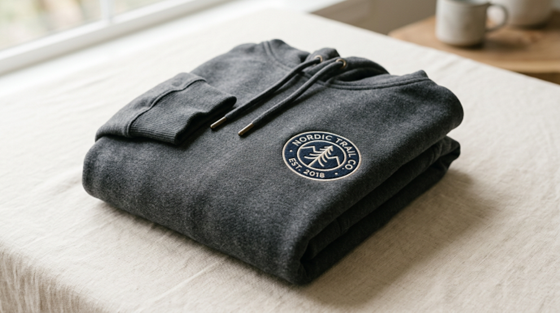
The personalization economy has moved well past monogrammed mugs. According to Business Research Insights, the global custom-made clothes market is valued at USD 63.82 billion in 2026 and is on track to nearly triple to USD 179.49 billion by 2033. For retail decision-makers, that trajectory signals something important: branded apparel is no longer a sideline marketing expense — it’s a category with serious strategic weight.
Custom embroidered hoodies sit at the intersection of brand identity, employee engagement, and rising consumer demand for personalized products. This piece breaks down the business case, the data behind the hoodie’s staying power, and what retail buyers should know before committing to a program.
The Business Case for Branded Apparel
Branded merchandise has matured into a genuine brand touchpoint — not a freebie at the bottom of a conference bag. According to PPAI research, apparel has overtaken writing instruments to become the number one promotional product category acquired by consumers. More telling: 72% of recipients said they made a purchase from a brand because of a promotional product they received, and 70% equate the quality of that product directly with the reputation of the company that gave it — a 30-point jump from 2021.
That last figure matters for retail brand managers. A cheap, poorly constructed item with a flaking logo doesn’t just fail to impress — it actively signals something about your brand. The inverse is equally true: a well-made, durable piece carries your brand story forward every time it’s worn.
Embroidery specifically elevates perceived quality. Unlike screen-printed transfers, embroidered logos are tactile, dimensioned, and don’t crack or fade with washing — attributes that translate directly to consumer perception of premium quality.
Why Hoodies? The Case for This Specific Format
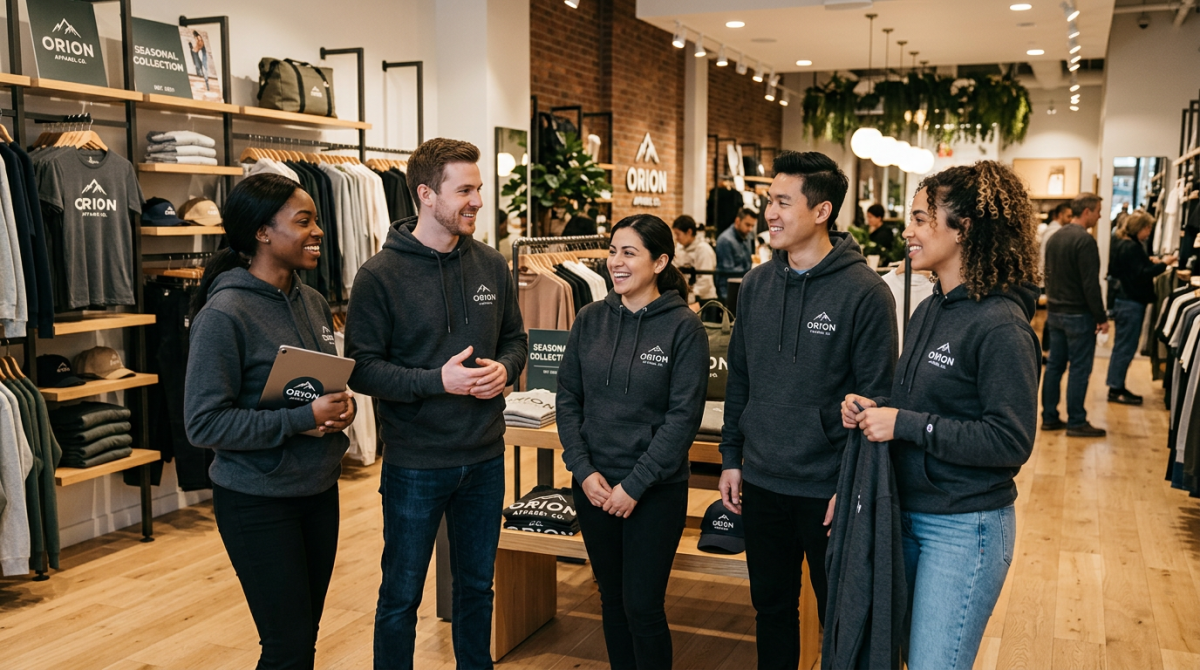
Retail team in matching branded hoodies at a store event
Not all branded outerwear performs equally. Hoodies have undergone a structural shift in consumer culture. Driven by the convergence of athleisure and everyday casual dressing, hoodies are now worn in office environments, at events, and during everyday errands — which means each branded item generates more impressions per week than virtually any other wearable category.
The market reflects this. North America accounts for approximately 40% of the global custom apparel market, and Fortune Business Insights projects the U.S. hoodies and sweatshirt market alone will reach USD 85.22 billion by 2026. That’s a category with broad consumer acceptance and deep seasonal utility.
For retailers and brands building out a branded apparel program, custom embroidered hoodies offer a format that holds up across all three primary use cases: employee uniforms, corporate gifts, and consumer-facing merchandise. The heavyweight fleece construction typically used for quality hoodies also makes it one of the better base materials for embroidery — the thread sits cleanly, logo detail is preserved, and the finished product holds its form through repeated wear and washing.
Three Use Cases Driving Demand in 2026
Now, let’s check out three use cases in order to develop an in-depth understanding of the topic.
Employee Uniforms and Team Identity
Retail floor staff and event teams in matching branded hoodies project brand consistency in a way that lanyards and name tags never will. Apparel functions as ambient brand communication — visible to every customer who walks through the door. For multi-location retailers, consistent branded outerwear also reinforces culture and cohesion across teams who rarely interact.
Corporate Gifts and Client Appreciation
Generic corporate gifting is a diminishing returns game. A quality embroidered hoodie — well-chosen, well-constructed, and properly packaged — is the kind of gift recipients actually keep and wear. The same principle holds for other high-utility branded items — personalized tote bags offer a similarly practical format that travels with recipients through daily routines, generating consistent brand impressions well beyond the moment of gifting. That means your brand stays visible for months or years, not days. PPAI’s industry outlook for 2025 notes that 65% of promotional product distributors expect continued sales growth, driven in part by demand for higher-quality, wearable gifting.
Consumer Merchandise and Loyalty Programs
More than 55% of consumers say they prefer customized garments over mass-produced alternatives, and online sales of custom clothing have grown 70% over the last three years. For brands with an engaged customer base, a well-designed hoodie as part of a merchandise drop or loyalty reward creates an additional revenue stream while deepening brand affinity. Online platforms now account for 65% of custom apparel sales — a channel that rewards brands who invest in quality product photography and clean customization UX.
Market Trends Retail Buyers Should Track
The decorated apparel market — which covers embroidery, screen printing, and sublimation — was valued at USD 28.98 billion in 2023 and is projected to reach USD 68.17 billion by 2030, according to Grand View Research, growing at a 13% CAGR. Embroidery remains the dominant decoration method in that market.
Two additional trends are worth noting for retail planners. First, sustainability: made-to-order production eliminates the overstock problem that plagues conventional apparel retail, and consumers are increasingly aware of this — a growing share of shoppers view custom-ordered clothing as the more environmentally responsible choice. This holds true even with a drop in retail numbers.
Second, personalization at scale: platforms offering on-demand customization tools report significantly higher engagement than static product pages. Retailers building private-label or merch programs should consider whether their supplier can accommodate individual customization alongside bulk orders.
As covered in Retail Insider’s look at branded promotional merchandise, the promotional product category broadly is evolving from volume plays toward quality-driven, brand-aligned selections — and hoodies are a centerpiece of that shift.
Choosing the Right Embroidery Partner
Execution quality varies considerably across the industry. The most common failure point is digitizing — the process of converting a logo file into machine-embroidery instructions. Poor digitizing produces muddy lettering and blurred detail, particularly on smaller logo placements. Before committing to a bulk order, request a physical sample and evaluate thread density, color accuracy, and how the logo reads at the intended placement size.
Standard considerations for retail buyers: minimum order quantities (relevant for small and mid-size operators), fabric weight (320–400 gsm fleece holds embroidery well), and turnaround time for reorders. Left-chest placement at roughly 3.5 inches wide is the accepted standard for corporate logo embroidery — deviations from this should be intentional, not default.
Understanding the craft behind personalized clothing gives buyers the vocabulary to ask sharper questions and evaluate supplier samples more critically — a small investment of time that pays off in a better finished product.
A Wearable Brand Strategy
The numbers behind branded apparel point in one direction: the market is growing, consumer appetite for personalization is accelerating, and quality is becoming the differentiator. Custom embroidered hoodies offer retailers a single SKU capable of serving employee programs, gifting initiatives, and consumer merchandise — with a durability and perceived-value premium that cheaper decoration methods can’t replicate.
Retailers who are now building quality-branded apparel into their strategy are investing in brand visibility that compounds over time. Every wear is an impression; every impression is a touchpoint that no media buy can replicate.

