

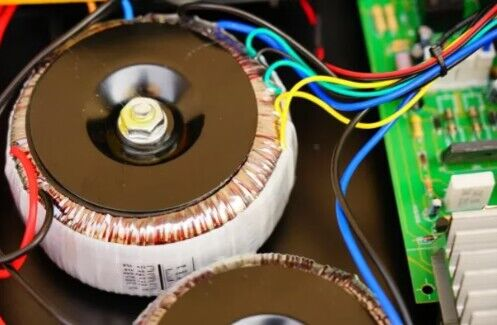
Your transformer is leaking energy. Not because it is broken because of the way it was built. Standard E-I core transformers have gaps in their magnetic path. Flux escapes at those gaps. You pay for it on every electricity bill.
A toroidal transformer has no gaps. The core is a solid ring. Magnetic flux travels in a closed loop and stays exactly where it should. The result is 40% less energy loss, 80% less magnetic leakage, and a service life measured in decades. A toroidal transformer does not contain any gaps. The core is a solid ring. Magnetic flux moves in a closed loop and does not go anywhere it should not. The result is 40% less energy loss, 80% less magnetic leakage and a service life measured in decades. This is why toroidal transformers become the go-to for medical equipment, high-end audio systems and precision industrial controls.
What Is a Toroidal Transformer?
A toroidal transformer is constructed around a donut shaped core of high flux ferromagnetic material. Both the primary winding and the secondary winding are wound evenly around this ring.Because the core is continuous with no joints or air gaps, the magnetic field stays locked inside it from end to end.
This single design decision the ring shape is responsible for every performance advantage a toroidal transformer has over conventional alternatives.
Where People Use Them
- Medical Devices: Zero EMI is not optional in operating rooms and patient monitoring equipment.
- Audio Amplifiers: The quietest power supply on the market, no hum, no interference in the signal.
- Industrial Controls: Deals with continuous heavy loads in harsh environments for decades.
- Voltage Converters 220 V to 110 V or 110 V to 220 V to Global Equipment.
What Makes It Better: The Numbers.
It is easy to make marketing claims; engineering data is not. We are not arbitrarily talking of 40 percent loss reduction or 80 percent magnetic leakage reduction, but of these are the direct consequences of the smooth geometry of the toroidal core.
In an energy environment where energy prices are on the increase and downtime of a system is costly, these figures translate to the difference between the power system that barely makes the make and those that will last decades. We do not simply enhance the specifications of the traditional E-I transformers by removing the air holes present in the construction, but entirely transform the way that power is treated, making each watt of power you spend count.
Why the Toroidal Core Wins on Every Metric
The unbroken ring structure is a direct consequence of the technical superiority of a toroidal transformer. The toroidal design offers a continuous path unlike the usual laminated transformers where the magnetic flux escapes at every joint and gap.
- 80 Per cent Less Magnetic Leakage: Field lines remain locked in the ring by removing core joints. This practically eliminates the electromagnetic interference (EMI) which usually disrupts the sensitive circuits around it.
- 40 percent less Energy Waste: Higher step up & step down transformer output requirements. When you eliminate leakage, you eliminate power waste. The toroidal design reduces hysteresis and eddy current wastes the hidden energy thieves so that more power gets to your equipment.
- 10-fold Service Life: Since the amount of energy wasted as heat is minimized the unit is maintained much cooler. Although switching power supplies can easily fail early because of thermal stress, a toroidal transformer is designed to last several decades when used under normal conditions.
The initial investment is likely to be more, but the arithmetic is easy: do away with replacement costs, as well as system downtime, the toroidal transformer will be more than compensated many times.
Toroidal vs. Conventional vs. Switching Power Supply
Not sure which technology fits your setup? This table settles the comparison in one look.
| Feature | Toroidal Transformer | Conventional Transformer | Switching Power Supply |
| Magnetic Leakage | Up to 80% less | High leakage | Variable |
| Energy Loss | Reduced by 40% | Higher core losses | Low at full load |
| EMI / Noise | Near zero | Moderate | High-frequency EMI |
| Size & Weight | Compact, lightweight | Bulky and heavy | Very compact |
| Service Life | Several decades | Long but shorter | Half of toroidal |
| Best For | Medical, audio, industrial | General use | Consumer electronics |
For anything where signal purity, long service life, or continuous industrial operation matters, the toroidal transformer wins on every row that counts.
Inside the Build What Goes Into a Toroidal Transformer?
What Are the Starting-Points of Everything in the Core?
A toroidal transformer is based on a high-permeability core of high-permeability ferromagnetic material ring shaped. Most transformers begin with a core upon which the joints or air gaps are made on which the break is to occur in the magnetic circuit.A toroidal core has none of these breaks.
What this means in practice: the magnetic flux circulates through a single, uninterrupted path. There is no leakage point for energy to escape. Core losses that you would pay for in heat and higher electricity costs simply do not occur in the same way. It is the reason every other performance advantage in this transformer traces back to the core geometry.
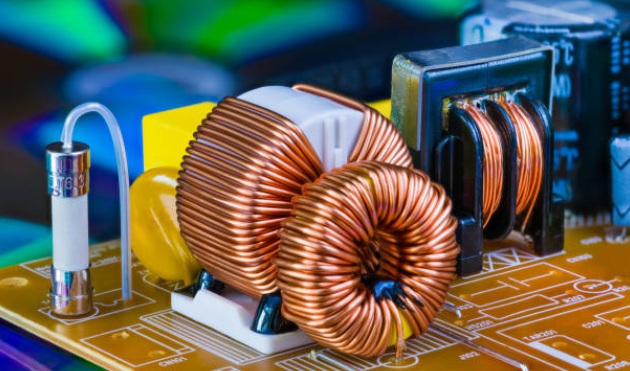
Why Does Winding Quality Determine Real-World Efficiency?
The core sets the ceiling on performance. The winding determines how close you get to it. Toroidal transformers use high-purity copper wire wound in a tight, uniform pattern around the entire circumference of the ring.
Uneven winding creates resistance imbalances. Resistance imbalances generate heat. Heat is wasted energy. The accuracy of winding in eliminating these imbalances ensures that resistance is kept to a minimum, efficiency to its maximum and performance does not vary depending on whether the transformer is carrying light load or heavy continuous current.
What Is the Protection of Insulation to the Toroidal Transformer in Strenuous Situ?
A Toroidal transformer that performs perfectly in a lab but degrades under real operating conditions is not a reliable transformer. The insulation system in a toroidal transformer is built to handle what industrial and medical environments actually throw at it.
Several levels of insulation PET with windings and Mylar tape on the outside cover have triple purposes: they ensure no electric leakage between windings, enhance thermal conductivity to ensure that the transformer operates in a high-efficiency manner, and ensure moisture, dust, and mechanical stress protection. In applications where hard industrial conditions are a requirement or are required to obtain a safety certification; this insulation system is what enables the transformer to service to specifications throughout its entire service life.
How to Pick the Right Toroidal Transformers
Step 1 : Calculate Your Load
Sum up the power of all the equipment on the secondary. Add 20% on top as a buffer.That sum is your minimum VA rating.
Step 2 : Confirm Input Voltage
North America runs on 110V or 120V. Most of the world uses 220V to 240V. ATO covers all the standard inputs and custom voltages up to 690V.
Step 3 : Set Your Output Voltage
Standard outputs are 12V and 24V. If your application requires any other type of voltage, state it during the quote process any voltage up to 690V is available.
Step 4 : Think About the Environment
• High heat: PET and Mylar insulation handle elevated temperatures reliably.
• Chemicals: Double-varnished copper winding resists most industrial environments.
• Medical or audio: Specify low EMI requirements and high isolation level upfront.
Conclusion:
Toroidal transformers are not a luxury option, it is the correct choice when alternative transformers fail to work in the application. The reduced heat production, the reduced noise, and the greatly decreased loss of energy all provide it with high-level performance and long-term stability.
Supported by decades of technical engineering experience, toroidal transformers nowadays are developed to cater to a variety of power needs, both small-scale electronics and large-scale industrial systems. They are very versatile, and adhere to the internationally accepted standards, including CE, RoHS, CQC and VDE, and, therefore, can be used in a variety of environments all over the world.
When it comes to projects that require accuracy, high durability, and clean and efficient power, selection of the appropriate transformer is a very important choice. Not only does a carefully designed toroidal transformer enhance the functioning of the system, but it also guarantees higher efficiency and dependability as time goes by thus a smart and futuristic decision to apply in any application.

