

Retail is one of those fields that looks simple until you spend a Saturday afternoon on the sales floor. If you are applying for your first role, looking at a retail resume example can help you see how to present everyday strengths like reliability and problem-solving in a way that actually fits the job.
Managers are looking for people who can show up on time, learn quickly, stay calm with customers, and keep the store moving when things get busy. Experience helps, of course. But attitude and common sense can carry a lot of weight, especially for entry-level roles.
Why Retail Is Still a Great First Job
Retail has long been a starting point for students, newcomers, career changers, and people returning to work after time away. It gives you a close-up look at how stores run and how teams deal with pressure in real time.
It is also a broad industry. “Retail” can mean a grocery store, pharmacy, fashion boutique, electronics shop, home improvement warehouse, luxury store, garden centre, cannabis retailer, bookstore, or online fulfilment operation. And the work can look very different depending on where you land.
In Ontario alone, the retail trade sector employed 841,500 people in 2024, making up 10.3% of the province’s workforce, according to Job Bank sector data. That same source notes that part-time work is more common in retail than across the wider economy, which is one reason the sector often appeals to people who need flexible schedules.
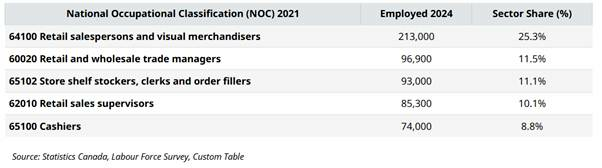
That does not mean every retail job is easy to get or easy to keep. Some roles are seasonal, and some teams are stretched. But for someone trying to build early work experience, retail still offers a chance to prove yourself quickly.
Skills Retail Managers Notice
The best retail workers are not always the loudest or most naturally outgoing. Some are just excellent at reading what customers need, while others are energetic and great at keeping a queue moving. Different stores value different personalities.
Still, a few skills show up again and again.
- Communication is the obvious one. You need to explain products clearly and listen when a customer is confused or frustrated.
- Reliability is just as important. When one person is late or cancels often, everyone else feels it.
- Attention to detail matters more than people think. Prices, displays, sizes, stock counts, expiry dates, promotions, and return policies all leave room for small mistakes that can become annoying problems.
- Patience is a big one. Customers may be rushed, distracted, disappointed, or not sure what they want. Taking that personally makes the day longer than it needs to be.
- Basic comfort with technology helps too. Most retail workers use point-of-sale systems, scanners, tablets, scheduling apps, inventory tools, or self-checkout support systems. You do not need to be a tech expert, but you need to be willing to learn without freezing up.
What Entry-Level Retail Work Usually Involves
A first retail role might include greeting customers, answering product questions, folding or arranging merchandise, working the cash register, restocking shelves, preparing online orders, handling returns, cleaning high-traffic areas, or helping with opening and closing routines.
The exact mix depends on the store. In a small shop, one person may do a bit of everything, while in a large retailer, tasks are often more structured. You might be assigned to cash, sales floor, stockroom, curbside pickup, customer service, or visual merchandising.
This is where many new workers get surprised. Retail is not only “selling.” A good part of the job is keeping the store ready for the next customer. That can mean facing shelves, checking sizes, replacing tags, moving boxes, tidying displays, and noticing when something looks off.
It is not glamorous work every minute. But it teaches habits that transfer well: staying organized, managing small tasks quickly, dealing with people, and understanding how a business makes money.
Understanding the Reality of Retail Schedules
Retail schedules can be a blessing or a headache, depending on what you need. Some people love evening and weekend shifts, and others need predictable hours because of school, childcare, transport, or another job.
Be honest about your availability. Saying you’re available anytime will catch up with you fast. At the same time, being too narrow can make it harder to get hired.
A useful middle ground is to be clear and flexible, where you truly can be. The wider labour and staffing picture is such that retailers have to match staff levels with customer traffic, seasonal demand, online orders, and budget pressure. For workers, that means the most useful people are often the ones who are dependable and able to help during peak periods.
Simple First-Step Plan
If you are starting from zero, keep it simple.
First, choose the types of stores where you would not mind spending time. Then, browse professional retail resume examples to prepare a polished, one-page resume that focuses on reliability, people skills, availability, and any practical experience.
Once you get an interview, prepare to talk specifics about how good you are at handling pressure and whether you’re the type of person to go out of your way to help someone.
Retail is not perfect. Customers can be strange, and schedules can shift. But it can also be one of the fastest ways to earn experience and learn how people behave when money, time, choice, and expectations all meet at the checkout.

