

Fragmented commerce created fragmented intelligence. The autonomous commerce engine is the architecture that finally closes the gap.
Somewhere between the third platform and the fifth tool, the technology that was supposed to help became the thing that needed managing. Dashboards multiplied, AI assistants stacked up, and the seller became the connective tissue holding it all together. Somewhere in that collapse lives what this article calls the Artisan’s Paradox and the architecture that finally resolves it.
This is the story of that problem, and what it costs when the intelligence running your business only ever sees part of it.
Three Sellers, One Person
Picture the same person at three different screens.
On Shopify, they are a rational analyst. Conversion rates, A/B tests, cart abandonment sequences. They speak the language of funnels and cohorts. Decisions are data-led and methodical. They feel, briefly, in control.
On Amazon, they become someone else entirely: a ranking-chaser, a keyword tactician, a competitive intelligence operative. They read buy-box dynamics the way a poker player reads a table. They live inside Seller Central, watching ad spend curves and BSR shifts, looking for the moment to press or pull back.
On Instagram, they transform again. Now they are storytellers. Aesthetics, captions, scroll-stopping thumbnails. They know which content earns saves versus shares. They understand that trust is built in one-second impressions and that the algorithm rewards consistency they can barely maintain.
Same person. Same brand. Same ambition. Three operational identities, three sets of tools, three entirely separate digital lives, none of which are aware of each other.
A competitor slashes prices on your core Amazon SKU on a Friday afternoon. Your social promotional calendar, locked in two weeks ago, is already committed to pushing that exact product all weekend at full price. Nothing connects those two facts. You run the campaign. You lose the buy box. You paid to drive traffic to a listing you were already losing. The data existed. It just never met.
This is the shape modern commerce pressed them into. You sell where your customers are. Your customers are everywhere. So you go everywhere. And somewhere along the way, you stopped running a business and started managing a machine.
There is a name for this tension. It is the first tax the machine levies, and almost no one sees it coming. The people best at building products, the ones with the sharpest taste, the deepest customer intuition, the most original vision, are the same people most crushed by the operational complexity of selling online. Running a store in 2026 demands fluency in SEO, ad optimization, data analytics, social algorithms, pricing science, competitive intelligence, and inventory forecasting.
None of which has anything to do with the reason they started. This is the Artisan’s Paradox: the more time you spend managing the machine, the less time you have for the craft that makes your business worth buying from. Every platform you add deepens it. Every tool you stack to manage those platforms deepens it further. The paradox does not resolve by working harder. It compounds.
Multi-channel selling is still worth the complexity: sellers operating across multiple platforms still earn 190% more revenue than those who stay on a single platform. But the operational weight of managing that complexity has grown faster than any tool built to handle it. The Artisan’s Paradox scales with your ambition. The further you grow, the more of yourself the machine consumes.
Your AI Only Knows Part of You
There is a deeper problem underneath the overload. It is structural, not behavioral. And working harder will not fix it.
The AI tools that were supposed to help are just as fragmented as the platforms they serve. They do not just fail to solve the Artisan’s Paradox. They extend it into the intelligence layer.
Shopify’s AI understands your store, with its conversion patterns, its abandoned carts, and its seasonal rhythms. But it knows nothing about your Amazon competitive position and is unaware of what your TikTok audience responded to last week.
Your social AI understands engagement, reach, saves, watch time, but cannot see that you are running out of the product it just helped you go viral with, or that your Amazon listing is being undercut while your Reels are climbing. Each system is an expert in one room of a house it has never fully explored.
The industry has quietly conceded this. As one 2026 independent review noted, Shopify Sidekick’s value is entirely contingent on being deeply embedded within Shopify, a structural concession that confirms what sellers have long sensed: platform-native AI is, by design, platform-captured.
It cannot see past the walls of the ecosystem that built it. This is the Platform-Switching Tax: every time you move between systems, you pay it in the form of context lost. And every time you pay it, the Artisan’s Paradox tightens its hold.
The consumer side tells the same story in reverse. 73% of consumers touch three or more channels before making a purchase. They move fluidly across platforms, carrying a unified sense of the brand. The buyer experiences coherence. The seller operates through fragments. The irony is architectural.
“Your AI only knows part of you. And the part it doesn’t know is where most of your decisions get made.”
In 2026, the average e-commerce merchant runs six to eight separate AI tools. Consolidation has overtaken adoption as the primary barrier to ROI. The stack itself has become the burden. Unified commerce, as the industry currently defines it, addresses the operational layer by syncing inventory, logistics, and pricing. It does not fix the intelligence layer. Operations get unified. Awareness stays fragmented. That gap has not yet been clearly named.
89% of retailers are already using or testing AI, and most remain in reactive mode: they ask, it answers, nothing happens when they are not watching. The question for 2026 is not whether to use AI. It is whether to keep treating it as a suggestion engine or finally let it become an operator.
What Being Seen Whole Actually Feels Like
Imagine a different architecture entirely.
Instead of three assistants each taking notes in a separate meeting, never comparing them, never aware of what the others heard. Imagine one operational brain that was in all three rooms. One system carrying context across every platform, every channel, every decision you have made this week.
It already knows what happened on Amazon this morning when you open your Shopify dashboard at noon. When you ask about your TikTok content strategy, it already understands your inventory position, so it does not recommend promoting the SKU you are about to run out of.
When a competitor drops prices on Amazon, it cross-references your Shopify margin data and your Instagram promotional calendar before suggesting a response. It holds context the way a senior colleague holds it. Not because you briefed it every time. Because it was there.
What would it feel like if you didn’t have to do that anymore? Not switching between tools, but working with one system that already knows what you know. One AI that knows all of you.
Grow your store profits with agents that know how to sell.
“One operational brain. One system carrying context across platforms. The difference between being understood and being processed.”
The Autonomous Commerce Engine
StoreClaw was built from a precise diagnosis: the fragmentation itself is the problem. Not any individual tool’s limitations. The fragmentation. The fact that intelligence is split at the seams of every platform you sell on, leaving the seller as the router between systems that were never designed to talk to each other.
StoreClaw is not a better version of those tools. It is a different category entirely. An autonomous commerce engine, a system that generates, launches, optimizes, and converts on your behalf, across every channel you operate, from a single operational layer. Not a chatbot. Not a copilot. An operator. Not another layer added to the machine. The system that finally makes the machine disappear.
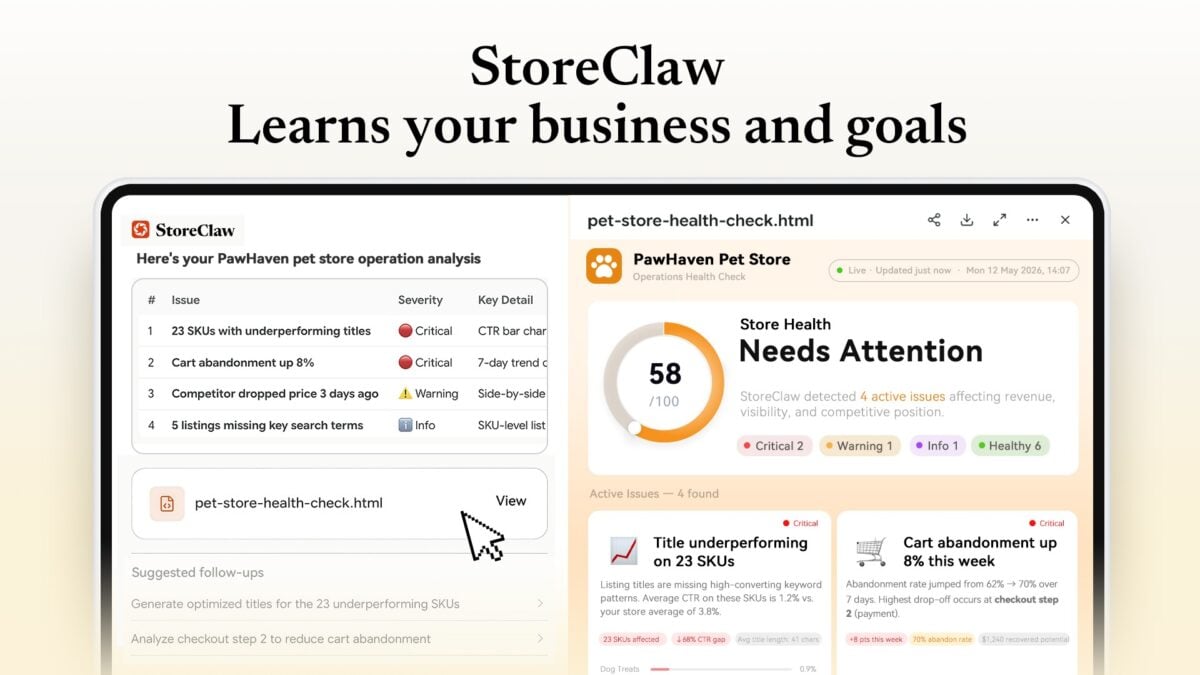
The distinction is not semantic. Every other AI tool in e-commerce is built around a conversation interface: you ask, it suggests, you decide, you execute. The operational burden stays exactly where it was, with the seller, while AI becomes a smarter search engine. The work does not move. StoreClaw is built for the post-copilot era. The AI does not wait to be asked. It connects to your business, reads the data, identifies the gap, executes the action, and reports the outcome. The shift is from copilot to colleague, from AI that responds to AI that operates.
You read the brief in the morning. StoreClaw compiled it overnight.
Why Every Other Category Falls Short
The landscape in 2026 falls into three categories, and understanding where each breaks is how you understand why StoreClaw exists.
General AI agents have no pre-loaded commerce knowledge. E-commerce point solutions are competent inside their lane but blind outside it. Platform-native AI feels sufficient until you sell on more than one platform, and then its structural limits become impossible to ignore.
StoreClaw is built to solve what all three cannot: a unified intelligence layer with pre-loaded commerce expertise, native connections across every channel you sell on, and automation that runs whether you are present or not.
One System. Every Channel. Ready on Day One.
StoreClaw arrives pre-loaded with thirty-plus commerce-specific AI skills: store diagnostics, listing optimization, PPC analysis, SEO and GEO, social content generation, customer insights, competitor radar, pricing intelligence, inventory health monitoring, each a functional working system, not a prompt template.
A seller launching on Amazon gets keyword-informed listing copy based on what is actually working in the category right now. A DTC brand expanding to TikTok Shop gets content that already understands the platform’s native format and the brand’s established voice across other channels. The skill knows what you need because it has access to context that earlier tools never did.
That context comes from the underlying Connector architecture. StoreClaw connects natively to Shopify, Amazon, WooCommerce, and eBay on the store side, and to Instagram, TikTok, X, LinkedIn, Discord, and WhatsApp on the social and community side, with every channel flowing into a single operational layer.
When the competitor radar identifies a rival cutting prices on a core SKU, that signal is evaluated against your inventory position, your Amazon PPC performance, and your Shopify conversion data simultaneously.
When the social content skill drafts a LinkedIn post, it already knows what you said on Instagram this week and what your promotional calendar looks like. The intelligence is not generated in isolation. It is generated with the full picture.
“StoreClaw’s intelligence doesn’t live on one platform. It lives at the intersection of all of them, where the real decisions actually get made.”
Works While You Don’t
StoreClaw runs tasks continuously. Not because you triggered them, but because they are scheduled, configured once, and running. Competitor monitoring at 3 am. Listing quality checks before the market opens. Inventory alerts fired by sell-through velocity, not by a seller manually checking a dashboard.
Customer sentiment analysis is running across review channels while the seller is doing something else. The morning brief is a StoreClaw staple: what changed overnight, why it matters, what StoreClaw has already handled, and what it is flagging for human judgment.
AI does not replace judgment. It processes the information so judgment can be applied to what matters, not consumed by monitoring tasks that the system should handle anyway.
For cross-border sellers expanding into new markets, this layer is existential: information asymmetry is severe, and StoreClaw’s continuous automation closes it. And for every independent DTC brand, Amazon seller, or growing multi-channel operator who cannot afford a ten-person ops bench, StoreClaw produces exactly what that bench would: competitive intelligence, optimization depth, 24/7 monitoring, and strategic synthesis. Intelligence, wired in.
The Gap Closes
The Artisan’s Paradox has a resolution. The one that named itself the moment you recognized it and the one that deepened with every platform you added and every tool you stacked. Not in working harder. Not in adding another point solution to a stack that is already the problem. But in building an operating layer underneath the business that carries the intelligence load, so the founder can carry the vision. StoreClaw is not a tool added to the paradox. It is the first system built to dissolve it.
The structural infrastructure shift is already happening. Enterprise software is becoming API-native, enabling AI to run it. The outcome economy is replacing the tool economy. Autonomous systems are replacing copilots. E-commerce is not ahead of this shift. It is next in line.
StoreClaw exists because the intelligence gap is real, structural, and solvable. One AI that knows all of you. One pane of glass for the entire operation. One system is running while you are not watching. The post-copilot commerce infrastructure is not a future roadmap item. It is here.
What percentage of your business does your AI actually understand?

