

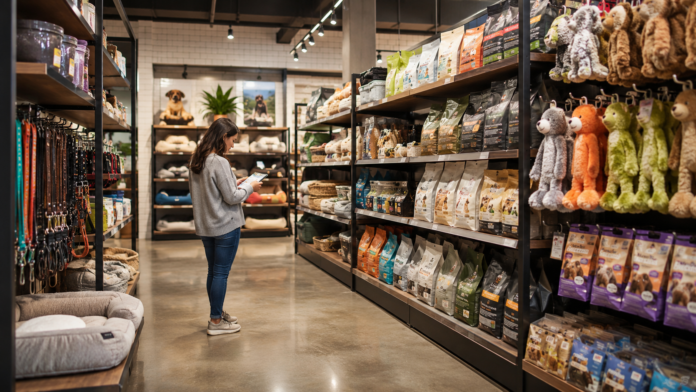
The American Pet Products Association reported that US pet industry spending reached $158 billion in 2025, with projections pointing to $165 billion in 2026. In Canada, the pet industry hit CAD 12.4 billion in 2023 and is expected to reach CAD 15.2 billion by 2027. These are numbers that get cited often, but rarely unpacked. For anyone in retail trying to understand where the actual growth is, the category-level breakdown matters more than the top line.
Food and treats: still the biggest slice
Pet food and treats remain the dominant spending category by a wide margin. American consumers spent $68.3 billion on pet food and treats in 2025, representing roughly 43% of total industry expenditure. In Canada, premium pet food alone accounted for CAD 2.9 billion in 2023, a full 50% of the country’s total pet food market, which signals how far the trade-up trend has gone.
The premiumisation wave in pet food is not new, but it has deepened. About 42% of dog and cat owners now choose to spend more on premium formulations, according to industry surveys. Raw dog food purchasing has seen a 147% increase over the past five years. Brands like Champion Petfoods, headquartered in Edmonton, price their Orijen and Acana lines at CAD 80 to 120 for an 11.4 kg bag, roughly 15 to 25% above standard kibble, and demand continues to grow.
Veterinary care and insurance: the second-largest category
American pet owners spent $41 billion on veterinary services and products in 2025, with spending forecast to rise to $42.4 billion in 2026. What is changing faster than the vet bill itself is the insurance market sitting behind it. US pet insurance premiums totalled $4.74 billion in 2024, up 21.4% year over year, making it one of the fastest-growing financial product categories in North America.

In Canada, vet-related spending is following a similar trajectory, though insurance adoption remains lower. Only about 1.2% of Canadian pet owners currently carry pet insurance, which suggests substantial runway for growth as awareness catches up with the American market.
Supplies and accessories: where the margin story lives
Americans spent $34.4 billion on pet supplies, live animals, and over-the-counter medicine in 2025. Within that broad category, the accessories and hard goods segment is where the most interesting shift is taking place. During 2022 to 2025, the pet accessories market expanded by an estimated $9.2 billion globally.
The growth is being driven not by volume but by product quality and price point. Average annual spending per dog has doubled over the past decade, from roughly $1,200 in 2015 to over $2,400 in 2025. For cats, spending grew from approximately $800 to nearly $1,600 over the same period. That increase is not because owners are buying more items. They are buying better ones.
Material and design upgrades are central to this shift. Ceramic and stainless steel are gaining share over plastic in feeding and hydration products. The sourcing base for these products is diversifying beyond the traditional East Asian supply chain. Ukrainian customs data, for instance, shows that Miaustore, a ceramic pet fountain brand, was the country’s largest exporter of household ceramics in 2022, with a 17.4% share of exports in the category. It is one example of how specialised pet product manufacturing is emerging in unexpected markets.
Services: the fastest-growing segment
Pet care services (boarding, grooming, insurance, training, and pet sitting) cost Americans $14.3 billion in 2025 and are projected to reach $14.9 billion in 2026. Over the past decade, the services category has roughly doubled, making it the fastest-growing major segment in the industry. Within services, training and enrichment represent the highest-growth subcategory, driven by urbanisation and the increasing demand for professional support with pet behaviour and socialisation.
Online is accelerating across all categories. US pet owners spent $28.8 billion buying pet food and supplies online in 2025, up 3.1% year over year. In Canada, online pet product sales contributed CAD 2.1 billion in 2023. For retailers, the question is no longer whether to invest in e-commerce but how to integrate it with physical store experiences. Chains like Pets at Home in the UK and PetSmart in North America are already executing this model, with in-store services wrapped around a digital purchasing backbone.
The bottom line
The pet economy is not a single growth story. It is several overlapping ones: premiumisation in food, rapid adoption of insurance, a material upgrade cycle in accessories, and a doubling of the services market. For retailers allocating shelf space and capital, the headline number matters less than understanding which of these sub-trends aligns with their customer base, and where the margin is actually expanding.

