

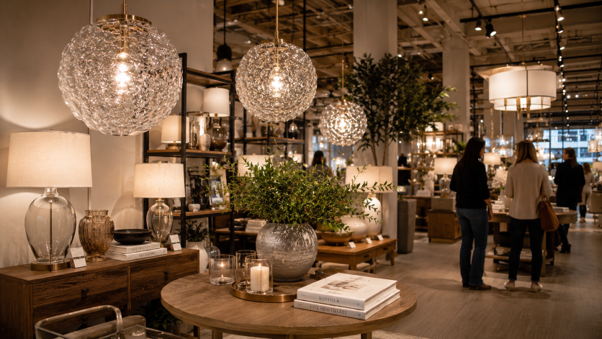
Walk into any major home goods retailer right now and you’ll see something that wasn’t there two years ago. End caps filled with statement lighting. Full aisles dedicated to fixtures. Even impulse displays near checkout.
What changed? The margins finally made sense.
Lighting used to be a low-priority category. Functional, sure, but not profitable enough to justify prime floor space. Then production costs dropped, import logistics improved, and consumer behavior shifted online. Retailers noticed people were researching fixtures digitally but still wanted to see them in person before buying. That’s when the category went from afterthought to strategic focus.
Why Lighting Became a Retail Priority
The numbers told the story first. According to the American Lighting Association’s 2025 retail report, decorative lighting sales grew 34% year over year in Q4 2025, outpacing nearly every other home category. Retailers who expanded their lighting assortments saw basket sizes increase by an average of $47 per transaction compared to those who didn’t.
The shift wasn’t just about demand. It was about margin structure. Decorative fixtures carry better margins than basic replacements. A builder grade ceiling mount might net 18% after MarkDown. A statement piece can hit 45% or higher, especially when retailers curate around trending styles that move quickly.
That’s where fixtures like a well designed bubble light chandelier started showing up in big box stores. These weren’t utility products. They were visual merchandising anchors that pulled customers into the aisle and created aspiration around an otherwise boring category. When shoppers see something that looks like it belongs in a design magazine, they stop. And when they stop, they browse the whole section.
The Merchandising Model That Made It Work
Retailers didn’t just add more SKUs. They rethought how lighting was presented. Instead of organizing by wattage or socket type, they started building lifestyle vignettes. Kitchen setups. Bedroom styling. Home office displays.
The strategy worked because it solved a customer problem. Most people don’t know what fixture goes where. They know what feeling they want. Retailers who built displays around that emotional outcome saw conversion rates double in some categories. Data from the National Retail Federation shows that experiential displays increased lighting category conversion by 58% compared to traditional fixture racks.
Placement mattered too. Lighting moved from the back corner near electrical supplies to high-traffic zones. Some chains put curated fixture collections near furniture. Others placed them adjacent to paint and wall decor. The logic was simple. If someone’s redecorating, they’re thinking about the whole room, not just one element.
What Worked on the Floor
Not every lighting style performs equally. Retailers learned quickly which designs moved and which sat. Mid-century shapes did well. Anything with visible bulbs or industrial detailing sells consistently. Oversized fixtures for dining rooms and entryways became anchor pieces that justified larger purchases.
But the surprise category was accent lighting. Small-scale pieces that customers bought on impulse. Things like sculptural desk lamps or decorative bedside fixtures that didn’t require installation. When merchants introduced more options like a sleek table lamp with glass details positioned near home office furniture, attachment rates jumped. People were already buying a desk or chair. Adding a $60 lamp felt like finishing the look, not an extra expense.
Target and West Elm both reported in early 2026 that their tabletop lighting categories outperformed expectations by over 20%. The key was positioning them as decor, not utilities. Instead of asking “do I need a lamp,” customers asked “does this fit my style.”
How Independent Retailers Adapted
Big box stores had buying power, but independent retailers had flexibility. Smaller shops couldn’t compete on price, so they focused on curation and service. They carried fixtures you couldn’t find at the chain down the street. They offered installation referrals. Some even started staging rooms in the store to show how lighting changed a space.
This approach worked in markets where consumers valued expertise over convenience. According to Lighting Magazine’s Q1 2026 survey, independent retailers captured 23% of the decorative lighting market despite representing less than 12% of total retail square footage. Their advantage was knowledge. Staff could answer questions about lumens, color temperature, and dimming compatibility. That mattered when customers were spending $200 or more on a single fixture.
The challenge for independents was inventory risk. Carrying enough variety to seem relevant without overextending cash flow required careful planning. Many partnered with distributors who offered consignment or fast reorder windows. Others focused on a narrower style range and became known for it. If you wanted farmhouse lighting, you went to one shop. For a modern minimalist, another.
Where the Category Is Headed
Retailers aren’t done experimenting with lighting. The next phase is about integration. Smart fixtures that work with voice assistants and app controls are moving from specialty stores to mainstream assortments. Pricing is dropping fast. What cost $180 in 2024 is under $90 now for comparable functionality.
Expect to see more collaboration between lighting brands and furniture retailers. IKEA’s already doing it with their TRÅDFRI line. Wayfair’s bundling fixtures with room packages. The goal is to reduce friction. When someone buys a dining table, suggesting a matching chandelier becomes automatic, not optional.
Sustainability is starting to show up in messaging too. LED adoption is near universal, but now retailers are highlighting recyclable materials, low-waste packaging, and energy certifications. It’s not the primary purchase driver yet, but it’s becoming table stakes for premium segments.
Practical Takeaways for Retail Buyers
If you’re sourcing lighting for retail, focus on versatility first. Fixtures that work in multiple settings move faster than hyper-specific designs. A simple pendant works in a kitchen, entryway, or bedroom. A highly ornate baroque chandelier only works in one type of home.
Pay attention to finish trends. Matte black and brushed brass are still strong. Chrome is softening. Anything too trendy risks markdowns in six months. Stick with finishes that photograph well for online listings because most customers research before they visit.
Don’t underestimate installation anxiety. Fixtures that require hardwiring scare off DIY customers. Anything plug-in or easily swappable has a wider audience. If you’re carrying hardwired pieces, make sure your staff can confidently explain installation or provide referrals.
Frequently Asked Questions
Why did retailers wait so long to prioritize decorative lighting?
Margins weren’t there until recently. Import costs dropped, manufacturing efficiency improved, and consumer willingness to spend on home decor increased post-pandemic. Once the unit economics worked, retailers moved quickly to capture the category.
What makes a lighting fixture successful on the retail floor?
Three things: visual impact, versatility, and clear differentiation from what’s available online. Shoppers want to see scale and finish in person. If your fixture looks identical to the $40 version on Amazon, it won’t move at $120 in store. Unique design or premium materials justify the markup.
Are smart lighting fixtures worth stocking for smaller retailers?
Only if you can support them, smart fixtures require more customer education. If your staff can’t explain setup, compatibility, and troubleshooting, you’ll get returns. Larger retailers can absorb that cost. Smaller shops should focus on what they can service well.
How do you merchandise lighting without overcrowding the space?
Vertical displays work better than spreading fixtures across multiple aisles. Use height variation to show different styles without eating floor space. Lifestyle vignettes need less square footage than you think. A six-foot section can showcase a full room concept if it’s styled intentionally.
Final Thoughts
Lighting went from a fill-in category to a margin driver because retailers finally treated it like furniture. They curated it, styled it, and gave it space that reflected its value to customers. The stores that figured this out early are seeing the payoff now. The ones still treating fixtures like commodities are wondering why the category isn’t performing.
The lesson isn’t complicated. When you sell aspiration instead of function, people spend more. That works for lighting. It works for most of home goods. Retailers just needed the margins to justify the effort. Now that they have them, expect this category to keep growing.

