

Retail has always been shaped by trust.
Whether a customer is reading a product description, comparing brands, browsing a buying guide, or interacting with AI-powered customer service, they are constantly making decisions based on the credibility of the information in front of them. Today, that trust faces a new challenge: the explosive growth of AI-generated content.
Generative AI has become an everyday tool for retailers, marketing teams, agencies, and eCommerce operators. Product pages can be created in minutes. Customer emails can be personalized instantly. Social media campaigns can be launched at unprecedented speed. While these capabilities improve efficiency, they also introduce an important question:
How do businesses know when AI is helping—and when it’s becoming a liability?
This is exactly where Lynote.ai enters the picture.
Rather than treating AI as something to fear or blindly embrace, Lynote.ai provides businesses with practical tools to understand, verify, and refine AI-generated content. Its combination of advanced AI detection and intelligent humanization makes it especially valuable for retailers who depend on authentic communication to build customer confidence.
AI Content Is Everywhere in Retail—Whether Customers Notice or Not
Few industries have adopted AI as quickly as retail.
Marketing teams rely on language models to draft newsletters and advertising copy. Marketplace sellers generate thousands of product descriptions. Customer support teams automate FAQs and responses. Internal teams create reports, supplier communications, and training materials using AI every day.
The productivity gains are undeniable.
However, AI-generated text often shares recognizable patterns:
- repetitive sentence structures
- overly polished wording
- generic explanations
- predictable transitions
- missing brand personality
Consumers may not consciously identify AI-written content, but they often recognize when something feels “off.” That subtle loss of authenticity can reduce engagement, weaken brand identity, and ultimately affect purchasing decisions.
Retailers therefore face a balancing act: benefiting from AI efficiency without sacrificing genuine communication.
Detection Has Become More Sophisticated Than Simple Pattern Matching
Many AI detectors available today still rely on relatively shallow statistical analysis. They may identify obvious AI-generated text, but performance often drops once the content has been rewritten or lightly edited.
Lynote.ai approaches the challenge differently.
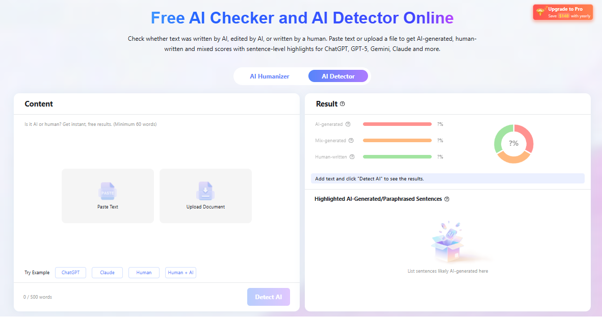
Its best free ai detector is designed to recognize content produced by virtually every major language model, including GPT-5, Gemini, Claude, LLaMA, and other modern AI systems. More importantly, it is capable of identifying AI-generated text even after it has been paraphrased or intentionally “humanized” by other rewriting tools.
That capability matters.
As AI writing tools become more advanced, simply looking for repetitive wording is no longer enough. Detection now requires understanding writing behavior, linguistic consistency, and deeper contextual signals.
According to Lynote.ai, its detector achieves up to 99% accuracy under supported conditions while offering multilingual detection across English, Spanish, French, German, Portuguese, and numerous additional languages. For retailers operating internationally, that broad language coverage eliminates the need to rely on multiple specialized tools.
Humanization Isn’t About Fooling Readers

The term “AI humanizer” sometimes carries the wrong impression.
Some assume humanizers merely replace words with synonyms or randomly alter sentence structure. Those approaches typically make content less readable rather than more natural.
Lynote.ai takes a far more thoughtful approach.
Its best ai humanizer analyzes the logic, context, tone, and flow of a document before rewriting it. Instead of changing isolated words, it restructures sentences while preserving meaning and improving readability.
The result is content that sounds like it was written by an experienced professional instead of generated by a machine.
This distinction becomes particularly valuable in retail.
Product pages need to persuade without sounding robotic.
Buying guides should educate while maintaining authority.
Email campaigns should feel personal rather than automated.
Brand storytelling requires consistency that generic AI outputs often struggle to achieve.
Lynote.ai’s humanization engine supports outputs originating from ChatGPT, Gemini, DeepSeek, Claude, and other major AI systems. With support for more than 80 languages and customizable bypass modes, businesses can adapt content for different publishing environments while maintaining a natural writing style.
Standing Out in an Increasingly Crowded Market
The AI software landscape is expanding rapidly.
Well-known platforms like Originality.ai, GPTZero, Copyleaks, and Winston AI have earned strong reputations in AI detection, each serving different user groups and use cases.
Lynote.ai distinguishes itself by combining both sides of the workflow.
Instead of asking users to switch between separate detection software and rewriting platforms, it allows them to evaluate content and improve it within one ecosystem.
That integrated experience saves time for content teams, agencies, and retailers managing large publishing pipelines.
The ability to detect rewritten AI content also addresses a limitation that many traditional detectors continue to face. As AI-generated writing becomes increasingly sophisticated, identifying heavily edited machine-generated text has become one of the industry’s biggest technical challenges.
Retail Success Still Depends on Human Trust
Technology changes quickly.
Consumer expectations do not.
Customers still respond to brands that communicate clearly, honestly, and naturally.
AI can dramatically accelerate content production, but speed alone rarely builds loyalty. The brands that succeed will be those using AI responsibly—leveraging automation while ensuring every customer interaction feels authentic.
That philosophy aligns closely with what Lynote.ai is building.
Its detection technology helps organizations understand where AI has influenced content. Its humanization capabilities help transform that content into writing that reflects genuine communication rather than mechanical generation.
For retailers navigating increasingly competitive digital markets, this combination is becoming less of a convenience and more of a strategic advantage.
As AI continues reshaping commerce, the question is no longer whether businesses should use artificial intelligence. The more meaningful question is whether they have the right tools to ensure AI supports trust instead of undermining it.
Lynote.ai makes a compelling case that the future belongs to organizations capable of achieving both efficiency and authenticity—and in retail, that balance may ultimately be the strongest competitive advantage of all.

