


Retail launches have traditionally been built around commitment. A concept is developed, merchandise is sourced, inventory is purchased, branding is completed, systems are configured, marketing is funded, and then the market decides whether the idea works.
That sequence is still appropriate for established formats with strong evidence behind them. For a new retail concept, however, it can force too many expensive decisions to be made before the retailer has learned enough about customer demand.
Digital commerce offers another approach. Instead of treating launch day as the moment when the business finally meets the market, retailers can use a smaller online launch to test the commercial assumptions first. The goal is not to build a miniature version of the final business. It is to create the smallest credible customer experience that can answer the questions that matter.
The framework below summarizes a practical “test before you scale” sequence for evaluating a new retail idea.
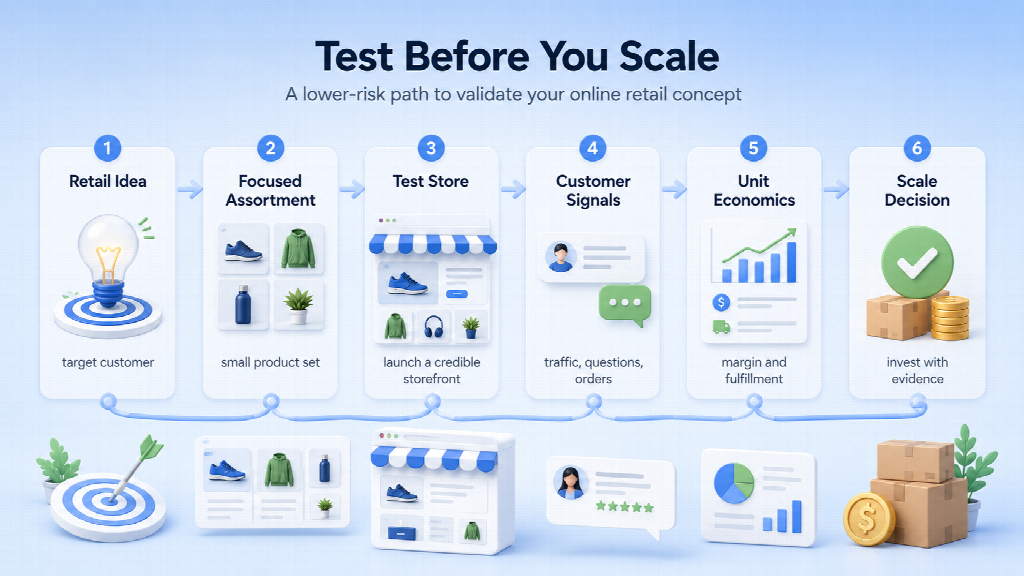
Start With a Commercial Question, Not a Website
The first question should not be which theme to choose or how many products to upload. It should be what the retailer needs to learn.
A useful hypothesis identifies a customer, a need, an offer, and a reason the concept might win. For example, an independent home retailer might test whether urban customers will pay more for a tightly edited collection of storage products designed for small spaces. A specialty food business might test whether an existing local audience will reorder online when delivery is convenient enough.
Those are testable propositions. “We want to sell online” is not. The narrower the commercial question, the easier it becomes to interpret the results and decide what to change next.
Treat the Initial Assortment as a Hypothesis
A test does not need the full assortment a mature business might eventually carry. In many cases, a deliberately limited range produces better information.
A focused assortment reduces inventory exposure and makes customer behavior easier to read. It also forces merchandising discipline. Each item should support the concept rather than simply fill space.
For an early test, retailers can favour products with manageable order quantities, reliable replenishment, clear use cases, and margins that can absorb realistic fulfillment costs. The aim is to learn what customers respond to before committing deeply to breadth.
This is especially useful when a retailer is evaluating a new category, a new audience, or expansion beyond the geographic reach of an existing store.
Build Only What the Test Requires
A test storefront still needs to feel credible. Customers should see accurate product information, transparent pricing, delivery expectations, return terms, contact details, mobile-friendly navigation, and a checkout that works.
What the test does not necessarily require is a custom technology stack, a large portfolio of applications, or months of design work before the first customer arrives.
Hosted commerce platforms such as Shopify make it possible to assemble a working storefront quickly, which allows more of the early effort to go into the offer, merchandising, customer experience, and demand signals rather than infrastructure.
The technology should be sufficient to run the experiment without becoming the experiment itself. If the concept later proves it needs more sophisticated integration, customization, or workflow, that investment can be made with better evidence.
Use Controlled Traffic to Learn, Not to Declare Victory
A retailer does not need a national campaign to test whether a proposition attracts interest. Relevant traffic from an existing customer list, local awareness, social channels, search, partnerships, or a modest advertising test can produce useful early evidence.
Traffic quality matters more than headline volume. Thousands of poorly matched visitors can make a concept look weak for the wrong reason. A smaller group of prospective customers who actually resemble the target market can be far more informative.
Each traffic source should have a purpose. If an email list is expected to validate interest among existing customers, measure that. If search advertising is being used to test whether people actively look for the product category, measure that separately. Combining every source into one top-line traffic number hides the learning.
Read the Funnel as a Diagnosis
Early sales matter, but the path to the sale often tells the retailer more than the sales total alone.
If visitors arrive and rarely move beyond the landing page, the positioning or audience may be wrong. If shoppers view products but do not add them to cart, the problem may be assortment, price, product presentation, or trust. If carts are created but checkout completion is weak, shipping cost, delivery timing, payment choice, or checkout friction deserves attention.
The point is not to overreact to a tiny sample. It is to use behavior to form the next question. A controlled test should create a sequence of increasingly specific decisions rather than one binary verdict on whether the idea is “good” or “bad.”
Pair Digital Behaviour With Direct Customer Feedback
Analytics can show where customers stop. It cannot always explain why.
Retailers can improve the quality of the test by speaking directly with a small number of customers and non-buyers. Ask what they expected, what felt unclear, what they compared the offer with, what nearly stopped the purchase, and what would make them return.
These conversations are particularly valuable for unfamiliar categories or premium products, where hesitation is often caused by questions that the retailer did not realize needed answering.
The strongest signal is not praise. It is repeated behavior or repeated friction that points to the same commercial issue.
Test the Economics Before You Test Scale
Early revenue can create false confidence if the cost of producing the order is not understood. Retailers should model the contribution economics of several realistic order types before increasing traffic.
That calculation should include merchandise cost, packaging, payment processing, fulfillment, shipping subsidies, discounts, returns, and customer acquisition. A concept that appears attractive at the gross-margin level may look very different once the cost of getting the order to the customer is included.
This is particularly important for store-based retailers moving further into ecommerce. An online order can introduce fulfillment and service costs that are not obvious in a traditional in-store transaction, even as it creates the opportunity to reach customers outside the store’s normal trade area.
If the model only works when every customer buys a large basket, pays full price, and never returns anything, the concept is not ready for aggressive expansion.
Define the Next Investment Before the Results Arrive
A useful experiment has a decision rule. Before the test begins, the retailer should decide what evidence would justify the next commitment.
That next commitment might be a larger inventory order, higher marketing spend, expanded geographic coverage, additional staff, a broader assortment, a physical pop-up, or deeper technology investment.
The threshold will vary by category. A high-ticket retailer may learn from a relatively small number of serious enquiries and completed purchases. A frequently purchased consumer product may need a larger transaction sample and evidence of repeat intent.
The discipline is to avoid moving the goalposts after the results arrive. Predefined criteria reduce the temptation to continue because money has already been spent or because the team has become emotionally attached to the concept.
Online Testing Can Inform Physical Retail Decisions
This framework is not only for digital-first businesses. Store-based retailers can use online testing before making larger physical commitments.
A retailer considering a new product category can launch a tightly edited online collection, measure which items attract attention, learn what questions customers ask, and assess demand beyond the current store catchment area. A business considering a pop-up can test the message and product mix before committing to space. A retailer planning geographic expansion can compare response from different regions before making a location decision.
In that sense, ecommerce becomes a research environment as well as a sales channel.
The Strategic Advantage Is Optionality
Retail has always required decisions under uncertainty. Digital commerce does not eliminate that uncertainty, but it can lower the cost of answering some of the questions that used to require a much larger launch.
When the first version of a concept is designed to learn, the retailer preserves optionality. A strong response can justify deeper inventory, marketing, systems, and physical expansion. A weak response can be diagnosed, revised, or stopped before the commitment becomes much larger.
That is the real value of testing before scaling: not avoiding risk, but taking the next risk with better information.
Conclusion
The most useful first version of a retail concept is not necessarily the most complete one. It is the version that can answer the most important commercial questions at an acceptable cost.
By defining the hypothesis, limiting the initial assortment, building a credible storefront, attracting controlled traffic, reading the full customer journey, checking the economics, and setting decision rules in advance, retailers can turn launch from a single high-stakes event into a sequence of informed investments.
The objective is not to prove the idea at any cost. It is to learn enough to know whether the next investment deserves to be made.

