

Modern retail technology connects marketing, e-commerce, customer communication, and performance analysis. Marketing brings potential customers into the business, while e-commerce platforms support product browsing and transactions. When customers need help, the journey often moves to WhatsApp.
A WhatsApp CRM helps retailers organise this consultation stage. It can route enquiries to the right team, record customer context, manage follow-up, share conversation information, and provide managers with performance data.
The complete workflow can be understood as:
Marketing traffic → customer routing → e-commerce browsing and ordering → WhatsApp enquiry → follow-up → management reporting → repeat purchase
Marketing Brings Customers Into the Retail Journey
Retailers attract customers through social media, paid advertising, email, influencers, physical stores, and other promotional channels.
A shopper might click an Instagram advertisement, scan a QR code in a shop, or follow a campaign link before opening a WhatsApp conversation.
At this point, the retailer needs to understand where the customer came from and which team should handle the enquiry.
A standard WhatsApp link may open a conversation, but it does not always provide enough information about the traffic source or direct the customer to the most suitable team.
Routing Links Connect Traffic With the Right Team
WADesk routing links can connect marketing activity with customer conversations.
Retailers can create different links for campaigns, markets, languages, or customer types. Enquiries entering through these links can then be directed to the appropriate sales or customer service group.
For example, a retailer might create separate routes for:
- UK customers;
- French-speaking customers;
- German-speaking customers;
- wholesale enquiries;
- online retail customers;
- specific advertising campaigns.
This reduces manual reassignment and gives each customer a clearer entry point.
Routing-link statistics can also help retailers compare traffic sources. Instead of only measuring clicks, the business can see which campaigns or regions generate actual WhatsApp conversations.
E-Commerce Platforms Support Browsing and Ordering
Once customers enter the retailer’s digital environment, the e-commerce platform handles product pages, inventory, shopping baskets, payments, and order records.
However, not every shopper completes a purchase without assistance.
Customers may want to confirm product availability, sizing, delivery time, specifications, or purchasing conditions. Higher-value products and wholesale orders may require several conversations before a decision is made.
This is where the customer journey moves from website activity into human consultation.
A WhatsApp CRM for e-commerce can give retailers more structure around this stage.
A typical workflow might be:
Campaign link → routed WhatsApp entry → product browsing → customer enquiry → assigned employee → recommendation → follow-up → purchase
Customer Follow-Up Becomes a Visible Process
A WhatsApp conversation may begin with a simple question, but the customer may not purchase immediately.
They may compare products, discuss the decision internally, or return several days later. If follow-up depends only on employee memory, promising enquiries can easily be missed.
WADesk can help retailers move customers through a defined follow-up process, such as:
New enquiry → contacted → needs identified → product recommended → awaiting decision → order completed
Employees can see the customer’s current stage and understand what should happen next. This makes follow-up more consistent and reduces reliance on personal notes or reminders.
Shared Conversations Support Team Follow-Up
Retail customers may interact with several employees during the same buying process.
One employee may answer the first product question. Another may confirm stock, while a third follows up later. If each person only sees part of the conversation, the customer may need to repeat information.
Shared customer records allow authorised team members to review the same conversation history and background.
Before continuing the conversation, an employee can quickly understand:
- what the customer asked about;
- which products were recommended;
- whether any concerns were raised;
- who handled the previous conversation;
- the customer’s current status;
- when the last contact occurred;
- what the next action should be.
This is especially useful for secondary follow-up. A new employee can continue the conversation without reconstructing the customer’s situation from screenshots or short internal messages.
It also protects customer relationships when an employee changes shifts, moves to another department, takes leave, or leaves the company.
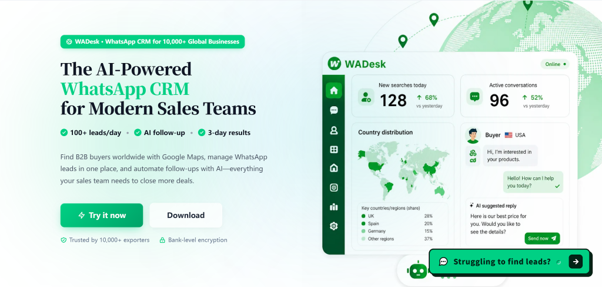
Management Dashboards Show Team Performance
Frontline employees need customer context and clear follow-up tasks. Managers need a wider view of the entire process.
A management dashboard can bring together data about:
- new customer enquiries;
- traffic from different routing links;
- average response time;
- customers awaiting follow-up;
- follow-up completion;
- customer status distribution;
- employee workload;
- regional or campaign activity.
This allows managers to review performance without opening every conversation individually.
Conversation volume alone does not show whether the team is working effectively. Managers also need to know whether customers receive timely responses and continue moving through the sales process.
Response Time and Follow-Up Efficiency Matter
Retail customers are often comparing several products or sellers. If a question remains unanswered for too long, the customer may purchase elsewhere.
Response-time data can help managers identify understaffed periods, overloaded employees, or markets requiring more support.
Follow-up data can reveal other problems. A team may respond quickly to new enquiries but fail to contact customers again after sending a recommendation.
Managers may discover that:
- many enquiries are not being qualified;
- customers remain at the same stage for too long;
- follow-up is inconsistent across teams;
- some campaigns generate conversations but few serious buyers;
- certain employees are managing too many active customers.
These findings can guide staffing, training, and customer-assignment decisions.
Connecting Marketing Data With Customer Outcomes
Routing-link data can help connect marketing activity with later customer conversations.
A retailer may use separate links for an Instagram campaign, paid search, an influencer partnership, and a physical-store QR code. WADesk can record how many customers enter WhatsApp through each source.
When this information is combined with customer status and follow-up data, the business can ask:
- Which campaigns generate the most conversations?
- Which sources bring customers who progress further?
- Which markets require the most assistance?
- Which campaigns create high enquiry volume but low purchase intent?
This gives marketing and sales teams a more connected view of customer acquisition.
Customer Data Can Support Repeat Purchases
The journey does not need to end after the first order.
Retailers can use previous conversations, product interests, and customer history to support repeat engagement. A customer might be contacted when an item returns to stock, a related product becomes available, or a reorder may be due.
Because employees can review the customer’s earlier context, the communication can be more relevant than a generic promotional message.
Conversation data may also improve other parts of the retail business. If customers repeatedly ask about sizing, the product page may need clearer information. If many shoppers ask about stock, the website may need better inventory visibility.
These insights can support decisions across marketing, merchandising, website content, staffing, and customer retention.
Building a Connected Retail Technology Workflow
WhatsApp CRM should not be viewed as an isolated messaging tool or a replacement for an e-commerce platform.
Its role is to organise the consultation and follow-up stage within the wider retail journey:
Marketing generates traffic → WADesk routing links direct and measure customer entry → the e-commerce platform supports browsing and ordering → WhatsApp CRM manages consultation and follow-up → shared records support team collaboration → dashboards measure performance → customer data supports repeat purchases
Each system has a different role.
Marketing attracts the customer. The e-commerce platform supports the transaction. WhatsApp CRM manages the human conversation around that transaction. Management reporting then helps the retailer improve future performance.
For retailers, the goal is to create a connected workflow where traffic can be measured, enquiries can be assigned, customer context can be shared, follow-up can be tracked, and managers can use the resulting data to improve sales and customer retention.

