

A Question With Four Different Answers
Ask how much carriers overbill shippers and the answer depends entirely on who you ask. One audit firm says 15 to 20%. Another says 2 to 20%. A freight-audit advisory puts it at 5 to 10%, with cases running as high as 40%. A fourth source, auditing over 124 million shipments in Q2 2026, says the “carriers overbill you and you just have to find it” story is largely a pre-2020 narrative that hasn’t caught up to how much more accurate carrier billing systems have become.

All four can’t be measuring the same thing, and they aren’t. The more useful question for a finance or fulfillment leader isn’t which number is right. It’s which categories of discrepancy are structured enough to catch automatically, and which aren’t billing errors at all.
For a retailer shipping tens of thousands of parcels a month, the difference between these framings isn’t academic. Carrier surcharges alone now make up roughly 40% of total parcel spend for the average direct-to-consumer brand, up from about 28% in 2022, and every one of those surcharge line items is a place a rate table, a contract term, or a packaging decision can go wrong. Knowing which of those wrong turns can be caught by a rule, and which one needs a person looking at the shipment, is the actual operating question, well before anyone gets to arguing over which industry benchmark to trust.
Why the Benchmarks Disagree So Much
Same Category, Different Populations
The spread in cited error rates isn’t a sign that nobody knows what they’re talking about. It’s a sign that “error rate” means different things depending on what’s being counted and over what population.
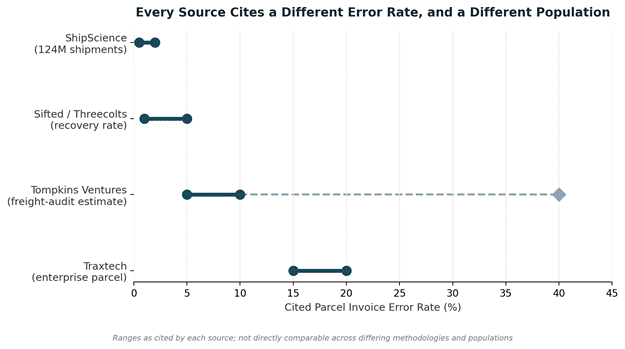
Traxtech’s enterprise parcel audit research puts the figure at 15 to 20% of invoices containing billing errors or recoverable service failures, a number that includes dimensional weight miscalculations, misapplied accessorial fees, duplicate charges, and unapplied contract discounts, counted at the invoice level rather than the dollar level. A separate estimate from a freight-audit advisory firm puts general freight and parcel error rates at 5 to 10%, with the caveat that this is an experience-based industry estimate rather than a measured study, and cases can run as high as 40% in specific shipper profiles.
The Contrarian Data Point Worth Taking Seriously
ShipScience’s Q2 2026 Parcel Refund Index, drawn from over 124 million audited shipments, tells a different story entirely: carrier billing accuracy has improved meaningfully over the last five years, most invoices it audits are now technically correct against the published tariff and contract, and both FedEx and UPS have narrowed their money-back service guarantees since the pandemic to a handful of premium express service levels. As of 2026, FedEx’s Money-Back Guarantee covers only Priority Overnight, Standard Overnight, First Overnight, and 2Day AM, while UPS’s Guaranteed Service Refund covers Next Day Air, Next Day Air Saver, Next Day Air Early, and 2nd Day Air A.M. only. The pool of dollars recoverable from straight carrier billing mistakes is genuinely smaller than the older playbook assumes.
The One Number Every Source Agrees On
None of these sources are wrong. They’re counting different populations against different baselines. What every serious source agrees on, regardless of the headline error rate, is the actual recovery benchmark once an audit runs: most shippers recover somewhere between 1% and 5% of total shipping spend through invoice auditing alone. That’s the number worth anchoring on. A vendor promising recovery well outside that range, in either direction, is a reason to ask harder questions about their methodology before signing anything.
Easiest to Automate: Deterministic, Rule-Based Errors
The categories of error that automate cleanly share one property: checking them is a boolean comparison against structured data, with no judgment call involved.
Duplicate Charges
The simplest case. The same tracking number, the same charge type, billed twice. A system comparing every line item against every other line item catches this with no ambiguity about whether it’s actually an error.
Late-Delivery Guarantee Refunds
Similarly mechanical, though the eligible population has shrunk considerably since the guarantee scope narrowed in the sections above. Checking eligibility is a simple lookup: service level, promised delivery timestamp, actual delivery timestamp. If the shipment falls outside the narrowed guarantee scope, there’s nothing to file regardless of how late it arrived, which is itself worth automating just to stop teams from wasting time disputing shipments that were never eligible.
Unapplied Contract Discounts
Both UPS and FedEx implemented 2026 General Rate Increases averaging 5.9%, with specific lanes seeing 8 to 12%. Billing system configurations frequently lagged behind the new published rates, meaning some shippers were charged at the updated tariff without their negotiated discount applied on top. Comparing the contracted rate schedule against the actual charged rate, line by line, is exactly the kind of check a rules engine handles without any human review.
Misapplied Surcharge Codes
Address correction fees, which can exceed $20 per shipment, residential surcharges, and delivery-area surcharges all have defined trigger conditions in the contract. When the trigger condition wasn’t actually met but the fee was charged anyway, that’s a rule violation a system can flag automatically.
Harder to Automate: Errors That Need Judgment
Some categories look similar on the surface but require more than a lookup table to resolve.
Address Correction Disputes
Address correction fees are the clearest example of this ambiguity. The fee is designed to apply when a shipping label has genuinely incomplete or incorrect address information. But it can also trigger from formatting discrepancies or ZIP code validation mismatches on an address that was actually correct to begin with. Automating the detection of “was this fee charged” is trivial. Automating the determination of “was this fee actually earned” requires comparing the original label data against the carrier’s validation logic, which isn’t always transparent enough to fully automate, and some cases still need a human to review the original shipment record before disputing.
Dimensional Weight Reclassification
A system can flag that a shipment was billed at a higher dimensional weight than expected, but confirming whether the carrier’s measurement was actually wrong, versus the packaging genuinely being that size, often requires the original box dimensions and sometimes photographic evidence. The flag is automatable. The resolution frequently isn’t, at least not without a review step.
Not a Billing Error at All: The Operational Ones
This is the category most audit conversations blur into the “carrier overbilled you” narrative, and it’s worth separating out cleanly because the fix looks completely different.
ShipScience’s data shows 27 to 32% of shipments across a typical network are dimensional-weight impacted, meaning the carrier billed based on dimensional weight rather than actual weight. Only a fraction of those represent a genuine billing error. The larger pattern is packaging choice: an oversized box for a small, light item triggers a legitimate dimensional weight charge under the contract terms as written. The carrier isn’t wrong. The box choice is the problem, and no dispute filing recovers a charge that was correctly applied under the rate table both parties agreed to.
This distinction matters for how a finance or operations team should read their own audit dashboard. A high volume of dimensional-weight-related “flags” isn’t necessarily a sign the audit tool is finding money to recover. It might be a sign that packaging selection needs an operational fix, which is a different project with a different owner than filing carrier disputes.
Conflating the two wastes effort in both directions. A fulfillment team that treats every dimensional-weight flag as a billing dispute to file will spend time contesting charges that are contractually valid and will lose most of those disputes. A team that ignores the flags entirely because “the carrier isn’t technically wrong” misses the actual savings opportunity sitting in front of them, which isn’t a refund at all but a packaging or carton-selection change that prevents the charge from applying on the next shipment.
Manual Review Versus Automated Audit Technology
Why Timing Matters as Much as Accuracy
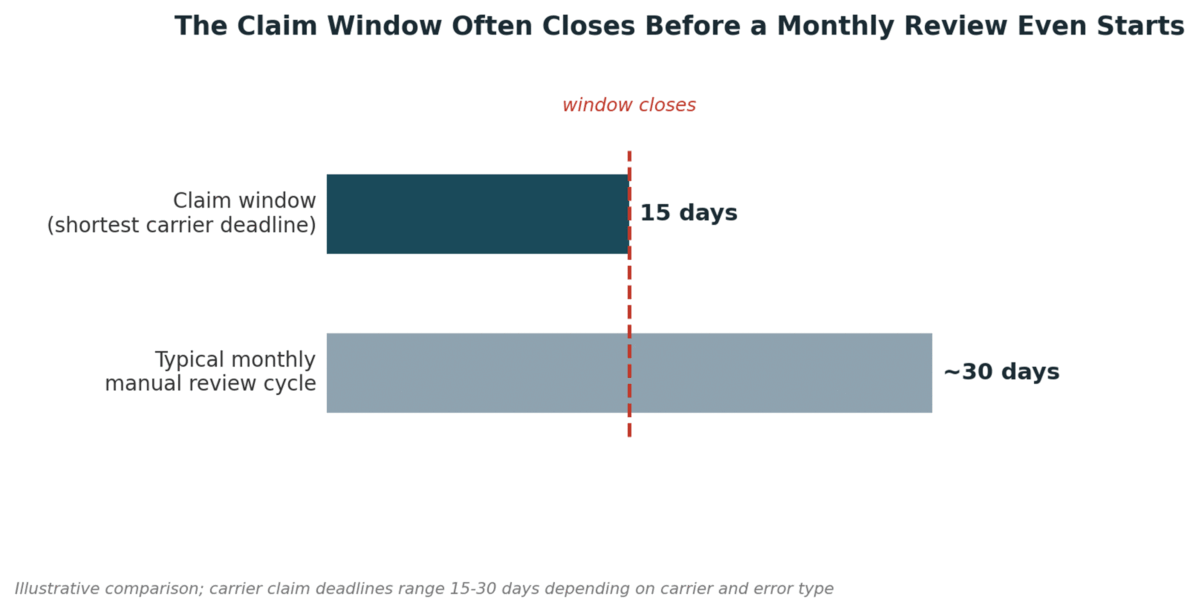
The mechanical categories above share a second property beyond being rule-based: they’re also time-sensitive in a way manual review structurally struggles with. Carrier claim filing deadlines run 15 to 30 days depending on the carrier and error type. A team running a monthly or quarterly manual invoice review is, by definition, checking most shipments after at least one relevant claim window has already closed.
What Continuous Processing Actually Changes
Automated parcel auditing (dash.fi/blog/parcel-audit-software) addresses this by processing invoices continuously as they arrive rather than in scheduled batches, running every line item against the same rule set daily instead of whenever someone gets to it, and flagging the deterministic categories, duplicates, guarantee eligibility, discount application, surcharge triggers, the same day they appear on an invoice rather than weeks later during a periodic review. Continuous processing doesn’t change which errors exist. It changes whether they’re caught inside the window that still allows a claim to be filed.
The categories that need judgment still benefit from automation as a triage layer, even without full automation of the resolution. Flagging a dimensional weight discrepancy or an address correction fee for human review the same day it posts is still faster than a human finding it three weeks into a manual pass through hundreds of invoices, even if a person still makes the final call.
Put a number on it. A retailer processing 40,000 parcels a month generates thousands of invoice line items across surcharges, base rates, and accessorial fees in that same window. A monthly manual review cycle means the earliest a reviewer even looks at week-one shipments is roughly three to four weeks after they shipped, right up against or past the 15-day claim deadline that applies to several of the deterministic categories above. The rule-based errors don’t require more analytical sophistication to catch. They require catching within a window that a monthly cadence structurally cannot hit for a meaningful share of shipments, no matter how good the reviewer is.
What This Means for the Benchmark Conversation
The 15% versus 5% versus “billing has gotten more accurate” disagreement stops being confusing once it’s read through this lens. Sources citing higher error rates are often counting the full population of discrepancies, including the ones that need judgment and the operational dimensional-weight cases that aren’t billing errors at all. Sources citing lower, more conservative recovery rates, in the 1% to 5% range, are typically measuring what actually gets recovered after the deterministic categories are audited and the ambiguous ones are resolved one way or the other.
Neither framing is dishonest. They’re answering different questions. A finance or procurement leader evaluating a parcel audit approach should ask which of these three tiers a given tool or process actually covers, because a solution that only catches the easy, rule-based categories will report a lower recovery rate than a headline benchmark promises, while still doing exactly what it should on the errors that are genuinely worth automating first.

