

Every retailer knows there’s a big difference between winning a customer for the first time and persuading one to come back. With a new customer, you’re building trust while competing for attention, but former customers are different. They already know your brand, have bought the product or experienced the service, and for whatever reason, decided it was no longer the right fit. So the challenge here isn’t getting them to notice you again, but understanding what changed before giving them a reason to believe in the relationship again. Well-designed customer rewards can play an important role in that process, but only when they’re used to rebuild trust rather than simply encourage another purchase.
Retailers have no shortage of win-back tactics, from discount codes and loyalty offers to gift cards and loyalty incentives. Some rebuild relationships. Others simply buy another transaction. Understanding the difference is what separates a successful win-back campaign from another short-lived sales promotion.
Why relationship repair beats price reduction
If you’re approaching a win-back campaign the same way you’d approach customer acquisition, you’re probably starting in the wrong place. Former customers don’t need to discover your brand. They already know who you are, so your goal now is to understand why they left and what would make returning worthwhile.
Reaching for another discount, while understandable, isn’t always the best move. Instead, ask yourself: “Why did this customer stop buying in the first place?”
If someone stopped buying because of a poor experience, changing needs or a stronger competitor, offering 20% off may generate another order without addressing the reason they left. A lower price changes the transaction, not necessarily the relationship.
The commercial case for getting this right is difficult to ignore. Research summarized by Harvard Business Review estimates that acquiring a new customer costs five to 25 times more than retaining an existing one, while Bain & Company found that increasing retention by just 5% can lift profits by 25% to 95%.
For most retailers, a lapsed-customer list is both a record of yesterday’s sales, and one of the biggest growth opportunities they already own.
Why discounts can become part of the problem
The challenge with repeated discounts isn’t just that they can fail to solve the underlying problem, they can also change customer behavior. Research by Carl Mela, Sunil Gupta and Donald Lehmann, published in the Journal of Marketing Research, found that sustained promotional activity makes customers increasingly price-sensitive over time. The more often discounts appear, the more shoppers learn to wait for them.
That’s where many win-back campaigns begin to undermine themselves. If every period of inactivity is rewarded with a better offer, customers don’t just respond to the discount—they begin to expect it. The campaign may recover the next order, but it also teaches customers that leaving can be worthwhile.
A gift changes the relationship, not the price
If another discount risks reinforcing the wrong behavior, what’s the alternative? Stop asking customers to buy again before you’ve given them a reason to want to.
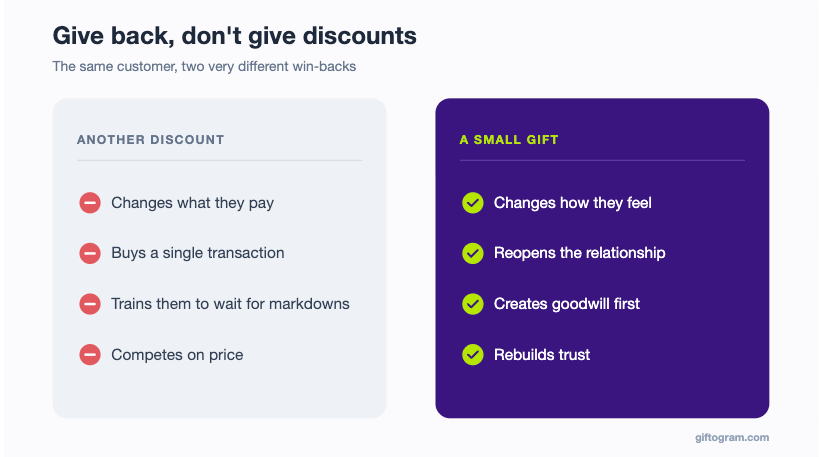
A small digital gift card changes the tone of the conversation. Instead of saying, “We’ll sell it to you for less,” it says, “We’d like to welcome you back.” The price of the product stays exactly the same, but the relationship starts from a different place.
One is a negotiation; the other is a gesture. Gifts create goodwill before asking for commitment. Research suggests giving first can influence how people respond. In a large field experiment published in Econometrica, economist Armin Falk found that including a small, unconditional gift significantly increased the likelihood of a response.
The principle is simple: giving first changes the tone of the interaction before asking for anything in return, which is one reason digital gift cards have become increasingly common in customer rewards programs. Unlike a store discount, they have value beyond the retailer’s own products and give recipients the freedom to choose something they genuinely want.
Customer rewards platforms such as Giftogram make that practical by allowing retailers to deliver digital gift cards through bulk campaigns. Rewards can be triggered from existing CRM and marketing systems, making it easier to run personalized win-back campaigns at scale.
The technology doesn’t create the thoughtfulness; it simply makes a thoughtful approach practical and repeatable. A discount changes what the customer pays. A gift changes how they feel about the business making the offer. One competes on price. The other starts rebuilding trust.
Where a gift card makes the most sense
Not every customer needs another offer. Some need a reason to feel differently about your brand. Take the customer who hasn’t bought in six to twelve months. A goodwill gesture often lands better than a discount here, precisely because it feels less like a transaction and more like being remembered. Or take the aftermath of a service failure. A refund fixes the money; it doesn’t always fix the feeling. An unexpected gift can.
A meta-analysis in the Journal of Service Research found evidence that, in some circumstances, a well-handled successful service recovery can leave customers more satisfied than if nothing had gone wrong.
Gift cards also work as a thank-you for private, post-purchase feedback, as long as the reward is never tied to a public review. Google’s policies prohibit incentivized reviews, so reward the feedback, not the rating.
Test the economics before you scale it
Like any retention strategy, the only way to know whether it works is to test it.
Start with one customer segment, one reward value and a genuine control group. Then measure the outcomes that matter: repeat purchases, incremental margin and customer value over time. Email opens and click-through rates may tell you whether the campaign was seen. They don’t tell you whether the relationship improved.
As campaigns grow, platforms such as Giftogram help centralize reward delivery and reporting, making personalized win-back campaigns easier to manage without adding manual administration.
Even when a customer doesn’t come back immediately, a gift card has still created a positive brand experience. Unlike another discount email, it’s a thoughtful interaction that can be personalized with your own branding and message, giving customers something of value rather than simply asking for another purchase. Whether they redeem it next week or remember the gesture months later, the reward continues working long after the email has been opened.
Conclusion
Every name on a lapsed-customer list represents someone who chose your business once before. Winning them back begins with understanding why that changed. Discounts, gifts and rewards are all tools. The results depend on choosing the one that solves the problem you’re trying to fix.

