

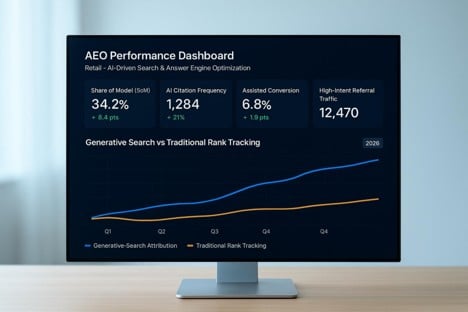
Retail brands can prepare for AI search by moving from basic keyword targeting to a structured digital system built around clear product entities. To succeed while machine learning systems create buying suggestions in real time, brands need verified product knowledge graphs, product pages that answer detailed conversational questions, clean structured data feeds, and teams that share the same standards for machine-readable information and customer trust.
For more than two decades, commerce followed a familiar pattern: a shopper typed two or three words into a search bar, scanned a page of blue links, and reached an e-commerce category page. That direct path is now breaking apart. Modern shoppers do not search only to browse. They ask large language models, conversational tools, and multi-modal assistants to solve specific lifestyle needs, compare small differences between products, and complete purchases without visiting several websites.
This shift may seem confusing, but it builds on many of the same search basics rather than removing them completely. In fact, SEO people are already on the frontline of AI. No other industry is so used to constant algorithmic change. The difference is that success no longer depends mainly on backlinks and keyword frequency. Visibility now depends on whether machine systems can find, check, and confidently combine your product information in their generated responses.
What AI Search Means for Retail Brands
From Ranked Links to Product Recommendations and Direct Answers
The traditional Search Engine Results Page (SERP) served as a list of possible resources. If a customer searched for “lightweight waterproof hiking boots,” the search engine might show ten organic links, several paid listings, and a local results section. The shopper had to open several tabs, read different descriptions, and compare sizing information on their own.
AI search changes this process by combining information into a single response. Instead of giving shoppers separate pages to study, services such as Google’s AI Overviews, Perplexity, and built-in conversational tools offer direct evaluations in natural language. The interface may suggest three specific models based on weight, breathability, and waterproofing limits gathered from different sources, with citations shown below. If your product is missing from that generated response, the shopper may never see it.
How Generative AI, Shopping Assistants, and Conversational Search Work
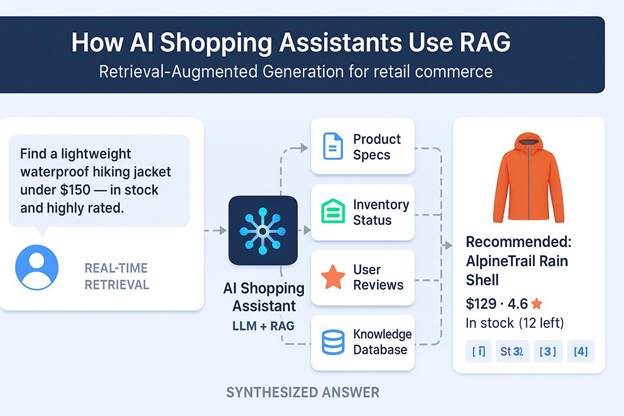
To gain visibility in this setting, retail leaders need a basic understanding of the technology behind these services. Modern conversational search often uses Retrieval-Augmented Generation (RAG). When a shopper asks an AI assistant a question, the system does not rely only on text learned during earlier training. It retrieves current facts from a search index or product database, adds those facts to the request, and creates a reasoned answer.
In retail, these systems must balance natural language with strict accuracy. They examine product measurements, materials, customer opinions, warranty information, and stock status. If a product page contains unclear wording or conflicting details, the system has less confidence in the product. It may then recommend a competitor with open, consistent, and well-organized specifications.
Why Search Is Splintering Across Google, ChatGPT, Retailer Apps, Marketplaces, and Voice Assistants
The starting point for product research has split across many services. Traditional search engines still bring in a large amount of traffic, but shoppers are also using specialist and closed interfaces. They may begin research in ChatGPT, use a shopping assistant inside the Amazon or Walmart app, or ask a voice assistant at home to reorder everyday items.
This spread means brands can no longer focus on one algorithm. Each service reads and ranks information through its own retrieval system. An AI tool inside a closed marketplace may give more weight to stock levels and delivery speed, while an open-web generative service may look at expert reviews, third-party opinions, and schema markup. Brands need a reliable base of accurate product information wherever these systems search.
How AI Search Is Reshaping the Retail Customer Journey
Conversational Product Discovery Replaces Single-Keyword Searches
Shoppers no longer have to reduce complex needs to short search phrases. Instead of typing “trail running shoes wide toe box,” a user might write: “I need a trail shoe for muddy terrain that accommodates bunions, has a zero-drop platform, and won’t fall apart after 200 miles.”
This type of exchange changes discovery from a passive search into a back-and-forth discussion. The AI assistant can ask about weekly mileage, weather, or color choices. If a brand’s product content covers only broad category terms and says little about detailed use cases or physical benefits, the system may pass over it. Brands that explain real-life uses in clear detail have a better chance of being included.
Query Fan-Out Expands One Shopping Question Into Multiple Intents
Modern generative search often uses a process called “query fan-out.” When someone submits a detailed shopping question, the system does not perform just one search. It breaks the request into several smaller searches. It may look at price comparisons, warranty conditions, independent durability tests, and sizing complaints in forums at the same time.
This parallel search examines your presence across the wider web within seconds. The system looks at what your official site says and at how professional reviewers, Reddit communities, and specialist publications support or challenge those statements. If your brand appears only on its own product pages, query fan-out will quickly reveal the limited outside support.
AI Shopping Assistants Compare Products, Prices, Reviews, and Availability
The research stage of shopping once involved many browser tabs and manual price checks. AI shopping assistants now handle much of that work. They can compare several product features and create a table that places your main product beside three close competitors.
These comparisons look at much more than price. The systems can study patterns in reviews, such as whether a piece of clothing shrinks in a washing machine or how quickly customer service handles return labels. Brands with verified customer experiences and clear product details are more likely to perform well in these automatic comparisons.
What AI Search Changes for Retail SEO and Content
Product Entities Matter More Than Isolated Keywords
Search engines and conversational models no longer treat the web as a collection of separate words. They read it as a network of things and their connections. In technical language, a product needs to exist as a defined “entity”: a distinct concept with a clear identity, attributes, relationships, and sources inside a connected knowledge graph.
When a catalog is handled as a group of product entities, content creation changes. Rather than repeating a target keyword throughout a description, the main task is to connect the product to official identifiers such as GTINs, MPNs, brand records, parent companies, and exact category levels. Once systems understand an item’s identity and setting, they can place it more confidently in an answer.
Product Pages Must Answer Comparison, Use-Case, and Trust Questions
A standard product detail page (PDP) with three bullet points, a sales paragraph, and an “Add to Cart” button does not provide enough information for AI-led discovery. Conversational systems use pages to answer specific concerns, so a PDP needs to work as a full source of product knowledge.
Pages should answer direct comparison questions such as: How does this version compare with last year’s release? Who should not use this product? How does it work in humid and dry climates? Adding clear answers to these questions gives the AI system reliable information for matching the product with the right shopper.
Content Formats Expand To Reviews, Buying Guides, FAQs, Video, and Images
Written content by itself is no longer enough. Generative search tools can work with several media types. They read text, examine detailed images, process video transcripts, and review structured data at the same time. A video that shows a stroller folding with one hand gives the system direct evidence for a question about travel convenience.
Brands need a connected mix of content formats. Detailed buying guides provide wider category knowledge, expandable FAQ sections answer specific questions, customer photos offer proof from real buyers, and professional testing or teardown videos support durability statements. Different formats give retrieval systems more ways to find and check information about your products.
The Retail Data Foundation Brands Need to Build
Create a Consistent Product Knowledge Graph Across Every Channel
An enterprise knowledge graph gives a company one shared source of meaning and product facts. It maps the catalog and shows how SKUs connect to collections, audiences, related accessories, materials, and certifications. Without this internal map, sending consistent information to external channels becomes very difficult.
When the same knowledge graph supports your direct-to-consumer store, wholesale portals, marketplaces, and social channels, AI systems gain more confidence in your brand information. Conflicts, such as different measurements on Amazon and your Shopify store, create uncertainty. Recommendation systems may then choose a competitor whose data is easier to trust.
Keep Prices, Specifications, Stock Levels, Delivery Details, and Returns Current
Current information has a strong effect on AI recommendations. A system is unlikely to suggest a product if it cannot confirm that the item is available, priced correctly, and able to arrive within the shopper’s required time. Recommending an unavailable or incorrectly priced product would reduce the usefulness of the service.
Retailers need to connect Enterprise Resource Planning (ERP) systems, inventory databases, and public product pages. Live API connections, regularly updated merchant center feeds, and quick schema changes help answer questions such as, “Can I get this by Friday?” with information the shopper can act on.
Use Schema Markup for Products, Offers, Reviews, Organizations, and Local Stores
Schema markup, usually written in JSON-LD, gives web crawlers a standard way to read the purpose and details of a page. Without it, systems have to guess what human-written text means. For retailers, basic Product markup is only the starting point.
Use connected schema types such as:
- ProductGroup and hasVariant to explain differences in color, size, and style.
- AggregateRating and individual Review markup to show genuine feedback from verified buyers.
- Offer and ShippingDetails markup for current price, currency, stock status, delivery information, and return periods.
- Organization and MerchantReturnPolicy markup to support brand identity and customer protections.
- LocalBusiness markup linked to store inventory to reach conversational searches such as “near me.”
A Practical AI Search Preparation Plan for Retail Brands
1. Map Customer Intent Across Discovery, Comparison, Purchase, and Support
Preparation starts with moving past simple conversion funnels and reviewing the real questions customers ask at each stage. Collect search logs, customer service chat records, helpdesk tickets, and forum conversations to learn the language people use while researching your product category.
Group these questions into four working areas: open discovery, such as lifestyle problems and compatibility needs; comparison, such as differences in brands, materials, and prices; purchase, such as delivery times, return rules, and warranties; and post-purchase support, such as setup, repairs, and care. Once these conversations are mapped, you can create pages that respond to each need directly.
2. Identify the Questions AI Assistants Must Answer About Each Product
Run simulated AI discovery sessions for every main SKU or product group. Use several leading conversational models to ask broad category questions, such as: “What are the best wireless noise-canceling headphones for running in the rain under $200?” Record which brands appear, which ones are missing, and what facts the systems use to explain their choices.
Look for gaps where the system says, “Information regarding the water resistance rating for Brand X was unavailable.” These gaps show where your content needs work. If an AI system cannot find a basic product attribute, add that attribute clearly to the page copy and to the structured data that machines can read.
3. Optimize Product Pages for Evidence, Clarity, and Factual Completeness
Rewrite product copy by replacing exaggerated sales language with measurable specifications and supporting proof. Instead of saying that a winter jacket offers “industry-leading warmth and supreme comfort,” say that it uses “800-fill-power Responsible Down Standard (RDS) certified goose down, rated for temperatures between -10°F and 20°F.”
AI systems respond well to clear, information-rich pages. Use tables, descriptive subheadings, and bullet lists for technical details. Add direct information about care instructions, certifications, environmental standards, and expected product life. When statements include measurable facts, retrieval systems can use them more easily in product comparisons.
4. Distribute Reliable Product Feeds To Search Engines and Marketplaces
Your content and stock systems should not remain separate from the services that publish product information. Send clean, checked feeds to search merchant centers, retail media networks, affiliate platforms, and shopping indexes on a regular schedule.
Feed attributes should match the structured data on your pages exactly. A mismatch between the price sent through an API feed and the price shown in the page HTML can trigger automated warnings. Those warnings may lower your merchant quality score and reduce the chance that your brand appears in conversational answer panels.
How Brands Can Use AI Without Losing Trust
Use AI-Assisted Workflows With Human Review and Source Verification
AI can help teams produce product descriptions, meta tags, and different FAQ versions at scale, but unchecked automation creates risks. Models trained on large collections of web text may use empty marketing phrases, weaken the brand’s writing style, or add small but serious errors.
Use a mixed workflow with people reviewing AI output. Generative tools can prepare drafts, organize information, and turn raw ERP data into readable text. Every published item should then be checked by technical writers or merchandising specialists. These reviewers can verify specifications, apply brand rules, and confirm that the text is accurate. Once the facts are verified, tone is the next thing to check. Drafts produced at scale often sound repetitive or robotic, which can make product pages feel less trustworthy to shoppers. You can humanize AI content so descriptions read more naturally and match the brand’s voice, then give the text a final editorial pass before publishing.
Prevent Inaccurate Product Claims, Hallucinated Specifications, and Outdated Offers
Incorrect AI content can create serious legal and reputation problems in retail. If an automated writing process invents an IPX8 waterproof rating for a product that is only resistant to light splashes, the brand may face returns, poor reviews, and attention from consumer protection agencies.
Set firm rules that keep generated content tied to trusted data. For internal AI tools, base prompts on approved specification sheets and prevent the system from adding facts that are not in those sources. Keep promotional terms, discount end dates, and bundle details up to date so external crawlers can read prices and offers correctly.
How to Measure Performance When Search Becomes AI-Driven
Track Visibility in Ai-Generated Answers, Citations, and Product Recommendations
Rank trackers that report positions one through ten no longer show the full picture of online visibility. Retail brands now need tracking methods such as Share of Model (SoM) and Answer Engine Optimization (AEO).
These tools regularly send high-intent shopping questions to major generative platforms. They record how often your brand appears in generated summaries, whether your product is chosen over competitors, and which pages are cited as sources. Tracking changes in citations can show whether retrieval systems are accepting and using your product data.
Measure Assisted Conversions, Branded Demand, and Qualified Traffic
Because AI services answer many questions directly on their own platforms, the number of clicks from broad informational searches may level off or fall. The visitors who do reach your site through an AI citation may be much closer to buying.
Shift attention to results further down the customer path. Track assisted conversion rates, growth in branded searches, average order value (AOV), and changes in direct traffic. A shopper who reaches your site after using a conversational assistant has already completed much of the product comparison process. Their buying intent is often stronger than that of someone casually browsing.
Monitor Product Feed Accuracy, Review Sentiment, and Answer Inclusion
Build technical dashboards that show the condition of your product data distribution. Track merchant center errors, schema validation records, crawl activity, and API synchronization delays. These checks help prevent technical problems from blocking systems that read your products.
At the same time, watch customer sentiment across review sites, forums, and retailer feedback areas. AI models consider written opinions as well as numerical ratings. A rise in complaints about weak packaging or slow delivery may quickly affect whether an AI system recommends your brand for urgent or reliability-focused searches.
What Retail Leaders Should Prioritize in the Next 12 Months
Fund Data Quality Before Expanding AI Content Production
As search technology changes quickly, many companies may want to publish thousands of AI-written articles, glossaries, and category pages. That approach confuses a large amount of content with authority. Pages with little useful detail simply add to the online material that modern search systems are built to filter.
Executives should invest in clean and reliable company data first. Buy or improve Product Information Management (PIM) systems, hire specialists who can organize product categories, fix old inventory mismatches, and add missing technical details. Trusted data is a long-term asset that supports AI search visibility and improves internal operations.
Build Cross-Functional Teams Across SEO, Ecommerce, Merchandising, and Technology
Separate departments cannot respond well to the speed of current search systems. If the merchandising team sets promotional prices, the technology team runs the stock API, the content team writes product pages, and the SEO team manages metadata without close coordination, the result will be a fragmented and conflicting digital presence.
Create shared Commerce Experience teams that bring together digital marketers, software engineers, data analysts, and inventory merchandisers. With common measures for stock availability, feed health, and customer-focused content, retail companies can build a flexible online presence that works across the conversational services shoppers use next.

