

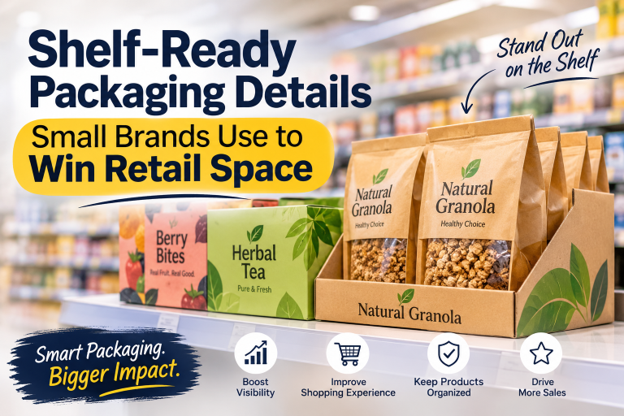
Getting a product into a store is only half the job. Once it is on the shelf, it has a few seconds to catch a shopper’s eye next to dozens of competitors, many of them backed by bigger budgets. For small brands, packaging is one of the few levers that can level that field, and the details that matter most are often not the expensive ones.
This article looks at the packaging choices independent brands are making to earn and keep retail space, from the box structure and print method to labels and premium finishes for higher-value products.
Choose a Print Method That Fits the Run Size
Many small brands overspend on printing because they choose a method suited to a far larger order. The right method depends mostly on quantity.
Packaging makers such as The Retail Packaging lay this out clearly. For runs from about 100 to around 1,000 units, digital printing needs no plates, allows several designs in one run and has a shorter schedule, with the trade-off that brand colors are built from process inks and come out close rather than exact. Every box is cut to the brand’s dimensions, which is why they stress getting the numbers right, since a die is made for one set of measurements and a resize after tooling means paying for the die twice. They also suggest checking the awkward spots when measuring, because bottles are usually widest at the shoulder and jars at the lid.
On finishes, they note that aqueous coating is the cheapest protection available and keeps paperboard recyclable, while foil, embossing and debossing need a die, a one-time cost. On a short run, keeping foil to a small logo mark controls that cost.
Design for the Shelf, Not the Screen
A box that looks striking in a mockup can disappear on a crowded shelf. Retail buyers and merchandisers judge packaging at arm’s length, under store lighting, next to competing products. That means bold, readable branding on the face that actually faces the shopper, and a clear indication of what the product is within a second or two.
Small brands often put too much on the front panel. A simpler face with one strong message, the product name and a clear visual cue tends to outperform a busy design. Supporting details, ingredients and instructions belong on the side and back panels, where an interested shopper will turn the box to find them.
Use Labels to Extend a Range Cheaply
Labels are one of the most useful tools for a growing brand. A single box design can carry several products when a label distinguishes the flavor, scent or size, which keeps packaging costs down while the range is still being tested.
Makers of custom glossy stickers offer formats suited to retail work, from 1 to 1.5 inch circles for jar lids and seals to 4 by 6 inch labels with room for ingredients and a barcode. Small die-cut stickers in the 2 to 3 inch range are their best sellers for merchandise, and anything from half an inch up to 24 by 36 inches can be produced, with pricing starting at $0.30 per sticker for small sizes at volume. They point out that a gloss surface shows every bubble and crease as a bright ripple, so careful application matters more than on matte, and that dark backgrounds that will be handled show fingerprints.
For food jars and sauce bottles, glossy labels give a bright, clean look that suits many specialty products. A matte finish may suit brands going for a natural or premium feel, so it is worth comparing samples.
Add Premium Touches Where the Price Justifies Them
Higher-value products need packaging that matches their price. A shopper paying a premium expects the box to feel substantial and the opening to feel considered. That is where rigid boxes, inserts and decorative finishes earn their cost.
Specialists in custom peptide packaging boxes describe the steps behind premium work clearly. The surface wrap and its coating come first, with soft-touch, uncoated fine paper and textured stocks all reading differently in the hand. Decoration follows, with hot foil, blind deboss, combined foil and deboss, spot UV and emboss each adding a separate pass, and therefore cost and lead time. They treat a physical sample as non-negotiable on premium work, because screen proofs cannot represent foil, texture or soft-touch. Inserts such as colored EVA foam or a wrapped board platform hold each item in place, and they warn that a premium box with an ordinary label undercuts itself at the moment of opening.
The broader point for any premium product is that the finishing has to be consistent. One expensive feature next to a cheap detail draws attention to the gap.
Make It Easy for the Store
Retail space is not only won by shoppers. Store staff have to receive, stock and display the product, and packaging that makes their job easier is more likely to stay on the shelf. Cases that are clearly labeled, boxes that stack without sliding and display-ready packs that can go straight onto a shelf all help.
Small brands can ask buyers what their stores prefer before finalizing case sizes and outer packaging. A five-minute conversation often reveals requirements that would otherwise show up as a rejected delivery.
Test Before You Commit to a Full Run
Before placing a large order, small brands benefit from putting a sample box on a real shelf. Placing it next to competing products under store lighting shows quickly whether the colors hold up, whether the brand name reads from a few steps away and whether the box stands straight. A sample also lets the team check that the product fits snugly and that labels sit where they should. These checks take a day or two and often prevent a costly reprint.
Small Details, Big Shelf Impact
The brands that hold their retail space tend to get a handful of details right. A print method matched to the run size, a front panel that reads at a glance, labels that let one box serve several products, premium finishes only where the price justifies them, and packaging that store staff find easy to handle. None of these require a large budget, but together they make a small brand look like it belongs on the shelf, which is often all a buyer needs to give it a second order.

