
In offices, there are inefficient processes hidden in mundane tasks, like the request to “put 2 image in one page pdf.” For example, a member of the finance team might need to consolidate two receipts on a single digital page for reimbursement, or an HR manager might need to place both sides of an employee ID in a single page for employee onboarding.
When a workflow requires “putting 2 image in one page pdf,” there are a variety of negative impacts on employees and the overall productivity of the workplace. The article covers the reasons for the gap in document workflow, how Artificial Intelligence is altering automation of document layout, and what companies should take into consideration when assessing document solutions.
Although these processes seem trivial, they create a significant workflow gap in managing documents. Traditional software is designed to support a single-page, single-image layout. When a workflow requires “putting 2 image in one page pdf there are a variety of negative impacts on employees and the overall productivity of the workplace. The article covers the reasons for the gap in document workflow, how Artificial Intelligence is altering automation of document layout, and what companies should take into consideration when assessing document solutions.
Why Putting 2 Image in One Page PDF Is Still a Manual Nightmare
Although progress has been made in digital workspaces, merging images into a single PDF page remains a cumbersome process. There are a number of systemic failures that occur when employees attempt to combine two images in a single PDF page.
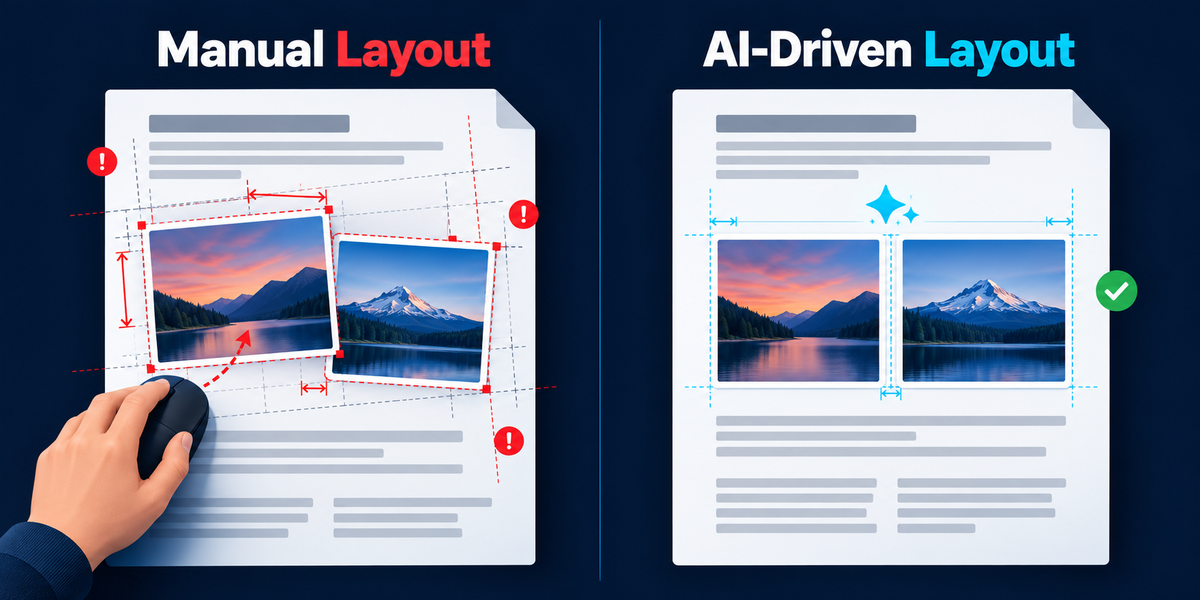
The first of these is the failure to maintain the aspect ratio of the images. When images are scaled down to fit on a single page, they may overlap with other elements of the document. As a result, the images may become distorted or cut off.
Second is fragmentation of workflows. Many basic converters work on a one-to-one basis. Users wanting to place 2 pictures on a single page PDF, first need to convert the pictures, and use a separate utility to stitch them in a “N-up” (multiple pages per sheet) format. This increases the opportunity for user error and wastes time.
There is also the rendering issue. As noted in technical forums, when users try to merge large pictures, the tools often produce blank pages or push the second picture to the next page, disrupting the flow of the document. These are not just bugs in the software. These are rather, a lack of intelligence in the tools to do page layouts.
How AI Is Transforming the “2 Image in One Page PDF” Workflow
AI is delivering measurable business impacts. Traditionally, users needed to manually manipulate images. Now with AI, tools are moving toward delivering impact based on user intent.
Rather than requiring the user to manually figure out dimensions, align, and scale images, AI understands the user’s intent. When for instance a user wants to merge 2 receipts, the system understands it is receipts, and therefore can determine the optimal layout to fit them, say for example by placing them vertically on top of each other.
Also, AI connects the dots of fragmented steps. Currently, a user can let an AI-powered PDF editor take care of the whole task. In the past, the user had to use multiple apps to accomplish the same task. Now, users no longer have to take screenshots, organize them in a page, and then upload them to a PDF. AI does all of that. AI analyzes input, proposes the best alignment of the two photos, and produces a print-ready output. Thus, users no longer have to worry about the manual layout of a document. All users, including non-technical users, can create documents effortlessly.
Evaluating Tools to Combine Two Images on One PDF Page
When business leaders assess software to optimize processes like combining images to a single PDF page, they need to review criteria beyond just basic features. When considering tools to combine images to a single PDF page, look at the following:
- Layout Control: Can the tool automatically align images to the edges when put side by side or stacked without distorting the images?
- Workflow Continuity: Can the tool automate the layout and arrangement of images and export to a single PDF?
- Output Reliability: Does the tool ensure no blank pages are generated and that all images are placed within page boundaries and are visible?

Some tools are addressing these friction points, and UPDF is a prime example. For putting 2 images on one PDF page, UPDF has simplified what was previously a multi-step process and is now completely automated. Users are able to choose the layout and let the tool do the rest to align the images to the edges. Because it processes documents locally on a user’s device, it meets the requirements for processing sensitive company data.
For more information and to see how to deal with images of different sizes and ensure the output is flawless, see this resource.
The Bottom Line
One example of a bigger trend in enterprise document management is the need to put two pictures on a single page of a PDF. These tiny document formatting tasks add up and slow down processes. The most compelling use cases for AI in this space will be in automating the insertion of structures and formats to documents. True value of AI will be derived from automating tedious document formatting tasks.
Businesses can address the micro-inefficiencies identified by Bain through the use of tools that help unify workflows and understand the intent of document formatting. The most useful tools in the modern workplace will be the ones that automatically accomplish the smallest tasks, like placing 2 pictures perfectly on a single page, to let employees focus on higher-impact work.