

Retailers who sell through Facebook Marketplace, run local ads across several cities or manage listings for multiple clients eventually hit the limits of one account, and many turn to the bulk account market. The suppliers people search for are not alike: some are built for fifty-at-a-time orders with automated delivery, others are gaming marketplaces with a Facebook category bolted on.
Here is how five of them compare on what is listed, how you pay, what you are charged, what you actually receive and what happens when an account fails, plus the operating rules that decide whether a batch is still alive a month later.
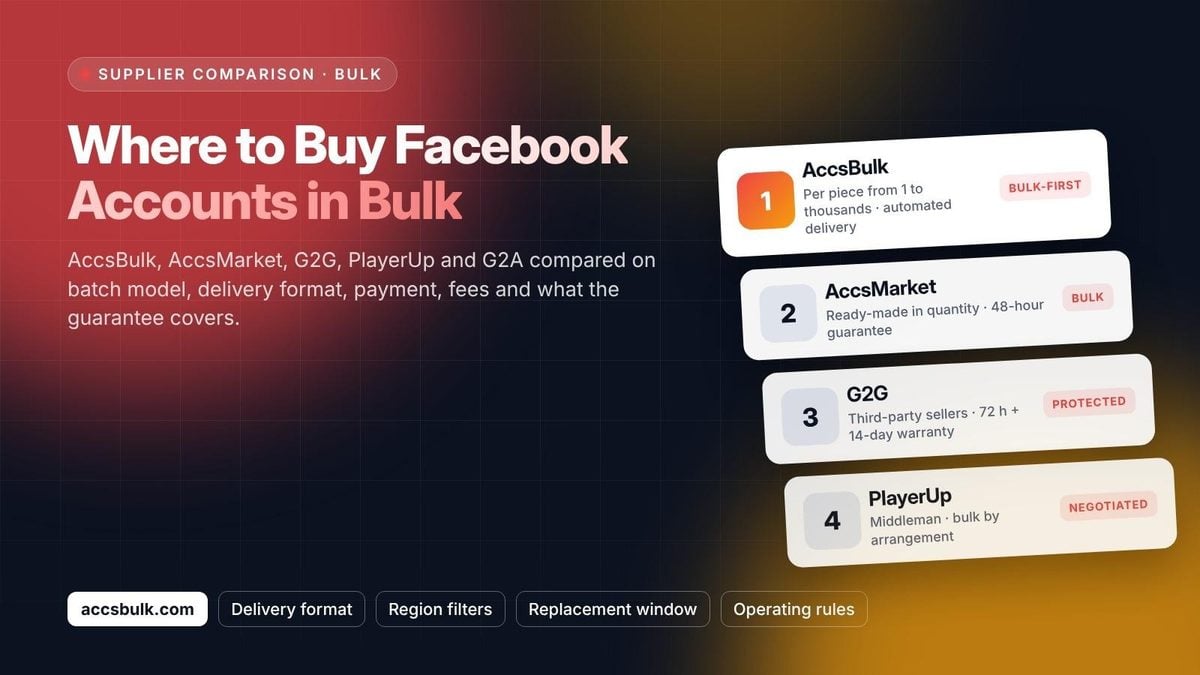
Bulk buying changes the questions: consistency across a batch and the replacement window matter more than any single account.
TL;DR
- AccsBulk leads for bulk Facebook orders: region and type filters, published listing attributes, automatic delivery and a 24-hour replacement window.
- AccsMarket is the main specialist alternative, but its guarantee comes with stricter conditions.
- G2G suits a protected trial batch, PlayerUp a negotiated deal through a middleman, and G2A a one-off purchase.
- Test the whole batch inside the guarantee window, with one browser profile and a region-matched connection per account.
A short glossary, because the listings assume you know it
Fresh accounts were registered recently and have little history. Aged accounts were registered months or years ago and have survived Facebook’s checks since; they tolerate more activity and cost more. Warmed accounts have had ordinary activity added after registration so they do not look dormant.
PVA means phone-verified account: a real mobile number confirmed the registration, which is what Marketplace and ads require. With cookies means the session cookies or an authentication token ship with the login, so you can sign in without a verification prompt.
BM is a Business Manager; ads account listings sell profiles that already have an advertising account, sometimes with spend history. Marketplace-enabled means the profile can list items locally, which Facebook grants by region and account standing, not to every account.
What “bulk” means in this market
A bulk order is typically ten to several thousand accounts of one listing type, delivered as a file of logins with the email, password and, increasingly, the cookies or authentication token needed to sign in cleanly.
The attributes that decide whether a batch survives are the same ones that decide the price: registration country, verification method (physical SIM versus VoIP number), account age, whether Marketplace is already enabled, and whether a recovery email and two-factor secret are included.
A Canadian or US seller logging into accounts registered elsewhere will lose them quickly, so country is the first filter, not the last.
How we compared them
All facts come from each supplier’s own catalogue, fee and policy pages. We looked at whether listings disclose the attributes above, whether volume pricing is published or negotiated, how delivery works, what the guarantee covers and for how long, and which payment methods are accepted. Where a supplier’s own pages contradict each other, we used the stricter wording.
| Supplier | Bulk model | Payment | Fees and discounts | Guarantee |
|---|---|---|---|---|
| 1. AccsBulk | Ready-made Facebook accounts by region and type, sold per piece from one to thousands; automated delivery; API and reseller programme | Cryptocurrency | No buyer fee; volume pricing per listing | 24-hour replacement window for accounts that fail at first login |
| 2. AccsMarket | Ready-made accounts in quantity | Perfect Money, Advcash, WebMoney, Litecoin and others | No buyer fee listed | 48 hours; void if accessed through a VPN, residential proxy, public proxy or without a proxy; refunds only to four payment systems |
| 3. G2G | Third-party sellers in a social hub that includes Facebook; quantity depends on the seller | 200+ methods | Seller commission from 7.99%, by category and rank, priced in | GamerProtect 72 hours plus 14-day account warranty |
| 4. PlayerUp | Middleman trades, mostly single accounts; bulk by arrangement with a seller | 50+ providers | Buyer 9.99% by card or 1.99% by crypto; seller 3% | Funds held until handover |
| 5. G2A | Facebook listings appear under its Subscriptions category when sellers offer them; one listing at a time | Cards and wallets | Seller commission 9.9% | Seller-to-buyer delivery; disputes through G2A; identity checks possible |
1. AccsBulk
AccsBulk is built around the batch order rather than the single purchase, which is why it leads this list.
Its Facebook catalogue is split by region (USA, North America and Oceania, UK and Europe, Latin America, Middle East and Africa, Asia-Pacific) and by type (aged, with friends, with cookies, ads accounts with Business Managers, Marketplace-enabled), and each listing title states the verification method, what is included and the registration IP country.
Delivery is automatic after a cryptocurrency deposit, in the email-password-cookies-token format that a batch buyer needs, and an API and reseller programme exist for agencies that order continuously.
The help centre sets a 24-hour replacement window for accounts that fail at first login, with instructions on using an antidetect browser and a region-matched proxy, which is the operating discipline that keeps a batch alive. Crypto-only payment and the short window are the trade-offs; the catalogue depth and the published attributes are the reasons to start here.
2. AccsMarket
AccsMarket has sold ready-made accounts for years and its catalogue is wide, which makes it the natural second quote for a bulk order.
Its guarantee is where buyers get caught: validity is covered for 48 hours, refunds are paid only to Perfect Money, Advcash, WebMoney or Litecoin, and the guarantee is void if the account is accessed through a VPN or a residential proxy.
Its rules go further: logins from a home IP without a proxy, from a VPN, from a public proxy or from an emulator all void the guarantee, and it asks for one private IPv4 datacenter or mobile proxy per account in the account’s country.
Set that up before delivery, test the first few accounts through it inside the 48 hours, and only then roll out the batch.
3. G2G
G2G is a gaming marketplace whose social hub lists Facebook accounts from independent sellers. Its strength is protection: GamerProtect covers the first 72 hours and accounts carry a 14-day warranty, backed by more than 200 payment methods, including cards.
Its weakness for bulk buyers is supply: quantity, country and verification detail depend entirely on the individual seller, and the seller commission, from 7.99% upwards by category, is built into prices. Good for a trial batch when you want a card payment and a dispute process.
4. PlayerUp
PlayerUp runs a middleman model: the buyer pays PlayerUp, the seller hands over, PlayerUp releases the funds. Fees are explicit, 9.99% for card buyers or 1.99% for crypto, plus 3% on the seller, and more than fifty payment providers are accepted.
Facebook is a minor category next to Discord, Reddit and TikTok, and bulk quantities are arranged with a seller rather than bought from stock, so it suits a negotiated order where you want a third party holding the money.
5. G2A
G2A is a game-key marketplace first; its Facebook accounts, when sellers list them, sit under the Subscriptions category and are delivered directly by the seller. The 9.9% seller commission and card payments make it convenient for a single account, and disputes run through G2A’s own process.
It is the least suitable option for volume: there is no batch pricing, no attribute filtering and no automated delivery, and identity verification can be triggered by larger purchases.
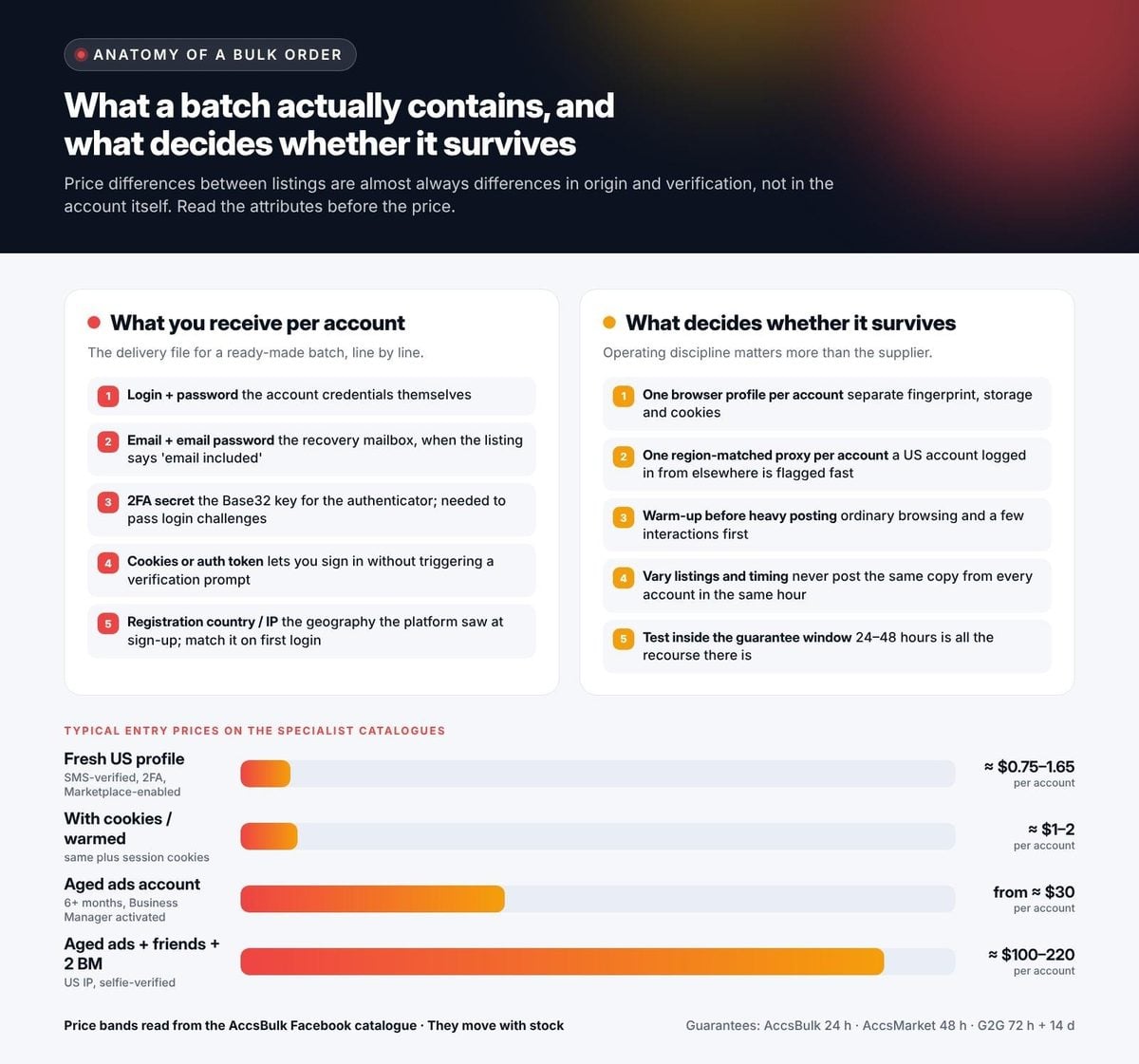
What a batch actually contains, what decides whether it survives, and the price bands you will see on the specialist catalogues.
What bulk Facebook accounts cost
Prices on the specialist catalogues at the time of writing fall into clear bands. Fresh US-registered profiles that are SMS-verified, two-factor enabled and Marketplace-enabled run from about $0.75 to $1.65 each; adding session cookies or a warm-up period moves them towards $2.
Aged ads accounts with a Business Manager activated start around $30. Selfie-verified US accounts aged six months or more with friends and two Business Managers run $100–220 each.
The reason the spread is so wide is that you are paying for survival probability: an aged, verified account with ad history is far less likely to hit a checkpoint on first use than a fresh one, and for an ads buyer that is worth a hundred dollars.
For a Marketplace seller listing furniture, the fresh profile is usually the right purchase.
Checkpoints: the failure you should plan for
The most common way a purchased Facebook account dies is not a ban but a checkpoint: a “confirm your identity” prompt that asks for a code sent to a phone or email you do not control, or a photo of ID.
Checkpoints are triggered by mismatches, most often a login from a country other than the registration country, a new device fingerprint, or a password change in the first session. Included cookies exist precisely to avoid the first two, because a recognised session skips the prompt.
A replacement guarantee covers an account that cannot be logged into at delivery; it does not cover one that checkpoints after you logged in from the wrong place, and the specialist suppliers draw that line explicitly.
Operating rules for a batch
Treat every account as a separate seller with its own device and network. One browser profile per account, so cookies and fingerprint never overlap; an anti-detect browser does this at scale. One residential or mobile proxy per account, in the registration country; never rotate accounts through a shared office IP.
Log in, browse and leave on day one; do not change the password, email or recovery phone until the account has survived a few sessions, and then change them one at a time.
Vary listing photos, copy and posting times rather than pasting the same item from twenty accounts in the same hour. Test the entire batch inside the guarantee window, because 24 to 48 hours is all the recourse there is, and keep nothing irreplaceable on any single account.
Matching accounts to your proxy locations is easier when the stock is already sorted that way; the AccsBulk Facebook catalogue is split by region and by account type.
When bulk is the wrong purchase
A retailer who needs one strong presence rather than many working logins should not be shopping on this list at all. Established pages with an audience are sold through escrow brokers such as Fameswap (5% fee, $50 minimum) and Swapd (20,000-follower minimum, merchant of record, up to 90 days of refund eligibility).
They cost more per account and far less per follower, and they survive scrutiny in a way that a batch of fresh profiles never will. And a single-location store with a catalogue to protect should use a Business Page, Commerce Manager and the sanctioned multi-admin tools, which do not disappear overnight.
Verdict
For a genuine bulk order of Facebook accounts, AccsBulk and AccsMarket are the two specialists; AccsBulk’s clearer listing attributes, automated delivery and proxy-tolerant replacement policy make it the easier first order, while AccsMarket is worth a comparison quote if you can meet its guarantee conditions.
G2G is the best of the general marketplaces for a protected trial batch, PlayerUp for a negotiated deal with a middleman, and G2A for a one-off.
In every case, log each account in from a connection that matches its registration country, run one browser profile per account, and test the whole batch inside the guarantee window rather than the following week.
Frequently asked questions
Is it legal to buy Facebook accounts in bulk? It breaches Facebook’s terms, which allow one personal account per person and prohibit transfers, and Facebook can disable purchased accounts at any time. Whether it is unlawful depends on your jurisdiction and use; this is not legal advice.
Can bought accounts get banned? Yes, and most are lost through checkpoints caused by the buyer’s set-up rather than through detection of the purchase itself. Country-matched proxies, separate browser profiles and a warm-up period are the controllable factors.
Do aged accounts perform better for ads? Aged accounts with ad history are less likely to hit review on first spend, which is why they cost thirty to two hundred times more than fresh ones. Performance after that depends on the campaign, not the account.
Should I change the recovery email and phone? Yes, but not in the first session. Change one detail at a time once the account has logged in cleanly a few times, and keep the original mailbox accessible until you have.
What is the minimum order? Specialist shops sell from one piece; discounts start at a few hundred. Marketplace sellers set their own minimums.
Operating multiple personal accounts or using purchased accounts breaches Facebook’s terms and can result in account loss. Fees, prices, payment methods and guarantee terms are taken from each supplier’s published pages and change without notice. This article describes a market practice and its risks for information purposes; retailers are responsible for their own compliance with platform terms and consumer-protection law.

