Maple Leaf Foods Inc. reported Wednesday higher sales and adjusted earnings before interest, taxes, depreciation and amortization (EBITDA) in the third quarter, but lowered its full-year EBITDA expectations as persistent inflation in food production and pressure on consumers weigh on its business.
The Mississauga-based company reported sales of $1.035 billion for the three months ended Sept. 30, 2026, up 2.4 per cent from $1.011 billion in the same period last year. Adjusted EBITDA increased 15.4 per cent to $128.9 million, while its adjusted EBITDA margin improved to 12.5 per cent from 11.1 per cent.
However, Maple Leaf Foods said it now expects full-year adjusted EBITDA to come in around the bottom of its previously announced range of $520 million to $540 million. The company maintained its outlook for mid-single-digit revenue growth in fiscal 2026 and said it remains committed to dividend growth of approximately 10 per cent.


Inflation pressures affect full-year outlook
Curtis Frank, President and Chief Executive Officer of Maple Leaf Foods, said the third-quarter results reflected the company’s execution of its business strategy, with revenue growth continuing for an eighth consecutive quarter.
“Our third-quarter results reflect disciplined execution of our strategy. We delivered our eighth consecutive quarter of year-over-year revenue growth. Sales increased 2.4%, Adjusted EBITDA grew 15.4% to $129 million, and Adjusted EBITDA margin expanded 140 basis points to 12.5%,” said Frank. “Branded sales and volume growth in Prepared Foods were strong, and a favourable sales mix and cost management improved profitability. We generated $175 million in free cash flow, further strengthening our balance sheet and giving us significant financial flexibility.”
Frank said the company’s operating environment has been more challenging than anticipated at the beginning of the year, with renewed inflation affecting food production costs and consumers.
“We entered 2026 expecting a relatively stable external environment. That has not been the case. Renewed inflation in food production worldwide has raised costs and pressured consumers, particularly in the second half,” continued Frank. “We began the year expecting Adjusted EBITDA of approximately $520 million to $540 million. While we continue to expect revenue and profit growth over last year in the fourth quarter, increased pressure on consumers and more persistent cost inflation mean we now expect full-year Adjusted EBITDA to be around the bottom of that range, given the normal time lag in mitigating inflation. Growing revenue and profit in this environment reflects the resilience of our business and the strength of our execution, and it reinforces our confidence in our strategic blueprint and our ability to achieve our 2030 financial targets.”
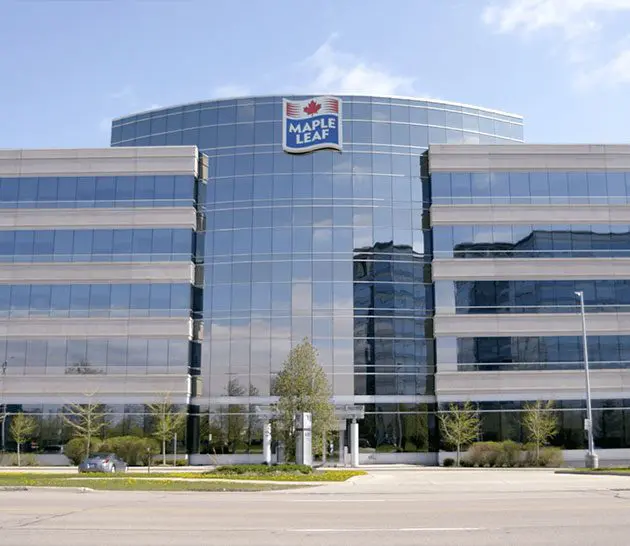
Poultry and Prepared Foods performance
Maple Leaf Foods operates through two business units: Prepared Foods and Poultry. Following the final stage of a previously announced reorganization of its commercial and supply chain operations, the Poultry unit now includes both fresh and further processed poultry categories.
Poultry accounts for approximately 40 per cent of company sales, while Prepared Foods represents approximately 60 per cent.
Third-quarter Poultry sales increased 4.3 per cent, supported by improved channel mix and pricing. The gains were partly offset by lower industrial channel volumes, which more than offset growth in foodservice and retail volumes.
Prepared Foods sales increased 1.3 per cent, driven by improved product mix and related-party revenue. Lower volumes and increased trade promotion spending partially offset the gains.
Gross profit for the quarter increased eight per cent to $175.8 million from $162.8 million a year earlier. Gross margin improved to 17 per cent from 16.1 per cent, reflecting favourable product mix in both operating units and improved operating efficiency.
Selling, general and administrative expenses declined to $96 million from $101.5 million, primarily because of lower variable compensation and the timing of advertising and promotional expenses.
Earnings before income taxes increased to $36.4 million from $35 million in the third quarter of 2025. However, earnings from continuing operations declined to $22.3 million, or 18 cents per basic share, compared with $23.3 million, or 19 cents per share, a year earlier.
Total earnings were $22.3 million, down from $43.1 million in the same quarter last year. The company attributed the decline primarily to earnings no longer generated by its divested pork operations.
Adjusted earnings and cash flow improve
On an adjusted basis, Maple Leaf Foods reported stronger profitability during the quarter. Adjusted operating earnings increased 29.5 per cent to $80.8 million from $62.4 million, while adjusted basic earnings per share rose to 36 cents from 21 cents.
Adjusted earnings before taxes increased 57.2 per cent to $62.8 million compared with $40 million in the third quarter of 2025.
Cash provided by operating activities reached $200.2 million, compared with $72.4 million a year earlier. Free cash flow increased to $174.9 million from $46.2 million.
The company said the improvement in free cash flow was largely attributable to the timing of working capital investments and an additional $35 million in receivables sold through its expanded accounts receivable securitization program. These gains were partly offset by higher income tax payments and maintenance capital expenditures.
At Sept. 30, Maple Leaf Foods reported net debt of $940.3 million, down $414.6 million from the same point last year. Its net debt-to-adjusted EBITDA ratio declined to 1.9 times from 2.0 times.
For the first nine months of 2026, sales totalled $3.018 billion, an increase of 3.3 per cent from $2.921 billion in the same period last year. Adjusted EBITDA rose 8.4 per cent to $388.4 million from $358.4 million.
Earnings from continuing operations for the nine-month period increased to $109.2 million from $78.4 million, while total earnings declined to $109.2 million from $150.4 million, reflecting the impact of the divested pork operations.

Company maintains 2030 financial targets
Despite the revised 2026 EBITDA outlook, Maple Leaf Foods reaffirmed its longer-term financial targets for 2030. The company is targeting approximately $5 billion in annual revenue and approximately $750 million in adjusted EBITDA, along with cumulative free cash flow of between $1.7 billion and $1.8 billion.
It also reiterated its commitment to maintaining an investment-grade balance sheet, with leverage below three times net debt to trailing 12-month adjusted EBITDA.
Maple Leaf Foods said it returned $119 million to shareholders through dividends and share repurchases during the first nine months of 2026.
The company’s board approved a quarterly dividend of 21 cents per share, equivalent to 84 cents annually. The dividend is payable Dec. 31, 2026, to shareholders of record at the close of business Dec. 17.
The company said its 2026 capital expenditure outlook is now between $130 million and $150 million. It also reaffirmed its commitment to maintaining an investment-grade balance sheet.
More from Retail Insider: