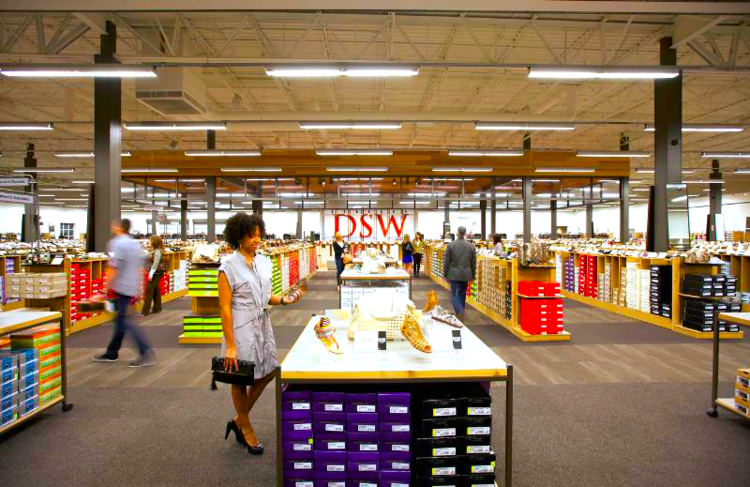
Popular value-priced American footwear retailer DSW Designer Shoe Warehouse has revealed six new locations, all scheduled to open in the fall. After they open, DSW will operate 12 Canadian stores, well on its way to a goal of roughly 40 to 50 Canadian locations.
The six new stores will measure between 20,000 and 22,000 square feet and will be located in Alberta, British Columbia, New Brunswick, and Ontario. The locations include:
Sherwood Park Mall, Sherwood Park, Alberta
Island Home Center, Victoria, British Columbia
Mapleton Center, Moncton, New Brunswick
Park Place, Barrie, Ontario
170 North Queen Street (Across from Sherway Gardens), Etobicoke, Ontario
DSW also sells online, and it’s Canadian e-commerce site launched last winter. DSW’s Canadian stores also operate as fulfillment centres, shipping ordered product either to customer’s homes or to local Town Shoes-owned locations for pickup. DSW’s new Western Canadian stores now also act as new e-commerce fulfillment centres, as the brand expands nationally.
DSW’s Canadian stores are about the same size as its U.S. locations. DSW Canada CEO Mr. Dinan recently told us that DSW is ideally seeking Canadian retail space in the 18,000 to 24,000 square foot range. Each Canadian DSW store will have over 22,000 pairs of shoes, as well as an extensive selection of handbags and accessories. About 80% of the brands in DSW’s American stores are carried in Canada, and Canada’s DSW stores also carry brands exclusive to Town Shoes.
DSW is hugely popular in the United States with over 430 locations in that country. Its name indicates its business model – it sells designer shoes at discounted prices. The company has hundreds of millions in cash and no debt.
As Canada’s urban cores continue to grow and add new residents, grocery stores continue to open new locations. In this article, we’ll list confirmed and anticipated new 10,000+ square foot grocery stores for inner-city Vancouver, Calgary, Edmonton, Winnipeg, Toronto, Ottawa and Montreal.
We’ve been working on an applied research study with the University of Alberta School of Retailing, where we mapped out current and proposed grocery store locations in Canadian urban cores. We then analyzed areas within these urban cores to determine what opportunities exist for new grocery stores, given current underserved populations and projected population growth.
Downtown Vancouver:
As Vancouver’s downtown continues to add thousands of new residents, we’ve identified two proposed grocery stores for the city’s downtown peninsula. These include:
1) Tenant Unconfirmed: With an estimated size of 17,900 square feet, a grocery store will locate at the southeast corner of Granville Street and Pacific Boulevard, within the new ‘Vancouver House‘ condominium development.
2) Tenant Unconfirmed: Estimated to be between 20,000 and 35,000 square feet, a grocery store is proposed for 902 Davie Street at Hornby Street, located at the base of a residential tower. Despite the rendering at the top of this article, Whole Foods is not a confirmed tenant.
Downtown Calgary:
Calgary’s downtown continues to see impressive growth, and as a result several grocery stores are proposed in areas adjacent to its central business district. These include the following:
1) Loblaws: Measuring about 100,000 square feet, Loblaws will locate on the second level of a multi-use development in Calgary’s ‘East Village’ at 428 6 Avenue S.E.
2) Urban Fare: The estimated 25,000 square foot store will anchor First Capital Realty’s Expanded Mount Royal Village at 880 16 Avenue S.W., and we’ll be discussing the project further in the coming weeks.
3) Tenant Unconfirmed: A 60,000 square foot, two-level grocery store is anticipated to locate near the intersection of 9 Avenue S.W. and 9 Street S.W. in a new multi-use development.
4) Tenant Unconfirmed: At least one grocery store is said to be proposed for Calgary’s Eau Claire neighbourhood, which continues to see new construction of upscale condominium towers. Sources say that possibly two grocery stores could open, though this is unconfirmed.
Downtown Edmonton:
Edmonton’s downtown continues to add new residents in new residential towers, as well as a new downtown development, called Edmonton Arena District, which will include a sports facility as well as offices, hotel rooms, a casino, and residential units. Grocery stores proposed for Edmonton’s Central core include the following:
1) Lowlaws City Market: Measuring 40,279 square feet, the store will be located in First Capital Realty-developed The Brewery District. The grocery store, itself, will be located near the corner of 104 Avenue and 121 Street.
2) Tenant Unconfirmed: With 18,898 square feet available at 10404 Jasper Avenue, a grocery store may replace this former Sobeys location. If so, it will locate across the street from a new Shoppers Drug Mart, which will also feature a grocery department measuring an estimated 3,000 square feet.
3) Tenant Unconfirmed: The approximately 30,000 square foot grocery store, located at 12250 Jasper Avenue, is currently under construction as part of a mixed-use residential development. A tenant announcement is expected shortly.
4) Tenant Unconfirmed: A grocery store is proposed within the new ‘Edmonton Arena District’, near the corner of 103 Street and 103 Avenue.
Downtown Winnipeg:
As Winnipeg’s downtown continues to see growth, a new 25,000 square foot grocery store is proposed for the corner of Graham Avenue and Smith Street, at the base of a new condominium tower.
A new Winnipeg tower is said to include a grocery store.
Downtown Toronto:
Canada’s largest city also has its fastest growing downtown, with thousands of new residents being added every year. Four grocery stores are confirmed, and a further six are proposed. The following is a summary of confirmed and discussed grocery store locations within the city’s urban core:
A grocery store is proposed for the 2nd level of the first tower of Toronto’s ‘The Well’.
Grocery Store Locations Confirmed in Central Toronto:
1) Loblaws: This 91,000 square foot store will include Joe Fresh’s headquarters upstairs, and will be located at 500 Lake Shore Boulevard (at Bathurst Street).
2) Loblaws: Located at 111 Peter Street in the city’s Entertainment District, sources say that the the new store will 12,450 square feet.
3) Saks Fifth Avenue by Pusateri’s: The approximately 25,000 square foot store is under construction, set to open in the spring 2016 on the concourse level of the flagship Hudson’s Bay building at Toronto Eaton Centre.
4) Loblaws: measuring about 20,000 square feet and located at 297 College Street, this store stirred controversy because of its proximity to popular Kensington Market.
Proposed and Speculated Grocery Store Locations in Central Toronto:
1) FreshCo (speculated): Estimated at 20,000 square feet, a grocery store is expected to locate at the base of a new residential tower at 565 Sherborurne Street.
2) Tenant Unconfirmed: Measuring about 11,000 square feet, at 101 Charles Street East. This grocery store will be at the base of a new condominium tower fronting onto busy Jarvis Street.
3) Tenant Unconfirmed: (Whole Foods speculated) – Measuring 39,434 square feet, a grocery store is proposed for a new residential development at 25 Bathurst Street, at the corner of Front Street West. Minto Developments has taken over a cancelled condominium project and according to a submitted application to the City of Toronto, it plans to include a grocery store at its base.
4) Tenant Unconfirmed: (Whole Foods also speculated): At an estimated 40,000 square feet, a grocery store will tentatively locate on the second level of 8 Spadina Avenue at Front Street West. Located at the base of the first tower in The Well project, this grocery store will serve the rapidly growing area.
5) Tenant Unconfirmed: Estimated at 42,000 square feet, this second-level grocery store will locate on the southwest corner of Wellington Street and Blue Jays Way in a large residential project with a municipal address of 400 Front Street West.
6) Tenant Unconfirmed: Located near the intersection of Queen Street West and University Avenue, we have few details on this rumoured grocery store proposal, given a recent study done by a prominent brokerage. Speculation persists that the grocery store in question may end up a couple of blocks away at the base of a new residential tower, east of the nearby Shangri-La Hotel.
Downtown Ottawa:
Canada’s capital city continues to add residents to its core. One grocery store is confirmed and it will open this spring — a Sobeys, measuring about 30,000 square feet, will open at the base of a new residential building on Metcalfe Street.
Downtown Montreal:
Montreal continues to add residents to its downtown core, which is already served with a number of grocery stores. Provigo will open a 25,000 square foot store in the heart of downtown, located at the corner of Rue de la Montagne and Avenue des Canadiens-de-Montréal.
Our University of Alberta School of Retailing study also maps existing grocery stores within Canadian urban cores, as well as identifies opportunities for grocery stores in underserved areas. As people continue to move into Canadian downtowns, large grocery chains will increasingly open new stores to serve locals.
Priced between $13,000 and $22,000, Apple Watch Edition is available for sale at 53 Apple Stores worldwide. Of these, only two Canadian locations carry them and remarkably, neither are in Vancouver as one might expect.
The Edition collection features eight designs, each crafted from 18-karat gold which has been developed to be twice as hard as standard gold. The watch’s display is protected by polished sapphire crystal, and watch bands vary.
According to 9to5mac.com, Apple Watch Edition perks include 24/7 support, private one-hour appointments, and no lines.
The only two Apple Stores in Canada carrying the pricey accessory are the 5,000 square foot Toronto Eaton Centre location, as well as the 9,300 square foot 1321 Rue Ste-Catherine Ouest location in Montreal.
Given luxury spending in Vancouver, both from locals and tourists, some are surprised to learn that Apple Watch Edition is not available for sale there at this time. A selection is on display at the Pacific Centre location, according to sales staff, though not available for purchase in the store.
A total of 21 U.S. Apple Stores carry Apple Watch Edition. These include three New York City locations, three Greater Los Angeles-area stores, two Chicago locations, two Washington D.C. area stores, two San Francisco Bay Area locations, and one each in Boston, Philadelphia, Atlanta, Miami, Newark DE, Las Vegas, Houston, Dallas and Seattle. The full international list can be found here.
Thank you ‘Toronto Shopkeeper‘ for providing us information on Apple Watch Edition’s Canadian availability.
Saks Fifth Avenue will continue with its plans to open multiple Canadian locations, under new leadership. Last week, Saks replaced Marigay McKee with a new President, Marc Metrick. Mr. Metrick will report to Hudson’s Bay Company (HBC) CEO Jerry Storch, providing Canadian direction for the New York City-based luxury department store. Sources say that Saks’ strategy could change slightly now that it is under new management, and we spoke with a retail expert and some vendors to learn more.
HBC’s CEO, Mr. Storch, says that he still sees room for as many as seven full-priced Saks Fifth Avenue locations in Canada, as well as up to 25 locations for its discount Saks Off 5th. Two Saks Fifth Avenue locations are currently under construction, and negotiations continue for other free-standing stores. The chain’s Canadian flagship, spanning 150,000 square feet over four floors within Toronto’s flagship Hudson’s Bay building, is scheduled to open in the spring of 2016. A second 132,000 square foot location, at Toronto’s Sherway Gardens, is also scheduled to open in the spring of 2016. Both stores will be unique in how they will feature large grocery departments, each approximately 25,000 square feet, unlike in Saks’ American locations.
Mr. Storch says that HBC will continue taking the chain more upscale, as Saks looks to position itself as North America’s premium department store brand. Sources we’ve spoken with also indicate that Saks will carry a variety of moderately-priced fashion brands, possibly more so than first intended. Several vendors, speaking on the condition of anonymity, say that Saks has approached them with the message that Saks will carry fashion brands at pricepoints comparable to both Holt Renfrew and Nordstrom. Seattle-based Nordstrom plans to open between seven and 10 Canadian stores, with locations already open in Calgary and Ottawa. Nordstrom will open its first Vancouver location this September and in 2016-2017, it will open three Toronto locations. Two of Toronto’s Nordstrom stores will be located in the same malls as Saks.
Sources say that Holt Renfrew, as well, has planned an assault against Saks. Holt’s seeks to keep its top brands by offering them expanded spaces within Holt Renfrew’s top stores. Sources say that two popular luxury brands will see large ground level boutiques with streetfront entrances at Holt’s Bloor Street flagship in Toronto, for example, with similar treatment for the Dunsmuir Street side of Holt’s Vancouver location. Holt’s will also expand its customer service component, having recently launched a new loyalty program as well as expanded personal shopping suites and, soon, an even greater focus on concierge and other services. The Toronto-based luxury retailer also plans to expand and renovate its store base at a cost of about $300 million, expanding square footage by about 40%.
Sources say that Saks continues to speak to mall landlords to open locations in Canada. As many as two Vancouver-area Saks stores could eventually open, possibly both in suburban shopping centres. As well, speculation persists that Saks could open in Cadillac Fairview-owned Carrefour Laval in suburban Montreal, given Saks’ close relationship with the mall’s landlord. Some speculate that Cadillac Fairview could also buy Target’s 115,500 square foot Chinook Centre location in Calgary, possibly converting it to a Saks while creating a luxury area around it. Chinook Centre is also home to Canada’s first Nordstrom, which opened in September of 2014.
We spoke with retail industry expert Farla Efros, COO and luxury retail expert at HRC Advisory, to get her opinion on Saks’ plans for Canada. She indicated that she feels strongly that Mr. Metric’s leadership will be advantageous for both the Saks and Hudson’s Bay brands. Specifically, both retailers will benefit from lack of potential cannibalization by being under HBC leadership, while at the same time each brand will be able to differentiate through branding and positioning. Overall, she says that new leadership will steer Saks’ Canadian endeavours in the right direction.
Saks also continues to negotiate with landlords for new Canadian Saks Off 5th locations. Saks’ discount division will open its first Canadian location this spring in Ottawa (according to Tanger Outlet’s website), with a goal to operate as many as 25 stores in this country. Saks will significantly expand its highly profitable Off 5th division in the United States as well, growing from its current 77 locations to an estimated 200 over the next several years.
Ms. Efros added that Canada is prime for the off-price business and if Off 5th’s U.S. results are any indication, its Canadian operations could be very successful. Canada is currently underserved by such retailers, though Nordstrom Rack plans to open as many as 20 Canadian locations, beginning in 2017. Ms. Efros also noted that both high-end and lower-end retail continue to thrive, while mid-priced retailers increasingly struggle. As a result, Saks’ addressing both luxury-spending and value-seeking Canadian shoppers could see tremendous success, likely at the expense of its competition. If Ms Efros is correct, HBC’s purchase of Saks Fifth Avenue could help facilitate tremendous growth for the company over the next several years.
Vancouver-based ‘Technical Luxury™’ brand Kit and Ace plans to open approximately 15 flagships by early 2016, according to the company’s co-founder J.J. Wilson. We interviewed Mr. Wilson yesterday, and he explained how the brand is ending its ‘test phase’, and how it will now operate full-concept flagship stores with longer leases across the country.
Founded in 2014 by Shannon Wilson (wife of Lululemon founder Chip Wilson) and her son, J.J., Kit and Ace’s clothing is made from proprietary fabric called Qemir, which includes cashmere. Remarkably, the product can be washed in a machine instead of having to be dry cleaned.
Kit and Ace currently operates five Canadian locations. These were originally intended to act as temporary test ‘studios’ prior to the brand’s long-term rollout. Located in Vancouver, Edmonton, Calgary, Saskatoon and Toronto, all but the Vancouver studio operate on 12-month leases. Mr. Wilson explains that these temporary locations were part of the brand’s ‘beta testing’ phase where store fixtures, exteriors, and general store design and function were evaluated. Beta testing also included evaluating and modifying Kit and Ace’s fashions, including fabric, styles, weight and scope of product. The brand continues to expand its product offerings as it matures.
Mr. Wilson tells us that two new Canadian flagship locations are confirmed, while two will be revealed shortly. Possibly its most prominent Canadian flagship will be a 3,300 square foot location at Toronto’s 102 Bloor Street West. It will replace a Benetton store as well as an adjacent retail space to the rear facing Critchley Lane, currently occupied by Industry Hairdressing. Sources say that the 102 Bloor retail space was recently considered by Italian luxury brands Brunello Cucinelli and Ermenegildo Zegna, both currently looking for retail space on or near Toronto’s famed ‘Mink Mile’.
Located at 2235 West 4 Avenue, a Vancouver flagship is confirmed for the city’s Kitsilano area. The store is scheduled to open on July 1. It will replace local retailer Oh My Gift, which recently secured retail space about two blocks east.
Mr. Wilson says that details are being finalized for Kit and Ace flagships in Edmonton and Calgary, and we’ll discuss these further when permitted. Kit and Ace also plans to open at least one more location in Toronto, as well as flagships in Saskatoon, Regina, Winnipeg, Halifax, and possibly eventually Kelowna, BC. Kit and Ace’s original 151 Water Street ‘studio’ will remain open indefinitely, as Mr. Wilson says that the store “is rocking”. The Vancouver location was the brand’s first, having opened in July of 2014.
Mr. Wilson explained that brick-and-mortar locations are key to Kit and Ace’s brand identity, and that the face-to-face, tangible shopping experience cannot be replicated online. Furthermore, physical stores allows the brand to connect with customers, even allowing them to occasionally host innovate community gatherings such as in-store dinners.
Mr. Wilson says that Kit and Ace continues to look for retail space, generally in the 2,800 to 3,200 square foot range. Although streetfront locations are preferable, Mr. Wilson says that the brand will consider locating in top-tier high-traffic malls such as Toronto’s Yorkdale Shopping Centre, West Vancouver’s Park Royal or Calgary’s Chinook Centre. Currently, no Kit and Ace locations are confirmed for these three shopping centres.
Besides the approximately 15 Canadian locations intended to open by early next year, Mr. Wilson says that Kit and Ace will open a further 15 to 40 locations internationally. Japan, the United Kingdom and Australia are on its radar, with American locations confirmed for Cincinnati, Columbus, Denver, Minneapolis, St. Louis, San Jose and Washington DC. The American locations will open by mid-October of this year.
We’ll update this article with details of Kit and Ace’s new Edmonton and Calgary locations, as well as further details as it expands nation wide.
Target will finish vacating all of its 133 Canadian locations by next Sunday, April 12, and Best Buy permanently shuttered 66 former Future Shop locations last week. Many are already speculating on who will replace these empty boxes, if they can ever be filled at all. Although some prime real estate will easily be leased to new tenants, a number of former Target and Future Shop stores are in less-than-prime locations. We spoke with a commercial real estate landlord and expert who, on the condition of anonymity, provided us the opinion that Target’s Canadian exit could even lead to the demolition of some shopping plazas and that Future Shop’s demise makes things even worse. Adding to landlord woes is the possibility that Sears Canada and potentially others could also exit Canada this year, creating a substantial oversupply of Canadian store real estate in only a few months time.
Having attended the International Council of Shopping Centres Whistler Conference in late January, our source reveals that many big box retailers have already fully budgeted their Canadian expansion plans for 2015 as well as for much of 2016. As a result, it may take a couple of years or more to find replacement tenants for many Target locations, if replacements can be found at all. Those larger retailers (such as Winners and Michaels) which are looking to expand into 2016 and beyond are currently seeking ‘home run’ urban locations where there’s more possibility to ‘nail it’, according to our source. A number of possible replacement retailers are also looking to operate smaller store locations, including companies such as Best Buy. None of this bodes well for replacing large Target locations, many in smaller and suburban communities across the country.
As a result of not securing replacements for Target in a timely fashion, some landlords may shutter their malls for more productive uses. Anchors act as a draw for retail plazas and when an anchor leaves, smaller neighbouring retailers could also fail and be forced to close.
Some point to the fact that Target’s relatively large Canadian stores could be subdivided for use by multiple tenants. Our source points out that although subdivision is possible, it’s also expensive. For each new retail space created, new loading bays, demising walls, and HVAC systems need to be installed, generally costing in the $50-70 per square foot range. As a result, many landlords forego demising larger spaces.
Sears Canada could further add to landlord woes, as sources say that Sears could announce its Canadian exit within the next several months. Some say that Sears may announce its departure later this year, while others say that Sears could continue to sell more stores and store leases to provide cash to the money-losing company. If Sears does exit Canada this year, it will be disastrous to malls such as Cottonwood Mall in Chilliwack, BC and Bonnie Doon Shopping Centre in Edmonton, both anchored by Target at one end and Sears at the other.
A combined Target and Sears closure in Canada could create a similar experience to that in the United States – that is, where some secondary and tertiary malls formerly anchored by JC Penney, Sears and Mervyn’s continue to experience vacancies. There may be a need to re-invent or re-purpose these malls by adding more entertainment, fitness, grocery and other non-traditional retail operations to reattain relevancy. Finding the right tenants will be key, and speed will be critical.
Regarding Best Buy shuttering Future Shop, finding replacements could be equally as challenging. Despite many Future Shop locations being in prime power centres and strip malls, times are changing for Canadian retail. Large retailers such as Staples also continue to close locations and the list of big box retailers looking for similarly-sized locations is getting shorter, especially as some chains look to downsize and consolidate as well as focus on e-commerce. What has resulted is a glut of Canadian retail space, and hopefully retailers such as Michaels, Marshalls, Homesense, Sport Chek, Giant Tiger, MEC and even gyms such as LA Fitness and GoodLife Fitness will somehow fill the void.
Not all is doom and gloom, however. We’re told that Walmart could take over a few dozen of Target’s ‘better’ Canadian locations. A reliable source says that Walmart is in talks to take over a ‘package’ of stores being assembled as part of Target’s exit, and we’ll update you when we learn more.
The following is a list of 23 retailers which are either new to Canada, or expanding their operations nationally. Some of these retailers have been discussed in Retail Insider since our last list on February 27, and some are new and haven’t been revealed to the public until now.
The list is sponsored by Vancouver-based Peregrine, which custom designs and fabricates retail, display, furniture and architectural features for some of the country’s top retailers.
STORE NAME
LOCATIONS TO OPEN IN CANADA
NEW OR EXPANDING?
ESTIMATED # OF LOCATIONS POST-EXPANSION
Aesop
Vancouver (Gastown), Toronto, Montreal
New
3+ (unknown)
Aquascutum London
Toronto, plans for Vancouver, Calgary, Edmonton, Ottawa (according to Developers & Chains)
Iconic Italian luxury brand Giorgio Armani will open its second Canadian outlet location this spring at Vancouver’s new McArthurGlen Designer Outlets. Armani is hiring for multiple positions at the new store.
The 5,350 square foot outlet will carry product from all Armani lines for men and women, except for the couture Armani Privé line.
Opening in the spring of 2015, North America’s first McArtherGlen Designer Outlets will be located at Templeton Skytrain Station next to Vancouver International Airport. The mall’s first phase will span 240,000 square feet with 80 retailers, many of them being luxury brands. McArthurGlen representatives say they’ll provide us a list of retailers closer to the mall’s opening date and when they do, we’ll reveal them in a separate article. Eventually, the mall will span 400,000 square feet with about 150 stores, with an unknown completion date.
Thank you to Urban Toronto‘s ACT7 for notifying us of this new store opening.
Upscale Australian skin care brand Aesop is set to continue its rapid expansion in North America by opening stores in Canada later this year. Sources have told us that Aesop will open a store in Vancouver’s trendy Gastown area this summer, with stores to also open in Montreal and Toronto. Aesop is currently advertising sales and management positions for all three Canadian locations.
Aesop was founded in 1987 in Melbourne by hairdresser Dennis Paphitis. Since then, it has grown to be commercialized in more than 11 countries throughout Oceana, Asia, Europe and North America. It operates through a combination of dedicated ‘signature stores’ (concept stores), high-end department stores, including Holt Renfrew and Barneys New York, and selected stockists. Canadian stocklists include multiple WANT Apothecary and gravitypope locations, as well as a handful of smaller independents.
In December of 2012, Aesop announced that the Latin-America cosmetic giant Natura Cosméticos S.A. had acquired a 65% controlling stake in the company for AUD $68 million. Natura is based in Sao Paulo, Brazil, with an enterprise value of $6.49 billion and was ranked by Forbes in 2013 as number 10 in a list of the most innovative companies. At the time the acquisition was announced, Natura indicated that its investment in Aesop would accelerate the growth of the brand internationally. Aesop continues to operate independently from its Melbourne headquarters.
Aesop has crafted a unique brand that can be differentiated from an otherwise overcrowded skin care market. Its product packaging is impeccably simple, yet stylized, creating an immediately recognizable uniform aesthetic. Aesop places significant emphasis on design, which can be seen across all levels of the brand. Its newsletter does not advertise its products; rather, it explores areas such as architecture, travel, books and movies. Its signature stores are remarkably distinct retail spaces that are often designed by local design studios. The contrasting affect between the uniform product packaging and the distinctive retail space creates a unique customer experience that sets itself apart from the ubiquitousness often associated with other skin care brands.
According to luxury retail expert Farla Efros, COO of HRC Advisory, Aesop’s opening free-standing Canadian locations is of no surprise. She notes that luxury brands continue to seek out Canadian real estate to open new store locations. Furthermore, she notes that Canadian consumers are often compared to Australians, who are generally known for their sophistication as well as their desire for health and wellness. As Canadians become more open, naturals and organics have seen double-digit growth over the past few years. Ms. Efros notes that partly due to strict government regulations, Canadians have had limited access to some cosmetics brands, having to seek certain lines outside of the country.
Differentiation by design
Aesop is yet another example of a retailer resisting the urge to create uniform retail spaces. Its founder Dennis Paphitis is quoted as saying that he was horrified at the thought of Aesop evolving into a soulless chain and as such, sought to ensure the brand didn’t “prostitute” its identity to expand. The Aesop store design seeks to reference the local customer, such that it does not take a one-size-fits-all approach; rather it respectfully considers each space individually.
It is a trend that has been witnessed across a broad spectrum of brands: Aesop v. L’Occitane en Provence; Whole Foods v. Safeway; Lululemon v. Foot Locker; Starbucks v. Tim Hortons; Aritzia v. Banana Republic. In each of these examples, the first brand has sought to avoid homogeneity by creating a unique customer experience, while still retaining an element of commonality that allows customers to identify the store that they are in. This movement indicates that brands are increasingly finding value in appealing to a different consumer sentiment, one that values authenticity over plasticity.
It has been said that an architect’s task is to render vivid to us who we might ideally be. The same could be said of retailers. Creating unusual and authentic spaces signals to shoppers that their individuality is valued and celebrated. It also serves to align the perceived values of the brand with the identity of the customer. We are excited to see how Aesop adapts to its new Canadian home in this the next chapter of its expansion.
We spoke with retail industry expert Antony Karabus, CEO of HRC Advisory, to get his opinion on why Best Buy shuttered Canada’s Future Shop locations. We also asked him about Best Buy’s strategy to close stores without warning, as well as the future for electronics retailers in Canada.
As a background, on Saturday, March 28, Best Buy closed all Future Shop locations, announcing that 65 of the chain’s 131 Canadian locations would be converted to Best Buy nameplates. The other 66 locations will remain closed, resulting in about 1,500 job losses.
We asked Mr. Karabus why Best Buy closed Future Shop’s stores. He explained the inefficiencies of operating two nameplates carrying essentially the same product, sometimes within close proximity. He believes that when Best Buy bought Future Shop, operating both brands was a strategic opportunity to gain market share. As Best Buy became increasingly familiar to Canadians, maintaining both became irrelevant. Closing Future Shop will likely free up significant capital for Best Buy, according to Mr. Karabus.
Furthermore, Future Shop sales consultants were paid on commission (according to the www.futureshop.ca website), as opposed to Best Buy’s hourly staff. Mr Karabus believes that as Canadians increasingly research potential electronics online prior to purchasing, commission-driven sales staff will generally become unnecessary.
Mr. Karabus explained that electronics retailers have increased competition from both e-commerce as well as hybrid brick-and-mortar competitors. Furthermore, there is also increasing competition from bricks-and-mortar retailers such as Walmart, Costco, London Drugs, The Source, as well as Tech departments at Chapters/Indigo. Apple Stores are also increasingly becoming competitors, as the brand becomes more popular and continues to open new and larger Canadian stores.
Mr. Karabus notes that electronics purchases are down, generally, as there haven’t been significant product innovations recently. Anything new has primarily involved upgraded or modified technology. As a result of the above challenges, Best Buy was best served to streamline its operations.
We asked Mr. Karabus’ opinion on Best Buy’s without-notice Future Shop closure. He explained that it may have been a good financial decision for Best Buy to immediately shutter Future Shop’s operations to concentrate on one brand. On a human resources level, however, Mr. Karabus notes that Best Buy’s actions were “harsh”, as many lost their jobs with no advance warning. Recent job losses from Target, Smart Set, Jacob and others have already caused considerable grief. We asked him if Best Buy’s actions will hurt its brand and Mr. Karabus felt that while some may be disappointed, customers are generally quick to forget. Given that Best Buy is now Canada’s only Big Box specialist electronics-focused retailer, it will likely not suffer from this decision, according to Mr. Karabus.
We asked Mr. Karabus about the future of consumer electronics retailers in Canada, given increased online price transparency and the ease of buying online. He feels strongly that there is still a meaningful role for brick-and-mortar consumer electronics retailers in Canada, especially well-stocked locations providing “advice and consultation”, building trust by suggesting the “right” product. After sales service, in particular Best Buy’s Geek Squad, is a brilliant weapon to fight pure-play online retailers, further enhancing trust in Best Buy’s brick-and-mortar operations and related in-store customer service, according to Mr. Karabus.
About Our Expert:
Mr. Karabus became CEO of HRC Advisory in January of 2013. He has been a trusted and passionate advisor to retailers on strategic and financial performance issues for over 25 years. He has assisted numerous North American retailers to create significant shareholder value during this time. He has worked with numerous well known retail chains in key sectors such as department store, specialty apparel and hard lines, big box chains and food and convenience.
Antony began his career at Arthur Andersen in Cape Town, South Africa and moved with the firm to Toronto, where he founded Karabus Management as a Canadian retail advisory firm in 1990. In 2001, Karabus Management expanded into the United States, where the firm became a leading North American specialist retail consulting firm. In 2008 he sold the firm to an International Accounting/Consulting firm where he served as the leader of that firm’s Retail Consulting Services practice until he left the firm in December 2011.
Antony conducts annual surveys of Retail CFO and CEOs to determine key priorities in assisting their business to enable substantive value creation.
Antony is a recognized speaker and a published author providing thought leadership at industry forums, including the National Retail Federation, Retail Council of Canada, World Retail Congress and the Fashion Institute of Technology and providing content to The Wall Street Journal, The New York Times, Stores Magazine, The Globe & Mail, Chain Store Age, National Post, Toronto Star and Women’s Wear Daily, among others.
About HRC: HRC Advisory is a specialist boutique retail advisory firm. Together with its predecessor firms, it has been assisting Canadian and US Retail Chains to improve their profitability and strategic positioning for more than 25 years. Many of HRC’s senior advisors were previously at Senn Delaney Retail Consultants and Karabus Management following retail leadership roles. Other senior advisors at HRC have a mix of retail leadership and retail consulting experience gained with other leading firms
HRC has significant retail depth in strategic planning, buying, merchandise planning and inventory management, indirect procurement, store operations and omni-channel processes, supply chain/logistics and fulfillment, and comprehensive cost optimization services. HRC has worked extensively with both healthy top performing chains as well as developing and executing turnaround mandates at a number of retailers in difficult situations. For more information, please visit www.HRCadvisory.com.