Mississauga’s Square One Shopping Centre will become North America’s only mall to feature both a luxury anchor and a Walmart store. A 120,000 square foot Holt Renfrew flagship is scheduled to open in the mall in the spring of 2016 and as far as we’re aware, the mall’s 225,000 square foot Walmart Supercentre will continue to operate.
While researching this article, we examined every American mall anchored by Saks Fifth Avenue, Neiman Marcus, Barney’s New York and Bloomingdale’s stores. Not one mall includes Walmart. In Canada, there are currently no shopping malls anchored both by Walmart and Canada’s luxury department store, Holt Renfrew.
Most of America’s better fashion malls include mid-to-upscale anchors. Some luxury-anchored American malls also have J.C. Penney and Sears as anchors, for example. Only two American malls, both in California, include both Target and a luxury anchor: Glendale Galleria is anchored by Bloomingdale’s and Target, while Westfield Topanga features Neiman Marcus in the same mall as Target.
HOLT RENFREW’S NEW SQUARE ONE STORE, OPENING IN THE SPRING OF 2016. RENDERING: JANSON GOLDSTEIN ARCHITECTS.
Speculation persists that Square One’s landlord, Oxford Properties, may seek to eventually remove Walmart from the mall. We’re unaware of any plans to remove Square One’s Walmart, especially as it’s one of the store’s top performers.
Will Square One’s mix of luxury and downscale anchors start a trend among North American shopping malls? We consulted with retail expert and acting Executive Director of the University of Alberta School of Retailing, Emily Salsbury. Ms. Salsbury noted that with most North American malls (especially those with luxury anchors), there is limited opportunity to add new anchor stores unless current anchors leave.
Given that very few upscale North American malls also include downmarket anchors, and that almost no new North American malls are being built, Square One’s anchor mix is unlikely to be replicated. Although Saks Fifth Avenue and Neiman Marcus may look to open new North American stores, it’s unlikely they will locate in malls already anchored by Walmart or even Target. The same goes for Canada, as we’re unaware of any other mall, anchored by a Walmart, that could eventually house a luxury anchor.
Italian luxury brand Versace plans to open five Canadian stores within the next five years, and possibly even sooner. Its target cities include Toronto, Montreal and Vancouver, and perhaps another Canadian city. Toronto will likely see two Versace stores: the company has already confirmed one, while it searches for a large downtown flagship space. A source tells us that all five Versace stores could be open in as little as two and a half years.
Versace is seeking retail space in Toronto, Vancouver and Montreal. In Toronto, the brand wants a large space on Bloor Street West. In Vancouver, Versace seeks space ideally in the city’s ‘luxury zone’, located between the Hotel Vancouver and the Shangri-la Hotel. In Montreal, we’re not sure if Versace will open a street-front shop, or if it will choose to locate within an expanded Ogilvy/Holt Renfrew store, expected to be completed in 2017. Montreal currently lacks a street-front luxury zone, save for a handful of upscale retailers in the vicinity of the Ritz Carlton Hotel on Sherbrooke Street West.
Our source can’t confirm which fourth Canadian city could see a new Versace location. Our best guesses would be Calgary, possibly at Chinook Centre, or in Edmonton, at West Edmonton Mall. Both properties have aggressive leasing teams actively looking to secure new luxury tenants. This is more speculation on our part, however, and we’ll update you when we learn more.
Canada’s only Versace store is a large shop-in-store within Vancouver-based luxury retailer Leone. Versace has operated out of the Sinclair Centre retailer since 1987. There’s no word yet on what will happen to Leone’s current Versace shop.
Canada has had several Versace stores in its past. In the 1990’s, Toronto had franchised Versace locations on Bloor Street West, on Hazelton Avenue, and within luxury retailer Chez Catherine at Hazelton Lanes. In Montreal, Versace once operated shops on Sainte Catherine Street West and within a Chez Catherine concession at Ogilvy.
It appears that popular British fashion brand Ted Baker may open a location at the Toronto Eaton Centre. Company officials aren’t openly commenting on Ted Baker’s further expansion into the rest of Canada.
In the United States, Ted Baker has 15 free-standing stores, 25 concessions within Bloomingdale’s stores, and 5 outlet stores.
Ted Baker’s first Canadian location opened in October of 2012 in the newest expansion of Toronto’s Yorkdale Shopping Centre. The roughly 3,200 square foot store is across from the hall from the recently expanded Holt Renfrew store. Ted Baker’s only Canadian outlet store opened in August of 2013 at the Toronto Premium Outlets.
We’ve all heard the Bricks & Mortar retail complaints about “showrooming.” Someone comes into the store to see, touch and experience the product, only to return home to the Internet to shop the price and buy it elsewhere. Yes it’s true, and a real drag. But what if that same Retailer could use “showrooming” to his or her advantage?
The good news is Retailers can! How you ask? By displaying samples of eCommerce Brands, taking orders through the existing eCommerce Brand website and getting a cut of the deal. The Retailer can even charge a base rent, calculated on sales per square-foot, using the same model that Bloomingdale’s uses for its shop-in-shops. Any sales above the base would be eligible for a cut to be earned by the Retailer.
Test New Categories
Here’s how the Retailer wins. First he or she can test new categories, without any financial inventory risk. That’s right: No inventory risk! The biggest risk in retail is removed! Not only that, instead of laying out cash for inventory, the Retailer can take it in with the base rent, adding to profitability.
In a clothing boutique, for example, the Retailer can test jewelry. A small sample presentation can be created, and remain live for six weeks in Bricks & Mortar, with the store staff taking orders through the existing Brand’s website. If it works the Retailer can continue the relationship. If not, the Retailer simply opts to bring in a new brand. The Bricks & Mortar Retailer now has a risk-free way to build their assortment and their business!
Another benefit to the Retailer is ‘newness.’ The sample presentation creates another reason to invite the customer back into the store. It’s a traffic driver. And it’s newsworthy, for publicity purposes.
Turn it over to a PR agency, along with some well-planned events and you can blow the doors off!
Expand Business, Not Footprint
Now that you understand the basics of this type of arrangement let’s take it a step further. What this arrangement amounts to for a Bricks & Mortar Retailer is a vehicle to expand their business using the existing footprint. In other words, without adding any square feet at all, the possibilities to expand the business across categories is virtually (no pun intended) unlimited!
Picture this: Some beautiful, adjacent well-merchandised little nooks displaying a dozen samples each from multiple new categories with a handy tablet (perhaps mounted on the wall) for a sleek look, along with a well-trained incentivized store sales staff to help the customer “round out the brand” using the tablet and close the sale! That means each and every square foot in your store becomes endlessly efficient. All at no risk to you!
Perhaps you are concerned that you keep your customer relationships intact. If they are not already customers then just enter new customers into your own database when they make a purchase. Your customer is also likely buying stuff online anyway. Why not be the resource that introduces them?
I refer again to the old adage: Although your business needs new customers too, it’s much easier to sell more of what they want to your existing customers than it is to get a new customer. What I call e-Pop-Ins is the perfect vehicle to put it to work.
Today in a meeting of CEOs sponsored by the Luxury Marketing Council, I heard Robin Lewis say, “The United States is overstored.” He backed it up with the following statistic. There is 46 square-feet of space for every American citizen compare to 3 feet in the UK. Here is a way for you to expand without adding more space in an already over-saturated market!
Besides that, as a Bricks & Mortar Retailer, you are providing a very valuable benefit to brands growing up online. That is a chance to see, touch and try on the brand. Or in the case of cosmetics, even to smell it! Or, for spices to taste it! What a way to create a memorable in-store experience. The latest buzz is all about “experience and entertainment” over “acquiring.” But I believe that the most exciting stores have the best merchandising combined with the best experiences. Sensory experience leads to emotion which leads to buying and loyalty.
This value cannot be underestimated. From new product launches to new geographic markets, a physical presentation is a critical element for a brand growing up online.
Why is this important to the store? Because that brand by definition, must support the presentation to acquire new customers. When they support it, they drive new customers to your store. So an added benefit for the traditional retailer is new customers too!
A Look at the Future
Let’s take it even one step further and paint the picture of the future. If in fact the store can spend less time on the trade of buying inventory and turning around and selling it and more time getting to know the customer better, wow, now we have something.
The store can really start to understand how that customer lives. What style home do they have? Do they commute to work? From where to where? How? What do they do for fun? How about for relaxation? Are they married? Do they have children? Where do they vacation? The list goes on and on. The retailer can get to know them as a friend instead of constantly worrying about inventory.
What is the benefit in all of this for the store? Well birthday, anniversary and holidays gifts for starters. Secondly, if you sell a certain type of clothing what’s the best fit in terms of home décor? What does your customer like for their homes? What about resortwear? And for the fitness inclined, how about activity trackers?
The point is, the more the focus goes to the customer and the less the focus goes to the management of inventory, the better off you are.
I see it going even one step further. The store become the front-end and the brand website becomes the back-end. What that means is that the store becomes a sophisticated database of details related to customers’ lifestyles with the appropriate “registry” along with a well-segmented and executed online marketing program.
And from a creative standpoint another big WOW! The more the store can understand the customer’s lifestyle the more exciting and focused the merchandising can become. And, the more focused the in-store events can become. Not only is the experience better but your store now becomes the destination for your customer for the way they live.
In this way, as an independent Bricks & Mortar Retailer, you can get everything the big guys get. Now that’s how to make showrooming work for you!
Pop-Up Artists is a strategic marketing agency that creates focused physical shops integrating e-commerce, for retail and luxury brand clients. Janet Valenza, president, is a former c-suite executive from the Young & Rubicam family of companies. She can be reached at 917.497.5319 or janetv@pop-upartists.com.
In June of 2013, Fruits & Passion’s parent company, S.C. Johnson & Sons Inc., sold the brand to South Korean conglomerate LG Corp. LG is parent company of TheFaceShop. A handful of franchised Fruits & Passions locations, including its store at Place d’Orléans in suburban Ottawa, will remain. The Company’s Quebec stores will also continue operating under the Fruits & Passion name for the foreseeable future.
PHOTO: WWW.HILLCRESTMALL.CA
Interview requests with the company were denied, though staff at some former Fruits & Passion locations confirm that the brand has struggled in much of Canada. Many Quebec Fruits & Passion locations continue to see strong sales, partly due to its exceptional brand identity and market coverage.
According to its website, the TheFaceShop has over 2,300 stores in 29 countries.
Nextopia created this very interesting infographic on e-commerce in Canada, including its projected sales of $34 billion by the year 2016. Canadians are increasingly shopping online, with sales growing substantially year-over-year. The infographic shows the biggest spenders by province, how many of us shop online, what products we buy, and how we compare to other countries.
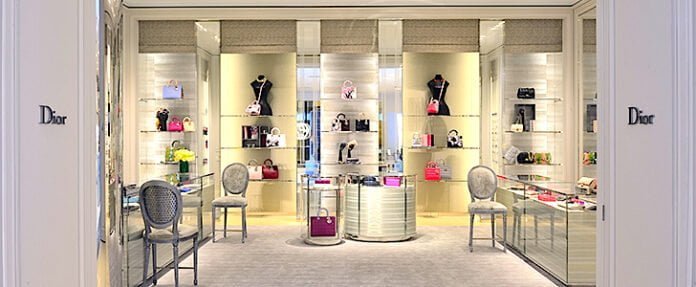
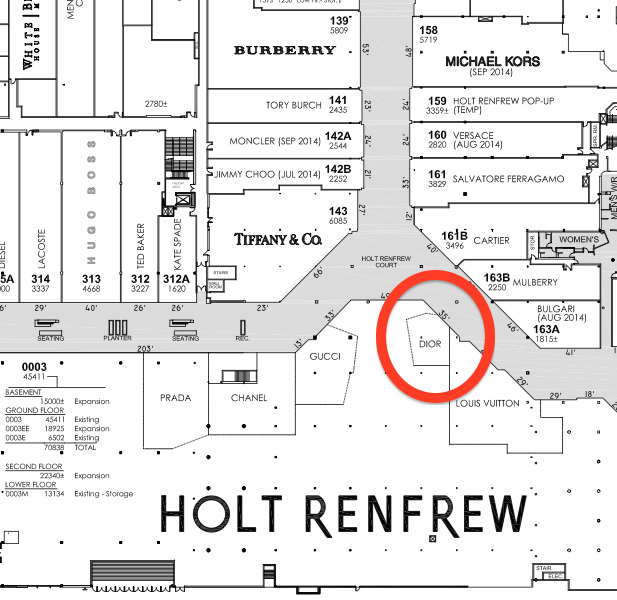
Christian Dior‘s fourth Canadian boutique has opened within Holt Renfrew at Toronto’s Yorkdale Shopping Centre. Featuring Dior’s updated boutique design, the concession is modelled on the interior of the brand’s Paris flagship. The shop carries primarily women’s accessories, as there are currently no Canadian Dior stores that carry women’s ready-to-wear. That will change next winter, however, when Dior’s first Canadian flagship opens at the Hotel Vancouver. A Toronto flagship is also anticipated.
Dior joins Holt Renfrew’s concessions for Louis Vuitton (4,000 sq ft), Gucci, Chanel and Prada. Lease plan: Oxford Properties, published with permission.
Dior’s other three Canadian boutiques are all shops-in-store concessions, within Holt Renfrew’s Vancouver, Montreal and Toronto (Bloor Street) stores. Montreal’s Dior concession recently renovated, despite the fact that it will close in 2017 when Holt Renfrew merges with an expanded Ogilvy store, two blocks south. Montreal’s current Holt Renfrew store will close as a result.
Dior’s first Canadian flagship will open next winter at the Hotel Vancouver. The two-level boutique will carry Dior’s women’s and men’s ready-to-wear collections, as well as accessories, children’s wear and luxury features including a private shopping salon. We’ll provide further details on Vancouver’s Dior closer to its opening date.
Dior is also shopping for flagship retail space on Toronto’s Bloor Street West, and we’ll update you when we learn of further details.
There are 11 free-standing Dior women’s ready-to-wear boutiques in 8 American cities (including 4 in Las Vegas), as well as 12 Dior accessory shops-in-store located within 9 Saks Fifth Avenue stores, 2 Bloomingdale’s stores and 1 Nordstrom store.
We published thousands of deals last July, which we’ve analyzed to offer our readers a bit of advice while planning purchases this month. And it’s a particularly important month to do so, since a number of sales will appear to be better than they actually are. In order to protect your wallet and spend your money wisely, be sure to read through our July buying guide below for everything you need to know to shop smart this month.
Plan a Trip Now for Late August
According to several different reports, it appears as if late August is the cheapest time to travel, both in terms of hotel pricing and airfare. Priceline.com data demonstrates that Disney World-accessible hotels are at their best during the second to last weekend. Why? This time frame falls right before Labor Day, so it’s likely a less traveled weekend; as a result, hotels and airlines push discounts to fill rooms and seats.
Can’t Wait to Buy an Air Conditioner? Opt for Energy Efficiency
Last year in July, we saw an uptick in air conditioner sales and discounts. And while in some cases these models will get cheaper in August and early September, you can still save 20% or more, or as much as $150, on a unit while you need it most. And if you’re careful about how you run it, you can make up for any lost savings with a lower energy bill. (Some examples: Blocking out direct sunlight can keep the room substantially cooler naturally, while a programmable temperature control saves a full $180 a year.)
Apple’s Cheaper iMac is a Terrible Deal
Last month, Apple debuted a cheaper iMac in its line of desktops. But while a similar strategy with the MacBook Air saw the manufacturer dropping the price and simultaneously upgrading the specs, Apple instead is offering a cheaper price because it removed some premium features in the process, including 500GB of storage and a high-end graphics card — two specs that are actually worth more than that $200 discount. If you want to pay less, we recommend instead buying an Apple-refurbished unit of the previous-generation iMac since it has a better configuration.
Summer is ‘Blah’ for TV Deals, Opt for Off-Brand Sets to Save
Summer months are generally a bad season for TV deals, but if you find yourself in dire need of a new set, there are a few categories you should look at. Off-brand 55″ LCDs, for instance, have been holding steady at $500 since January, the second-best price of the year. Look to Best Buy and Sears for deals on models from the likes of Westinghouse and RCA.
60″ LCDs, on the other hand, should be avoided at all costs. Earlier in the year prices were aggressive, ranging from $699 to $747, but for the past two months the best deals for this size category have averaged $944, which is a high we haven’t seen since 2012. Plasma sets of the same size offer a better value, averaging $626 and occasionally dropping to an all-time low of $600. Look for deals from Sears, which has offered the best bargains to date.
Finally, you may see some 32″ 1080p LCD TVs discounted as retailers begin their back-to-school sales. Currently at $189, these TVs are at their second-best rate of the year and just $9 over the best rate we’ve seen in 2014. Just keep in mind that if your college-bound student can wait until November, these sets may get even cheaper around Black Friday; last year, a freak sale marked one of these sets down to an astonishingly low price of $110!
Mainstream Laptops Hit New Low, 1080p Deals Ramp Up
July is expected to be a hot month for laptop deals, as back-to-school sales continue to roll out. (After all, back-to-school season is the second-best time of the year to buy a laptop.) Ultimately, you’ll get the biggest savings with touchscreen systems and mainstream 15″ laptops (equipped with Intel’s Core i5 Haswell processor and at least 4GB of RAM). The latter hit a new price low of $380 in June, about $70 below the average from the previous month. This sets a new benchmark for the category, and provides a preview of the type of deals we’ll see in the coming weeks.
Meanwhile, 11″ touchscreen systems hit an all-time price low of $199 in May, a price we might see again if retailers get aggressive. Should 11″ prove too small for your needs, you can opt for a 15″ touchscreen laptop with deal prices ranging from $300 to $330.
Finally, laptops with 4K displays are slowly hitting the market. For shoppers, this means you can expect to see numerous deals on laptops with a “lesser” 1080p resolution. For the average student or home user, a 1080p laptop is more than sufficient, and the best deal we’ve seen so far for a 15″ system has been $499.
Follow @DealNews on Twitter for the latest roundups, price trend info, and stories. You can also sign up for an email alert for all DealNews features.
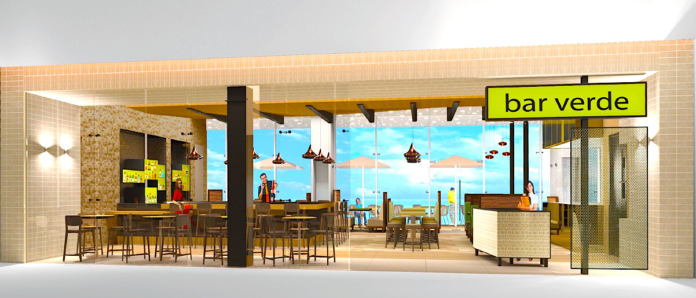
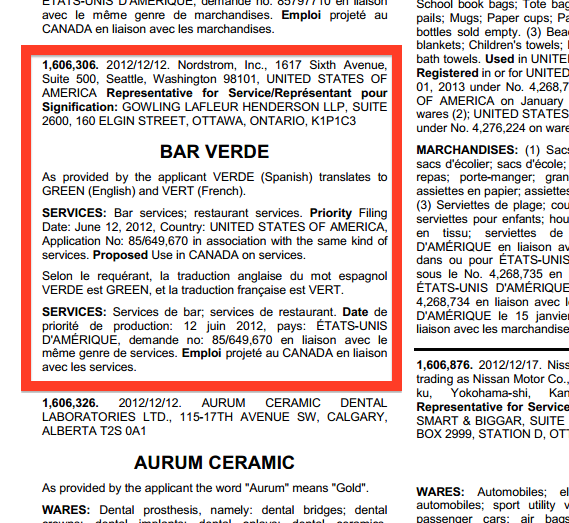
Nordstrom representatives won’t yet reveal what restaurants the retailer will operate in its Canadian stores. An astute Toronto-based lawyer may have found an answer, however. Anjli Patel noticed that in the April 16th Canadian Trade-Marks Journal (PDF), Nordstrom registered the Bar Verde name for use in Canada. Bar Verde is a new restaurant concept for Nordstrom, and currently operates within two California Nordstrom locations.
Bar Verde is a full-service restaurant and bar, serving lunch and dinner. Its focus is on fresh, locally-grown seasonal fare. The restaurant’s menu changes by season, four times a year. Its bar offers wine, speciality cocktails, beer, and a dedicated menu of small plates. Zagat describes Bar Verde’s lunch menu, featuring Caesar salad topped with fried Pacific oysters and yogurt dressing, Asian chopped shrimp salad, and dark cherry chicken sliders. Dinner consists of salads, flatbreads topped with wild mushrooms and truffled pecorino cheese, and entrees like roasted chicken with prosciutto and sage, oven-roasted wild salmon with black olive tapendade, and lamb with butternut squash and taleggio risotto. Nordstrom’s full restaurant menus and other dining concepts can be found here: http://restaurants.nordstrom.com.
EXCERPT FROM THE APRIL 16 2014 CANADIAN TRADE-MARKS JOURNAL.
Bar Verde’s first location opened in September of 2013 at Nordstrom’s new store in The Americana at Brand in Glendale, California. Its second location opened last November in the newly renovated Nordstrom at The Grove in Los Angeles.
We can’t confirm which Canadian Nordstrom stores will include Bar Verde locations. Sources do confirm, however, that Nordstrom’s coffee concept, eBar, will likely be found in all of its Canadian stores.
Every day, retail managers are inundated with numbers: sales, margin, conversion, operational expenses and profitability. The confusion is not helped when the corporate raison d’etre from the higher ups keeps changing from ‘increasing revenue’ to ‘reducing costs’ or ‘increasing brand equity’. In a climate where it’s hard to understand what the actual objective is many retail managers are left scratching their heads as to how to make sound managerial decisions that will guide their stores to success.
Even with the ever-changing goals and action plans, it is encouraging to know that the main objective of most retail businesses is pretty much set in stone. What actually changes is how that objective is achieved. That main objective is creating a healthy Return on Investment, or simply, making a profit.
There are many figures that retail managers monitor on daily, monthly and yearly bases. We’ve all heard the terms, units per invoice, average invoice, and sell through. These metrics are excellent at gauging how a specific aspect of the business is performing. However, what are the main drivers that managers can directly influence that will ultimately increase the profitability of a store? There are two main managerial issues and four key performance indicators (KPIs) that can directly influence and monitor to ensure increased profitability.
The first main managerial issue is all about Asset Management. Are your assets working hard for you? The entire purpose of a business investing in assets is to generate sales. When money is invested in stock, fixtures, computers or buildings, the purpose is to help the store create revenue. The two greatest assets that a company invests in that requires constant attention is the physical store and the inventory. In accounting terms it’s all about better Space and Stock management.
SPACE MANAGEMENT – A retail manager must constantly be asking themselves what is being done to improve the store’s selling potential. The KPI to look for here is the store’s Return per square foot. Managers should always be monitoring the store’s actual sales versus square footage, against, budgeted sales versus square footage looking for opportunities to increase sales for every square foot of the store. Since so much money is tied up in retail real estate, it becomes crucial that a store is ‘earning its rent’.
STOCK MANAGEMENT – The second biggest asset and subsequently where most of the stores cash is tied up in, is the inventory. When looking at inventory, what we’re really interested in is how effectively they are being used to generate sales. The most important KPI that measures effective stock management is a store’s Stock Turn. This tells us how many times a store’s stock is turned over in a year. So when your manager says, “I want to no more than 3 months of stock cover” what he is really saying is that he wants the store to maintain a yearly stock turn of four, more simply, he wants the inventory to be turned over every three months. The higher the stock turn, the more revenue is being achieved in a year compared to the amount of cash being tied up in stock. If a store strives to achieve the same amount of sales, with less forward cover, while replenishing more often with a lower volume of stock, a store’s profitability will increase exponentially, as the same sales have been achieved with less funds being tied up in stock.
A retailer has now committed to making sure that they are using their assets, namely their Space and Stock, to their full potential to generate sales by diligently monitoring the stores, Sales per square foot and Stock turn. Better asset management to generate sales is only half what is needed to ensure an increased profit. Remembering that Profit=Sales-Costs and that we now have increased our sales through proactive asset management, we must start looking at smart ways to decrease costs. Once again in accounting jargon it’s all about Cost Management and the two management issues to think about here is better Sales and OperationalCost Management.
SALES MANAGEMENT – Though we have ensured that our assets are working hard to generate sales by rigorously checking our Return per square footage and Stock turn, we can’t pat ourselves on the back yet. The mantra being choired by retail execs seems constantly to be ‘we must maintain a healthy margin’. That translates to making sure stock is sold at full price, thereby achieving maximum margin, leading to a ‘healthy’ gross profit. The KPI here is your store’s percentage of gross profit against sales. Margin really means how much contribution your are receiving per sale of an item. So if you have a shirt which retails for $100 and costs $60 your gross profit will be $40 or 40%. This means that 40% of the sale will be contributed to the operational costs and profit of your store. In that same scenario let’s say that shirt is on 15% discount, meaning it now retails for $85 the cost remains the same at $60 but the contribution per sale towards your operational costs and profit is now $25 or 25%. Small decreases in prices often require much larger increases in sales to compensate for the lower profit/contribution per sale. Therefore, as astute managers we must constantly be pushing to achieve full margin sales, by looking at our markdowns as a percentage of sales, versus, our markdowns as a percentage of budget, ensuring minimum deviation.
OPERATIONAL COST MANAGEMENT – We have now made sure that each item is contributing the maximum amount towards operational costs and profit. The next step is effectively managing our operational costs. So what is one of the biggest operational costs a retail manager must worry about? Easy, your staff! Personnel usually account for a significant portion of your operational expenses and in my opinion also constitutes the most important element in any store. The KPI to metric here is the percentage of payroll expenses versus sales, compared to percentage of payroll expenses versus budget. The key here is to ensure that each and every single member of your team is operating at 100%. A knowledgeable, involved and motivated sales associate apart of a driven sales team translates into a store being able to achieve more sales with equal or less amount of staff. Closely performance managing your team, while persistently looking to root out loss in productivity (according to statistics Canada the average Canadian worker is absent 9.3 days a year, multiple that by your average daily individual sales and you will get a pretty alarming figure of potential sales lost per employee per year) requires a great deal of follow through but will yield tremendous dividends in both the short and long run. Ensuring maximum productivity per sales associate means less money in the budget being allocated to operational expenses therefore, increasing the profitability of the store.
Its store audit day and you’re doing a floor walk with your senior manager and he or she complements you on the presentation of the product, staff and store. He or she then turns to you, with a smirk and ominously asks you, “what are some of the ways we can improve store profitably?” Without skipping a beat you answer, that you have come up with plans to improve the store’s, Space, Stock, Sales and Cost situation by measuring progress against your four KPIs namely, Sales per square foot, Stock turn, Percentage Gross Profit on Sales and Percentage of Payroll Expenses on Sales. Aside from your boss being flabbergasted, what essentially has been achieved is a structured approach to managing a profitable store. Asking yourself how to improve the Stock, Space, Sales and Cost of the store on a regular basis will accentuate when and where management action is required.
Nima Ghodratpour
Nima Ghodratpour is an MBA candidate at Queen’s University with over 11 years of Canadian and International Luxury retail experience, working for Clinique, Bloomingdale’s and Boutique 1. Nima can be contacted at linkedin.com/in/nimaghodratpour.