Advertisement
Home Blog Page 276

Skills You Need to Cultivate as a Project Manager

Project managers play an important role in multiple industries. Whether you’re a part of a large-scale marketing initiative or a construction project, there are a few key skills that you would need to do your job effectively. The good news is that many of these skills can be learned. The more you practice them, the better you get. With that in mind, you must first know what skills you need to work on. Here are some of the skills that project managers should spend time developing.

What does a project manager do?

As their job titles suggest, project managers are responsible for managing all the aspects of a project, including planning, executing, and closing the project when it’s completed. Their roles often require them to be a bit of a jack-of-all-trades as they are generally the ones who are responsible for the overall performance of the project, making sure the team is productive, that they stick to strict deadlines, and that the quality of the work being done is up to standards.

Skills every project manager needs to cultivate

As you can imagine, to do their job effectively, project managers need to be quite skilled, ensuring that while they manage the project, they are also sticking to legal guidelines, treating employees fairly, and managing their budget well. If you’re thinking about becoming a project manager, then here are some skills you might want to cultivate first:

1.  Leadership

Leadership is undoubtedly a quality that almost all project managers need to demonstrate. In most cases, many of the other skills would probably overlap with leadership. Project managers with strong leadership skills are able to effectively coordinate tasks and motivate their staff to work. Furthermore, they provide clarity and direction, drawing out a roadmap for the team to follow to ensure they get the project done within a reasonable time.

They also make sure to acknowledge achievements when key milestones are reached or a project is completed, using methods such as team shout-outs, lunches, milestone awards, or personalized recognition plaques to keep motivation and morale high.

2.  Organisation

Project managers need to be naturally organised to ensure that processes are running smoothly and in line with the project goals. This often also means that project managers have the ability to multitask, prioritising tasks, compartmentalising multiple projects and also being able to document the progress of each project in real time as the progress.

3.  Negotiations

As a project manager, you’ll often be put into situations where you need to source supplies for a project, talk to clients and advise on a better plan, or collaborate with other project managers. This requires decent negotiation skills. You need to be able to effectively bring your point of view across in a way that looks more beneficial to your audience. This skill will help you secure better deals from suppliers and customers and avoid any potential conflicts that may arise.

4.  Communication

Following on the same lines as negotiation, as a project manager, you need to be able to communicate effectively in a number of ways. Whether it be setting expectations for the standard of work or explaining specific tasks to members of your team, if you’re unable to communicate effectively, your team may interpret your instructions differently, leading to costly mistakes. So, communication is key to your success as a project manager.

5.  Time management

When it comes to managing a project, you need to remember that every project has its deadlines, which means that it’s your responsibility to make sure the team works in a way that gets the job done by its deadline. This requires good time management. You should have a general idea of how long certain tasks take to complete so you’re able to give your clients a reasonable estimate for the project.

6.  Risk management

Projects always come with risks. As the project manager, it would be your responsibility to identify these risks and create a strategy around them or to avoid them altogether. As a project manager, you need to train yourself to identify risks and to be quick on your feet when dealing with them. Whether the risk involves materials getting damaged, an employee who may be a liability, or the weather conditions, you need to be able to clearly assess it and create a plan for it.

7.  Adaptability

Which leads us to our next point. Sometimes things happen during a project that force you to pivot and adapt. Depending on what industry you’re in, you need to be able to change to the environment, this means adopting to new trends, technology, and anything else that might throw a spanner in the works for you.

8.  Conflict management

In an ideal world, it would be nice to say that conflict management isn’t a skill project managers need to learn. Unfortunately, it is. As a project manager, when conflicts arise between employees, your role would be to help bring a resolution. This may require you to mediate, collaborate with HR, or enforce disciplinary action if the case is severe.

Study further in project management

Many of these skills can be self-taught, but if you really want to take your project management skills further, then doing a Master of Project Management online through Edith Cowan University is the way to do it. A master’s degree will teach you an effective way to practice and implement the skills above so they make a real difference in your day-to-day job.

Final thoughts

Let’s recap the skills you would need to master as a project manager. Project managers need excellent communication skills so they can clearly communicate plans and instructions for projects. Combined with this, they need to inspire hard work, have good interpersonal skills, leadership skills, and the ability to make effective decisions on the spot. If you’re a project manager, then these skills will help you level up your effectiveness as a project manager.

Avoid Tax Surprises: Year-End Planning Tips for Retail Store Owners

Let’s be honest—when you’re running a retail store, year-end tax planning isn’t exactly the thing you’re itching to do in December. There’s a ton going on. Holiday orders, staff schedules, last-minute inventory headaches—it all piles up. But here’s the thing: skipping tax prep now usually means a bigger mess (and bill) later. And in Canada, where tax rules don’t always play nice, that’s not a risk worth taking. SRJ Chartered Professional Accountants has worked with countless Canadian retailers, offering year-end tax guidance that’s clear, practical, and tailored to business realities. So, if you can carve out even half a day before the year’s out, here’s what’s worth looking at.

1. Grab a Coffee and Look at the Numbers

    No need to overcomplicate it. Just sit down, open your books, and take a real look. Are sales higher than you expected? Did you have more returns this quarter? Are there expenses that haven’t been entered yet? The idea isn’t to become an accountant overnight—just to know where things stand.

    2. Move Things Around (If It Makes Sense)

      If you’re reporting on a cash basis, you’ve got some wiggle room. For example, let’s say you’ve got a client you usually bill at the end of December. Would it be the worst thing to send that invoice in January instead? That income bumps into the next tax year. Same goes for expenses—if you know you’ll need new packaging supplies or software subscriptions next month, paying for them now could help you out tax-wise.

      3. Got Equipment Needs? Don’t Wait

        Say you’ve been meaning to buy a new receipt printer or update your checkout tablet. If you do that now, before year-end, it might qualify for Capital Cost Allowance (CCA). You won’t get to deduct the whole thing at once, but even a partial deduction this year helps. And hey, if you’re going to buy it anyway, why wait? 

        4. Inventory: Not Fun, But Necessary

          This is one of the things that puts off most folks, but it matters. Count your stock. If you’ve got stuff that’s expired, broken, or hasn’t sold since last winter, consider writing it down or writing it off. It can reduce your taxable income—and make your shelves less chaotic.

          5. Thinking About Bonuses?

            If you’re giving out staff bonuses (or taking one yourself), timing is everything. As long as it’s recorded before December 31 and paid within six months, it can still count as a deduction this year. Just make sure it’s properly documented, especially for payroll.

            6. Check for Overlooked Credits

              There are actually some decent federal and provincial tax credits out there—especially if you’ve made upgrades to your space or hired seasonal help. These things change, though, so it’s worth having someone double-check what you might qualify for.

              Wrap-Up 

              Taxes in Canada aren’t straightforward—especially when your business has busy seasons, payroll, and stock moving constantly. If you’re feeling unsure, talking to an accountant who knows the retail world can make a huge difference.

              SRJ Chartered Professional Accountants works with Canadian retail owners who need clear, no-nonsense tax help. They’ve seen it all—seasonal swings, surprise audits, you name it—and they know how to help you stay on track without the jargon. To learn more, visit https://www.srjca.com/ 

              Fiducia Demands Reform at Calgary Co-op Over $440M Risk

              Calgary Co-op Store Front. (CNW Group/Odd Burger Corporation)

              *This article was updated from an earlier version to include a statement from Calgary Co-op below.

              Fiducia Infrastructure, a private investment firm with expertise in turnarounds and real estate, is calling for changes at Calgary Co-operative. The firm alleges that financial mismanagement and governance breakdowns have put the member-owned organization at risk of collapse.

              A letter sent to the Calgary Co-op board outlines Fiducia’s proposal for reform. The plan includes appointing independent directors, forming a separate property company, and bringing in qualified executive leadership to guide a turnaround. Fiducia has also launched a campaign website, SaveCalgaryCoop.com, to rally the organization’s more than 400,000 members.

              “Calgary Co-op’s current leadership has presided over a steady erosion of performance, accountability, and member confidence,” said Albert Guido, Managing Partner at Fiducia. “This is not a governance structure built to serve members — it’s one designed to protect insiders.”

              Acquisition Overpayments and Operational Losses

              Fiducia points to several failed investments that it says have damaged Calgary Co-op’s financial health. One of the largest concerns is the 2021 acquisition of Care Pharmacies. The Co-op paid more than $160 million, despite external valuations estimating the company’s worth between $6 million and $10 million. Fiducia says the purchase reflects an 80-times EBITDA multiple, far above industry norms.

              Another major concern for Fiducia is the acquisition of Willow Park Wines & Spirits. Calgary Co-op recorded $51 million in goodwill related to the transaction, although the business was reportedly generating just $3 million per year in profit. Fiducia says the acquisition has not delivered any measurable return and continues to weigh on the Co-op’s finances.

              Derivatives Exposure Raises Solvency Concerns

              In addition to what it says are questionable acquisitions, Fiducia is raising alarms over a growing financial liability. The Co-op is reportedly facing over $440 million in derivatives exposure, with obligations due by 2027. The firm claims this exposure was not properly disclosed and could lead to insolvency.

              Last year alone, Calgary Co-op reportedly lost $5.3 million due to these interest rate contracts. Fiducia alleges the Co-op has resorted to selling off inventory to manage its cash flow.

              “If Calgary Co-op were a publicly traded company, this leadership team would have been removed years ago,” Guido said.

              Real Estate Strategy Under Scrutiny

              Calgary Co-op owns a substantial real estate portfolio estimated at more than $800 million. Fiducia says the portfolio has underperformed due to poor capital allocation and a lack of professional oversight.

              The firm highlights several recent projects, including the newly opened Oakridge location, as examples of what it calls financially unsound investments. Fiducia says the Oakridge development involved over $35 million in land and building improvements. Given typical margins of around 3.4% on grocery and pharmacy sales, the firm argues it is virtually impossible for the store to generate a sustainable return on that investment.

              To break even, the Oakridge store would need to generate over $100 million in annual sales, a threshold that no current Calgary Co-op location reaches. Fiducia says these numbers reflect a broader failure in return-on-investment planning and capital deployment.

              As part of its proposed solution, Fiducia says it is calling for the creation of a dedicated property company (PropCo) to manage the Co-op’s real estate assets and improve financial transparency.

              Leadership Vacuum and Board Entrenchment

              Calgary Co-op has not had a permanent CEO since October 2024, when former CEO Ken Keelor departed. The position remains unfilled ten months later.

              Following Keelor’s departure, another Board Chair assumed responsibility for risk management. Fiducia argues this concentration of oversight was inappropriate and suggests a breakdown in governance separation between board and management roles.

              The firm also alleges the board has failed to enforce its own term limits. It says some directors have remained in place for eight to nine years, reportedly using interim reappointments to bypass bylaws. Fiducia says this practice undermines member accountability and isolates leadership from necessary scrutiny.

              Fiducia’s Plan for Change

              Fiducia is urging the board to immediately appoint four new independent directors with experience in retail, governance, and capital strategy. It is also calling for the appointment of an Executive Chair or Interim Strategic Advisor to lead the turnaround.

              The firm has submitted a private offer to acquire Calgary Co-op’s land portfolio. The proposed transaction is valued between $150 million and $200 million, backed by a $10 million deposit to begin due diligence. Fiducia says it expects resistance from the board and has released its proposal publicly to ensure members are informed.

              Despite the proposed acquisition, Fiducia says it does not seek control of the organization. Its goal, according to the firm, is to restore financial discipline, protect member interests, and prevent further value destruction.

              Calgary Co-op Responds to Fiducia’s Allegations

              In response to the public campaign and claims made by Fiducia Infrastructure, Calgary Co-op issued a statement rejecting the firm’s assertions and defending its governance and business practices.

              “Fiducia’s press release is filled with inaccuracies, basic factual errors and numerous assumptions that show a fundamental lack of understanding of Calgary Co-op’s business and our robust governance practices. Even a casual reading of our audited public disclosures would reveal a fundamentally different and much more accurate picture than what Fiducia has attempted to present.

              We are always interested in constructive dialogue with our stakeholders and consistently seek feedback about how we can serve members better, operate more efficiently and create even more sustainable and lasting value in the community. We look forward to continuing these discussions, and our Board of Directors and management team remain focused on executing on our strategy, purpose-built around our 400,000 member-owners, the communities we serve, and our producers, growers, vendors, and community partners.”

              For More Information:
              Visit: www.SaveCalgaryCoop.com
              Media Contact: SaveCalgaryCoop@gmail.com

              More from Retail Insider:

              TikTok’s economic impact in Canada

              Photo: MART PRODUCTION
              Photo: MART PRODUCTION

              TikTok has released its “The Economic Impact of TikTok in Canada,” developed by consulting firm Nordicity, which quantifies the economic impact of small and medium-sized businesses (SMBs) that use TikTok to reach audiences in Canada and globally from 2019-2024.

              It said it not only delivers entertainment – it powers economic growth for 613,000 Canadian small and medium-sized businesses (SMBs) using the platform, and the Canadian economy at large. 

              The social media platform said it has emerged as a platform where Canadian entrepreneurs are finding new customers, and financial success can be unlocked. 

              Nordicity, a leading international consulting firm providing economic analysis, estimates that in 2024 alone, the platform supported a combined total of $2.3 billion in gross domestic product (GDP) for Canada and the equivalent of 19,250 full-time jobs (FTEs) across its operations and SMB activities on the platform.

              Joshua Bloom
              Joshua Bloom

              “We’ve seen how businesses of all kinds, across Canada, have utilized TikTok’s unique ability to not only reach, but forge impactful relationships with customers around the world – driving a positive impact on everything from finding new hires, to marketing, to driving increased revenue,” notes Joshua Bloom, GM, Global Business Solutions at TikTok Canada. “This report clearly demonstrates what our team already knows and is so proud of – TikTok, as a platform and as a local team, has a significant impact on the Canadian economy and drives results for small businesses.”

              In fact, Nordicity highlights that 84% of surveyed SMBs reported promotion on the platform is essential to their survival.

              Kristian Roberts
              Kristian Roberts

              Kristian Roberts, CEO and Managing Partner of Nordicity said: “As our findings reflect, TikTok Canada provides significant contributions to the Canadian economy both as a business itself and also as key enabler of success in many small and medium-sized businesses around the country.”

              Key highlights:

              • Over the span of five years, TikTok Canada’s operations injected $1.4 billion into the national GDP, directly supporting 9,000 full-time equivalent (FTE) jobs;
              • In 2024 alone, it contributed $2.3 billion to Canada’s economy and supported 19,250 full-time equivalent (FTE) jobs through its operations and small business activities on the platform;
              • SMBs on TikTok reported a $950 million increase in revenue in 2024, driven by their marketing investment on the platform;
              • Among the Canadian SMBs and creators surveyed for the report, 84% said that advertising on TikTok is “essential” to their survival and 55% ranked TikTok as the leading social media platform for business promotion.The research by Nordicity also shows that in 2024 it’s estimated SMBs using TikTok contributed $1.4 billion in GDP to the Canadian economy and supported 13,670 FTEs;
              • Through marketing investment on TikTok, SMBs increased their revenue by $950 million across Canada

              Behind these figures are inspiring success stories from real Canadians across the country:

              Smudge the Blades
              Smudge the Blades

              Alberta – Harlan Kingfisher, founder of Smudge the Blades, blended Cree culture with hockey to create a brand rooted in Indigenous identity. His business gained velocity through TikTok, where 80% of sales now originate.

              XXL Scrunchie
              XXL Scrunchie

              Ontario – Tina Nguyen, founder of XXL & CO, saw her accessory brand become an overnight sensation, moving from her parents’ closet to a 4,000-square-foot warehouse thanks to TikTok.

              Chez Mag
              Chez Mag

              Québec – Marc-Antoine Gagnon, owner of Chez Mag, turned his restaurant into a provincial sensation after one viral TikTok video. He has since opened a food truck and doubled his restaurant staff to meet the overwhelming demand.

              Related Retail Insider stories:

              American Express survey: 71% of business travelers see travel as positive

              Photo: Tima Miroshnichenko
              Photo: Tima Miroshnichenko

              The way Canadians travel for work is changing with Gen Z leading a shift in one area: bleisure. According to new research from American Express Canada, younger employees are approaching business travel differently than their Gen X and Boomer counterparts. 

              Here are a few highlights from the American Express report:  

              • Travel still drives satisfaction and growth. 71% of Canadian business travelers across generations say it positively impacts their job satisfaction, and two thirds (67%) believe it supports their career development. 
              • Bleisure preference shifting. While nearly half of Millennials (45%), Gen X (47%) and Boomers (53%) are more likely to extend business trips for leisure (i.e., ‘bleisure’), only a third (34%) of Gen Z travelers do the same and only 25% were interested in exploring this option in the future (compared to 46% of Millennials) – indicating a stronger preference for keeping work and personal time separate.  
              • Shared benefits across all age groups. Regardless of generation, business travelers agree that improved team collaboration, stronger client relationships, and increased employee satisfaction are the top benefits of corporate travel. 

              This survey was undertaken by The Harris Poll Canada. It ran overnight on May 14 and 16, with a total of 3,024 randomly selected Canadian adults, 603 of whom are business travelers and 336 who book business travel for others.

              Some additional poll findings from the American Express report:

              • 71% of Canadian business travelers said that business travel has an impact on their job satisfaction 
              • 67% of Canadian business travelers said that business travel has an impact on their career growth  
              • When booking business travel, 71% would consider extending their trip to make it a longer vacation 
              • 63% of business travelers would have liked an extended stay on their last business trip to make it a longer vacation  
              • 76% of those booking travel said that they believe business travel is important for their company’s growth  
              • Only a third of Gen X business travelers (34%) have blended work travel with leisure and just a quarter (25%) would like to experience it in future business trips  
              • 44% of business travelers expressed interest in blending business with leisure, with Gen X / Boomers+ (55%) most likely to have interest. 
              • 37% of business travelers and bookers believe business travel strengthens client or partner relationships and improves team collaboration, while 33% agree that is has a benefit for providing new business opportunities.  
              • The survey found that new business opportunities (27%), conferences (26%), and professional development (25%) are the top factors influencing corporate travel destinations. 
              Phanikar Yenamandra
              Phanikar Yenamandra

              Phanikar Yenamandra, Vice President Customer Marketing and Engagement at American Express Canada, said Gen Z may be more intentional about drawing boundaries between work and personal time.

              “Unlike Gen X or Boomers – of whom nearly half extend work trips for leisure – only a third of Gen Z travelers do the same, and even fewer (25%) are interested in doing so in the future,” he said. “It’s possible many of them entered the workforce during a period of blurred work-life lines and they’re now reclaiming that separation.

              “Companies should think about what their business travel incentives look like and if it matches up with their employees’ needs and preferences. For younger employees, it’s about travel with clear value, efficient itineraries, and flexible policies. We may see a shift toward tools that respond to this by offering greater choice. That’s where the things we do at Amex can help – with flexible rewards, premium access and tools that make business travel feel like it offers employees a competitive edge.”

              Yenamandra said American Expreiss is building for the kind of business traveler who wants flexibility, speed, and personalization.

              “That means smart, intuitive tools for managing expenses, access to exclusive perks that upgrade the travel experience, and rewards that go beyond the basics. Whether it’s point accelerators on flights, lounge access between meetings, or simplified mobile expense tracking, our travel solutions are designed to support a modern, mobile workforce,” he said. “Our Platinum Cards for example help you earn points on business travel, which you can redeem for personal trips, plus enjoy access to 1,400+ airport lounges. Gen Z values convenience, control, and efficiency – so we’re designing products and platforms that let them travel on their terms, while still delivering the premium service Amex is known for.

              “Business travel remains a powerful way to build relationships, drive growth, and foster innovation regardless of generation. In fact, 71% of Canadian business travelers say it boosts job satisfaction, and 67% say it supports career development. We’re helping companies maximize that value by streamlining the travel and payment experience. From smart expense management to curated travel perks, our goal is to make business travel feel purposeful and productive for employees, while giving employers the data and insights to make smarter decisions.

              “Business can focus on smarter, more strategic spending in response to changing attitudes – and investing in experiences that deliver clear ROI, like team offsites or client-facing travel. And they’ll need tools that offer visibility, flexibility, and personalization. That’s where Amex can add real value, helping organizations balance employee expectations with business outcomes.”

              Related Retail Insider stories:

              Boost for Restaurants Canada’s Consumer Dining Index

              Photo- Restaurants Canada
              Photo- Restaurants Canada

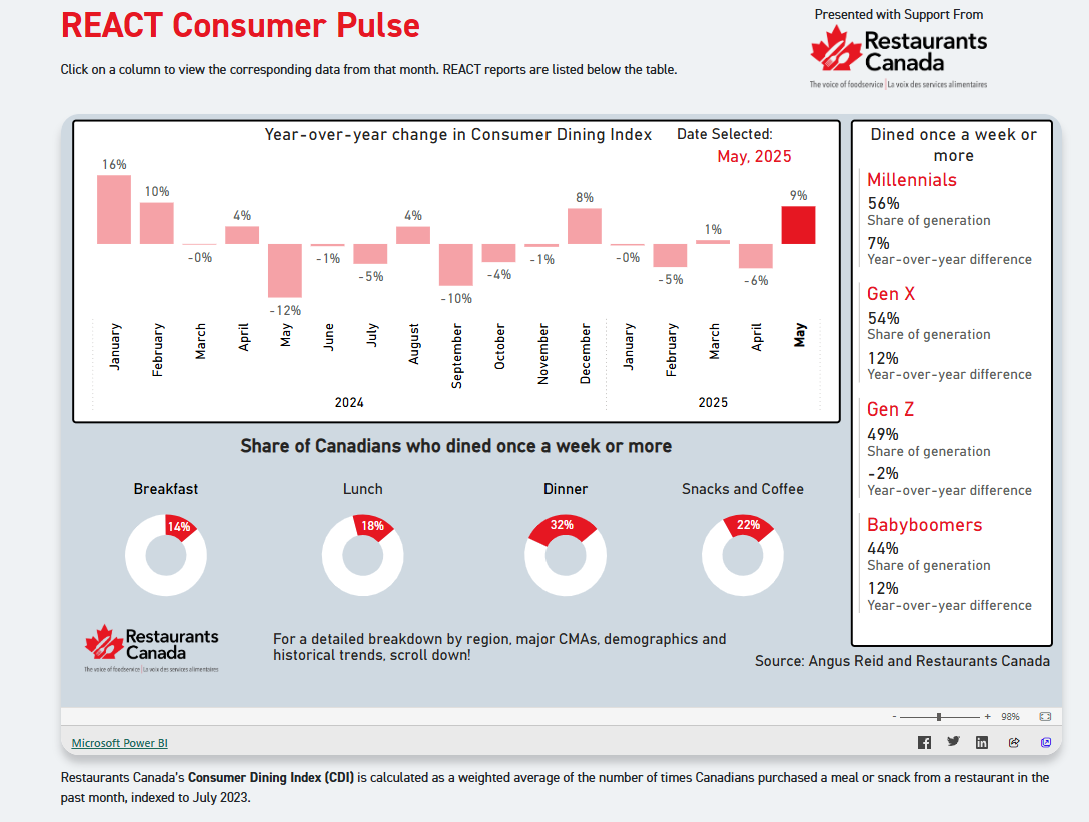
              Restaurants Canada’s Consumer Dining Index (CDI) rose to 89.8 in May 2025, up from 87.0 in April. On a year-over-year basis, the index shows even stronger growth, increasing by 7.2 points compared to 82.6 in May 2024, according to Chief Economist and Vice President of Research for Restaurants Canada, Chris Elliott.

              Chris Elliott
              Chris Elliott

              The strongest growth came from the dinner day part. In May, 31% of Canadians reported purchasing dinner from a restaurant at least once a week, up from 24% the year before. This increase was largely driven by more frequent visits among consumers aged 35 to 54, said Restaurants Canada.

              Despite the overall increase, certain day parts lagged behind. The snack and coffee category saw a two-point drop from April, with a minimal year-over-year increase of one percentage point. Lunch showed a similar pattern, indicating continued weakness in mid-day dining.

              Much of May’s overall rise can be credited to Millennial consumers (30 to 41 years old). In 2025, 56 percent dined out once a week or more, compared to 51 percent a year earlier. Gen X (42 to 59 years old) also made a notable impact, with 54 percent dining out weekly—up significantly from 42 percent in May 2024, added Restaurants Canada.

              For more details, check out the latest REACT report here.

              Related Retail Insider stories:

              Canada’s internal trade barriers finally coming down: CFIB (Video)

              Photo: Adi K
              Photo: Adi K

              More progress has been made on removing trade barriers within Canada in the past six months than in eight years since the Canadian Free Trade Agreement (CFTA) was signed, finds the Canadian Federation of Independent Business (CFIB)’s latest State of Internal Trade report: Interprovincial Cooperation Report Card.

              Ryan Mallough
              Ryan Mallough

              “While progress to date has been encouraging, we also have seven different jurisdictions taking seven different approaches to mutual recognition. That kind of patchwork can wind up recreating the barriers it was meant to knock down,” said Ryan Mallough, CFIB’s vice-president of legislative affairs.

              “We’re marching the ball down field, but we haven’t reached the end zone just yet. The premiers and the prime minister have instructed the Committee on Internal Trade to reach a pan-Canadian mutual recognition agreement for December. We’ll be watching those conversations closely to ensure we cross the goal line and finally eliminate Canada’s internal trade barriers once and for all.”

              Nova Scotia, the first province to introduce and implement mutual recognition legislation, achieved the highest grade in CFIB’s 2025 Internal trade report card with a score of 9.4 (A grade). Ontario is a close second after eliminating all of its CFTA exemptions, scoring a 9.2 (A grade), said the CFIB.

              The 2025 report card grades are:

              Jurisdiction Canadian Free
              Trade Agreement
              Exceptions
              (40%)
              Select Barriers 
              to Internal Trade
              (20%)
              Status of Items from
              Reconciliation
              Agreements 
              (40%)
              Bonus
              Indicator:
              Mutual
              Recognition
              (Multiplier)
              Overall
              Score and Grade
              NS2.3F5.9D8.9A-8.59.4A
              ON10A+6.0D8.2B59.2A
              MB7.3C+5.4D9.6A58.9A-
              BC6.3C-4.1D9.2A58.5B+
              FED*6.8C9.7A08.2B
              AB7.9B4.1D9.5A18.0B
              PEI3.1F4.7D8.8A-57.8B
              SK6.8C5.3D9.2A17.7B-
              NB4.8D4.7D8.5B+16.6C
              QC0.0F3.6F8.9A-36.0C-
              NL4.1D2.6F8.5B+16.0C-
              NT4.82.0F8.8A-05.8D
              NU4.52.0F8.6B+05.6D
              YT1.33.0F8.8A-04.6D
              The federal government is scored on two areas: the economic impact score based on the procurement exceptions they maintain from the CFTA in 2025, and the implementation status of reconciliation agreements. Both areas are weighted equally (50% each) as the select barriers area was not available for this analysis. 

              The report grades three major areas of interprovincial/territorial cooperation: CFTA exceptions, select barriers to trade, and the status of items from reconciliation agreements. There’s an updated bonus indicator that rewards jurisdictions that accept other regions’ regulations and standards as sufficient within their own jurisdiction, said the CFIB.

              SeoRhin Yoo
              SeoRhin Yoo

              “Three years ago, we challenged governments to blow a hole through Canada’s internal trade barriers by adopting mutual recognition policies to get the flow of goods, services and people moving across the country. At the time, we heard all the reasons why it couldn’t be done. But just in the past six months we’ve seen seven jurisdictions with mutual recognition legislation on the books,” said SeoRhin Yoo, CFIB’s senior policy analyst for interprovincial affairs.

              “The internal trade file is finally getting the attention it has desperately needed since the CFTA was signed in 2017. While there’s lots of reason for optimism, we’ll be closely watching governments’ next steps, including the crucial regulations that will follow legislation, to ensure the rules match the rhetoric and small businesses feel actual progress on the ground.”

              The CFIB is Canada’s largest association of small and medium-sized businesses with 100,000 members across every industry and region.

              Related Retail Insider stories:

              How Retailers Can Protect Staff and Shoppers From In-Store Accidents

              The last thing any retailer wants to see is an accident in their store. However slippery floors, precarious merchandise displays, and other conditions can cause accidents and injuries that affect shoppers and employees. Worse yet, accidents can lead to legal problems that result in costly payouts and blemished reputations for retailers. That’s why it’s so important to be proactive about creating a safe environment less likely to cause issues. Keep reading to learn how retailers can protect shoppers and staff from in-store accidents.

              Address Common Risks

              Taking the time to identify potential in-store accident triggers can help prevent actual accidents from happening. Parts of the store may be dimly lit, for instance, making it harder to see obstructions and other tripping hazards. Installing better lights is an easy fix to illuminate those areas. Likewise, if a door is difficult to open or the flooring is uneven, it’s relatively simple to tackle these structural issues with the help of a qualified repair person. 

              Other common problems can include wet floors after mopping and merchandise displays prone to falling. In these instances, staff will need to intervene with solutions. Signage indicating that floors are slippery can alert walkers to move with more caution. Other interventions can include introducing non-slip floor mats to workspaces or high-traffic pathways.  And staff should know the best practices for stacking or displaying merchandise to ensure it doesn’t fall and hit someone.

              Ultimately, ongoing vigilance is key. Retail managers should do daily checks within the store, making sure the walkways are safe and noting any maintenance needs. Retailers should be aware that they can be liable for injuries sustained by staff or shoppers if there is an existing problem that they don’t fix. In short, being dutiful about store safety is an essential part of a retailer’s job. An attorney skilled in injury law in Denver can act as a guide to make sure retailers have policies in place. And they can provide support for retailers entangled in litigation if there is an injury in the store. 

              Make Sure Staff Understand Safety Protocols

              Managers can head off in-store accidents by making sure they train their staff. Small businesses need to be able to trust that their employees are focused on best practices when it comes to store safety. All employees should know how to reach items on high shelves, for instance. They should be able to access temporary signage to indicate the presence of wet floors or debris. And if an accident does occur, they should know the right steps to document and report it. 

              Ideally, this type of training should be embedded within onboarding for new staff. But even seasoned employees can benefit from refreshers. Managers should commit to offerly quarterly or biannual trainings so everyone is on the same page. Encouraging a culture of safety and open communication can keep all individuals safer.

              Respond to Accidents Quickly

              Sometimes the best prevention protocols can’t stop accidents from occuring. For retailers, that means it’s critical to follow a series of steps that can help improve outcomes. Failing to take action quickly can result in slower medical intervention for injured parties and potentially lead to legal consequences.

              After an accident, a retail manager should address injuries first. They should have a designated first aid kit for minor cuts and bruises. But they should reach out right away to medical professionals if injuries are more severe. Then they should create an incident report with details about what happened. Witnesses may be able to weigh in with their accounts of the scene. And camera footage can offer another unbiased perspective that can help demonstrate that a retailer was swift in offering help. 

              Avoid In-Store Accidents

              Retailers owe it to their customers and employees to cultivate a safe environment. They should have regular safety trainings for employees and audit the store for maintenance needs. With clear procedures in place and some legal guidance, retailers can offer a welcoming and secure shopping space. Customers and employees will take notice, helping build a positive reputation for the retailer. 

              Bruno Marc Is Quietly Disrupting Men’s Footwear–And Shoppers Are Taking Notice

              Bruno Marc, a fast-rising name in men’s footwear, is expanding its reach in 2025 with a bold new lineup that reflects the evolving needs of today’s style-conscious, comfort-driven consumer. Blending performance engineering with modern design, the brand’s latest launches are making a statement not just in fashion–but in the shopping space.

              Bruno Marc’s growth reflects broader shifts in the men’s footwear sector: consumers are demanding more versatile, wearable styles that can transition seamlessly across lifestyle moments. In response, the brand’s Spring/Summer 2025 range focuses on flexibility, breathability, and all-day wear–without compromising the visual appeal traditionally tied to premium dress shoes.

              Key technologies like CrossFlex™, MexFlex™, and KnitFlex™ are central to the brand’s material and comfort innovations–targeting busy professionals, hybrid workers, and urban commuters alike.

              CrossFlex GentEdge

              A reimagined classic, the GentEdge introduces Bruno Marc’s signature CrossFlex™ tech into formalwear, offering increased flexibility for men constantly on the move. Finally, a dress shoe that feels as good as it looks—fluid flexibility meets boardroom polish.

              Shop Here

              KnitFlex SmartCraft

              With a breathable knit upper and smart-casual appeal, this model straddles the sneaker/dress shoe category–ideal for consumers valuing style versatility in hybrid settings. If a tailored sneaker existed, this would be it—flexible, featherlight, and surprisingly sharp.

              Shop Here

              MaxFlex SuiteCraft

              Built to keep up with your longest days and liveliest nights, the SuiteCraft blends contemporary style with breathable comfort and flexible support. Whether you’re powering through back-to-back meetings or unwinding at a late-night gathering, this shoe ensures you stay comfortable and sharp from morning to midnight.

              Shop Here

              MaxFlex SuiteCraft–

              A minimalist update on the original SuiteCraft, this style reflects the increasing demand for clean, understated formal options that also deliver ergonomic support. Minimalist, modern, and made to move—built for today’s multitasking man.

              Shop Here

              MaxFlex ActiveMetro

              Part of the growing athleisure segment, the ActiveMetro leverages MaxFlex technology to support active daily routines while maintaining a streamlined urban aesthetic. Your new favorite hybrid—sporty enough for errands, sleek enough for the office.

              Shop Here

              CrossFlex NeatPolish+

              A performance-first dress show featuring CrossFlex™ support, anti-slip soles, and moisture-wicking liners–engineered for long days on your feet, in polished form. Polished to impress. Cushioned to perform. The dress shoe that outlasts your longest day.

              Shop Here

              CrossFlex CrestHigh

              A high-cut option with outdoor styling cues, the CrestHigh boot offers cold-weather function with modern lines, suited for both city and countryside consumers. All-terrain style with metropolitan edge—this boot does both, brilliantly.

              Shop Here

              Today’s consumers aren’t interested in being boxed into one category — whether it’s work shoes, casual sneakers, or performance kicks. They want shoes that can keep up with their busy, varied lifestyles. Bruno Marc understands this perfectly. Their collection is designed to fit the needs of hybrid workdays, fast-paced city living, and active social calendars. By using advanced materials like CrossFlex™, MaxFlex™, and KnitFlex™, the brand delivers footwear that’s comfortable, durable, and breathable — exactly what the modern man demands.

              The Spring/Summer 2025 lineup from Bruno Marc strikes the perfect balance between timeless style and modern innovation. The CrossFlex GentEdge revitalizes the traditional Oxford with flexible soles ideal for men on the move, while the KnitFlex SmartCraft reinvents casual elegance with breathable knit uppers that work just as well in a café as they do in the office. For the urban commuter, the MaxFlex ActiveMetro provides shock-absorbing comfort without sacrificing sleek city style.

              Bruno Marc isn’t just innovating with products — their retail approach is equally savvy. Leveraging Amazon’s powerful data and logistics systems, they’re able to move inventory quickly, target customers more effectively, and deliver a smooth shopping experience. This digital-first strategy not only speeds up the brand’s growth but also builds lasting customer loyalty through reliable, fast delivery and engaging online presence.

              What sets Bruno Marc apart is not just their cutting-edge footwear but their dedication to making quality and style accessible. With prices that offer premium features without the premium tag, the brand appeals to men who want the best without compromise. As retail shifts towards more personalized and experience-driven shopping, Bruno Marc’s well-rounded approach to design and distribution positions it as a key player ready to make a lasting impact in men’s footwear. With premium features at an accessible price point and a strong foothold in e-commerce, Bruno Marc is a brand to watch in the years ahead.

              Explore the full Bruno Marc lineup on Amazon.

              Cineplex CEO Ellis Jacob to retire at year end 2026

              The Palms at The Rec Room Granville, photo credit: Tom Belding (CNW Group/Cineplex)

              Cineplex Inc., Canada’s leading entertainment and media company, has announced that longtime President and CEO Ellis Jacob will retire from the company on December 31, 2026.

              In the interim, Jacob will continue to lead Cineplex and assist the transition to a new leadership structure, said the company in a news release.

              Ellis Jacob

              “The Board is delighted to recognize Ellis, who has built Cineplex Inc. over the past four decades into one of the world’s best operators of movie theatres and family entertainment centres,” said Board Chair Phyllis Yaffe.

              “Ellis is, quite simply, a giant in our industry. It has been a privilege to work alongside him for many years and we look forward to working with him through this transition.”

              The company said Jacob is the recent recipient of the Canadian Cinema and Television (Canadian Academy) Tribute Award at the 2025 Canadian Screen Awards. In 2022 Mr. Jacob was honoured by the National Association of Theatre Owners (NATO) with the 2022 NATO Marquee Award at CinemaCon in Las Vegas. He is the recipient of numerous other awards and recognition, including the Order of Canada and the Order of Ontario.

              “After thoughtful consideration, I welcome this next chapter. For decades, I have been focused on making Cineplex a great Canadian company, and I move forward with immense pride in what we’ve built for generations of Canadian movie fans who come to us for those magical moments of escape that can only be found in a true theatre experience,” said Jacob. “I remain committed to working with the Board and the talented team at Cineplex during this transition period and have unwavering confidence in Cineplex’s bright future.”

              The company is a top-tier Canadian brand that operates in the Film Entertainment and Content, Amusement and Leisure, and Media sectors. Cineplex offers a unique escape from the everyday to millions of guests through its circuit of over 172 movie theatres and location-based entertainment venues. In addition to being Canada’s largest and most innovative film exhibitor, the company operates Canada’s favourite destination for ‘Eats & Entertainment’ (The Rec Room), complexes specially designed for teens and families (Playdium), and an entertainment concept that brings movies, amusement gaming, dining, and live performances together under one roof (Cineplex Junxion). It also operates successful businesses in cinema media (Cineplex Media), digital place-based media (Cineplex Digital Media or CDM), alternative programming (Cineplex Events) and motion picture distribution (Cineplex Pictures).

              Related Retail Insider stories:

              Cineplex reports strong Q1 2025 results with $264.3M revenue, record concessions, and 38% surge in media sales

              Cineplex reports drop in annual box office revenue