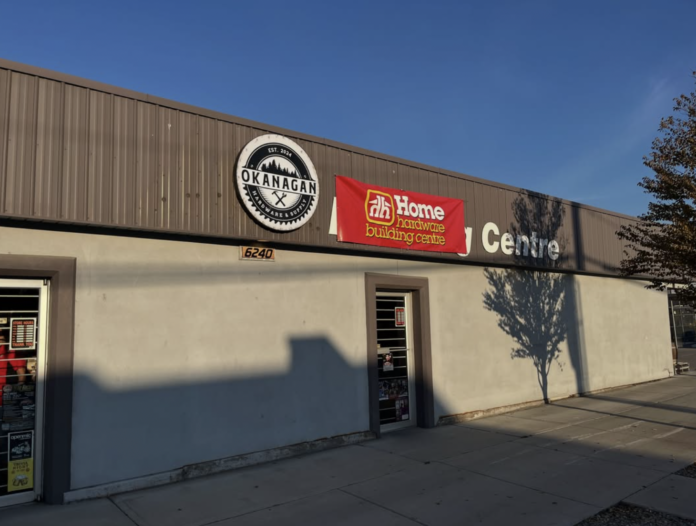
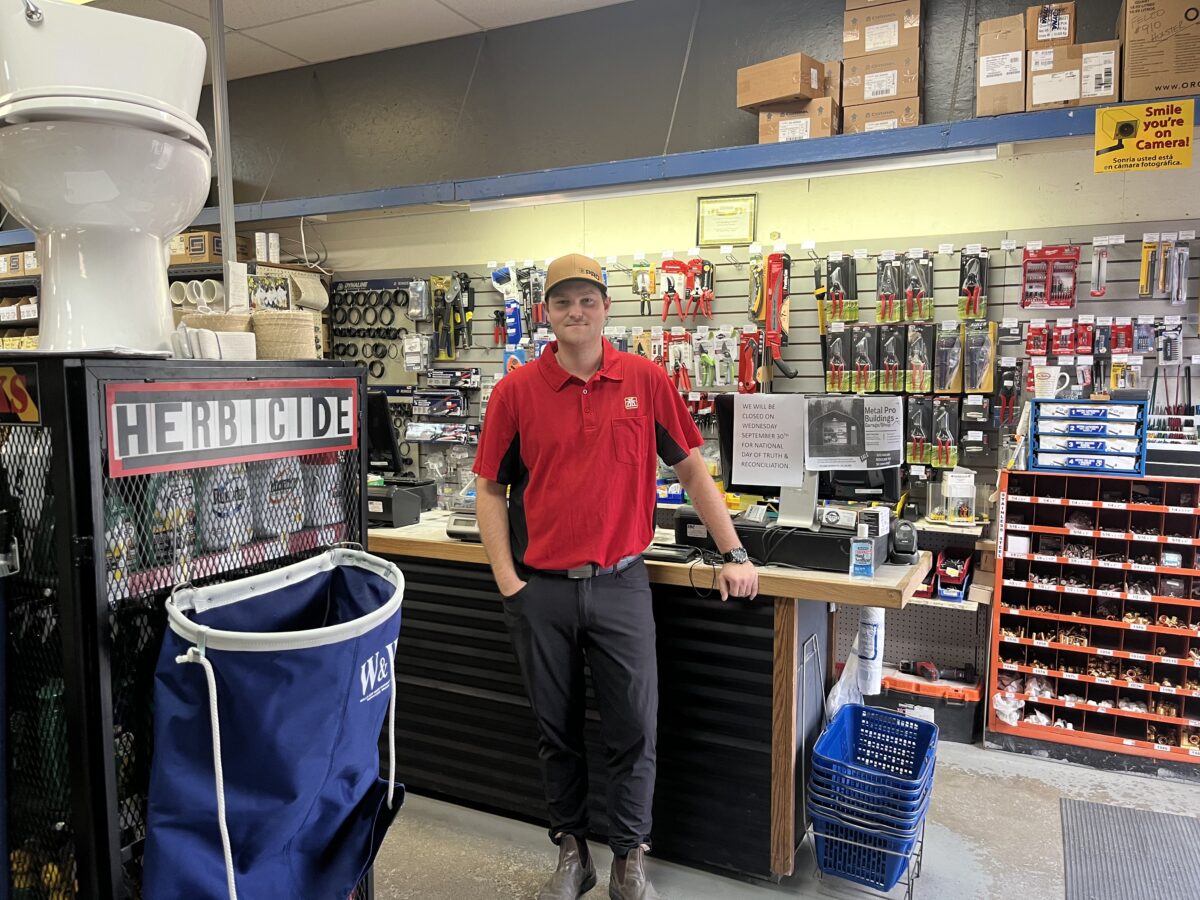
The store is locally owned and operated by Logan Malmberg and Kianna Carvalho and will remain independent while gaining access to the support and buying power of Canada’s largest Dealer-owned home improvement retailer.
“Choosing Home Hardware was an easy decision for us,” said Logan. “We looked for a partner that supports independent businesses and understands the importance of local relationships. Home Hardware gives us both the hardlines and LBM programs to continue growing while staying true to who we are and the community we’ve proudly served for years.”
The family owned business began in 1999 and doubled in size in 2014, expanding its offering to include lumber and building materials.
“When successful independent businesses choose to join Home Hardware, it speaks volumes about the strength of our Dealer-owned model,” said John Pierce, Chief Retail Operations Officer, Home Hardware Stores Limited. “Logan, Kianna and their team have earned the trust of customers throughout the Oliver community, and we’re proud to welcome them to the Home Hardware network of proud Dealer-Owners.”
Home Hardware was founded more than 60 years ago in St. Jacobs, Ontario and today has nearly 1,000 stores as the country’s largest Dealer-Owned and operated home improvement retailer.
Welcome to the Daily Synopsis by Retail Insider. We hope you enjoy the 11 articles we published covering key developments in Canadian retail. Here are a couple highlights with a full list of the day’s articles thereafter.
Aritzia is managing higher U.S. tariffs and the end of duty-free low-value imports while growing revenue and margins, demonstrating how cross-border expansion involves complex trade and real estate considerations. At the same time, Toronto-based STEFF ELEOFF is growing its Canadian retail presence through Holt Renfrew pop-ups at Yorkdale and Bloor Street, blending physical and digital experiences to enhance customer engagement during its FW26 launch. Both highlight distinct growth approaches amid regulatory and market challenges.
Bed Bath & Beyond has returned to Canada with an e-commerce platform, offering a curated selection of about 6,000 home-related products tailored to Canadian consumers under Sleep Country Canada ownership. The retailer plans to open physical stores by late 2027, emphasizing a mix of trusted essentials and new brands in a design-forward approach. At the same time, Craig’s Cookies has expanded to 25 locations across the country using franchising, focusing on balancing market demand and community fit while baking locally in each store.
Last week, we reported on Aritzia and its success south of the Canadian border. The company’s U.S. expansion has exposed the Vancouver-based retailer to a cost that was far less important when Canada accounted for most of its business: American trade policy. This brought about a continuation of our reporting on the retailer, as they navigate the dynamic trade relationships directly influencing its expansion – past and present.
The additional tariffs and the suspension of the U.S. de minimis exemption put approximately 260 basis points of pressure on Aritzia’s adjusted EBITDA margin in fiscal 2026. Despite that burden, revenue increased 35%, while adjusted EBITDA margin improved substantially. The effect was particularly visible in the fourth quarter. Aritzia reported 390 basis points of gross-margin pressure from tariffs and de minimis, yet gross margin still increased 90 basis points to 43.3%. Improvements in initial markup, lower markdowns and leverage on store occupancy and other fixed costs more than compensated for the trade-related pressure. The pattern continued in the first quarter of fiscal 2027. Tariffs and de minimis represented another 190 basis points of pressure, according to CFO Todd Ingledew, while gross margin increased 310 basis points to a record 50.3%.
For the non-financial minded: Aritzia is paying a significant tariff-related bill, but its operating performance has so far improved faster than that bill has grown.
Why Aritzia Is Exposed
Aritzia’s Canadian headquarters do not insulate it from U.S. import duties. The company sources merchandise internationally, and goods imported into the United States can be subject to duties based on factors including their country of origin and tariff classification.
Who ultimately bears the economic cost is more complicated. Aritzia can absorb some of the expense in its merchandise margin, seek lower costs through sourcing and vendor negotiations, reduce freight or other operating expenses, or pass some costs to consumers. Aritzia’s financial results do not disclose precisely how the fiscal 2026 burden was divided among those responses. Attributing a specific portion to customers or suppliers would therefore go beyond the evidence.
De minimis (a threshold set by a country below which imported goods can enter without paying customs duties or import taxes) adds another dimension. The suspension of duty-free treatment for qualifying low-value shipments into the United States removed a route that had allowed eligible merchandise valued at US$800 or less to enter without the usual duties.
For a retailer with a large U.S. digital business and Canadian distribution infrastructure, that change makes cross-border fulfilment economics more important. It does not mean every Aritzia order incurred the same additional cost, but one previously available route for duty-free low-value imports disappeared.
Aritzia Has Been Able to Offset the Cost
Aritzia’s financial results show why higher tariffs do not necessarily produce an equivalent increase in consumer prices or decline in retailer margins. In fiscal 2026, the company absorbed substantial tariff and de minimis pressure while improving profitability through better initial markup, lower markdowns, expense leverage and other savings. The first quarter produced a similar result. Gross margin reached 50.3% despite the 190-basis-point tariff and de minimis headwind, while adjusted EBITDA margin reached 20%. Those offsets are increasingly important because the United States now accounts for most of Aritzia’s business. U.S. revenue increased 54.5% to $638.1 million in the first quarter and represented 67.1% of company revenue.
The physical footprint has crossed the same threshold. In our earlier analysis of Aritzia’s expansion strategy, the company had 76 boutiques in the United States and 67 in Canada at the end of the quarter, excluding Reigning Champ. Most incremental store investment is also going south. Aritzia expects 11 to 12 of its 12 to 13 new boutiques planned for fiscal 2027 to open in the United States.
The economics remain compelling. CEO Jennifer Wong said in July that recent new boutiques were paying back their investment in less than one year, ahead of Aritzia’s 12-to-18-month target. Management has also said newer U.S. boutiques are opening closer to maturity than earlier generations of American stores, which historically required a longer ramp.
Tariffs have therefore increased the cost of Aritzia’s largest growth opportunity without, so far, undermining its store economics. The returns help explain why management continues directing most incremental boutique expansion toward the United States.
Measuring Aritzia’s Tariff Exposure
Aritzia has incorporated tariffs directly into its financial planning, although the policy environment has continued to change. On the May earnings call, Ingledew said the company was paying what he described as a 10% global surcharge, and management’s fiscal 2027 outlook assumed that rate would remain in place along with the suspension of de minimis.
The July call provided a useful measure of Aritzia’s sensitivity to higher tariffs. At the time, management said its guidance continued to assume a 10% tariff. If that rate increased to 20%, Ingledew estimated it could create another $25 million to $30 million of pressure during the second half of fiscal 2027.
That figure is better viewed as a sensitivity analysis than a forecast. It was based on the tariff assumptions in place when Aritzia reported in July, and Ingledew also said potential tariff refunds had not been included in the outlook. Depending on their treatment, those refunds could offset incremental pressure. Tariffs are not the only cross-border cost facing the retailer. Ingledew said in May that Aritzia had encountered higher fuel surcharges and air-freight costs, which the company incorporated into its outlook at then-current levels.
U.S. Customers Have Yet to Show Much Resistance
There is little in Aritzia’s current results to suggest its American customers are pulling back as the company manages higher trade-related costs. First-quarter comparable sales increased 35.1%, digital revenue increased 55.5%, and U.S. revenue increased 54.5%.
Wong was similarly direct when asked about U.S. conditions on the May earnings call: “We’re not seeing any letup in demand.” She said traffic remained strong and the company continued to benefit from it. Those figures do not establish unlimited pricing power, nor does Aritzia disclose enough information to determine precisely how much of its tariff burden has been passed through to consumers. They do indicate that tariffs have yet to produce an obvious demand problem in the company’s reported results.
The more consequential test could arrive as growth normalizes. Comparable sales growth of 35.1% and U.S. revenue growth above 50% are generating considerable operating leverage, but neither is a reasonable perpetual assumption. If tariffs remain elevated while sales growth moderates, the operating leverage that has helped Aritzia offset higher costs would become less powerful. Increased markdowns, weaker store productivity or greater consumer resistance to pricing could put additional pressure on the factors that have protected margins so far.
Management’s outlook does not anticipate margin deterioration this year. Aritzia expects further adjusted EBITDA margin expansion in fiscal 2027 despite incorporating tariffs and de minimis into its assumptions.
Distribution Is Following the U.S. Business
Aritzia’s distribution strategy is also moving closer to its largest market. Its new 380,000-square-foot British Columbia distribution centre went live in May, and management has begun planning for additional distribution capacity in the United States.
Wong said in July that the company was beginning to “pivot toward expanding our distribution network in the United States.” The project remains preliminary, however, with no site selected when management discussed the plans. Management has not characterized the planned U.S. facility as a tariff-mitigation project, and there are straightforward operating reasons to put distribution capacity closer to a rapidly growing U.S. store and digital network. The loss of de minimis nevertheless means cross-border inventory movement carries different economics than it did previously.
For Aritzia, the broader shift is significant. A Canadian retailer that once had its domestic business as its centre of gravity is building an operating system increasingly designed around U.S. scale, while becoming more exposed to the trade rules governing that market.
The Lesson for Canadian Retailers Looking South
Aritzia provides an instructive example for Canadian retailers considering the United States. Geographic expansion can diversify revenue away from Canada while increasing exposure to U.S. trade policy, particularly when merchandise is sourced internationally.
For landlords and brokers, tariffs have not stopped Aritzia’s store program. Recent boutiques are producing paybacks ahead of management’s target, and almost all of this year’s planned new stores are still heading to the United States. Persistent import costs can also give retailers an incentive to protect initial markup through sourcing, product costing and vendor negotiations, although Aritzia has not disclosed how much of its tariff burden, if any, has been pushed upstream to suppliers.
For investors, the relevant measures include U.S. sales growth, gross margin, markdowns, new-store productivity and the size of the tariff headwind. So far, improvements in Aritzia’s underlying business have outweighed that headwind.
The harder test will come if tariff pressure persists or increases as extraordinary sales growth begins to normalize. Aritzia has demonstrated that it can absorb substantial trade-related costs while expanding margins, but the United States has become too important to its growth strategy for American trade policy to remain a peripheral supply-chain risk.
“Retailing activity at gasoline stations and fuel vendors (-3.5%) contracted in July, offsetting most of the increase recorded in the previous month and coinciding with rapidly rising gasoline prices during the peak travel season. Similarly, lower activity at general merchandise retailers (-2.2%) further contributed to the decline in July after being among the largest contributors to growth in June,” explained the federal agency.
“Sporting goods, hobby, musical instrument, book, and miscellaneous retailers (-1.8%) and motor vehicle and parts dealers (-0.6%) further contributed to the sector’s contraction in July.”
Tima Miroshnichenko photo
Statistics Canada said real gross domestic product (GDP) nationally was essentially unchanged in July.
The goods-producing industries grouping was essentially unchanged in July as increases in construction and utilities were offset by declines in the other sectors comprising the aggregate. The services-producing industries aggregate was essentially flat, as increases across several sectors were offset by declines in retail trade and wholesale trade. Overall, 10 of 20 industrial sectors expanded in July, it said.
Advance information indicates that real GDP increased 0.2% in August, added StatsCan.
“Activity was flat in July, with that result in line with the advance estimate albeit coming off the heels of a stronger than initially reported 0.4% gain in the prior month. Manufacturing, mining, oil & gas and retail weighed on growth during July, countering a surge in construction activity. The advance estimate for August pointed to growth of 0.2%, which leaves Q3 as a whole tracking around a 2.0% annualized pace,” he said.
“While that’s a deceleration compared to the strength seen in Q2, it would still be enough, if maintained, to gradually reduce slack within the economy. However, given the escalation of US trade uncertainty towards the end of August, today’s data will likely be viewed as old news, with even the advance estimate mostly covering a period of time before new tariffs came into effect. Because of that, we suspect that upcoming employment and CPI data will be more important heading into the late October rate decision, as well as the Bank’s own Business Outlook Survey.”
“It is still early in the quarter, but given the advanced guidance, Q3 real GDP growth is tracking a solid 2% annualized–consistent with our expectation for a moderation in growth following a robust second quarter rebound. Renewed U.S.–Canada trade frictions and higher energy costs weigh will continue to weigh on household and business activity over the near-term,” he said.
“This report alone is unlikely to materially alter the Bank of Canada’s outlook. Markets have recently turned more hawkish as persistent energy pressures raise the risk that inflation broadens, while higher U.S. policy rates and the spillover from rising global bond yields add to the tightening in Canadian financial conditions. Still, we think uneven domestic growth, a labour market that remains in recovery mode, and elevated uncertainty gives the Bank cover to remain on the sidelines for now.”
“This report puts Q3 GDP growth in line or slightly better than the BoC’s forecast. However, the new round of tariffs creates some questions for the outlook, but the Productivity Mega Deduction should provide a firm tailwind for Q4. There’s nothing here to heavily skew the balance of risks for the October policy meeting, with CPI, energy prices and the Business Outlook Survey likely the key inputs for policymakers,” he said.
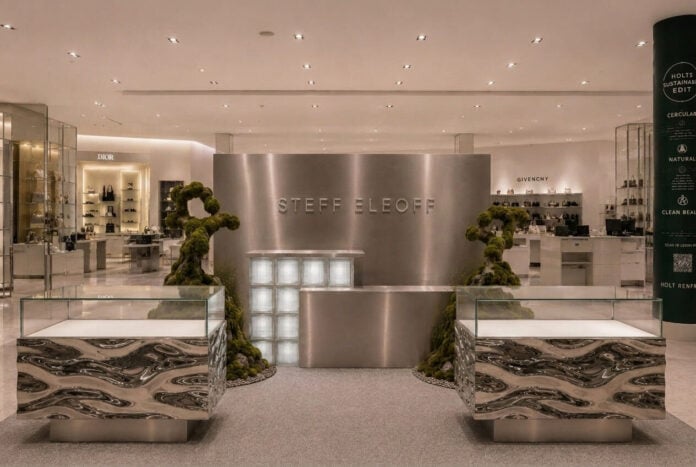
Rendering of the STEFF ELEOFF space at Holt Renfrew, Yorkdale Shopping Centre in Toronto. Image supplied
Toronto-based jewellery brand STEFF ELEOFF is expanding its presence in Canadian luxury retail through a partnership with Holt Renfrew, bringing experiential pop-ups to the retailer’s Yorkdale and Bloor Street stores this fall.
The first activation will run at Holt Renfrew Yorkdale from October 2 to 29, followed by Holt Renfrew Bloor Street from November 12 to December 12. The installations coincide with the launch of STEFF ELEOFF’s FW26 Body of Water collection and will feature an edited assortment alongside pieces created exclusively for Holt Renfrew.
For founder and designer Steff Eleoff, the partnership brings a largely digital business into a more substantial physical setting in its home market. Despite the company’s Canadian roots, Eleoff told Retail Insider that most of its business now comes from outside Canada.
“We’ve grown so much online, but haven’t had many opportunities for customers to experience STEFF ELEOFF physically,” Eleoff said. “As a Canadian brand with most of our business coming from outside Canada, it felt like the right time to build a stronger presence at home.”
Holt Renfrew offered an established Canadian luxury platform for that next stage, while the two Toronto stores provide access to different customer bases.
Steff Eleoff
Yorkdale and Bloor Offer Different Toronto Markets
Eleoff sees distinct roles for the two locations. Yorkdale provides the scale and traffic of one of Canada’s major shopping centres, while Holt Renfrew’s Bloor Street flagship places the brand within Toronto’s established luxury shopping district.
“Yorkdale has incredible scale and energy, while Bloor sits at the heart of luxury and fashion in the city,” Eleoff said.
Operating at both stores will also allow the company to see how different customers interact with the brand in person, providing information that is more difficult to capture through a predominantly digital business.
The Holt Renfrew partnership follows earlier experiments with offline retail and brand experiences. STEFF ELEOFF has previously staged pop-ups during Paris and London Fashion Weeks, and its products have been carried internationally, including at Kith Tokyo. The company has also experimented with experiential concepts in Toronto, including a STEFF ELEOFF Café activation.
A Preview of What a STEFF ELEOFF Store Could Become
Eleoff describes the Holt Renfrew installations as an interpretation of what a future STEFF ELEOFF store could eventually feel like, although the company has not announced plans for a permanent location.
The environment combines metal with natural elements and is intended to create a calmer setting than a conventional multi-brand retail space.
“We wanted it to feel almost zen, where you can slow down, experience the jewellery and step into our world for a moment,” Eleoff said.
That approach reflects how the company develops its collections beyond the individual pieces. Eleoff said imagery, film, art direction and storytelling are used to create a broader visual world around each collection, with the Holt Renfrew installation allowing that work to take physical form.
The format also addresses some of the limitations of selling jewellery online. Customers can handle pieces, feel their weight and try different shapes while encountering the product within the environment envisioned by the designer.
“Digital will always be a huge part of our business, but physical retail gives customers something online can’t,” Eleoff said. “I see physical experiences becoming an important part of how we enter and grow in key markets in the brand’s future.”
From Toronto Start-Up to an International Customer Base
Eleoff launched her namesake brand in Toronto in 2020. The company grew initially through digital channels, attracting fashion-industry attention and subsequently reaching customers outside Canada.
Early exposure included coverage from Vogue France, while international distribution and collaborations broadened the company’s audience. Eleoff was also recognized at the Canadian Arts & Fashion Awards in 2024, winning the Emerging Talent, Accessories award.
How consumers discover the brand has changed considerably as the business has expanded. Eleoff said customers now arrive through TikTok and Instagram, celebrity exposure, retailers and the company’s growing business producing covers for wearable technology.
“Our customer wants something they haven’t seen everywhere else,” she said. “The entry points have multiplied, but what ultimately brings them into the brand is still the design and the product itself.”
That range of discovery channels has allowed STEFF ELEOFF to develop an audience without relying solely on traditional jewellery retail distribution.
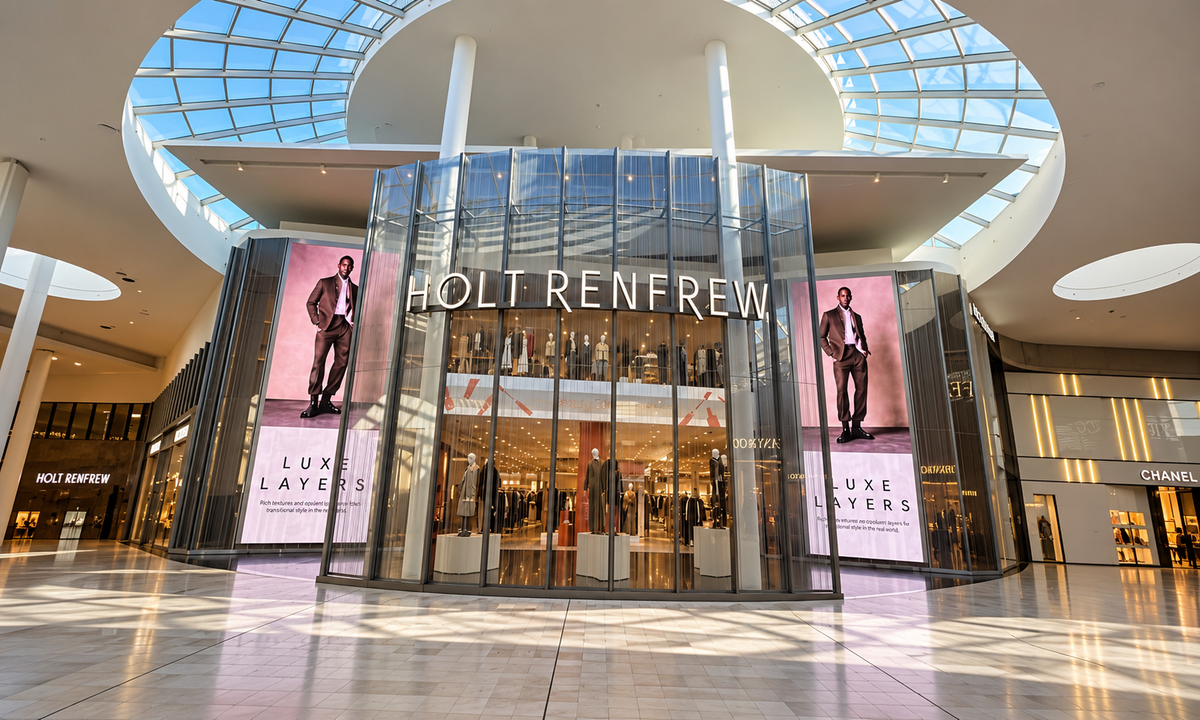
Holt Renfrew Yorkdale. Photo: Nishant Anand
Collaborations Bring STEFF ELEOFF to New Audiences
Projects involving Kylie Cosmetics and Porsche have also introduced the company to consumers outside conventional jewellery channels.
The Porsche collaboration extended STEFF ELEOFF’s design language into a much larger format. For Porsche SCOPES Toronto, the company translated the aesthetic of its Sedona ring into an installation and art car, providing an earlier example of Eleoff taking a design developed for jewellery and applying it to a physical environment.
“Porsche allowed us to explore our design language through a much larger-scale installation, while Kylie Cosmetics brought the brand into a different cultural and beauty space,” Eleoff said.
Those projects served both creative and customer-acquisition purposes for the company, putting the brand in front of audiences that may not otherwise have encountered its jewellery.
Wearable Technology Develops into a Significant Business
One of STEFF ELEOFF’s more unusual growth categories sits at the intersection of jewellery and wearable technology. The company designs sculptural jewellery covers that fit over smart rings, changing the appearance of a functional wearable device. The concept gives consumers a way to incorporate increasingly common wearable technology into a more traditional jewellery wardrobe.
What began as another product category has become an important source of business and customer discovery.
“Tech ring covers have become a significant part of our business and introduced an entirely new audience to STEFF ELEOFF,” Eleoff said.
She views the products as an extension of the company’s jewellery rather than a separate technology business. The same sculptural design approach is applied to the covers, while the category has introduced customers searching for wearable accessories to STEFF ELEOFF’s broader assortment.
Exclusive Product for Holt Renfrew
The Holt Renfrew pop-ups will not simply reproduce the assortment available through STEFF ELEOFF’s website. The company has developed pieces specifically for the retailer alongside an edit of its broader collection.
“We wanted customers to have a reason to experience STEFF ELEOFF at Holt Renfrew rather than simply recreating our website in a store,” Eleoff said.
The exclusives include colour and design variations connected with what Eleoff describes as the company’s 2026 “gem hunt journey,” with those pieces available only through Holt Renfrew.
The approach gives Holt Renfrew differentiated product while allowing STEFF ELEOFF to present a curated version of the brand to customers encountering it through the retailer.
Holt Renfrew at 50 Bloor Street West in Toronto. Photo: Craig Patterson
International Markets Remain a Focus
While the Holt Renfrew partnership strengthens STEFF ELEOFF’s presence in Canada, international markets remain central to its growth plans.
“We want to continue bringing STEFF ELEOFF into the markets where our customers already are,” Eleoff said. “International markets are a big focus for us, as we want to give people the brand experience.”
The company has not identified specific markets for future physical locations or announced plans for a permanent standalone store. Eleoff’s comments point to a strategy in which in-person experiences could increasingly accompany digital growth as the company enters or develops key markets.
The Holt Renfrew installations provide an early look at how a more permanent STEFF ELEOFF environment might eventually take shape.
“At the heart of it all, I want every physical expansion to feel intentional and distinctly STEFF ELEOFF.”
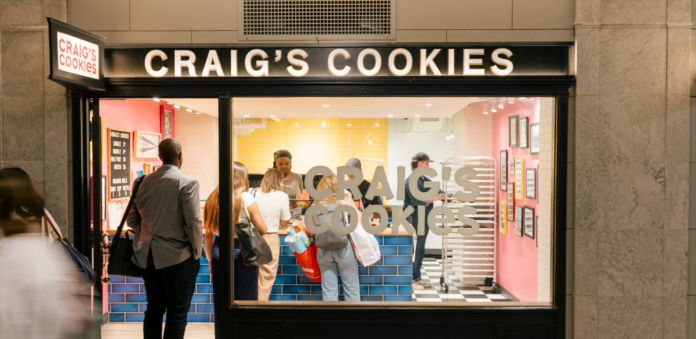
Craig's Cookies at Union Station in Toronto. Photo: Toronto Union
Craig’s Cookies has grown to 25 locations across Canada, with the Toronto-founded brand preparing for further expansion into Western Canada and other markets outside its established Ontario base.
Craig Pike
Founder Craig Pike told Retail Insider that Edmonton is expected to open in late 2026 or early 2027, while Vancouver is being considered for 2027. The company is also looking at opportunities in Eastern Canada and additional Ontario markets as its franchise network expands.
“We’re still looking at expansion across the country, but more so now looking into the West Coast and a bit more into the East Coast,” Pike said in an interview.
The expansion marks a significant change from where Craig’s Cookies stood three years ago. When Retail Insider interviewed Pike in April 2023, the company had six locations and was preparing to use franchising as its next vehicle for growth. The franchise system has since become central to the company’s expansion.
Port Credit Marks 25th Location
The latest addition is in Port Credit, marking the company’s first location in Mississauga. The store at 102 Lakeshore Road East opened this summer and is operated by franchisee Imtiaz Hussain.
Pike said Mississauga was a logical extension of a customer base Craig’s Cookies had already established across the Greater Toronto Area. “We have so many guests and lovers of Craig’s Cookies that live in Mississauga,” he said. “To be able to offer our baked goods to Mississauga means a lot to me.”
The network has also moved considerably farther beyond Toronto. Craig’s Cookies now operates in markets including Calgary, Halifax, Ottawa, St. John’s, Windsor and London, alongside its larger concentration of stores across the Greater Toronto Area and Southern Ontario. Calgary represented the company’s first move into Western Canada; Edmonton would deepen its Alberta presence, while Vancouver would take the brand into British Columbia.
Pike said expansion is being driven by individual market opportunities instead of a predetermined national store count. The company considers demographics, population growth and the ability of individual communities to support a location while trying to avoid clustering too many stores in one market.
“We don’t want to oversaturate any market either,” he said. “It’s really making sure that we’re keeping an eye on the pulse of what neighbourhoods and communities are growing.”
Pike pointed to Oshawa and communities along the broader corridor between Toronto and Ottawa as areas worth watching as populations grow. The company also has to plan well ahead: finding real estate, negotiating a lease and getting a store built can sometimes take a year, during which local demographics can continue to change.
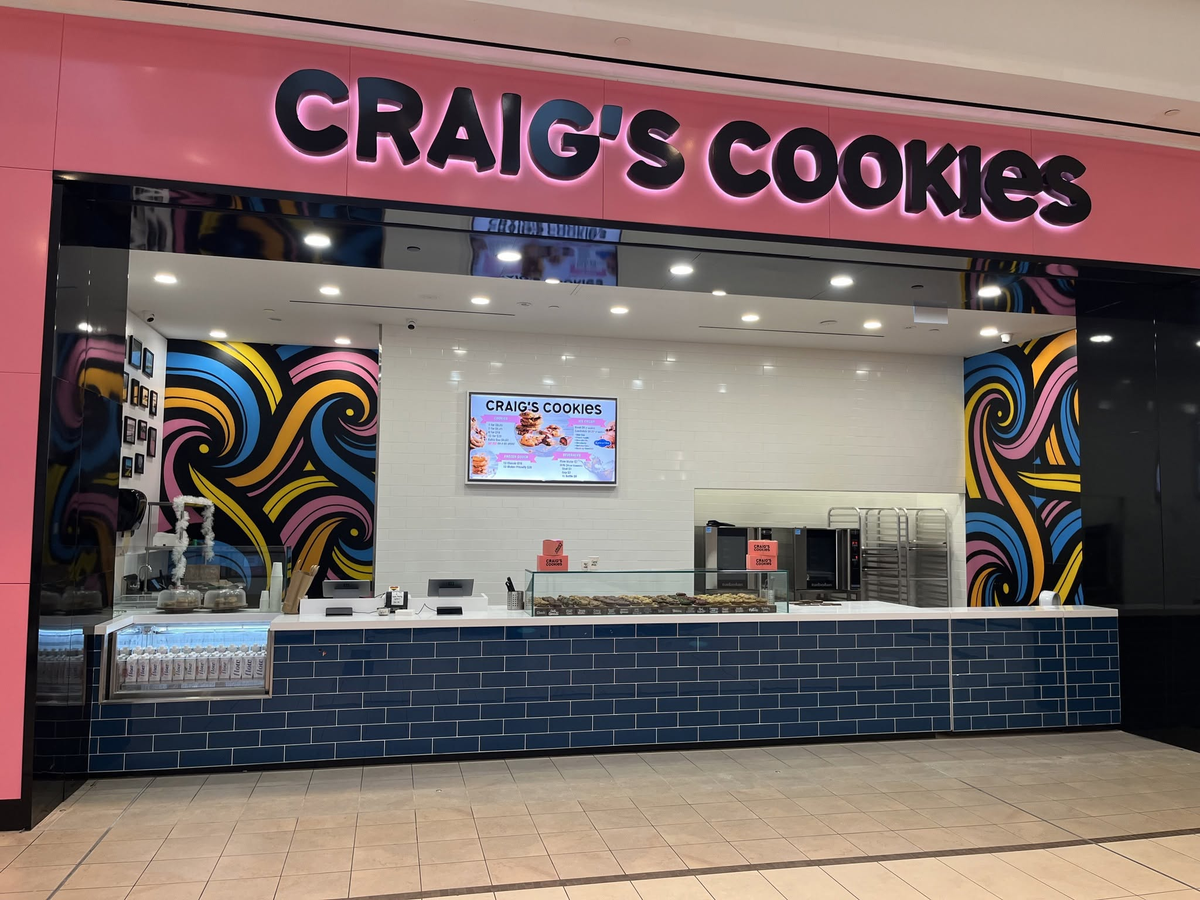
Craig’s Cookies at Scarborough Town Centre in Toronto. Image: Facebook/Craig’s Cookies STC
Franchising Becomes the Growth Engine
The current expansion has its roots in a strategy Craig’s Cookies was only beginning to implement when Pike spoke with Retail Insider in 2023. At the time, he had opened six stores and said the company was receiving franchise inquiries from prospective operators in markets ranging from Vancouver to Abu Dhabi.
Pike was cautious about growing faster than the company could support. He said preserving the culture and integrity of Craig’s Cookies mattered more than reaching an arbitrary store count. One strong new franchise in a year could be sufficient, while a considerably larger network could work if the company had the infrastructure to support it.
Later in 2023, Craig’s Cookies began putting that strategy into practice. Its first franchise opened in Niagara-on-the-Lake, followed by a multi-store development agreement with LLH Loose Change Holdings that called for at least five additional locations, with an emphasis on major regional shopping centres. It represented a significant change for a business that had largely expanded through corporate stores in Toronto.
“We’re generally still a new franchising system,” Pike said in the latest interview. “It’s only been two and a half years, and we’ve learned a lot over the last two and a half years.”
Those lessons include refining store operations and strengthening support for franchisees. Pike said maintaining consistency becomes increasingly important as the network grows, requiring sufficient corporate infrastructure to keep stores aligned with the brand. Craig’s Cookies is also using feedback from franchisees to improve operations and identify efficiencies.
A More Defined Real Estate Formula
Craig’s Cookies has developed a clearer real estate model as its footprint has expanded. Pike said the company generally prefers approximately 1,000 square feet for a franchisee’s first location, although the concept can operate in spaces ranging from roughly 800 to 1,200 square feet.
Site selection considers demographics and the surrounding community, while franchisees receive defined territories negotiated around individual locations. The model has also become increasingly flexible in terms of format.
Craig’s Cookies began primarily as a neighbourhood streetfront concept but has since established a significant presence in shopping centres. Its network includes stores at CF Toronto Eaton Centre, Scarborough Town Centre, Vaughan Mills and Bramalea City Centre, alongside streetfront and tourist-oriented locations.
Pike said the customer and operating dynamics of mall stores differ from those of neighbourhood locations. “It’s a different ballgame,” he said. “It’s a different kind of guest. It’s a different kind of experience, but equally enjoyable and successful.”
Tourist-oriented locations have different seasonal patterns, with stronger business during peak visitor periods and quieter times of the year. The range of formats has given Craig’s Cookies experience operating across neighbourhood streets, tourist destinations and major shopping centres.
Pike said broker Julie Auckland has worked with Craig’s Cookies on real estate since around 2018 and assists franchise partners as they search for locations.
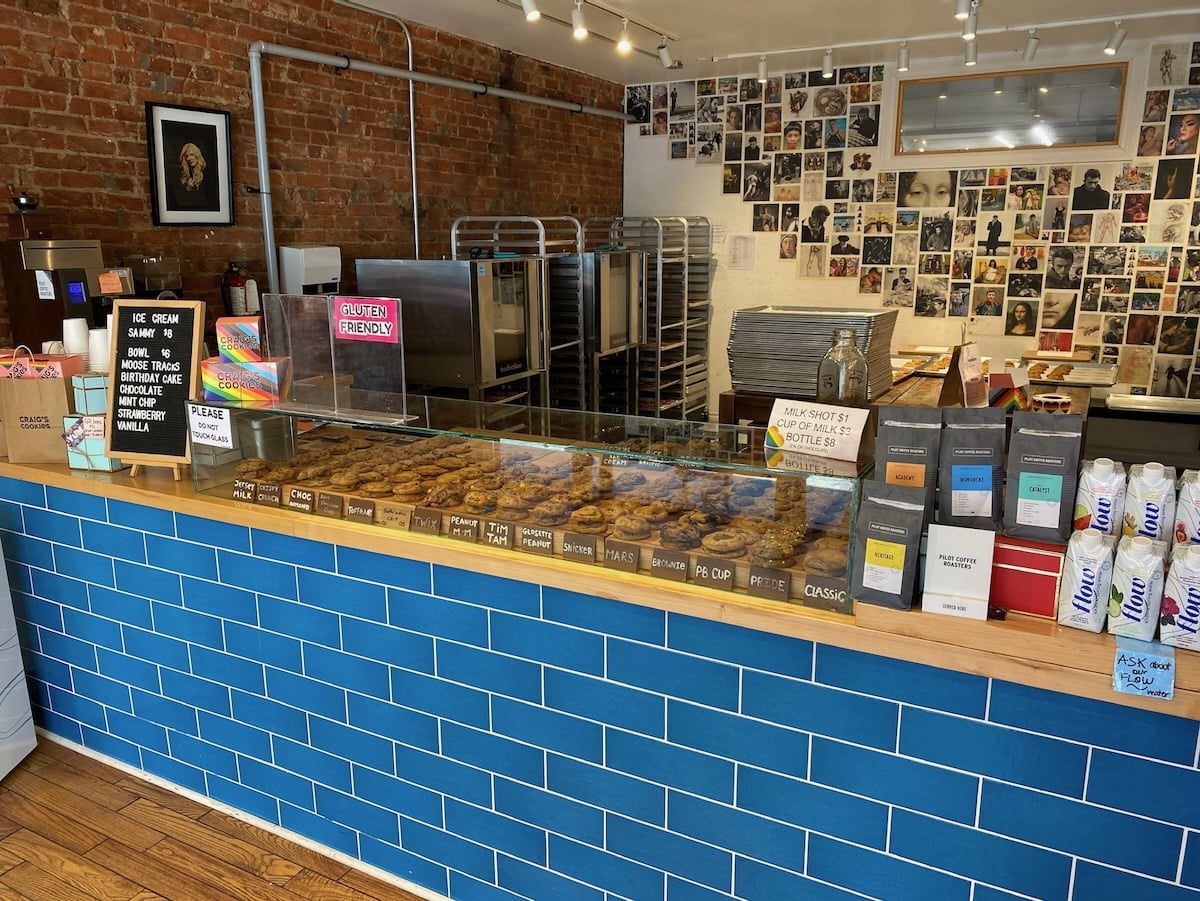
Craig’s Cookies at 483 Church St (Image: Dustin Fuhs)
Designing a Concept That Can Scale
The physical design of Craig’s Cookies has evolved alongside its real estate strategy. The original Parkdale store was about 300 square feet, and as additional stores opened, Pike repeated elements of its design to establish a recognizable identity.
When Retail Insider interviewed him in 2023, Pike explained that several of those elements had personal origins. Hardwood was intended to recall his grandmother’s Victorian home in St. John’s, while the signature blue represented the Atlantic Ocean. Black-and-white flooring was used to evoke a traditional kitchen.
Those choices subsequently became useful as Craig’s Cookies moved into franchising. Pike said the company had been thinking about replicability while it was still opening corporate stores, after receiving advice years earlier to consider how its design could support broader expansion.
The result is a relatively simple store format that remains recognizable as Craig’s Cookies while being easier to reproduce. The company has also refined workflow behind the counter, incorporating feedback from franchisees about how stores can operate more efficiently as the network grows.
Retail Insider’s Craig Patterson interviews Craig Pike of Craig’s Cookies in 2023 (video podcast)
Baking Remains Local to Each Store
Despite reaching 25 locations, Craig’s Cookies continues to make and bake its cookies at individual stores instead of distributing finished product from a centralized production facility.
“Right now everybody’s baking and making their cookies themselves at each location,” Pike said.
It is the same approach he described to Retail Insider in 2023, when the company had six stores. At the time, Pike said fresh on-site production was important to maintaining the integrity of the product. Scaling that system across a much larger network adds operational complexity, and he acknowledged that it could eventually evolve as Craig’s Cookies looks for additional efficiencies.
“There’s always room for us to change that model as we grow to make things even more and more efficient,” Pike said.
For now, production remains at store level. Pike said the broader objective is to make the operation as straightforward and profitable as possible for franchisees while maintaining the product and experience customers expect.
Craig’s Cookies at 483 Church St (Image: Dustin Fuhs)
From Bicycle Deliveries to a National Network
Pike grew up in St. John’s and moved to Toronto in 2004 to attend theatre school at George Brown College. He later worked professionally as an actor, including four seasons at the Shaw Festival, before returning to Toronto.
In 2013, after losing a restaurant job, Pike began selling cookies to generate some income. He promoted them through Facebook and Instagram and delivered orders himself by bicycle, telling Retail Insider in 2023 that he sold 200 dozen chocolate-chip cookies during his first month.
For several years, the business operated alongside his work in bartending and the arts. Pike baked overnight, sold cookies at flea markets and delivered orders around Toronto before the brand began attracting a broader audience.
An appearance in Air Canada’s enRoute magazine in 2017 helped generate more corporate and catering business. A subsequent relationship with Williams Sonoma led to pop-ups at Yorkdale Shopping Centre, where Pike eventually began baking inside the store using its demonstration kitchen.
Pike opened the first permanent Craig’s Cookies store in Parkdale on April 8, 2018, in a space of approximately 300 square feet. He recalled having roughly $4,000 when he committed to the location and quickly discovering that opening even a small retail business required considerably more capital.
The store gained traction quickly. Pike told Retail Insider in 2023 that he initially expected approximately $80,000 in sales during the first year but ultimately generated roughly $600,000.
Church Street followed in 2019, with additional locations opening during and after the pandemic. By 2023, the company had reached six stores and Pike was preparing to shift more of its future expansion to franchise operators.
Partnerships Extend the Brand
Craig’s Cookies has also continued using partnerships to reach customers outside its own stores. The company recently worked with WINNERS on a limited-edition cookie and broader national campaign, with Pike saying WINNERS approached Craig’s Cookies about the collaboration.
Brand partnerships have been part of the company’s growth for years. Nordstrom approached Craig’s Cookies when the business was still small, leading to an early collaboration at CF Toronto Eaton Centre.
“I remember the early days, Nordstrom reached out to me and said that they would love to have Craig’s Cookies in their Nordstrom in Toronto,” Pike said. “At that time I think I only had one little store.”
Pike said additional collaborations are planned for the remainder of 2026, although he was not yet able to identify the companies involved. The assortment is evolving as well, with Craig’s Cookies adding banana pudding, including a core version and rotating monthly features, while new cookie flavours are planned for Thanksgiving and Christmas.
Expansion Without a Fixed Store Target
Pike does not put a final number on how many Craig’s Cookies locations Canada could ultimately support. Western Canada is a particular area of interest, while the company continues to examine Eastern Canada and growing Ontario communities.
The strategy depends on finding viable markets, suitable real estate and franchise partners capable of operating the business. It remains consistent with what Pike outlined when franchising was in its early stages: growth has to be supported by the company’s infrastructure and by demand in individual markets.
The scale has changed considerably. When Pike discussed the strategy with Retail Insider in 2023, Craig’s Cookies had six stores and franchising represented the next stage of the business. Three years later, it has 25 locations across multiple provinces and retail formats, with Edmonton expected next and Vancouver under consideration.
For Craig’s Cookies, the next stage will be managing that expansion as the company enters additional markets while maintaining consistency across a growing franchise network.
Neato, an e-commerce acceleration partner for consumer brands, has launched its Neato Shop Studio, a dedicated content and commerce environment designed to help brands turn social video into measurable marketplace performance.
It also appointed Nicole Lenora as Creative Director.
As artificial intelligence accelerates the pace and volume of e-commerce, brands increasingly need stronger creative capabilities to stand out, connect with consumers, and convert attention into sales. Neato said it is responding by expanding its in-house creative infrastructure and leadership while connecting content production directly to marketplace operations, social commerce, and performance data.
“AI is making it easier to produce more content, but scale alone does not create meaningful brand connection or commercial impact,” said Anthony Connelly, Founder and CEO of Neato. “The brands that win will pair technology with stronger creative thinking, sharper storytelling, and disciplined execution. Nicole’s leadership and our content studio reflect our belief that creative is now core commerce infrastructure.”
“Creative teams are being asked to do more than ever, to move quickly, produce at scale, and deliver work that performs across an increasingly complex commerce ecosystem,” said Lenora. “I’m excited to build the creative systems, teams, and content strategies that help Neato’s partners show up with greater consistency, relevance, and impact.”
Anthony ConnellyNicole Lenora
Neato’s Shop Studio expands the company’s broader social commerce capabilities, including TikTok Shop, creator programs, and content-to-commerce initiatives. The content studio will support TikTok-native formats such as short-form product storytelling, unboxings, creator-led education, affiliate content, and live shopping. Neato’s broader platform also combines marketplace operations, creative and content, performance marketing, direct-to-consumer growth, fulfillment, and profitability operations.
Neato said the content studio is designed to help brands move faster from creative concept to shoppable experience while connecting content, community, and commerce across the broader e-commerce ecosystem. Because Neato operates as a second-party retail partner, purchasing inventory, managing execution, and selling and fulfilling orders from a unified inventory pool, creative can be developed and refined with direct visibility into marketplace performance.
“TikTok Shop specifically changes the speed at which ideas need to move from creative concept to shoppable experience,” added Connelly. “We are building Neato’s Shop Studio so our partners can meet that pace without sacrificing discipline. Every video, live, and affiliate touchpoint is tied back to clear performance goals, whether that’s new customer acquisition, higher repeat rates, or more efficient spend across marketplaces.”
In an interview with Retail Insider, Connelly spoke about the industry.
How is the rapid growth of AI-generated content changing the way e-commerce companies approach creative strategy, and what problems are you seeing with the increasing volume of AI-produced content?
AI is changing e-commerce creative strategy by making it easier to produce and test more variations. That means the focus is shifting away from simply making more content and toward deciding which ideas are worth testing, which fit the brand, and which are most likely to help sell the product. The challenge is that more content also creates more opportunities for mistakes. AI-generated creative can look polished while showing the wrong pack size, missing an offer, or promoting a product that is unavailable. It can also create a lot of low-value work for teams to review. We use AI to test different ways of presenting a product, but every test needs a clear purpose. Otherwise, more content does not lead to better creative, it just creates more to sort through.
Ivan S photo
Why do you believe e-commerce creative needs to be more closely connected to inventory, storefronts and marketplace performance rather than operating as a separate marketing function?
On a marketplace, creative is part of the shelf. It affects how a product is found, how quickly a shopper understands it, and whether they trust what they are seeing enough to buy. That is why creative cannot operate separately from inventory, listings, pricing, advertising, and fulfillment. If those teams are disconnected, important information gets missed. You can create strong content for a product that is out of stock, or drive traffic to a storefront that is not ready to convert. Creative needs to reflect what is actually happening across the business, and marketplace performance should help inform what the creative team makes next.
For example, when digital channels show both brick-and-mortar availability and pricing, creative may need to account for a single item being cheaper in-store. Product bundles can help differentiate the online offering and give shoppers a stronger reason to purchase. Creative can then highlight bundles around specific use cases, such as pantry stock-up, parties, or office use. This shows why creative needs to be informed by inventory, pricing, and marketplace dynamics.
What prompted Neato to launch its in-house Neato Shop Studio, and how will bringing short-form video, creator programs, affiliate content and live shopping into the same operation affect the way the company works with brands?
TikTok Shop is an additive channel, not a replacement for Amazon or the rest of a brand’s e-commerce business. But it moves at a different pace, and brands cannot treat it like a separate project that sits off to the side. We built the Neato Shop Studio because brands need more than a video production partner. They need someone who can connect the content to the product, the inventory, the storefront, the creator or affiliate program, and the results. Putting short-form video, creators, affiliate content, and live shopping under one roof gives us a plug-in operating layer instead of a collection of disconnected vendors. It lets us move from an idea to a shoppable experience faster, then use what we learn to improve the broader business.
Viktoria Slowikowska photo
What does it take to build an in-house creative team and systems that can produce content quickly at scale while maintaining a consistent and distinctive brand voice in an increasingly AI-heavy environment?
You need creative leaders, experienced producers, and a team that understands the brand, the customer, and the channel. You also need a process for deciding what to make, how to approve it, and how to learn from the results. Agentic workflows that perform everyday, mundane tasks free up time to let the creative team do what they do best: be creative. However, it can’t replace the strategy.
Agentic workflows are an acceptable, highly regarded industry term to describe the process a company implements, intelligently, to replace systems or processes that would otherwise be mundane. For example, a creative using AI to create initial design concepts saves hours of work for the team, letting them execute the final creative on their own with the support of an agentic workflow. We still need people making the calls about the story, the product, and the voice. The goal is to give the team more capacity and turn more people into brand builders, not to fill every channel with content just because we can. Consistency comes from clear standards. Distinctiveness comes from having something real to say.
Our Creative Director, Nicole, is establishing agentic workflows that rapidly visualize initial concepts and establish creative direction with the client before significant production resources are committed. This gives clients something tangible to react to, creates alignment earlier, and helps avoid content creation before direction is fully established. This means fewer revision cycles, more efficient use of creative resources, faster approvals, and ultimately a faster path to go-live.
Brett Sayles photo
As AI makes it possible to produce more creative content at lower cost and greater speed, what do you think will differentiate e-commerce brands that successfully turn that content into customer engagement and sales?
Shoppers do not care about how quickly a brand produced an asset. They care whether it answers their question, feels credible, and makes it easy to buy the right product. The brands that stand out will not necessarily be the ones producing the most content. They will be the ones producing the most useful content for a specific customer and a specific channel. That takes more than creative volume. This is where Neato stands out. Our proprietary, agentic workflows connect creative to the broader business, giving our team visibility into real data and signals from across the systems that support our brands. That helps us create more relevant content, identify when a listing or asset needs to change, and improve the buying experience, not simply produce more content. AI is becoming more accessible, but the advantage comes from how it is built into the business and paired with the judgment of an experienced team. That is what helps Neato perform more efficiently while producing better creative.
Between September 16 to 27, he said Field Agent Canada surveyed 1,410 Canadians to better understand today’s coffee occasion, from the kitchen counter to the drive-thru.
The report, The Canadian Coffee Cup: How Canadians Are Drinking Coffee, At Home and Away in 2026, explored the habits shaping both the retail and foodservice coffee markets.
With National Coffee Day today September 29, Doucette highlighted some fun facts:
91% of Canadians consume coffee on a regular basis.
40% of Canadian coffee drinkers say that they are drinking more coffee today compared to one year ago.
Drip Coffee is still the most popular type (71%) but Iced Coffee is very popular as well with Canadian coffee drinkers (68%).
45% of Canadian coffee drinkers consume Decaf Coffee at least some of the time, but only 1% drink Decaf exclusively.
48% of Canadian coffee drinkers have a Keurig / K-Cup system in their home – the most popular type of coffee machine.
The top brands at-home are the same as out-of-home: Tim Hortons, Starbucks and McCafe.
The average Canadian coffee drinker consumes 1.3 coffee servings out-of-home (at a cafe / restaurant / on-the-go) per day.
17% of Canadian coffee drinkers report that they regularly visit Independent / Local coffee shops.
Dunkin Donuts is coming back to Canada and Canadian coffee drinkers rated their likelihood of regularly visiting Dunkin’ at a 3.6, on a scale of 1 to 5.
Jeff DoucetteAndrea Piacquadio photo
The report said coffee remains deeply embedded in Canadian routines—and consumption is strengthening.
“Consumption is highest in the morning and gradually declines through the day,” explained the report.
“At-home consumption skews more strongly toward older consumers, while away-from-home participation rises from 84% among Boomers to 96% among Gen Z. The at-home market combines traditional coffee habits with considerable equipment and format diversity.
“Tim Hortons leads at-home brands at 25%, while Costco is the leading retail destination, used by 50% of respondents shopping for coffee to prepare at home. Away from home is a more varied, mobile and afternoon-oriented coffee occasion.”
Vitaly Gariev photo
The report said that drive-thru ordering is used by 64%, versus 51% ordering at a staffed counter, and 84% consume their purchased coffee in the car/on the go.
“Away-from-home coffee also extends further into the afternoon than at-home consumption. Convenience is central, but coffee also creates a meaningful incremental food occasion. Tim Hortons dominates away-from-home purchasing at 82%, ahead of Starbucks at 62% and McCafé at 58%. Importantly for foodservice operators, a food item accompanies 28% of away-from-home coffee orders,” it said.
“Taken together, the study depicts Canadian coffee as an ecosystem spanning the kitchen, grocery shelf, drive-thru and café—with consumers moving fluidly between at-home convenience and away-from-home variety, portability and foodservice occasions.”
Bed Bath & Beyond is returning to the Canadian retail scene first as an e-commerce shopping platform and plans for brick-and-mortar stores to follow in late 2027.
“Bed Bath & Beyond has long held a special place in Canadian homes, and we’re excited to welcome it back for a new generation,” said Carol Deacon, President, Bed Bath & Beyond Canada. “We’ve taken what people know and love about the brand and given them new reasons to discover it, with a thoughtful assortment that brings together style, function and accessibility. This homecoming isn’t about looking backward. It’s about taking a name Canadians already know and trust forward.”
Sleep Country Canada acquired the brand’s rights in late 2025 after it shut down its stores. Bed Bath & Beyond Canada entered CCAA creditor protection in February 2023. At the time, it operated 54 stores.
Carol DeaconBed Bath & Beyond photo
“What makes a home feel truly yours is deeply personal,” added Deacon. “The most meaningful homes aren’t created by following a formula or a particular look. They’re shaped over time by the people who live there, their routines, their traditions, their personalities and the moments that matter to them. We want to help Canadians create homes that feel unmistakably their own.”
Bed Bath & Beyond Canada launches with about 6,000 products from over 80 brands across eight categories, with greater depth in bedding and bath to serve as the go-to destination for Canadians’ home needs. Categories span bed, bath, kitchen, dining, décor, organization, baby, seasonal and more, it explained.
“The assortment has been intentionally built for the Canadian market, balancing trusted everyday essentials with fresh finds across a range of styles and price points. It brings together established global brands and Canadian favourites, alongside the return of select internationally recognized home brands. Underpinning the assortment is a belief that there is no single way to create a beautiful home, with enough choice to help Canadians find the products and styles that feel right for them,” said the retailer.
Bed Bath & Beyond Canada said it offers a more curated approach to home, bringing together trusted brands, design-forward products and unexpected finds across bed, bath, kitchen, décor and beyond.
Stewart SchaeferBed Bath & Beyond photo
Stewart Schaefer, President & CEO of Sleep Country Canada as well as SleepCountry, Dormez-vous, Endy, Hush, Silk & Snow, Casper, Simba, and Sleep Number, said bringing Bed Bath & Beyond back to Canada is a dream come true for him.
“And what makes this moment even more exciting is that we’re not simply bringing back a familiar name — we’re building something new for Canadians. We know bed. We know bath. And now, this is the next chapter,” he said.
“Across the Sleep Country family, we’ve spent years helping Canadians create homes they love. Bringing Bed Bath & Beyond into our family gives us the opportunity to do even more — across more rooms, more categories and more moments at home. This is a BIG step for our business and an exciting one for Canadian retail.
“I’m incredibly proud of the team that brought this vision to life, and I can’t wait for Canadians to see what we’ve built.”
The Huddle, a free, hands-on football experience, will take over the popular Calgary mall from October 5 to October 18.
Visitors of all ages are invited to test their quarterback skills over target practice, measure their vertical jump, tackle a blocking sled, and try out a digital football simulator during the two-week event hosted in Grand Court and Centre Court, said Cadillac Fairview which operates the shopping centre.
“We’re thrilled to bring the energy of the CFL and the start of football season to our mall this October,” said Paige O’Neill, General Manager, CF Market Mall. “With The Huddle, we’re creating a vibrant, fun-filled experience where local sports fans and shoppers can come together to celebrate their love of the game in an entirely new way.”
Cadillac Fairview photo
Here’s what’s happening at The Huddle:
Skill Challenges & Simulator: Precision target throws, jump tests, blocking sleds, and a digital football simulator.
CFL Athlete & Mascot Appearances: Scheduled autograph sessions, photo ops, and meet-and-greets featuring CFL players, alumni, and team mascots.
Custom Player Card Photo Ops: Free personalized player cards printed on site from 1:00 PM to 5:00 PM on October 10–11 and October 17–18.
Cadillac Fairview said the free event runs during regular mall operating hours, and is open to participants of all ages and skill levels. For schedule details and guest appearance announcements, visit https://shops.cadillacfairview.com/property/cf-market-mall.