Retail Insider is streamlining its Canadian retail news from around the web to include a handful of top news stories that can be viewed quickly during the day. Here are the top stories from the past 24 hours.
Anatomy of a Leader: Ian Rosen, President and COO of Harry Rosen
With a grandfather and a father being icons in the Canadian retail industry, it was probably only natural that Ian Rosen would end up today as President and COO of Harry Rosen, one of the country’s most recognizable brands.
“Actually if you had asked a straw poll of people in my family before I joined, who will join, it would not have been me,” said Ian Rosen.
“I was just dead set on figuring out my own interests, my own path, developing probably my own confidence at the end of the day. And through a happy coincidence at every stage of my professional career I ended up realizing that the things that excited me just so happened to be in the world of consumer and retail and fashion.
“My first job out of school was at a smaller strategy consulting firm before I joined Bain (& Company) and my first project was working with a big mine. They were trying to figure out how to improve operations and mine more effectively, get more out of their resource pool, deploy capital differently. I visited the mine, it was a real interesting problem to solve and I loved doing it once but if you told me to do it again, I wasn’t excited. It was predictable in a lot of ways.”
Image provided by Ian Rosen
The thing that really excited Rosen was the first time he ever did a project where consumer goods and consumer retail was involved with one unknown variable – the customer.
Rosen joined the iconic retailer in 2018 and was Executive Vice President of Digital & Strategy, with the challenge of transforming the company’s online business, until February 2022 when he took over his current role.
“You got to inspire them to act. You can’t force them to act and it got me really addicted to the idea of coming up with strategies a customer might mobilize around and if they don’t how are you going to change what you do and how do you take big risks knowing that unknown variable,” said Rosen. “It’s something that got me really excited and led me to where I am today.”
Prior to joining the family business, he did a number of placements in retail including Harry Rosen at a young age.
“My funniest story is that my first employment stint here I was asked to leave because I was showing up late to the store all the time. I got no preferential treatment when I was 16 or 17 years old,” said Rosen.
“But I grew up around the business and before I did my MBA I spent four or five months supporting the executive team and learning how we do business which I think is very important. I joined in the digital role and I was at Bain & Company right beforehand working in the U.S. doing strategy consulting, as much as possible with companies that were in the retail side of things. And a lot of them were thinking through their ecommerce strategy . . . I got a lot of exposure to that and got the itch to say ‘hey I really want to do this somewhere else where I can own it and see it through’.
“And Larry (Rosen, his father) convinced me there was an exciting opportunity here.”
Image provided by Ian Rosen
Rosen did his undergraduate degree at the University of Western Ontario at the Ivey Business School in London. He then did an MBA at the Kellogg School of Management at Northwestern University in Chicago.
After being asked to leave the Yorkdale location when he first started working with Harry Rosen, he managed to convince his boss to give him another shot and he worked at the Bloor St location for two weeks over the holidays.
“My job was to organize and clean up tables after the holiday madness had started. I think probably the most amazing experience – I still contrast it to what Boxing Day is today – we were setting up for Boxing Day weekend, rows and rows and rows of overcoats and suits organized by size. We had a big gate crasher and a lineup outside. The doors opened early and the shopping madness was like people were grabbing things and tossing them on the floor, it was chaos in the store. And my job was to clean up quickly after the chaos,” said Rosen.
“That was a really fun experience, getting to really appreciate just how offline retail used to be high volume especially during the holiday period.”
Rosen grew up as a young boy always shadowing either his father Larry or a man named Bob Humphrey who was the CEO before Larry and was Rosen’s grandfather Harry’s right hand man.
“Getting to walk a store with Harry was a treat. Moments I cherish especially after his passing.”
Rosen said the funny thing about being a part of a retail family is a vacation is always turned into a work trip. You’re down in Florida and you have to check out the latest shopping centre to notice the different trends and what people are up to.
“I can’t tell you how many times I drove down to Buffalo or to Detroit to check out what Nordstrom was up to or Neiman Marcus was up to. It was always ‘do you want to go see the Bills game’ and it turned into a stopover at the Walden Galleria and checking out things,” he said.
“Definitely a lot of memories in tagging along and it was a master class in how to look at retail. Harry was able to pick apart how people were speaking to the customer better than anybody else.”
Image provided by Ian Rosen
Surrounded by such legendary Canadian retail personalities like his grandfather and father, Ian Rosen learned many things first hand about the retail business.
From his grandfather Harry, he learned that saying it’s all about the customer doesn’t mean talking about it. It’s about doing it. It’s being around the customer. Asking them questions. Observing them while they are in the store.
“If someone did a horseshoe around the store and didn’t connect with anything, Harry was the first person to chase them out of the door and say ‘can I just ask you a few questions? What didn’t you see? What did you come in here for?’ He was always looking to learn not in an invasive way ‘hey I want to close the sale’ but he was very obsessed in understanding what the customer was doing,” said Ian Rosen.
“And number two with Harry, he was just a legendary merchandiser. He could articulate how a store was speaking to a customer. Like what signals we were giving off . . . He was just a master of that and I got to walk so many stores and malls with him. In fact, when I joined I did a day every two weeks with Harry just walking stores and I would try and teach him about ecommerce . . . I was trying to teach him and see if he could add anything to what the client experience ought to look like.”
Image provided by Ian Rosen
Rosen said his father Larry is phenomenal at inspiring standards and scaling excellence.
“Harry came up with a brilliant idea of how to become a square peg in a round hole. How to mean something just for men and develop an expertise there. But how do you take that and scale it across 18,19, 20 stores? How do you train a leadership team to embrace that way of doing things? Pass on those standards. How do you measure success? Harry I think came up with a phenomenal concept but Larry and his leadership did a really good job evangelizing the way we do things,” said Rosen.
“These are still some of the same ways we do things today. And that’s really key.”
With Larry still in the role of CEO and Chairman, he is constantly available to give advice about the retail industry and the business.
“To my father’s credit he’s surrounded himself with a youthful leadership team that brings a fresh perspective and he realizes that fashion is a bit of a younger person’s business. He’s not on the cutting edge of what’s in and hip and he doesn’t want to pretend to be. So he needs to bring points of view into that.”
Image provided by Ian Rosen
Ian Rosen said he reminds himself on a recurring basis that he is not Harry Rosen, and he is not Larry Rosen. And he will not be either of those two gentlemen. His brother Graham is the retailer’s Executive Vice President of Corporate Strategy and Finance.
“He and I talk about how we’re not one another either,” said Rosen. “You can’t replicate it. In terms of my leadership style, I really love to understand how it works and I will invest a tremendous amount of energy in understanding why we’re doing things the way we’re doing it because I don’t want to bring anybody along on a journey that I can’t speak credibly to.
“And I think the worst thing that I’ve seen in my past life is when a dogmatic point of view starts to shift an organization one way and everybody underneath says they don’t understand, it doesn’t make sense to them. So I’m really invested in understanding why and I think that allows me to bring more and more people along with me and I think especially during COVID that was a huge win for me in my old role where we were taking a monumental step forward with respect to ecommerce and how we invest in technology.
“I can tell you where all the data is stored and how it’s mobilized and what systems speak to what systems. I put in the energy there so that we can come up with the right solution.
“I’m also a bit of a coalition builder. Once we build and shape the vision I like to work with a team that’s going to inspire the solution and come up with an answer. It’s not about me baking the cake.”
Image provided by Ian Rosen
Rosen said he also likes to be approachable as it allows him to build stronger connections with not only his team around him but also their reports. Rosen doesn’t mind being forthcoming with his own shortcomings and he doesn’t mind picking on people for the expertise he believes they should have. He tries to make sure the company isn’t too hierarchical in the way it’s speaking to one another.
Outside of work, Rosen is busy with his family with three young girls and another one on the way. He enjoys playing hockey in a league. He loves to spend time in the pool. Skating as well.
“I had my first (child) at the end of 2019. COVID was the strangest blessing because the business I was in and charging forward was facing such an existential problem but I also got to be around for my first child’s firsts every step along the way because we were all locked up inside our houses,” he said.
“It showed me that the balance is so important.”
Today, balancing work and family remains important to Rosen. He said as a leader you have to be very trusting of the team around you.
“One of the best leadership sound bites that somebody shared with me recently that I’ve been leaning into is one of the luxuries you have as a leader is you get to set the expectations. You get to be very clear and ask ‘I need this to do my job’. That’s a luxury you have and if you don’t use it you’re not doing your job and you’re not helping other people do their jobs effectively.”
Image: Ian Rosen
He said it’s also important to understand where to find things that give you energy so you’re more productive with the limited time you do have.
“This isn’t about clearing your email inbox. It’s about driving a business forward and sometimes you’ve got to sacrifice answering that email to make sure you’ve really weighed in strategically on a key project. That ultimately becomes one of the biggest challenges in front of people these days.”
The Body Shop at CF Toronto Eaton Centre (Image: Dustin Fuhs)
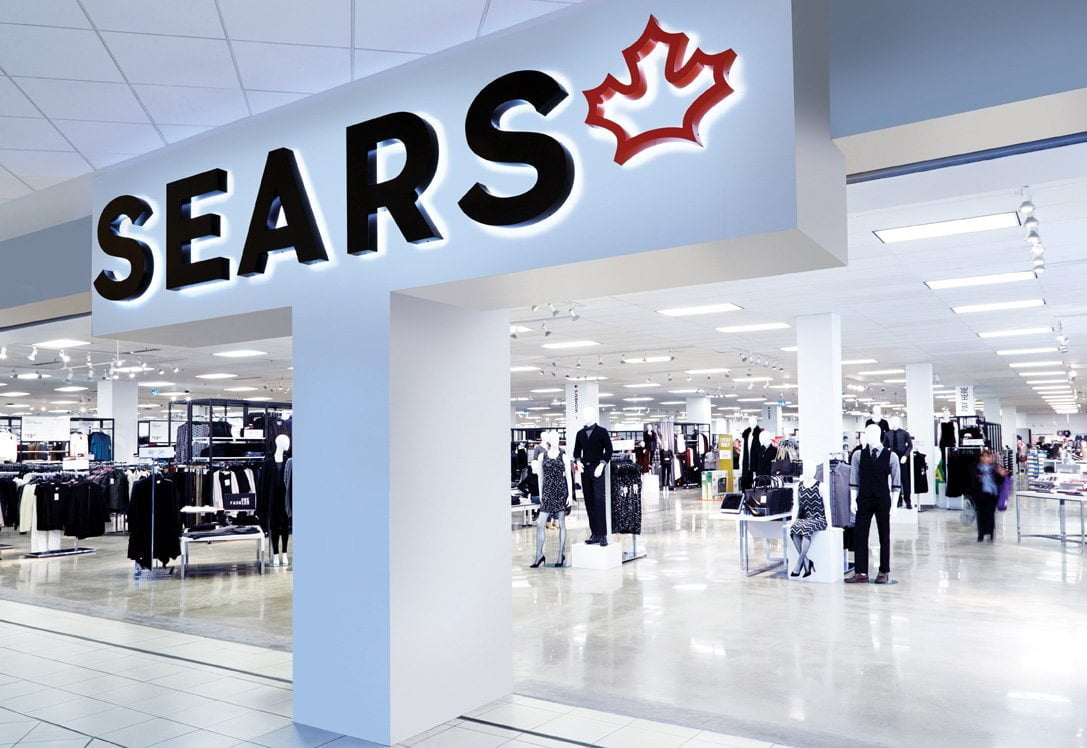
Mid-market retail has been facing challenges for years. As early as 2015, publications like this one documented the sector’s struggles, and casualties so far include Sears, The Body Shop, and Bed Bath & Beyond. The reasons cited range from supply chain disruptions and labor challenges to the burdens of private equity and unsustainable debt. But among these, the most pervasive is consumers’ flight away from the mid-market. What is unique about the current moment is that there is a real opportunity to turn things around.
Defining the Mid-Market Dilemma
Photo: Sears Canada (2017)
The mid-market’s identity crisis stems from its nebulous definition: not discount, yet not luxury. At Faculty of Change, our anthropologists invest hundreds of hours annually in ethnographic research. They’ve repeatedly validated that customers seek status, exclusivity, and quality at luxury retailers, while discount retail appeals for its price and convenience. Historically, mid-market retail promised the best of both worlds, offering superior quality to discount options without the premium of luxury. Over time, prices rose and perceived quality eroded, disrupting the balance that was key to this market. The post-pandemic landscape presents both monumental challenges and fresh opportunities for strategic renewal — a process of leveraging core capabilities to spur new growth.
Challenges to Overcome
Based on our scanning of the retail market and ethnographic studies, customers frequently talk about their challenges with the mid-market which are quality, the rise in resale/vintage and limited access. This highlights where the opportunities for strategic renewal lie.
Customer’s impression of product quality, once the segment’s hallmark, is diminishing, leading consumers to pivot towards discount alternatives or save up for luxury splurges. The rise of vintage and resale markets, seen on platforms like Facebook Marketplace, offers quality and affordability and so encroaches on traditional mid-market territory. Meanwhile, the dwindling presence of mid-market retailers in already shrinking retail spaces, caught between the increase of luxury experiences and the convenience of big-box retail, is compounding the challenges of accessibility and visibility.
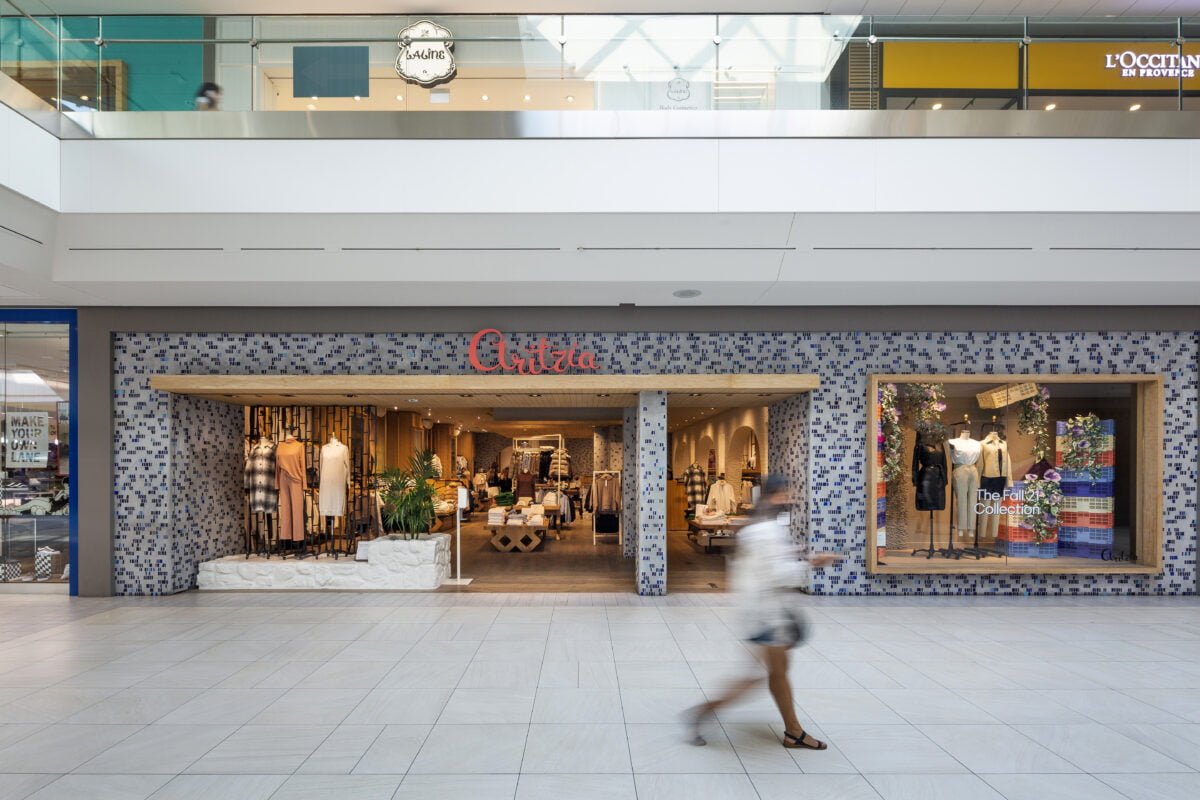
Aritzia at CF Masonville Place (Image: Cadillac Fairview)
As a practical example in apparel, the Aritzia story is indicative. While recovered from last winter’s lows, the stock still trades at roughly half its 2022 levels. From the consumer perspective (as seen on forums like Reddit), the quality has fallen off, leading customers to ask, “is it worth it?” They can either purchase vintage or resale clothing for less or splurge for luxury items that they know they can resell when their tastes change.
Increasing customer interest in vintage and resale items is a small but emerging challenge to the mid-market. In the minds of customers, when looking for a sub $2,000 sofa, Leon’s competitor set is not Rove and Article as much as it is Facebook Marketplace. Second-hand allows customers to meet their quality benchmarks (which are otherwise perceived to only be available at luxury stores) at a more affordable price.
Lastly, the places where consumers would come across mid-market retailers are disappearing. With tier 1 malls focusing on luxury retail experiences and tier 2 and 3 malls being converted into residential developments, the number of potential great locations for mid-market retailers are disappearing. Every town has a big box mall nearby and luxury retailers are destinations unto themselves. They do not need to be widely retailed. Additionally, given the volumes that mid-market retailers do, ecommerce tends to be subscale. This results in limited competitiveness against the DTC brands that are trying to grow in their markets.
Spotlights of Success
Image: EQ3 CF Polo Park
Despite these adversities, the mid-market segment has had its success stories in categories like affordable workwear, athleisure, and home goods — sectors thriving on consistency and functionality. These underscore a critical strategy: applying legacy capabilities and strength to redraw what the market is. Retailers in these segments build off their history and capabilities to better align to specific customer needs and values, thereby rebalancing the mid-market equation.
– **Banana Republic’s Renaissance**: The brand’s 2021 relaunch, expanding into baby, home goods, and athleisure, underscores the power of cultural relevance — a focus traditionally reserved for luxury brands. This pivot not only spurred growth but also realigned Banana Republic with contemporary consumer values, carving out a new customer base from luxury segments.
– **EQ3’s Strategic Positioning**: In the home goods domain, EQ3’s emphasis on quality manufacturing has allowed it to capitalize on the public’s disillusionment with many DTC brands. The company’s expansion into the U.S. market, leveraging the demand for durable, high-quality furnishings, illustrates a successful counter to the challenges facing mid-market retailers.
Call to Action: Embrace Strategic Renewal
For mid-market retailers pondering their future, the time is ripe for strategic renewal. The cornerstone of this is answering a few questions: What does the company excel at? What are the unique strengths that will make the company competitive? What has changed in the lives of target customers? How has what they value shifted? How can the company’s expertise be applied to provide unique value to customers?
By reframing customer needs and values, retailers can uncover growth opportunities and, navigate the rocky retail landscape with agility and clear direction. The path forward involves not only a re-evaluation of product offerings and quality but also an innovative approach to customer engagement and value creation. In the dynamic retail ecosystem, strategic renewal is not just an option — it’s an imperative for survival and growth.
Canadian retailers are catching up to global peers on seamless commerce, according to a new KPMG International report.
The report said Canada emerged fourth among eight major countries in making retailing a simpler, friendlier and more convenient experience for consumers.
“Canadian retailers are making significant strides to build bridges across multiple channels – online and bricks and mortar – to become more efficient and improve the consumer shopping experience,” said Kostya Polyakov, Partner and National Leader for Consumer and Retail, KPMG in Canada.
Kostya Polyakov
“Amid tight profit margins, higher costs and sharply lower discretionary spending, retailers recognize they must embrace digital solutions to remain competitive and stay in business.
“The most important finding is that as we come out of COVID, out of a period of time where seemingly consumers shifted to online and ecommerce sales were up all over the industry, what we’re seeing now, and it’s been proven with this survey, is that the overwhelming majority of consumers actually still prefer to shop in-store, bricks and mortar. However it doesn’t mean you can ignore ecommerce . . . You need to blend the two together and this is this concept of seamless commerce that we’re referring to.
“It is something that maybe some expected, some didn’t. But it is interesting to see that in this age of technology people still like to feel, see and touch stuff.”
In-Store Pick up at Indigo (Image: Dustin Fuhs)
Key report highlights include:
A customer-aligned workforce: This suggests that Canadian retailers might already be shifting towards incentivizing customer-centric KPIs over traditional product and channel-centric metrics
Challenges with strategy driven by insights: Canadian retailers may face challenges in breaking down data silos and leveraging data analytics to drive strategic decisions
Relatively strong in adopting digital technologies: Canada should look at further leveraging AI to enhance the customer experience and operational efficiency
Lower product and service innovation: There’s potential to push the boundaries further by leveraging customer data to tailor product assortments and develop more personalized services
“Retailers must shift their focus from channel to customer,” said Polyakov. “Consumers expect retailers to meet them where they are – online, whether it’s mobile or laptop, in-store, or on social media – and to deliver the same experience regardless. The only way retailers can meet their expectations is by breaking down data silos and developing a seamless, connected experience.
“While live commerce isn’t a huge factor yet in Canada, we expect this will change as more retailers experiment with their offerings to attract younger audiences who find the format fun and engaging and a way to secure better deals and prices.
“Retailers will need to stay one step ahead by delivering consistent, personalized experiences, regardless of how customers choose to shop.”
Personalization Shopping at the NHL All Star Game in Toronto 2024 (Image: Dustin Fuhs)
Polyakov said Canada is in the middle of other countries when it comes to blending the two experiences. Retailers are working through the challenges – breaking down traditional silos and traditional ways of running a retail organization.
“Every retailer is trying to come up with how they will deal with this issue because they know it’s important to the consumer,” he said.
The key he said is putting a customer lens on everything. What would make a customer’s life and shopping experience easier?
Polyakov said ecommerce has not reached its peak and will continue to grow. But there will be a separation of product categories. Certain products people want immediately. Certain products people will expect to buy in bricks and mortar but more and more they’ll realize they can buy those products online if there is no emergency in getting them.
A recent KPMG in Canada survey found that, despite the pandemic accelerating the move to online shopping, 67 per cent of Canadians still prefer to shop in-store versus online. A similar storyline is unfolding in the U.S., with 70 per cent of total retail sales coming from brick-and-mortar locations, the report finds.
The survey found Canadian shoppers want more detailed specs, better search functionality, easier returns, the ability to ask questions about a product and a better delivery experience as necessary to improve the online shopping experience. Meanwhile, research found that Americans focus more on speed, convenience, and personalization, likely due to the larger availability of e-commerce experiences and products in the U.S., the report says.
“E-commerce capabilities like click and collect and return in-store are becoming must-have services for retailers to remain competitive,” said Polyakov. “But seamless commerce needs to go beyond that. Our survey found almost two-thirds of Canadians want retailers to be more creative when replicating in-store experiences online, such as using virtual reality and artificial intelligence.”
Retail Insider is streamlining its Canadian retail news from around the web to include a handful of top news stories that can be viewed quickly during the day. Here are the top stories from the past 24 hours.
Indigo Books & Music Inc., Canada’s leading book and lifestyle retailer, announced Wednesday it has agreed to be taken private by Trilogy Investments L.P. (TILP) and Trilogy Retail Holdings Inc. (TRHI) whereby TILP will acquire all of the issued and outstanding common shares of the company that Trilogy, its affiliates and joint actors do not currently own, for $2.50 in cash per share, subject to approval by the holders of Minority Shares and other customary closing conditions.
Trilogy, together with its affiliates and joint actors, currently owns an aggregate of 16,774,665 common shares of the company, representing approximately 60.6 per cent of the issued and outstanding common shares. Trilogy is controlled by Gerald W. Schwartz, a member of the board of directors at Indigo.
“Following careful consideration of a wide variety of factors and negotiations with Trilogy that resulted in a material increase to the price first offered to minority shareholders of Indigo, the Special Committee has determined that the Transaction is in the best interests of Indigo and its minority shareholders,” said Markus Dohle, Chair of the Board and Chair of the Special Committee which was created to look into the proposal, in a statement.
“Since its inception, Indigo has established itself as a cherished Canadian brand with an important leadership role in the Canadian publishing and bookselling industries. We believe that this transaction will provide minority shareholders with a substantial premium for their shares following some challenging years for the business, while also ensuring a strong future for Indigo with full ownership by a team that has demonstrated a deep commitment to Indigo’s mission.”
Indigo at CF Toronto Eaton Centre (Image: Dustin Fuhs)
Bruce Winder, Retail Analyst & Author, said going private is a good move for Indigo.
Bruce Winder
“The retailer needs a serious overhaul and it will probably get uglier before they can turn things around. This is best done in private as Indigo would be forced to make some hard decisions with customers, employees, suppliers and investors watching,” he said.
“They probably need to get smaller in the near term and that doesn’t bode well with public investors. The retailer was bought far below its previous high from a share price perspective so the new owners are getting a good deal which gives them financial flexibility to reinvest in the business once they get their strategy set.
“Hopefully Indigo can right the ship and find a solid path to profitability in the future.”
George Minakakis, Founder and CEO of the Inception Retail Group, said there are several reasons why this is a good outcome.
George Minakakis
“Now, there is the possibility of brand and cultural preservation; it is reassuring that Indigo remains a big contributor to Canadian culture. It can stabilize their financial footing and keep them away from the watchful scrutiny of investors, who can do more damage to brands than necessary. There are plenty of retailers who should do the same. Full ownership by Trilogy allows for a unified strategic direction, which can streamline the decision-making process and accelerate the implementation of long-term recovery and growth strategies. I would look at how they implement AI to enhance their customer experience. This means they must invest more capital in elevating the relationship with consumers in-store, online, and through other channels,” he said.
“Of course, we may never know how the brand performs going forward. This brand still needs to reset its purpose and vision to ensure it is leading the way in its industry. Large stores require a lot more traffic and sales per square foot. Trilogy may want to sell this business off at some point in the future, and you would need strong customer loyalty. To do that, you must understand the basic non-negotiables customers have for this brand and deliver on that first. If the move becomes more online, we could see smaller stores or the entertainment factor in Indigo needs to increase substantially to keep these large footprints. Therefore, while they are out of the watchful eye of the financial markets, they still need to recover with strategies to create long-term growth.
“At the end of the day, this isn’t a simple merchandising fix or new product introduction; they’ve been there and have done that; this is about being relevant to today’s and future consumers.”
Indigo at The Well (Image: Dustin Fuhs)
Michael Kehoe
“Indigo Books & Music is regarded as a Canadian ‘legacy’ retail brand and an important cog in the wheel of the national publishing and bookselling business,” said Michael Kehoe, Broker of Record at Fairfield Commercial Real Estate Inc. in Calgary.
“I feel that the proposed Trilogy share acquisition is positive news in an industry where capital is transient and ownership structures have been fluid to say the least in recent years. This category dominant retailer should be in good hands with Trilogy if the acquisition process unfolds as planned. On the Canadian retail scene stability is the operative word in these challenging economic times,” he went on to say.
“Indigo going private will allow the retailer to continue to restructure without public scrutiny. The reality is that Indigo needs to rock the boat and bringing Heather (Reisman) back at the helm was just the beginning,” said Liza Amlani, Principal and Founder of the Retail Strategy Group.
Liza Amlani
“The ransomware attack shifted the retailer’s focus and now they have to catch up on what matters most – how to best serve the customer with the most relevant product assortment. Going private could allow them to make changes they need in the organization while reimagining their product mix.”
Indigo at The Well in Toronto (Image: Dustin Fuhs)
Doug Stephens
“If I believed that this move was aimed at freeing company leadership to make more daring and transformational changes to the business, changes that might have otherwise been difficult as a public company, I’d be more optimistic. Companies like Nordstrom, for example, have sought to re-privatize for exactly this reason. But having seen little in the way of experimentation or innovation from Indigo up until now, I’m left unsure as to what the true underlying intention behind the move is or how it will improve their situation,” said Doug Stephens, Founder of Retail Prophet.
Indigo said the announcement on Wednesday is the culmination of negotiations that took place following the public announcement on February 1, 2024 of Trilogy’s non-binding proposal to acquire the Minority Shares.
“The purchase price of $2.50 per share reflects a 69 per cent premium to Indigo’s closing price of $1.48 per share on the Toronto Stock Exchange (the “TSX”) on February 1, 2024, being the last trading day prior to the public announcement of the Initial Proposal, a 56 per cent premium to the 20 business day volume weighted average price for Indigo’s common shares on the TSX and an 11 per cent increase in the consideration as compared to the Initial Proposal of $2.25 per share. The cash premium transaction will provide Minority Shareholders with immediate and certain value that is expected to be higher than that realizable in the foreseeable future,” said Indigo.
Christmas Display at Indigo Bay/Bloor on September 25th, 2023 (Image: Dustin Fuhs)
It said the Special Committee was established by the Board to consider the Initial Proposal, as well as other alternatives available to the company and, if it deemed advisable, negotiate with Trilogy. Following a comprehensive evaluation of the Initial Proposal and negotiations between the Special Committee and Trilogy on price and other terms of the Transaction, the Special Committee unanimously recommended that the Board approve the Transaction, said the company.
The company expects to hold the special meeting of shareholders to consider and to vote on the Transaction in May 2024. If approved at the meeting, the transaction is expected to close in June 2024, subject to court approval and other customary closing conditions.
Harry Rosen Flagship at 82 Bloor Street West in Toronto (Image: Dustin Fuhs)
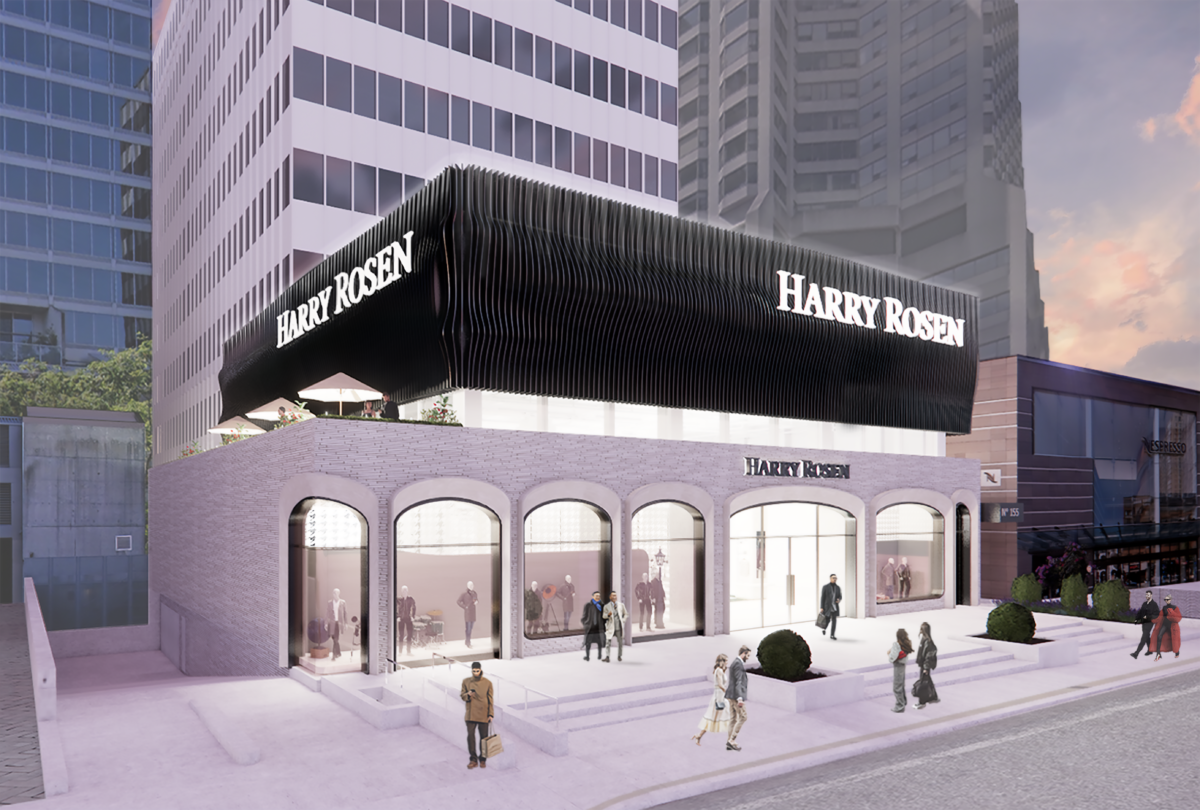
Craig and Lee discuss the relocation of Harry Rosen’s flagship store from 82 Bloor Street West to 153 Cumberland Street in Toronto’s upscale Yorkville neighborhood. This move from its long-standing Bloor Street location represents a major development in the city’s retail scene. The store’s design features will include a three-floor layout and expanded back-of-house operations, which are part of Harry Rosen’s evolving retail strategy. The relocation is seen as a transformative moment for Yorkville, further establishing it as a luxury retail hub.
They also touch upon the broader implications of this move for Yorkville and Bloor Street’s retail dynamics. The conversation highlights the influx of luxury brands into the area, including new and expanding stores like Bulgari and Lululemon, and the role these developments play in attracting more foot traffic and elevating the shopping experience.
The historical context of Harry Rosen’s establishment and its founder’s legacy in Canadian menswear is explored in the conversation. From its origins in 1955 to the passing of its founder in 2023, Harry Rosen has been instrumental in shaping men’s fashion in Canada. The discussion concludes with reflections on the store’s past locations and the evolution of Toronto’s retail environment over the decades.
Rendering of the new Harry Rosen flagship store at 153 Cumberland Street, opening in the spring of 2026. (Rendering: dkstudio architects inc)
Episode Sponsor:
SAJO – Canada’s first specialized retail builder. Visit SAJO to see their holistic approach and transdisciplinary team to explore and understand your needs.
The Weekly podcast part of theThe Retail Insider Podcast Network by Retail Insider Canada and is available on Apple Podcasts, Stitcher, TuneIn, Google Play, or through our dedicated RSS feed for Overcast and other podcast players.
Subscribe, Rate, and Review our Retail Insider Podcast!
Drop us a line at Craig@Retail-Insider.com. You can also rate us in Apple Podcasts or recommend us in Overcast to help more people discover the show!
Background Music Credit: Hard Boiled Kevin MacLeod (incompetech.com). Licensed under Creative Commons: By Attribution 3.0 License. http://creativecommons.org/licenses/by/3.0/
In this dynamic era shaped by AI-driven advancements, retail human resource professionals navigate a landscape rich in complexity and transformation. Understanding and addressing employee needs has become more crucial than ever for cultivating vibrant workplace environments and cultures. Embracing this challenge, Retail Council of Canada (RCC) is excited to host the essential one-day Retail Human Resources Conference on April 25, 2024, at the International Centre in Mississauga. Promising a packed agenda with distinguished speakers, this event is set to be a pivotal gathering for retail HR professionals, offering a wealth of insightful strategies and valuable knowledge as well as 3.5 hours of HRPA pre-approved professional development credits .
The conference will explore the pressing issues shaping the future of retail HR. Attendees will learn to strike a balance between leveraging AI and other technologies for operational efficiency and the critical task of engaging with employees to nurture thriving workplaces. Discussions will encompass AI’s impact on workforce development, the nuances of compensation and labor relations, and inventive tactics for attracting talent, enhancing employee experiences, and boosting retention.
Featured sessions include:
Just announced!Mastering Finance for HR: Winning Executive Buy-In for Change
Robert Laufer CFO of Browns Shoes Inc. and RCC President and CEO Diane J. Brisebois discuss crafting a compelling HR investment proposal, focusing on alignment with leadership and demonstrating HR’s role in supporting organizational growth and change.
What Employees are Seeking Beyond “Competitive Pay”
John Mortimer and Shelly Patel from LabourWatch present frontline strategies to enhance retail workers’ daily experiences, boosting engagement, customer loyalty, and business performance.
Building Bridges, Breaking Barriers: Empowering your DEI Strategy
Rochele Padiachy, Learning Manager at the Canadian Centre for Diversityand Inclusion will lead a session on transformative DEI strategies and their integration into business plans for an inclusive future.
AI-Driven Innovations for Tomorrow’s Workforce
David Lloyd, Chief Data and AI Officer at Ceridian, examines the role of AI in retail HR, from streamlining tasks to providing actionable insights and improving workforce efficiency.
Revitalizing Inspired Employee Engagement
Deb Craven of Longo’s shares their journey in enhancing employee engagement, highlighting key lessons, accountability, and the positive impact on workplace dynamics.
Additionally, RCC’s Retail Human Resources Conference offers extensive networking opportunities, complete with delicious snacks and a filling lunch. It’s the perfect setting for participants to connect with peers, meet other HR professionals, exhibitors, and solution providers. This year introduces peer-to-peer learning and roundtable discussions, providing a unique forum for sharing ideas and addressing common industry challenges.
Secure your spot at this unmissable conference at www.rcchrconference.ca. Groups of five or more can enjoy a 20% discount, making it an ideal opportunity for team building and mentoring junior HR professionals.
*Partner content. To work with Retail Insider, email: craig@retail-insider.com
Leger, the largest Canadian-owned market research and analytics company, has released its 27th annual Reputation study – unveiling the list of the most reputable companies according to Canadians in 2024.
The Top 10 Most Reputable Companies in Canada in 2024
The maximum possible reputation score is 100. This year, according to Canadians, the most reputable companies are:
Google (Reputation Score: 75)
Sony (Reputation Score: 72)
Canadian Tire (Reputation Score: 71)
Samsung (Reputation Score: 71)
YouTube (Reputation Score: 70)
Shoppers Drug Mart (Reputation Score: 69)
Microsoft (Reputation Score: 69)
Amazon (Reputation Score: 68)
Dollarama (Reputation Score: 68)
Costco (Reputation Score: 68)
Leger surveyed more than 38,000 Canadians to explore their perspectives on close to 300 companies across 30 different sectors. Conducted annually, it is based on Leger’s exclusive model of six recognized pillars of reputation—financial strength, social responsibility, honesty and transparency, quality, attachment and innovation.
Google on King Street East (Image: Dustin Fuhs)
As Canadians struggle with turbulent economic times throughout the country, Canadians are looking for companies that can cater to their needs during these tough times and will be more forgiving to those companies that understand and respond to consumers’ needs, said Leger.
Lisa Covens
“Although certain sectors experienced greater reputation losses and gains than others during these unsettled economic times, we also see an overall resiliency of corporate Canada in this year’s study. The overall reputation of Leger’s cross-section of corporate Canada has remained stable with an average company reputation change of 0,” said Lisa Covens, Senior Vice President.
“This stability highlights the dynamic equilibrium within the landscape of corporate reputation, showcasing resilience even as Canadians shift their confidence among various brands.”
Canadian Tire (Image: Canadian Tire)
Leger said eight of the top 10 companies in 2023 remain in the top 10 this year (Google, Sony, Shoppers Drug Mart, Samsung, and Canadian Tire, Dollarama, and Costco). Google, remaining at #1, has kept its reputation stable and remains in the top spot for the second year in a row. Keeping consistent with the current fiscal climate, Canadian company Dollarama reaches #9, while Costco, geared towards Canadians looking for maximized savings, remains in its position in the top 10 this year (#9).
“(Reputation) attracts customers. It brings their attention, their spending. If you lose reputation then the customers aren’t as likely to engage with you and less likely to go into your stores or go to your website and just do business with you overall,” explained Covens.
“When there is a problem with reputation, customers want to disassociate with you. For retailers if you think of some of the big brands that are sort of splashy in their branding and I’m thinking of those brands we have seen on people’s shirts, with reputation if a company such as one of those ran into reputation trouble you really wouldn’t want to wear that on your body anymore.
“That’s an extreme example of where reputation really matters. And just generally people know where their friends and family shop for retail. If you run into trouble, you’re not going to want to be seen as shopping there, you’re not going to want to talk about it, you’re not going to want to actually shop there and spend your money. It’s important. It’s important for everybody and every company across our society really.”
Dollarama at Adelaide and Peter Street in Downtown Toronto (Image: Dustin Fuhs)
Covens said companies can always move the needle if for some reason they have a bad reputation.
“You can always figure out what’s important to your sector and do the good work, the hard work, that goes with that,” she said.
“So if you run into trouble you want to turn things around . . . You really need to invest where things make sense. Obviously try to address whatever the crisis got you in hot water in the first place but then to do the hard work that follows, really invest your time, your money and your energy into what makes sense for your sector.”
Shoppers Drug Mart at The Well (Image: Dustin Fuhs)
She said retailers should invest their efforts in corporate citizenship in reducing their carbon footprint.
Leger said there were a few industries/sectors whose reputations improved in the last year.
“For example, as sports leagues returned to pre-COVID attendance levels and fan experiences, the MLB (+5), MLS (+5) and the CFL (+4) all had their reputations increase through the lens of the Canadian public,” said the company.
“The telecommunications industry also had a rebound year, and had an average of +5 in their score this year. This increase was highlighted by Rogers, who appear to have recovered from their service reliability issues of a year ago with a 14-point increase in their reputation from last year. As well, Telus saw their score increase by 5 points this year.
“At the other end of the Reputation spectrum, the transport industry saw many of its companies’ reputations drop. For example, the public’s perception of Sunwing’s reputation declined by 9 points from last year. It is possible negative news coverage associated with last-minute holiday cancellations and pulling out of Saskatchewan contributed to this decline. Other similar providers in the sector also experienced declines as VIA Rail dropped by 6 points, followed by WestJet (-4) and Air Canada (-3).”
Via Rail Niagara Falls (Image: Dustin Fuhs)
The Leger study also looked at ESG (Environmental, Social and Governance) as a driver of corporate reputation.
Shanze Khan
“What we found is the data underscores a critical insight: consumers are increasingly discerning, rewarding companies that truly integrate their stated values into their business models.,” said Shanze Khan, Senior Research Director.
“In a competitive landscape, with companies vying for finite attention, it is imperative to focus efforts on sector-relevant initiatives rather than diluting them across numerous fronts. This shift towards authentic and impactful action, aligned with their sector, is indicative of the evolving expectations of consumers, who are looking for more than just surface-level commitments that can come across performative.”
Retail Insider is streamlining its Canadian retail news from around the web to include a handful of top news stories that can be viewed quickly during the day. Here are the top stories from the past 24 hours.