Walmart worker outside of company warehouse holding a sign that reads 'Unifor defends your rights at work'. (CNW Group/Unifor)
Workers at Walmart‘s Mississauga warehouse have voted to join Unifor, Canada’s largest private sector union.
It is Walmart’s first warehouse to unionize in Canada, said the union on Friday.
“This victory is the result of uniting around a belief in workplace democracy and better working conditions,” said Unifor National President Lana Payne in a news release. “Walmart workers in Mississauga stood up for their rights, and we are excited to get to work on their first collective agreement.”
In a statement, Walmart Canada said: “A vote occurred at one of our distribution centres in Mississauga. The Ontario Labour Relations Board shared that the majority of those who voted did so in favor of the union. We are reviewing next steps in this process. We’ve always believed that the best person to speak for our associates is the associate. Our culture is founded on an environment of transparency, honesty, and direct dialogue with our associates, without involving individuals outside of our organization who don’t know our culture or our business.”
The union said more than 40 per cent of the workers at the facility signed a union card this summer and the Ontario Labour Board awarded the workers a vote, which was held September 10–12.
It said the “notoriously anti-union company” did their best to “spread falsehoods about the protections of a union, but workers saw through the thinly veiled intimidation and chose unity over fear and division.”
“Unions are the most effective way to have a say in your conditions at work,” said Unifor Ontario Regional Director Samia Hashi. “These Walmart workers are showing warehouse workers across Canada what’s possible when we stand together.”
Unifor’s campaign at Walmart’s facility began in December 2023.
Unifor is Canada’s largest union in the private sector, representing 315,000 workers in every major area of the economy.
Canada’s leading business organizations are expressing deep concern with the looming possibility of a strike by the Air Line Pilots Association (ALPA) at Air Canada.
In a letter to Steven MacKinnon, federal Minister of Labour and Seniors, the organizations said the potential for a labour disruption is alarming, given the wide-reaching implications it would have on Canadians, the nation’s economy, supply chains, and our global reputation.
“Air Canada provides a crucial service, carrying up to 150,000 passengers each day. Be it a business trip, seeking medical treatment, visiting family and friends, or a long-awaited vacation, reliable long-range transportation is non-negotiable for Canadian travellers,” it said.
Steven MacKinnon
“However, the impact of a strike would extend far beyond passenger travel for both urban and rural Canadians—it would significantly disrupt Canada’s supply chain. Air Canada’s cargo network is important for the import and export of critical, time-sensitive goods such as vaccines and medical supplies, agriculture and perishable food products, and parts and machinery for small and medium sized Canadian manufacturers. For example, radioactive isotopes, which are crucial for cancer treatments, are shipped via Air Canada Cargo domestically and internationally due to their 48-hour lifespan. A disruption in this service, however short, would be devastating, as no other means of transport can meet the stringent time requirements for these products.”
“The timing of this potential strike could not be worse. The dust has not yet settled on the labour disputes that paralyzed Canada’s two major rail networks, causing yet untold damage to not only our national economy, but also our global reputation. It was another example of a disturbing trend—labour disputes, and threat of them, have disrupted operations at the ports of Montréal and British Columbia, the St. Lawrence Seaway, as well as at WestJet and the Canadian Border Services Agency this past year alone. If Canadian businesses are unable to deliver our goods to market on time, our international partners will begin to seek permanent alternatives.”
The organizations said the federal government needs to take decisive action. The impacts of a labour disruption at Air Canada will ripple throughout the economy, affecting Canadian consumers, employees, and businesses. A work stoppage will lead to thousands of temporary layoffs for airline employees, which will negatively impact the air transportation ecosystem across the country. It will reinforce a growing perception that Canada is not a reliable trading partner.
Outside the Edmonton International Airport. Photo: Edmonton International Airport
Beyond passenger services, air cargo is a vital component of Canada’s export economy, ensuring the timely delivery of goods, including medical supplies, agricultural products, and critical parts for manufacturers. A labour disruption would be catastrophic for industries reliant on just-in-time delivery systems, said the organizations.
“Canada cannot afford another major disruption to its transportation network. A labour disruption at Air Canada would ripple through our economy, from tourism to critical supply chains. The federal government must be prepared to intervene if necessary,” said Goldy Hyder, President and CEO of the Business Council of Canada.
“Canadians and businesses nationwide are going to suffer the consequences of labour disruption in the air travel industry. They are not at the negotiating table and are powerless to control the outcomes. We need proactive, decisive action from all actors and from the federal government to ensure we can avoid more damaging consequences for everyone,” said Candace Laing, President and CEO of the Canadian Chamber of Commerce.
“Quebec companies risk being hit with another labour disruption they cannot afford. A labour disruption at Air Canada would have severe consequences for our businesses across Quebec, particularly in sectors such as manufacturing, tourism, and exports. We depend on reliable air transportation to move goods, materials, and people. Even a short disruption would lead to costly delays and further strain our supply chains. The federal government must intervene to ensure Quebec businesses can continue to thrive and remain competitive in both domestic and international markets,” said Karl Blackburn, President and CEO of Conseil du patronat du Québec.
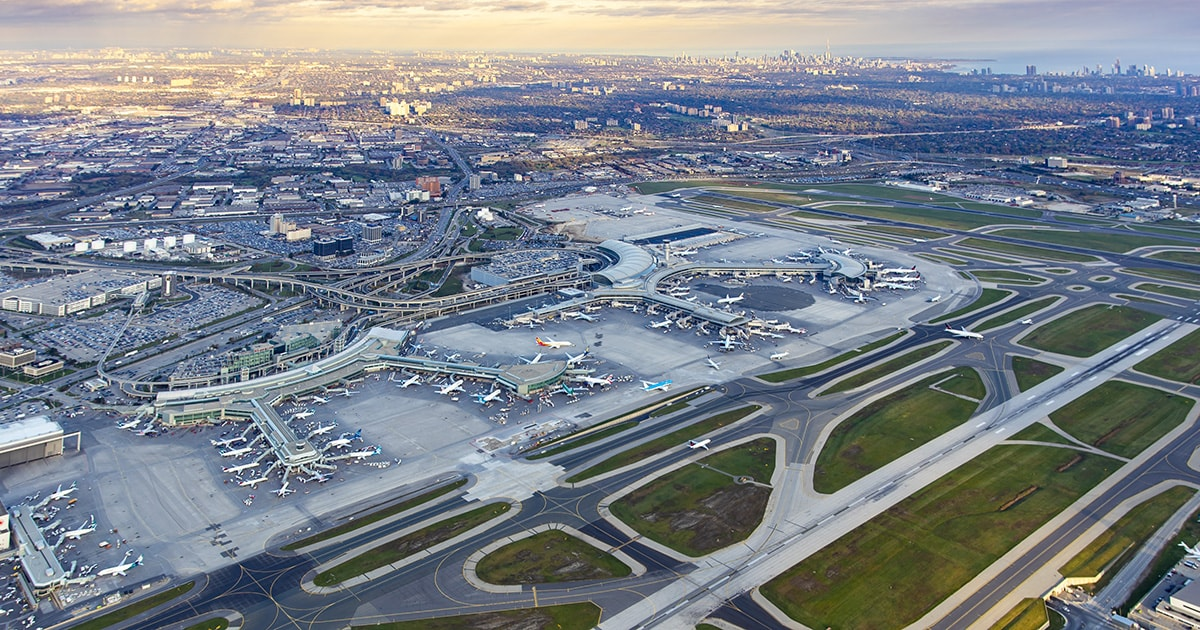
Pearson Airport in Toronto. Photo: Pearson Airport
“The economy is already fragile after recent disruptions in our transportation networks. Another labour dispute would further damage Canada’s standing as a reliable global trading partner. The government must act promptly to help protect small businesses across the country,” said Dan Kelly, President and CEO of the Canadian Federation of Independent Businesses.
“Thousands of Canadians are relying on flights for critical business, healthcare, and personal reasons. Even a brief suspension will leave many stranded and further strain an already stressed tourism industry,” said Andrew Siegwart, President and CEO of the Tourism Industry Association of Ontario. “We need the federal government to show leadership and intervene before it’s too late. Another disruption in the transportation sector will reverberate across the country and hurt businesses, employees, and travellers alike.”
Gary Newbury, a retail supply chain and last mile expert, a Rethink Retail’s Top 100 Retail Influencer and CITT’s Innovator Award 2020, said the threat of yet another strike within our domestic transportation and supply chain infrastructure is a major concern in a number of areas.
“If you are an international shipper looking to support the Canadian market (including businesses shipping from the US), you are doubting the resilience of Canadian supply chains (with the recent rail strike disruption last month, amongst others). If you are a shipper to the significant US market east coast ports, and desperately seeking help from Halifax and Montreal (to avoid labour disruptions which looks highly likely on 30th September), there’s both a capacity constraint (due to be resolved by the end of 2024) and ongoing challenges with labour relations at PoM, and now, even if you are within the Canadian market, you are likely to have headaches trying to find Air Transportation alternatives with the main couriers such as UPS, Purolator and Fedex,” he said.
Gary Newbury
If it’s not ports, it’s rail, if not rail, it looks like air transportation. We can rule out trucking as we discovered as recently as two to three weeks ago, our surge capacity is very limited.
“Our reputation as a market that has high risk of labour disruption affecting business accessing urban to remote territories, transportation is starting to look very weak indeed.
“In terms of this particular threat (Air Canada pilots), some pharma companies I have spoken to recently have already been switching modes from air to sea. With alternatives like the major integrators (DHL, Fedex and UPS), many B2B shippers will have been exploring options in this area or using whatever trucking capacity they can find. Spot rates are set to rise sharply.
“This leaves the impact on passenger transportation. Although much progress was made during the restrictions of doing business over video conferencing, there are still many areas which require face to face activities, moving vital organs, patients and medical supplies around the country, as well as movement within Canada by consumers and between Canada and other countries which is now at serious risk. The tourism and hospitality industries here are set for what could be a significant short term disruption.”
Will the government apply the same approach as they did with rail and avoid labour disruption by forcing any unresolved negotiations into binding arbitration?, he wondered.
“It seems fairly certain this “tool” will be used once again to make an intervention between a commercial organization and its workforce. With the cooperation agreement dissolved, the federal government will be free to force workers back to work. This tool will continue to be used to quell labour disruption, until it is successfully challenged by the rail union as an impingement to their right to freely negotiate. If that legal challenge is successful, it will likely determine the ultimate commercial risk classification of Canada.
“Unfortunately, we are in the hands of both Air Canada and its union leaders to continue to negotiate in good faith and avoid a major supply chain disruption. What we are likely to see, much as we saw with CN/CPKC, is the withdrawal of capacity by Air Canada to avoid their equipment, passengers and crew being “out of position” immediately ahead of the strike, so they can resume scheduled services once any strike action has been resolved. So we are set for a challenging week, or more.”
Retail Insider is streamlining its Canadian retail news from around the web to include a handful of top news stories that can be viewed quickly during the day. Here are the top stories from the past 24 hours.
McDonald’s, the world’s largest burger chain, is taking a significant step towards a cashier-less future. The fast-food giant is introducing a new store format in the United States, featuring advanced digital ordering stations capable of handling cash transactions.
Digital Kiosks Revolutionize McDonald’s Ordering Process
The new digital kiosks represent a major shift in McDonald’s operations. While many locations already feature self-service screens, the updated versions can now accept cash payments and provide change. The innovation allows most customers to complete their entire transaction without interacting with a human cashier.
Despite this technological advancement, McDonald’s emphasizes that human workers will remain an essential part of their operations. The new format aims to redeploy cashiers to other crucial tasks, such as delivering food to customers opting for table service or curbside pickup.
McDonald’s Adapts to Changing Customer Preferences
In response to growing consumer demand for digital options, McDonald’s is reimagining its in-store experience. The traditional menu screens behind the counter will now showcase select items and encourage customers to use kiosks or the mobile app for ordering. The company assures that customers they can still order at the counter if they prefer, with full printed menus available upon request.
The shift reflects the broader trend of mobile ordering reshaping the fast-food landscape. During the third quarter of last year, digital orders accounted for over 40% of McDonald’s sales in its top markets. The surge in app-based, delivery, and kiosk orders has been particularly notable since the onset of the pandemic.
Impact on McDonald’s Workforce and Customer Experience
The move towards digital ordering is transforming the nature of jobs at McDonald’s. While traditional cashier roles may decrease, new positions are emerging. Some franchisees have introduced “guest experience leads” to assist customers with the new technology, mirroring similar roles in retail giants like Walmart and Target.
McDonald’s CEO Chris Kempczinski emphasized the company’s commitment to digital growth, stating, “Digital is going to continue to grow for us. We’re going to get more and more customers on our digital platform.”
Retail Insider will be watching for when this technology comes into the Canadian market.
Provigo grocery store in downtown Montreal. Image via Broccolini
Quebec may have taken a notable step this week that warrants attention from other provinces. By introducing Bill 72, Quebec Justice Minister Simon Jolin-Barrette has moved toward increased pricing transparency in both grocery stores and restaurants—an initiative that’s long overdue.
Impact at the grocery store
The bill’s impact on grocery stores is significant. If passed, it will require taxable food items to be clearly identified at the point of sale. Currently, the average Canadian grocery store has more than 4,600 taxable products, but most consumers are unaware of which items are taxed, as few scrutinize their receipts closely.
In Quebec, where sales taxes can add over 15% to the cost of taxable goods, this oversight has notable consequences. To contextualize, this tax increase is equivalent to four to five years’ worth of inflation in one shot. The rise of shrinkflation—where products become smaller—further complicates matters, as many items that were previously non-taxable, such as snacks, now fall into taxable categories. As a result, products like ice cream and granola bars, which were tax-exempt last year, are now subject to tax.
Provigo store in downtown Montreal. Photo: Provigo
While the ethical debate on taxing food remains outside the scope of this discussion, Quebec’s effort to enforce clearer price disclosure is commendable. In addition to requiring clarity on taxable items, grocers will need to differentiate between member and non-member pricing, a response to the increasingly complex loyalty programs offered by retailers. The bill also introduces standardized unit pricing based on quantities like 100ml or 100g, across all food categories. This uniform approach will streamline price comparisons, benefiting both consumers and enhancing market efficiency.
Another important reform targets price accuracy. The Retail Council of Canada’s Scanner Price Accuracy Code, implemented decades ago, protects consumers from pricing errors at checkout. If an item scans at a higher price than listed, the customer is entitled to a price adjustment. For items under $10, the product is given for free, while for items over $10, customers receive a $10 discount. However, inflation has pushed a growing percentage of grocery items well beyond the $10 threshold, with estimates suggesting that 15% to 25% of items now exceed this price point. To address this, Bill 72 raises the threshold to $15, better aligning with current price levels and ensuring continued consumer protection.
Crucially, these reforms do not impose additional costs on grocers and can be implemented swiftly. From an operational standpoint, the changes are minimal, requiring only procedural adjustments. Extending these measures across Canada would yield widespread consumer benefits with little disruption to retailers.
Le Fou Fou food hall at Royalmount in Montreal. Photo: Le Fou Fou
Tipping in Quebec restaurants
Bill 72 also seeks to reform tipping practices, an area that has seen growing discontent among consumers. The increasing prevalence of tipping prompts in payment terminals has led to what is often referred to as “tipping fatigue,” where consumers feel pressured to tip without fully understanding how much they are adding. The bill aims to simplify the process by requiring tips to be calculated on pre-tax amounts, rather than including provincial and federal sales taxes. This change, if passed, would bring clarity to tipping and provide relief to consumers.
The food service industry’s silence on the tipping issue has been notable. For years, despite rising consumer dissatisfaction, the industry has failed to lead on this issue. With Bill 72, the Quebec government is stepping in, and it wouldn’t be surprising if other provinces follow suit.
Overall, the regulatory costs of implementing these changes are minimal, and most of the reforms are principle-based, necessitating only slight operational shifts. Quebec’s leadership on this front sets a valuable precedent, and it is time for other provinces to take note. These reforms are not only beneficial but essential for maintaining consumer trust and promoting fairness in the marketplace.
Dr. Oetker executives Valery Henle, Dino Koundoutsikos, Christian Von Twickel and Josh Van Bladel were joined by Robert Flack, Ontario Minister of Farming, Agriculture, and Agribusiness and Teresa Armstrong, MPP for London-Fanshawe, at a Sept. 12 event in London, Ont. to commemorate the tenth anniversary of Dr. Oetker's frozen pizza plant in London. (CNW Group/Dr.Oetkar)
Dr. Oetker Canada Ltd., a leading manufacturer of frozen pizzas, desserts, and baking products, marked the 10th anniversary of its pizza manufacturing facility in London, Ontario this week.
The London plant has been a cornerstone of Dr. Oetker’s North American operations since 2014. With a daily production capacity of 400,000 pizzas, it has become a vital hub for the company’s pizza business. The facility employs 430 people, contributing significantly to the local economy and the agri-food industry in southwestern Ontario.
Dino Koundoutsikos, Executive Vice President for North America, expressed pride in the company’s Canadian presence. “London has become our Canadian home, fostering our culture of innovation and quality,” he said. Koundoutsikos also praised the local workforce, noting that many Londoners have launched their agri-food careers at the plant.
Celebrating growth and innovation in Canadian retail
The anniversary event showcased Dr. Oetker’s commitment to the Canadian market. Guests toured the state-of-the-art facility, engaging with executives who shared insights on the company’s achievements and future plans.
“It is an honour to mark the 10th anniversary of this plant and recall the optimism we felt upon cutting the ribbon in 2014, optimism that remains today thanks to the tremendous talents of our London team,” said Dr. Christian von Twickel, Member of the Executive Board, Dr. Oetker. “Our investment here is a true Canadian success story, and a testament to the robust agri-food community of London, which has become one of the top centres of food production in North America. We believe in local production and manufacturing and look forward to our continued bright future in this great city!”
Since its opening in 2014, Dr. Oetker Canada has experienced remarkable growth. The company has doubled in size, becoming the market leader in the thin-crust pizza category and the second-largest player in the overall pizza market in Canada.
The decision to establish the London facility in 2011 marked a strategic shift for Dr. Oetker. Instead of importing products, the company chose to create a North American production hub in Ontario.
Dr. Oetker’s presence in Canada dates back to 1960. Today, it ranks among the top five subsidiaries for the global food organization, which operates in over 39 countries. The Canadian operation includes manufacturing and R&D facilities in London and Mississauga, producing more than 190 products.
Metro Supply Chain Inc., a leading Canadian contract logistics provider, has announced the integration of SCI into its operations. The strategic move aims to bolster the company’s position in the global supply chain solutions market.
“We’re leveraging our shared customer-first approach and culture of innovation to generate growth for our clients,” said Chris Fenton, President and CEO of Metro Supply Chain. The integration, set to complete this fall, will bring SCI’s capabilities under the Metro Supply Chain banner.
Metro Supply Chain Integration Expands Service Portfolio
The acquisition of SCI marks Metro Supply Chain’s 12th business acquisition in less than a decade. This integration adds critical sectors such as technology and healthcare to Metro Supply Chain’s service offerings. It also reinforces the company’s e-commerce fulfillment capabilities in Canada.
The unified entity significantly scales Metro Supply Chain’s White Glove delivery services. Currently, the company leads in last-mile logistics for big and bulky goods in Canada. SCI brings expertise in White Glove business-to-business services, including delivery and installation of specialized equipment.
Enhances Cross-Border Operations
Together, the companies offer seamless, omni-channel e-commerce fulfillment to North American businesses. Their cross-border services include setting up U.S. e-commerce fulfillment directly from Canada. This approach leverages US Section 321 to reduce import costs for clients.
Metro Supply Chain now operates from over 175 locations internationally. The company’s innovative solutions are backed by in-house engineering experts and investments in advanced technology.
As Canada’s largest privately owned supply chain solutions company, Metro Supply Chain manages 19 million square feet of space. With a team of 9,000 across North America, the UK, and Europe, the company continues to excel in meeting complex distribution needs.
Metro Supply Chain’s commitment to innovation and customer service has earned it recognition. The company ranks as a top-performing supplier and was named one of Canada’s Best Managed Companies in 2024.
Canadian grocery conglomerate Empire Company Limited announced a decrease in its first-quarter earnings for fiscal 2024. The retail giant, headquartered in Stellarton, Nova Scotia, reported a profit of $207.8 million, down from $261 million in the same period last year.
Despite the profit dip, Empire’s CEO Michael Medline expressed optimism about the company’s trajectory. “We are increasingly optimistic as market conditions are gradually improving, contributing to a more predictable operating environment,” Medline stated in a press release.
The earnings, which cover the 13-week period ended August 3, 2024, translate to 86 cents per diluted share. This represents a decrease from $1.03 per diluted share in the previous year’s quarter, which had been boosted by the sale of 56 gas stations in Western Canada.
MICHAEL MEDLINE. PHOTO: LINKEDIN
On an adjusted basis, Empire’s earnings showed improvement, reaching 90 cents per share compared to 78 cents per diluted share in the same quarter last year. The company’s sales also saw a modest increase, totalling $8.14 billion, up from $8.08 billion a year earlier.
Same-store sales, a key metric in retail performance, rose by 0.5% overall. Excluding fuel, this figure increased by 1%, indicating resilience in Empire’s core grocery business.
Empire’s strategic initiatives appear to be gaining traction. The company has been investing heavily in store renovations, converting some traditional outlets to discount formats, and expanding its network. “Investing in the store network will remain a priority, demonstrated by a sustained emphasis on renovations and continued store expansion in discount,” the company emphasized.
Founded in 1963, Empire Company Limited has grown into a major player in Canadian retail through a series of strategic acquisitions and investments. The company owns, affiliates, or franchises more than 1,500 stores across Canada, operating under various banners including Sobeys, Safeway, IGA, Foodland, Farm Boy, FreshCo, Thrifty Foods, and Lawtons Drug.
Image: Sobeys Orangeville
Empire’s growth strategy has been marked by significant acquisitions over the decades. In 1976, the company acquired Lawton’s Drug Stores Limited, expanding its presence in the pharmacy sector. A pivotal moment came in 1980-1981 when Empire acquired a majority stake in Sobeys, solidifying its position in the grocery retail market.
The company’s expansion continued through the 1980s and 1990s with investments in various retail and real estate ventures. Notable acquisitions included the purchase of the Oshawa Group for $1.5 billion in 1998, which significantly expanded Empire’s grocery retail footprint.
Recent Strategic Moves
In more recent years, Empire has made several high-profile acquisitions to strengthen its market position:
In 2013, Empire made a bold move by acquiring all of Safeway Canada’s stores for $5.8 billion, significantly expanding its presence in Western Canada.
In 2018, the company announced its intent to buy Farm Boy stores in an $800 million deal, enhancing its offerings in the fresh and prepared foods category.
Most recently, in March 2021, Empire announced plans to acquire a 51% stake in Longo’s and its Grocery Gateway e-commerce business for $357 million, further expanding its presence in the Ontario market and bolstering its e-commerce capabilities.
Value Village, the well-known thrift store chain, has unveiled its first-to-Alberta boutique concept in downtown Calgary. This marks a bold step into upscale, curated second-hand retail for the city.
The doors opened on September 12 and opened to a new era of thrift shopping on Stephen Avenue at 120 8th Avenue SW. The multi-level boutique stands out with its sleek design and carefully selected merchandise. The location is quite different from the traditional, warehouse-style layouts typical of Value Village stores across the province.
The location previously hosted a SportChek which closed in the first half of 2023. Independent bookseller, McNally Robinson, occupied the space prior to SportChek but closed its doors in early 2008 bringing the end of the chain’s presence in Calgary.
The Value Village ‘Boutique’ Shopping Experience
The “Boutique” iteration of Value Village first came to the Canadian marketplace in June 2022 in downtown Toronto. The boutique concept focuses on quality over quantity. Unlike traditional Value Village stores, this location offers a refined selection of goods. Designer labels, vintage pieces, and trendy items take center stage.
Shoppers will find a curated collection of clothing and accessories. The store also features stylish home decor options. This approach aims to attract fashion-forward customers who value sustainability.
Value Village Across the Province
This would be the first “Boutique” location in the province of Alberta. The remaining seven other locations in the greater Calgary area (including Airdrie) are the traditional, non-Boutique variety. Other Albertan communities with traditional Value Village locations include:
Grand Prairie (1 location),
Edmonton (10 locations, including Spruce Grove, Sherwood Park and St. Albert),
Toronto-based Jimmy The Greek, third-generation family business and beloved Greek quick-service restaurant, has opened its newest location in Toronto’s Premium Outlets in Halton Hills and it’s the brand’s first-ever dine-in experience.
Jimmy Antonopoulos opened the first restaurant in Toronto in 1985.
After offering food in the food courts of major shopping centres and office towers across the country for more than 35 years, Jimmy The Greek now has indoor seating, alongside its traditional take-out option.
Nicole Mitrothanasis. Photo: LinkedIn
“We’ve built a restaurant with a one-of-a-kind design that pays tribute to my grandparents’ hometown and restaurant roots,” said Nicole Mitrothanasis, Director of Operations at Jimmy The Greek and granddaughter of original founder, Jimmy. “While we’ll still be providing the same fast, fresh, and delicious meals, we’re thrilled to have created such a special place where we can welcome customers in through our very own doors, and continue to serve them our family’s favourite recipes.”
After immigrating to Canada from Greece, husband and wife, Dimitrios ‘Jimmy’ Antonopoulos and Helen Antonopoulos, opened their first fine-dining restaurant, Epikourion, in 1977. Upon noticing an opportunity to serve freshly prepared, home-cooked meal options for consumers on-the-go, the first quick-service Jimmy The Greek restaurant opened in 1985 to offer the same high quality menu options and Greek hospitality with the convenience of take-out.
James Mitrothanasis: Photo: LinkedIn
“After our grandparents immigrated from Greece in the 1960s, they opened three successful Greek fine dining restaurants in Toronto’s downtown core. One of those restaurants, Epikourion, expanded to become the first ever Jimmy The Greek location in 1985 and it’s been there ever since as our standalone corporate location,” said James Mitrothanasis, Director of Network Development.
“This fine-dining feel has been translated to our QSR concept, shaping the brand identity of Jimmy The Greek – which we definitely feel differentiates us. And we’re really proud of it.”
The brand has 57 locations in Ontario, Manitoba and Alberta.
Photo courtesy of Jimmy The Greek
“The typical size is around 300 to 600 square feet. We are a compact restaurant in a food court. Our new location at Toronto Premium Outlets is 1,200 square feet, giving us a brand new landscape. We’re extremely excited,” said Nicole.
James said the company is excited to introduce its first dine-in, sit down experience.
“We’re staying true to our core strengths, but we are eager to expand our new dine-in concept with street level locations. We’re sticking with our roots, but looking to capitalize on this momentum,” he added.
The brand is focused on its existing markets and strengthening its foothold there.
“We are fortunate to have a vast customer base that appeals to all ages and demographics. It’s amazing to see three generations in line; grandparents, parents, grandkids, and friends. It’s food you can confidently share and feel good about,” said Nicole.
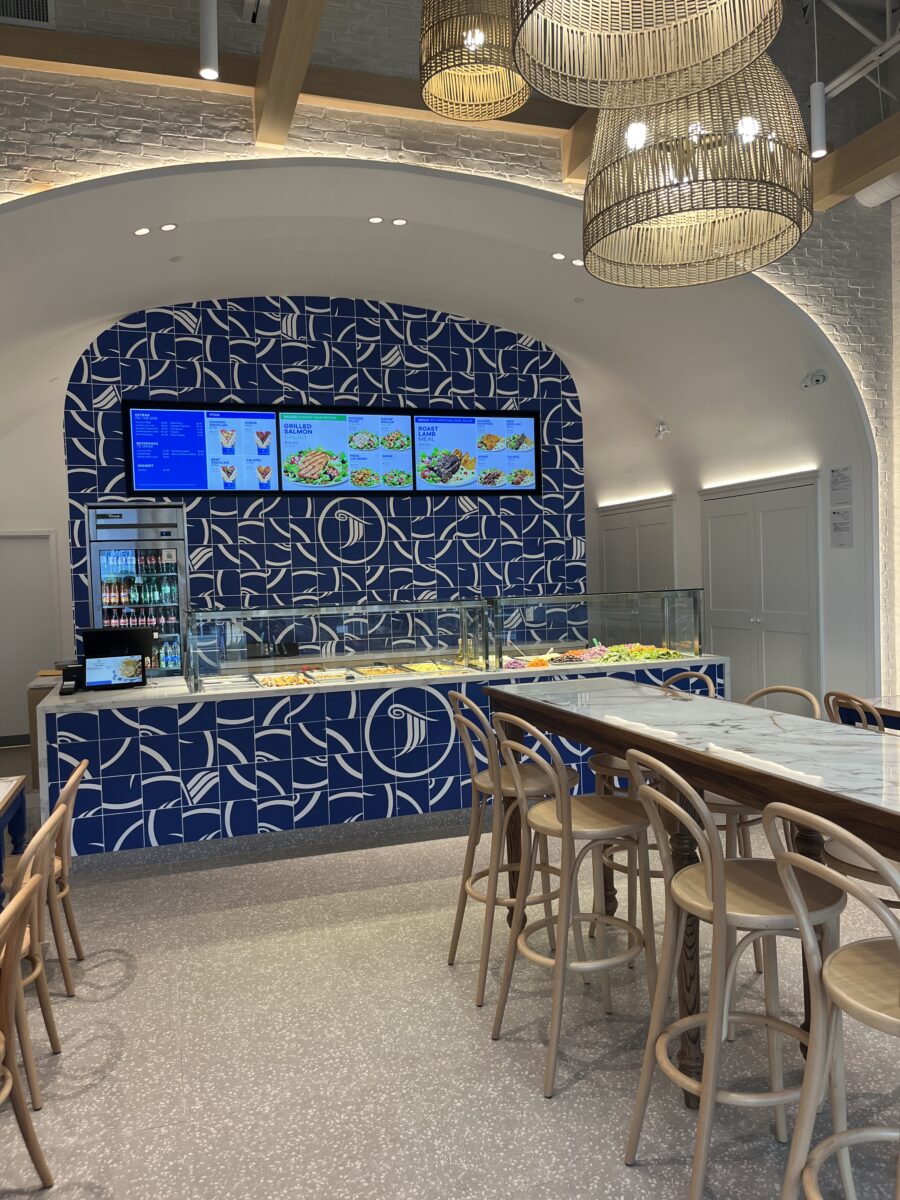
Using Greek cuisine and tradition as its guiding light, the new location has been designed to offer a relaxed and elegant mediterranean-inspired space. It nods to the original Jimmy’s heritage and fine-dining restaurants, including Epikourion and Penelopes, which first opened in Canada in the 1970s by Dimitrios ‘Jimmy’ and Helen Antonopoulos following their arrival from Greece, said the company.
“Notable design elements include cobblestoned tiling, alonger main table to promote group ‘family-style’ dining, and an archway reminiscent of traditional Greek homes and monuments. The design remains true to Jimmy The Greek’s legacy, promising all customers an environment to enjoy a home-cooked meal away from home, while also demonstrating the brand’s mission of constantly innovating its award-winning store designs,” according to the company.