Advertisement
Home Blog Page 638

Guelph-Based ‘Crafty Ramen’ Expands into Toronto Market while Also Growing Ecommerce [Interview]

Crafty Ramen on Ossington Avenue (Image: Dustin Fuhs)

Crafty Ramen, a popular Guelph-based ramen shop, has opened its first location in Toronto on the popular Ossington strip as it continues to expand its footprint with physical locations as well as e-commerce.

The concept first began in 2017 by co-founders Miki and Jared Ferrall.

Khalil Khamis, CEO of Crafty Ramen, said the business is now in Guelph, Kitchener, and Toronto.

“Jared is a chef by trade. He’s worked for some of the fanciest kitchens in the world like Gordon Ramsay and the Point One Per Cent (wealthy people). Jared and Miki met in Vancouver while Miki was learning English. They moved to Japan together and ended up working on a super yacht. Jared was a chef on that boat. They toured the world and during that time they figured out that they wanted to not do food for the Point One Per Cent and open something that could be for everyone,” said Khamis.

Khalil Khamis

“Jared has family here in Guelph. Everywhere they went on the boat they ate ramen, they had a passion for the product and wanted to do something around ramen. When they went back to Tokyo before coming to Guelph here they studied (at a ramen school in Tokyo) and they travelled the country eating bowls from top to bottom. One thing they learned is a couple of the key pillars of ramen are regionality and creativity.

“So when they settled in Guelph and opened their ramen shop here they really wanted to have a local take on ramen. We source all of our broth, our noodles, proteins, all of that is sourced locally, made in house from scratch. There’s a couple of ingredients that we need to source from Japan but for the most part we’re sourced locally.”

Crafty Ramen in Guelph (Image: Crafty Ramen)
Crafty Ramen in Kitchener (Image: Crafty Ramen)

Khamis comes from a franchise background. He lives about a 10-minute walk from the Guelph restaurant and met the Ferrall’s as a regular customer about a year after they opened. 

“I said this is incredible. I love the food and the brand and you guys have done a great job, let’s partner and grow restaurants. So after many conversations and meetings we partnered and we opened our second restaurant in downtown Kitchener four months before the COVID pandemic. We opened in November 2019,” he said.

Then they started to create the ramen meal kit where people could buy the broth, noodles and toppings on the side. In the early days of the pandemic, they were able to make about 100 at a time and put them on its website for local pick up. 

They were selling out in minutes. People on social media across the country were asking Crafty Ramen to ship these meal kits out.

The company’s e-commerce was launched in December 2020 and started shipping the ramen meal kits across Ontario and that organically grew into independent grocery stores reaching out to them who wanted to sell the meal kits.

“Through that we learned there’s nobody doing restaurant quality ramen in grocery,” explained Khamis.

Crafty Ramen on Ossington Avenue (Image: Dustin Fuhs)

Recently it launched its frozen ramen product as well. That is available from coast to coast with numerous partners scattered throughout the country. 

“It’s been going very well,” he said.

“A bowl of ramen is more than a meal — it’s an experience of comfort and connection that lives at the heart of everything we do at Crafty Ramen,” said Miki Ferrall, Crafty Ramen co-founder and VP of operations. “We opened Crafty to create a space that feels like ‘home,’ where people can unwind and share their day over something warm and familiar. We’re so excited to continue to grow our community and make Toronto our newest home.”

Now, with the opening of their third restaurant location, Toronto ramen-lovers (and noodle-curious) can get a taste of a Crafty Ramen bowl made fresh for themselves. The space serves as an homage to the shops Miki grew up with in Japan. Diners seated along the bar have a full view of the open kitchen and are encouraged to watch and learn, while the narrow intimacy invites everyone inside to engage in the cooking experience as their meals are prepared.

The closeness of the space also allows guests to enjoy the interior ‘craftiness’ of the restaurant’s decor. Two back walls are covered in an intricate Japanese pop culture collage, assembled by hand by Miki herself, while the adjoining wall is made to recreate the feel of an open-air ramen stall, with an awning overhanging the seating area and a mural hand painted by a local artist. Every aspect of the design sets the tone for a space alive with fun, care, creativity and appreciation for the full ramen experience.

Crafty Ramen co-founders, Miki and Jared Ferrall, are bringing their ramen experience to the Ossington strip. (CNW Group/Crafty Ramen Market Inc.)
Crafty Ramen on Ossington Avenue (Image: Dustin Fuhs)

The new restaurant also includes a mini-market at the front of the shop so that guests can easily grab from an array of Asian-inspired products made by other local small businesses, along with Crafty Ramen’s own make-at-home meals and sauces  — and soon an exciting new frozen ramen product launching in the coming weeks.

Khamis said e-commerce has really shone a light on the brand but its focus is around brick and mortar and the grocery channels.

“We’re going to look to open another restaurant corporately early next year in Q1 of 2024 and then we’re going to explore franchising. We have some super passionate community members that have reached out . . . so we’re going to explore what that looks like next year,” he said.

Are Canadians Buying Less Groceries with Ongoing Inflation? [Op-Ed]

Image: Sobeys

We learned last week that Canada’s food inflation rate in March dropped for a second month in a row, to 8.9%. However, prices at food stores rose 9.7% year-to-year. While prices increased by 0.3% in one month, the lowest percentage so far in 2023, the gap between food inflation and the general inflation rate reached 4.6%, the highest it has been since 2009. Even though Canada still has the third-lowest food inflation rate within the G7, after Japan and the United States, a stubbornly high food inflation rate compared to that in other economic sectors will only continue to cause sticker shock at the grocery store. 

Many are asking when food prices will return to pre-2022 levels. The truth is, they won’t. With higher wages and increasing packaging and energy costs, food prices just won’t drop. Some food companies will raise salaries by more than 10% over the next three years, just to increase employee retention. It’s challenging to recruit for many remotely located agri-food companies, and the work in some cases can be physically demanding. Consumers are feeling the impact of these financial adjustments up the food supply chain. Grocers are paying more for goods, as shown in their financial statements for several months now.

Our best hope, though, is to see the food inflation rate drop. With a lower food inflation rate comes more predictability for the industry.  Many households are dedicating a larger percentage of their total budget to food purchases – or are they?

The retail sales numbers released by Statistics Canada over the past few years are telling us an interesting story. In January 2017, Canadians were spending 48% on food, among all other goods bought at retail. This went down to 46% just before the pandemic started. In March 2020, this rate shot up to 74% for obvious reasons – nothing was open for business. Today, 41% of the money spent on retail goods is for food, excluding alcohol and cannabis. These numbers exclude major components of our economy like services and housing. The data seems counter-intuitive but may in fact suggest a few things. For one, while this certainly means inflation is impacting all aspects of our lives, the data is telling us that Canadians are still spending.

Sylvain Charlebois
Sylvain Charlebois

Most important though, total retail sales for grocery and specialty food stores appear to have almost plateaued. In February 2023, the monthly food expenditures per capita were about $583. In February 2020, three years earlier, the monthly food expenditures per capita were roughly $618. Since we get less for our dollar now, these numbers are astonishing. If we are to believe these numbers, Canadians are likely buying less food in volume and are also spending less in food retail. Also, since major grocers’ revenues including Loblaw, Empire/Sobeys and Metro have increased in recent years, this may also indicate that independent grocers are simply selling less food. Again, these numbers don’t provide a full retail picture since they exclude services, but numbers suggest that while the size of our retail market is still increasing, food retail in Canada is stagnating. In fact, from January 2022 to January 2023, retail food sales have dropped in Canada by more than 5%. By mid-2022, when food inflation was really putting more pressure on everyone, food retail sales started to drop despite more people coming to Canada.

Unsurprisingly, many, many households are just spending less, and being more frugal about food purchases in times of financial stress. They may also be wasting less food as well and are more careful with food inventories they have at home. Or is it more gardening, or more visits to famers’ markets? This causes concern about the numerous health and nutritional compromises made by consumers due to higher food prices. We can see how trading-down at the grocery store can have long-term effects on the health of individuals and families, especially children.

It certainly has been confusing for Canadian shoppers over the last 12 months. Grocery shopping takes more thought and analysis on the part of the consumer. We can’t just drop by the grocery store and pick up what we’ll need for the next few days. The bad news is that Canadians are coming out of an era during which food was dirt cheap. In fact, the world is experiencing the same challenges, not just Canada. The good news is that things are slowly calming down for the food industry, giving them much needed breathing room, and allowing food retail to offer consumers more frequent and better discounts. So, yes, with food inflation, patience will pay off.

Krispy Kreme Doughnut Chain Plans Cross-Canada Location Expansion after Downsizing [Interview]

Krispy Kreme Scarborough (Image: Krispy Kreme Canada)

Years after exiting a number of locations in Canada, doughnut chain Krispy Kreme is looking to expand its current presence in the Canadian market with more cafes as well as theatre-style stores with drive-thrus.

Levi Hetrick, Chief Growth Officer & Operating Partner for Krispy Kreme Canada, said the brand currently has 13 locations across the country in BC, Ontario and Quebec – 12 of those are owned and operated by his group. A franchise based out of Seattle runs the brand location in BC.

Levi Hetrick

“What we’re looking to do is build a factory, a theatre hub, location in Calgary much like we already have in Mississauga, in Scarborough, Ontario, in Greenfield Park, a suburb of Montreal and one in Quebec City and the deals we’ve recently completed and will open soon in Winnipeg and Edmonton,” said Hetrick.

“It’s about a 4,500-square-foot production facility that’s also a drive-thru with sit-down retail. We call it a theatre hub because you can see the doughnuts being made. So the way that Krispy Kreme works each of our drive-thru facilities it’s also a factory. That’s where all the doughnuts are made fresh every day and then they’re sold on site and then also delivered to a nearby could-be smaller cafe. We sell at Costco We produce for our fundraising program. We do a lot of e-commerce through different partners and are potentially talking about wholesale agreements with people like Walmart, Loblaws, etc. But those are not currently in place today.’

Image: Krispy Kreme Canada

The Calgary store is looking at opening late 2024 or early 2025. Fairfield Commercial Real Estate Inc. is working with Krispy Kreme to assist with their expansion in the Calgary market.

“We’re trying to be a bit opportunistic with real estate. We’re not going to build many, many factories like this – theatre hubs and drive-thru theatre hubs – in Calgary so we want to find the best one or two spots in Calgary to build a facility,” said Hetrick.

He said a theatre hub will open later this year in Toronto and then Winnipeg will also likely open later this year. There’s a signed deal in Edmonton as well to open likely in Q3 of next year.

“What we’re looking to do is build sort of the same building in multiple locations,” explained Hetrick. “Sort of a prototype that we’ve designed for the Canadian market and find great real estate in high traffic areas in each of the major cities across Canada and expand our reach.”

Krispy Kreme Doughnut Theater Experience in NYC (Image: Krispy Kreme)

He said about 20 theatre hubs in the future would cover Canada with an additional 40 or so smaller locations in the cafe format.

“Krispy Kreme never actually left Canada. It just drastically reduced operations. What you probably recall is that in the early 2000s it was quite a run-up not just in Canada but across the globe to open as many Krispy Kreme’s as possible,” said Hetfrick. “Mississauga was literally the first international Krispy Kreme for the brand and it is still open and one of the most successful shops on the planet today. It produces and sells more doughnuts than any other shop, basically in the world.

“Early 2000s they got up to about 17 locations across a bunch of cities in Canada but the business was losing money and for a variety of reasons . . . the corporate group decided to drastically reduce and eventually to close most of Canada.

“It was at that time that my now business partners took the brand private. It was corporate owned. They took it private in 2006/2007 and that went down from 17 locations down to three. From that time, they’ve slowly grown it up to 10 locations and in late 2021 they established a partnership with the corporate entity and it’s no longer a franchise. It’s a joint venture partnership with Krispy Kreme corporate back in the States and that’s when I joined because I was part of Krispy Kreme corporate at the time. The brand has been around and we still think it’s got tons of potential in Canada just because Canadian consumers are fans of Krispy Kreme. But to be honest our biggest issue is access. Also a lot of people don’t know that the brand is still here. We have an opportunity to re-establish the brand for a lot of people and grow.”

Aburi Restaurants Launching WA-BAGEL Retail Concept in Canada with Vancouver Launch [Interview]

Seigo Nakamura and Yukiko Iikura at her Kepo Bagels in Japan

Aburi Restaurants Canada is opening its brand new WA-BAGEL concept in the heart of downtown Vancouver in late-spring bringing a unique Japanese-style bagel to the market with plans for expansion.

The concept will open in 1,887 square feet at 666 Burrard Street.

Huy Tran, National Director, Marketing, Aburi Restaurants Canada, said the location is anticipated to open in June or July.

Seigo Nakamura

He said WA-BAGEL follows in the footsteps of its sister restaurant, WA! CURRY, as a counter service spot to start, offering take-out and delivery options. Guests can also order and dine across the hallway in the building’s spacious communal concourse.

“Japanese-style bagels are my favourite type of bagel because they are more light and smaller in-size, often with a filling, similar to another Japanese snack-favourite, the onigiri,” said Seigo Nakamura, founder and CEO of ABURI Restaurants Canada. “They are becoming more and more popular in Japan, and there is really nothing like it in Canada yet. I thought it would be a great idea to introduce something new to the Canadian market. There are so many different kinds of flavours. Have you ever had a mochi cheese bagel or a lemon peel and azuki bean bagel? They are delicious!”

Image: WA-BAGEL
WA-BAGEL by Aburi

WA-BAGEL’s bagels are made with Canadian flour and a koji-based yeast. When it opens, WA-BAGEL will have 14 flavours of bagels and bagel sandwiches to start, including red bean paste and cream cheese, sweet potato and black sesame, Aburi Market’s fresh cut salmon lox & scallion cream cheese sandwich, and eggplant and bacon with miso and cheese. There will also be a variety of drinks, such as coffee and tea.

Yukiko Iikura, Head Baker, WA-BAGEL, founded her own popular bagel shop in Japan called Kepo Bagels for the past 15 years.

“I love baking and I also love chewy-textured things and WA-BAGEL’s dough features the texture and aroma of mochi,” she said. “In Japan, we use many different types of flavours and fillings for our bagels, and we’ll definitely be using some very Canadian-inspired ingredients in some of our options. I’m very excited as Canada has some of the best flour in the world, and we’ll get to use it in our bagels.

“Instead of mixing the ingredients in the dough, I roll the ingredients into the dough . . . For me, the texture is most important. I’m using Canadian flour. I think Canadian flour is the best for me in the world. I love Vancouver’s water. I’m so excited I can make bagels here in Vancouver.”

Image: WA-BAGEL
Image: WA-BAGEL

Tran said when Iikura creates her bagels, and the reason why it’s very unique, is because she actually puts the ingredients inside the dough and rolls the dough over it.

Huy Tran

“And the reason for that is that it doesn’t compromise the dough itself and it preserves the taste,” he said.

“Vancouver is a very, very rich cultural hub. It’s very diverse. Aburi has been known for being innovators. Thirteen years ago we opened the first Aburi concept in Vancouver and we also introduced Aburi cuisine to North America. So we always want to be that concept of first to market and we realize that Vancouver has a lot of audience especially people who crave diverse tastes and constantly trying to chase new trends.

“So that’s why we wanted to bring this concept to life with Yukiko to introduce to the audience there.”

Tran said the company does foresee more locations in the future.

“We have plans for Toronto and probably beyond Canada,” he said.

The Aburi Restaurants brand includes Miku, Miku Toronto, Minami, Minami Toronto, TORA, Hana, WA! CURRY, WA-BAGEL, grocerant ABURI To-Go, and ABURI Market.

Another Slow Month for Canadian Retail Sales [J.C. Williams Group Analysis]

Image via Cadillac Fairview

Slow and steady remains the trend for Canada’s 2023 retail sales to date, with All Stores in January growing 4.9% YOY and All stores Less Automotive, Food, Pharmacies up only 2.4% YOY.

An early trend in 2023 is the Food and Beverage Stores industry, up 3.5% YOY (below the rate of food inflation, which rose 10.6% in February, 2023). As a result of these seemingly endless increases in the cost of food in Canada, Specialty Food Stores are bearing a significant brunt, continuing a downward trend in February of -9.1% YOY. Currenty, non-specialty food costs the same as specialty foods did a year ago. Specialty foods seem to be the first cutbacks that Canadians are taking to combat their rising grocery bills.

Even though February 2022 and February 2023 were very similar through a COVID lockdown and health lens, there were still significant shifts in consumer sentiment. A key example of this is people’s work lives. Last week, the JCWG team visited RCC Human Resources Conference in Toronto and returning to office work is still on everyone’s minds. This is being reflected in Clothing Stores, up 14.3% YOY, and Shoe Stores up an even more impressive 24.4% YOY.

An interesting correlation that is further showing itself in 2023 is the decline of Beer, Wine, and Liquor Stores, down -1.7% YOY. This has been a topic of discussion at JCWG recently, and our early insights consider:

February’s modest growth in retail sales continues as the trend of inflation, housing, work life, and societal changes being major factors in specific categories’ growth or decline. However, certain players can still succeed in their industries with the right strategy.  As we continue to move through 2023, the alcohol and cannabis categories are on our minds, as we consider:

  • Where will be the next municipality to approve dispensaries after  success in other markets?
  • When will Cannabis Retailers oversaturate current demand and start to shutter?
  • What can make alcohol more appealing within the new guidelines?
  • Why are alcohol retailers not innovating more in their store strategy to combat changing consumer preferences?
  • How are YOU changing your alcohol/cannabis consumption habits in 2023 with new information, guidelines, and accessibility?

For support in your retail strategy, planning, and innovation, reach out to the trusted experience at JCWG!

Canadian Retail Sales by Product Category, Same Month Comparison
Canadian Retail Sales by Store Category, Year to Date Comparison
Retail Trade, Canada, All Stores, by Geographic Regions

Fabricland Lands at Yonge & Bloor in Toronto [Photos]

Photo: Craig Patterson

It’s a story of fast fashion becoming much slower fashion — Fabricland has officially opened just off the corner of Bloor and Yonge Streets in Toronto in a retail space formerly occupied by an H&M store. Fabricland will remain in its bright new location for several years until its building and an adjacent building are demolished for a major redevelopment. 

The Fabricland store spans three levels of the former H&M space at 13-15 Bloor Street West, measuring about 15,000 square feet with a full range of items focused on sewing, quilting, knitting and crafting among other activities.  

The street level of the new store houses fabrics focused on ‘fashion’, while the upper level includes items that can be used to make home decor. The basement of the former H&M store houses items that can be used for crafts and notions. 

The store is considered to be one of the flagships for the Fabricland chain, and is testing out some new concepts such as signage that will eventually be rolled out into other Fabricland locations. Fabricland is the largest fashion fabric distributor in Canada with over 130 stores across the country. 

Click image for interactive Google Map
A view towards Fabricland, the adjacent bank building also owned by the Kimel family. The Yonge & Bloor intersection is to the left in the photo, including a new Apple store under white hoarding. Photo: Craig Patterson
Main floor escalators and signage in the new Fabricland on Bloor. Photo: Craig Patterson
Main floor fabrics, including a special range that can be used for gowns and other garments for eveningwear (Fabricland notes that some drag queens may wish to check out this area of the store for ideas and supplies). Photo: Craig Patterson
Main floor elevator entrance and various fabrics on display. Photo: Craig Patterson
Main floor Pride-related display, as well as denim and Toronto sports-themed fabrics. Photo: Craig Patterson

The store aims to attract consumers such as students in nearby post-secondary institutions studying in programs where textiles may be utilized. The retailer noted that even drag queens in the nearby Gay Village may shop the store for a range of fabrics that can be used in designs — a display of rainbow fabrics and Pride-related accessories is also on display. Some ornate fabrics in the store could be used for flowing gowns or other designs. 

Toronto’s diversity means that some patterns and ornaments, appropriate for ethnic garments, are on offer as well. On the opening day, the store was busy with shoppers who began to line up almost an hour before the store opened. 

Fabricland is waiting for a permit from the City of Toronto to install a protective covering over the glass of the upper level of the store in order to protect merchandise from sunlight. The upper level includes a display near the windows for outdoor designs and more will come, including a display with beach umbrellas. A Fabricland representative said that it took several weeks to convert the new store from the former H&M store that occupied the space for nearly 20 years

Second-floor outdoor display and foam/mattresses — Fabricland has applied for a permit to add protective UV glazing and branding over the windows. Photo: Craig Patterson
Second-floor bedding-related area for quilting and home decor at Fabricland on Bloor. Photo: Craig Patterson
Third floor home goods, including a range of fabrics for indoor and outdoor use. Photo: Craig Patterson

One of the reasons Fabricland opened on Bloor Street is its corporate ownership — the wealthy Kimel family that owns the retailer also owns the building. A proposal is in place for a massive residential tower on the site as well an adjacent building currently occupied by a bank.

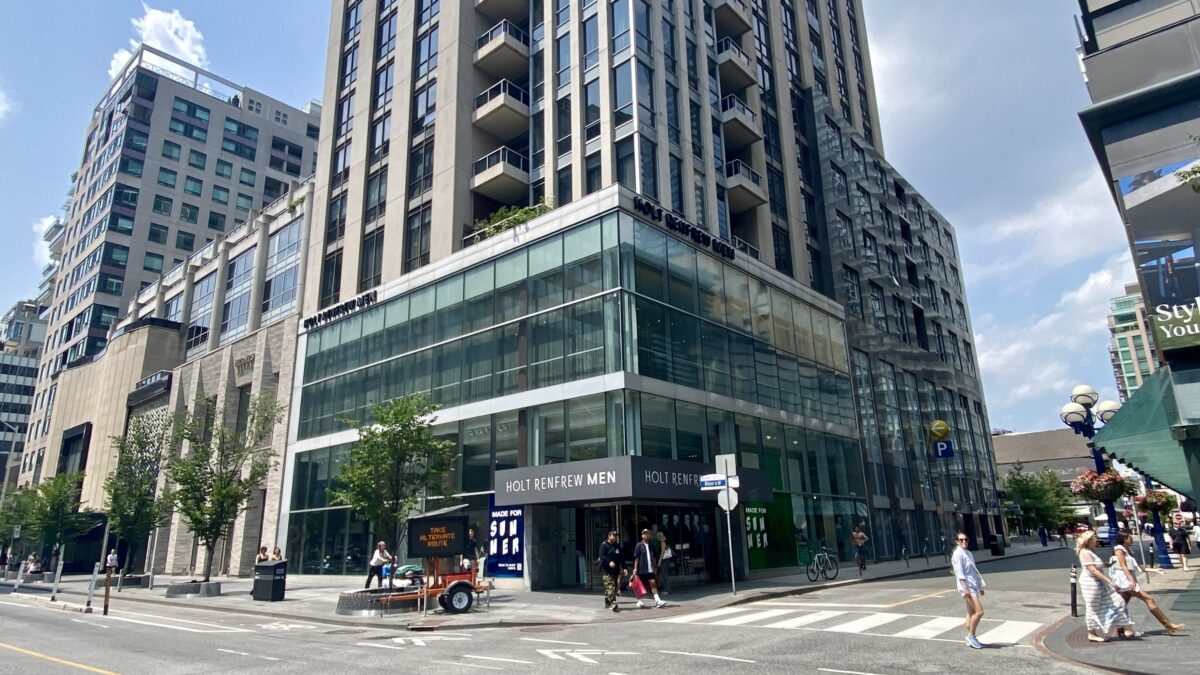
The new Fabricland is steps away from an intersection that by next year will be home to a flagship Lululemon store as well as, tentatively, an Apple flagship store. A new tenant or tenants will eventually be secured for the former Nordstrom Rack space at 1 Bloor Street East, and we recently reported that The Ballroom bowling concept will replace a former McEwan grocery store in the basement of the same 1 Bloor East complex. Across the street from Fabricland is the Holt Renfrew Centre, which is home to Holt Renfrew’s main flagship store as well as a large Aritzia store and a soon-to-be-announced tenant that will occupy the main floor of the centre’s former Zara space. 

Further up the street is the Bloor Street luxury run, which is seeing a remarkable number of new luxury stores being added. Over the next few months, stores opening on Bloor Street between Bay Street and Avenue Road will include the likes of Van Cleef & Arpels, Rolex, Ferragamo, Saint Laurent, Alexander Wang, Bonpoint and others. They will join names such as Louis Vuitton, Tiffany & Co., Gucci, Hermes, Dior and others that have opened on the street over the years. 

Cutting boards and measuring tools in the basement area of Fabricland on Bloor. Photo: Craig Patterson
Yarn area on the basement level of Fabricland Bloor Street. Photo: Craig Patterson
Escalators into the basement level of the new Fabricland store. Photo: Craig Patterson
Fabricland Jingle via Youtube

Fabricland had a store nearby on Bloor Street East at the former Hudson’s Bay Centre until about 12 years ago — Dollarama now occupies the basement space. Fabricland also had a presence within the former Honest Ed’s store that operated at the corner of Bloor and Bathurst Streets until late 2016. 

The Fabricland chain was founded in 1968 as Fabricland Distributors, and its first store was at Queen and Roncesvalles in Toronto. The retailer carries a large selection of fabrics as well as sewing notions and accessories, patterns, broadcloth, flannelette, suitings, utility and cleaning cloths, arctic fleece, cottons and blends, home goods such as curtains, as well as bridal and party wear and coordinated fashion collections.

Demand Returning to Food & Beverage in Canada as Costs and Staffing Challenges Persist [JLL Report]

Turquoise Goat Board Game Cafe at 122 W Hastings St, Vancouver, BC (Image: Turquoise Goat)

JLL’s Food & Beverage 2023 report indicates demand is returning in Canada while restaurants continue to battle rising costs and staffing shortages as customers increasingly to seek out experiences when they go out for food and drink.

January reservations in Canada were 38.1 per cent above 2019 levels.

Tim Sanderson

Tim Sanderson, Executive Vice President & National Lead, Retail, JLL Canada, said what’s happening in Canada is mirroring what’s taking place in the U.S. which has always had a propensity to eat out more than people do in Canada.

“I think that people are after how many years of being shut in they just want to get out and experiential food and beverage is something that’s attracting people. I don’t think we have enough of it in this country quite frankly where you can go and have a meal and play some games, whatever. But I think it’s coming,” said Sanderson.

Experience remains one of the top trends in food and beverage. Consumers’ demand for fun and novel experiences continues apace. Consequently, new “eatertainment” concepts are opening as well as “clubstaurants”, which offer members exclusive experiences at a premium price, said JLL.

Image: The Ballroom

“It’s a similar trend to introducing food to a shopping centre. When people go to a shopping centre and there’s a place to eat and it’s decent and it’s not just an old tired food court, statistics prove that they spend more time on the property and when they spend more time on the property the conversion rate of buying something other than just food is higher,” said Sanderson.

“Clearly that’s the same thing for a bowling experience. Or something like the Rec Room. Let’s go. Let’s have something to eat. Let’s have a beer or two. And let’s go play some basketball hoops or let’s go play some games. It’s a third dimension to food, alcohol and gaming.”

The Rec Room at Square One (Image: Dustin Fuhs)

But restaurants are still facing some challenges these days with many of their costs elevated and finding people to work is not easy. JLL said more than nine out of 10 restaurant operators report that rising costs are a significant challenge to their business. They are battling these costs primarily by raising menu prices, which pass these costs on to the consumer.  And staffing shortages are limiting the quality of service restaurants can offer their diners. Operators are offering higher wages, cutting back on opening hours, or utilizing technology to remain efficient.

“We see it when American restaurateurs come to Canada and start looking at wage rates. Our wage rates for labour in Canada for the restaurant business are much, much higher than they are in the United States,” said Sanderson.

“Food as a category is a very thin-margined business. I don’t know where all the people that worked in food service went when the pandemic hit but they all left the industry it seems . . . My personal experience is service levels are troublesome. They’re either under-staffed or the staff aren’t well trained within.

“I think as an industry they do have to work a little harder at training their staff. It’s a problem.”

NBA Courtside Restaurant in Toronto (Image: Dustin Fuhs)

Canadian operators are focusing on food and fun. Here are a few examples of that in the JLL report:

  • In the Greater Toronto Area, Cineplex is opening its new Junxion concept, which is being hailed as the movie theatre of the future. In addition to showcasing movies, games, and live events, Cineplex Junxion Erin Mills will feature a food hall with a variety of food and beverage options, as well as an indoor food truck and bar with a selection of wines and beers.
                                                                  
  • Sports and entertainment food operators have positioned themselves in high-traffic areas to capitalize on the growing demand for in-person experiences.
                                                                  
  • In Toronto, the city’s first NBA-themed restaurant, NBA Courtside Restaurant, is opening just steps from Scotiabank Arena. Similarly, Vancouver is opening near the Broadway Corridor a basketball-themed bar ─ Courtside Bar ─ that will serve beer and stadium food.
                                                                  
  • Vancouver’s Turquoise Goat is the city’s newest board game café, joining a market with numerous board game bars and pizzerias. The café offers an inexpensive and tech-free way to socialize while enjoying simple food and drinks. It has already become a popular destination for patrons.                                              

Calgary-Based Japanese Knife Retailer ‘Knifewear’ Plans Multi-Store Expansion Including Ontario and BC [Interview]

Image: Knifewear

A fascination and passion for Japanese kitchen knives led Kevin Kent into opening a retail location a few years ago, focused on selling the items in the Canadian market.

Kevin Kent

Today Knifewear has five locations with two in Calgary, and one each in Vancouver, Ottawa and Edmonton. A new Toronto store has been announced to open at 517 Bloor Street West in the city’s Annex area, set to open in June.

Kent, Founder and CEO, said Toronto and Vancouver are huge.

“I’m not going to put the idea that we only need one store in those cities. I see two or three stores in Toronto and Vancouver. They’re huge cities. I can see them supporting two or three stores,” he said. “Montreal would be great but Quebec has its challenges. Then after that I’d really like a shop and a warehouse in Japan. Kyoto would be fantastic.”

Knifewear Toronto (Rendering: Knifewear)
Image: Knifewear

He said people assume Knifewear sells only to chefs but the brand sells to all consumers.

“I’m an old chef and I bought a Japanese knife when I was living in England in 1999 and I had that moment . . . I said hold on what’s going on here. Why is this way, way, way better than anything I ever had before?,” said Kent.

At the time, he was working as sous-chef for the legendary chef Fergus Henderson at St. John restaurant in London, England. Back in Canada in 2007 he began selling them out of a backpack from the back of his bicycle, while working as a chef in Calgary.

Image: Knifewear
Image: Knifewear

In January 2008, he opened his first store in the inner city Inglewood neighbourhood of Calgary.

“We haven’t opened a new shop in about six years. We were going to open in Toronto in 2020 in May or June and we were in the middle of dealing with a lease at that time in the middle of March when COVID hit. So we hit the brakes as you can imagine. I’ve been trying to get to Toronto for a long time,” said Kent.

“But finally, finally, finally. I’m pretty excited about it.”

He considers his chef years as the best education for being an entrepreneur.

Being a chef takes long hours, involves hard work, both mentally and physically, and chefs must be able to put out fires, both literal and figurative, with extreme competence. Today, Kent is still just as obsessed with Japanese knives as the day he first held one. A couple times a year, he travels to Japan to meet with his blacksmith friends and drinks far too much sake, according to his biography on the company website.

“Each visit he learns more about the ancient art of knife-making. Through this obsession Knifewear has expanded to include five Knifewear stores in Calgary, Vancouver, Ottawa, and Edmonton. Plans are also underway to open a store in Kyoto, Japan. He refuses to confess how many Japanese knives he owns … but he admits the number is rather high.”