Retail Insider is streamlining its Canadian retail news from around the web to include a handful of top news stories that can be viewed quickly during the day. Here are the top stories from the past several days.
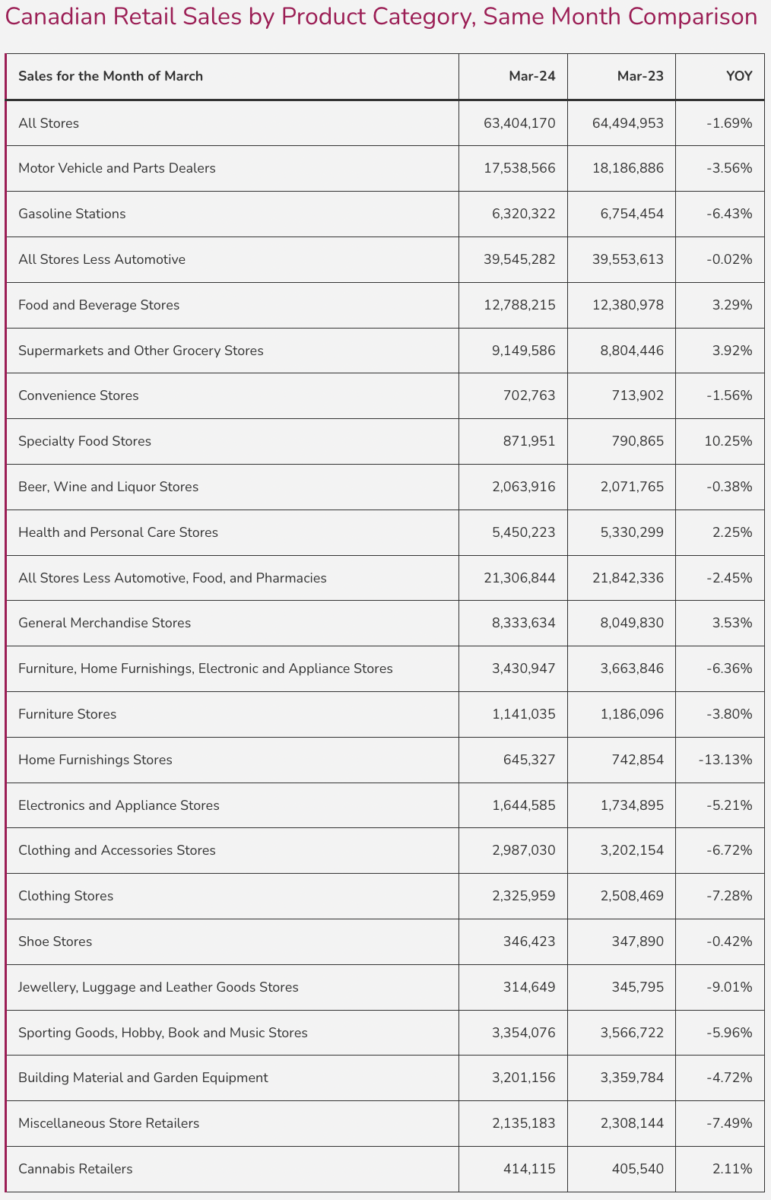
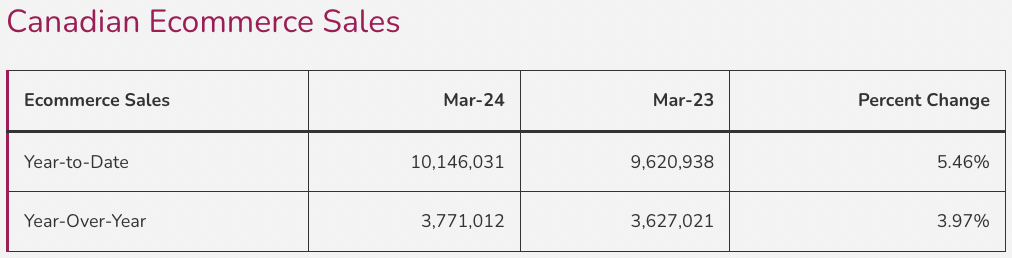
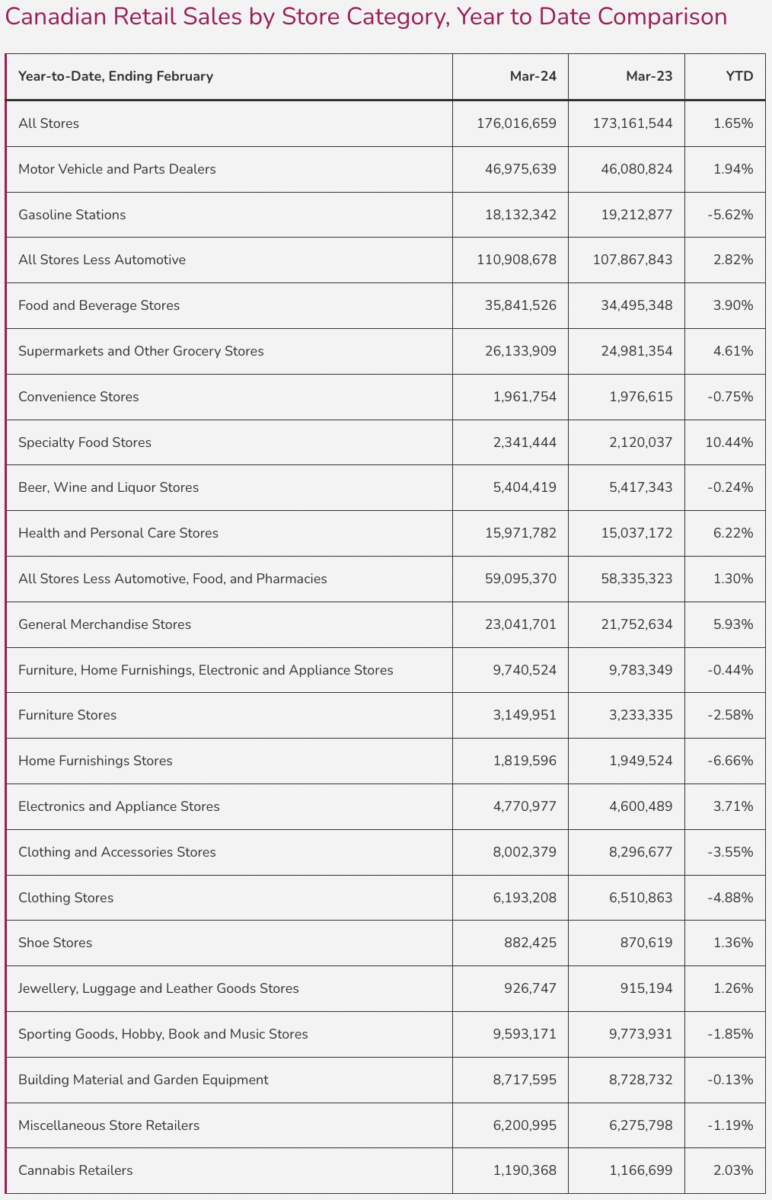
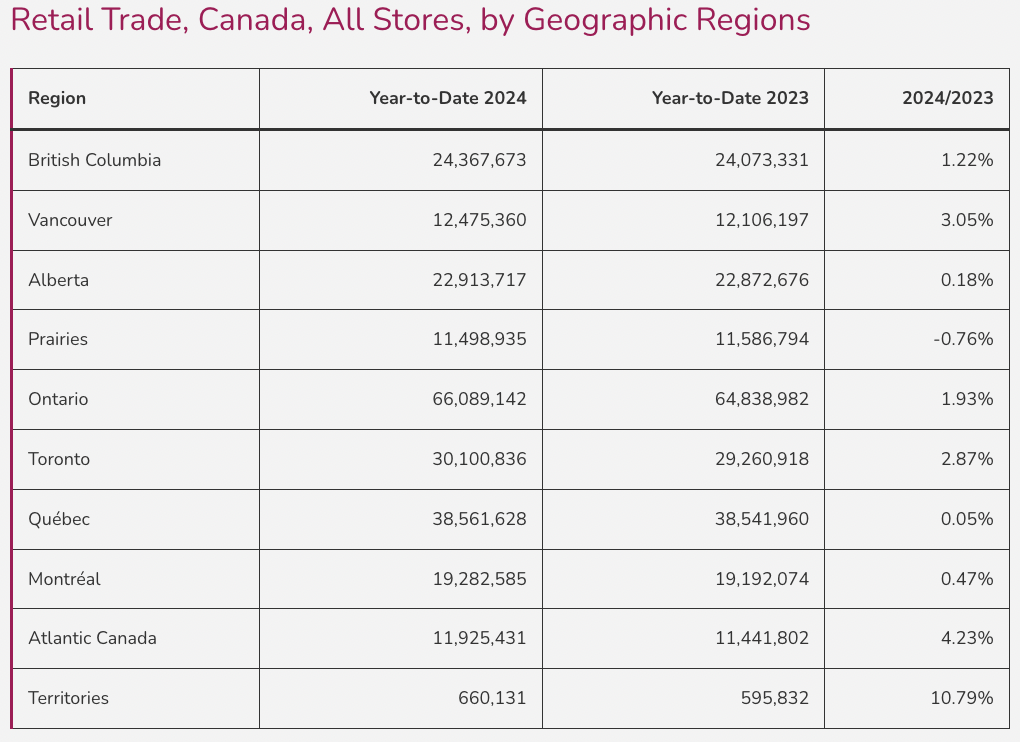
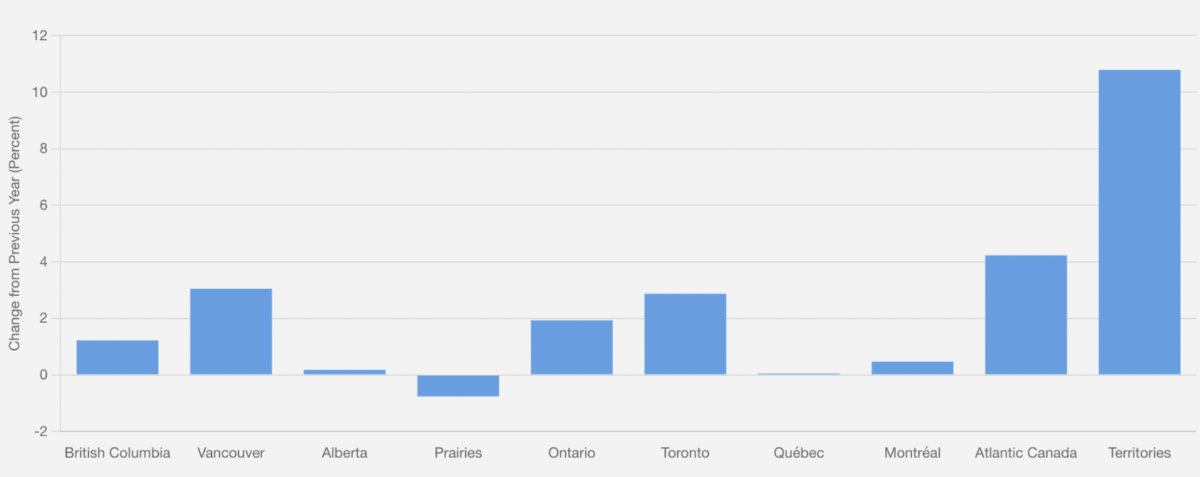
Canadian retail sales slumped in March with All Stores declining -1.7% YOY, with discretionary categories (All Stores Less Automotive, Food, and Pharmacies) down -2.5% YOY. March experienced two fewer shopping days (Good Friday and Easter Monday) in 2024 compared to 2023, but this is only a small factor as high levels of inflation continue.
Retail in general is seeing fluctuating footfall in Canada. Shopping centres are down approximately -6.3%, whereas BIAs are up by 10.9% at the end of March 2024, as compared to 2023. While this does not immediately correlate to sales, this is a telling factor that can predict the prevalence of browsing and potential future purchases.
Grocery prices and the associated large grocers were top of mind in March, and remain top of mind at the time of writing. Grocery prices are up over 20% compared to this time in 2021 and consumers have responded in multiple ways, including moving to lower cost options and full boycotts. A partial result of these changes in consumer behaviour have resulted in continued increased revenue for Specialty Food Stores.
In March, the category’s revenue is up 10.3% YOY. January and February also saw increased revenues, up 6.6% YOY and 14.4% YOY respectively.
Canadians are more willing to shop with small grocery stores. In a study by Wagepoint, findings included: 58% of consumers are willing to pay more for items/services in order to support a local grocery store, with 78% wishing they could do some or all of their shopping at a small business. A large barrier for consumers is access. There are insufficient small grocery options in their area, or they are not aware of them.
RONA+ Charlemagne (Image: RONA)
Building Material and Garden Equipment stores were down -4.7% YOY in March, echoing what we are hearing from the industry. Both Lowes and Home Depot both reported decreased sales in Q1 2024, which had been predicted; Lowes was down -4.4% YOY and Home Depot -2.3% YOY.
Lowes, specifically, experienced decreases in both average transaction size as well as number of transactions. Overall, these decreases are as a result of fewer discretionary sales (patio furniture, barbecues, etc.), as well as decreases in consumers taking on large scale projects, such as remodels.
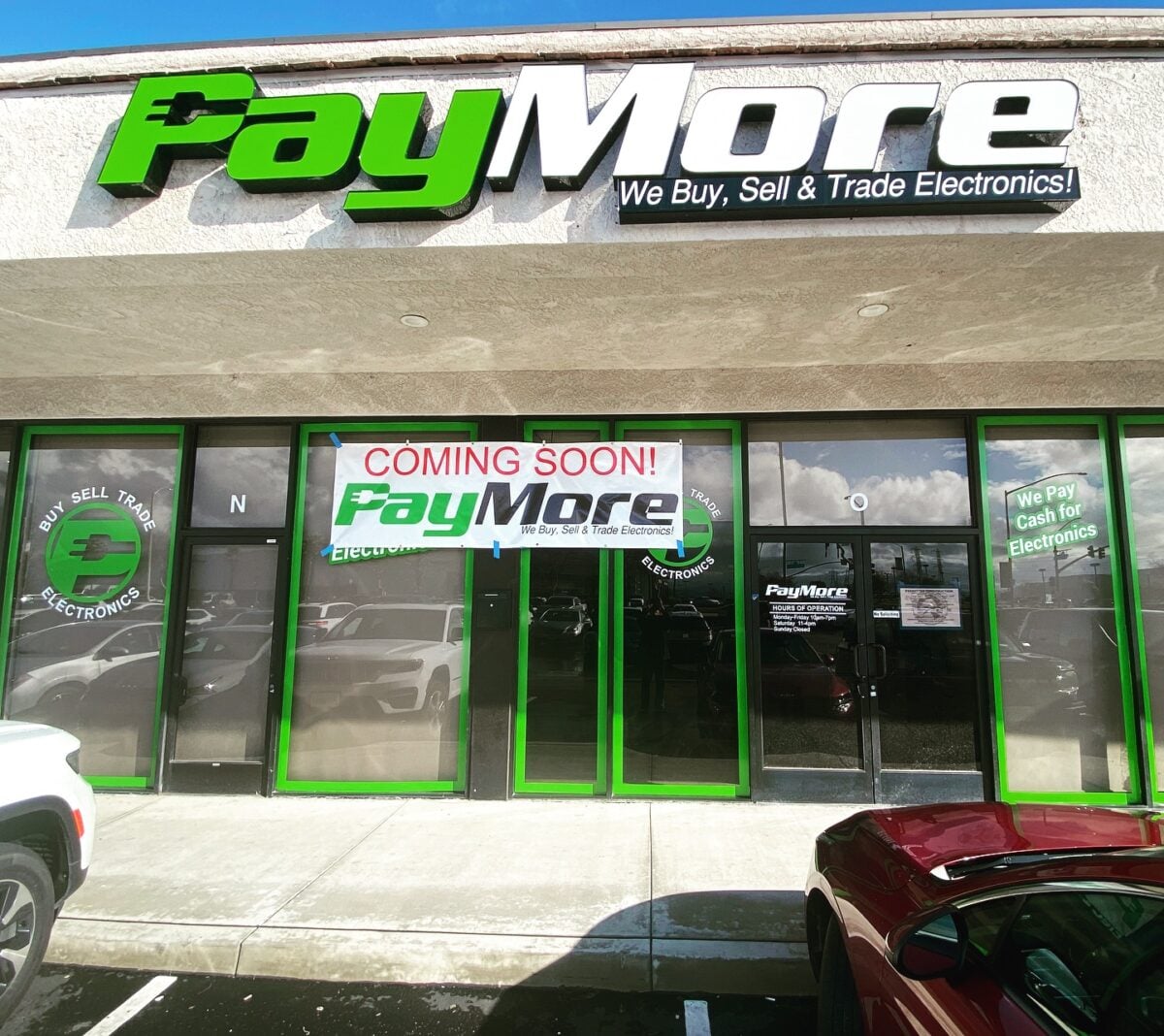
Second-hand electronics retailer PayMore, based in the United States, is expanding its retail footprint into Canada.
Stephen Preuss, Co-Founder and CEO of PayMore Stores, said the brand’s goal is to grow to as many communities as it can “because as long as technology is around, people will need to buy, sell, trade, and recycle their devices.”
Stephen Preuss
PayMore was founded in Massapequa, New York to obtain and repurpose old electronics and recirculate them back into the marketplace instead of having them pile up in landfills.
“We are a buy, sell, trade, recycle electronics retail store. We started this path in 2004 my partner and I . . . We built our business on technology and data. We just happen to sell electronics in a retail format. We ran our business in Long Island and then we started franchising in 2020. We opened up our second location at that point in time,” said Preuss.
Image: PayMore
“To date now, we have 36 stores open in 16 different states. We have another 55 being opened this year. So by the end of the year we should have 100 locations open in 29 different states. And we have contracted now including stores that we have open about 270 that are opening in the United States and we are now opening several in Canada as well.
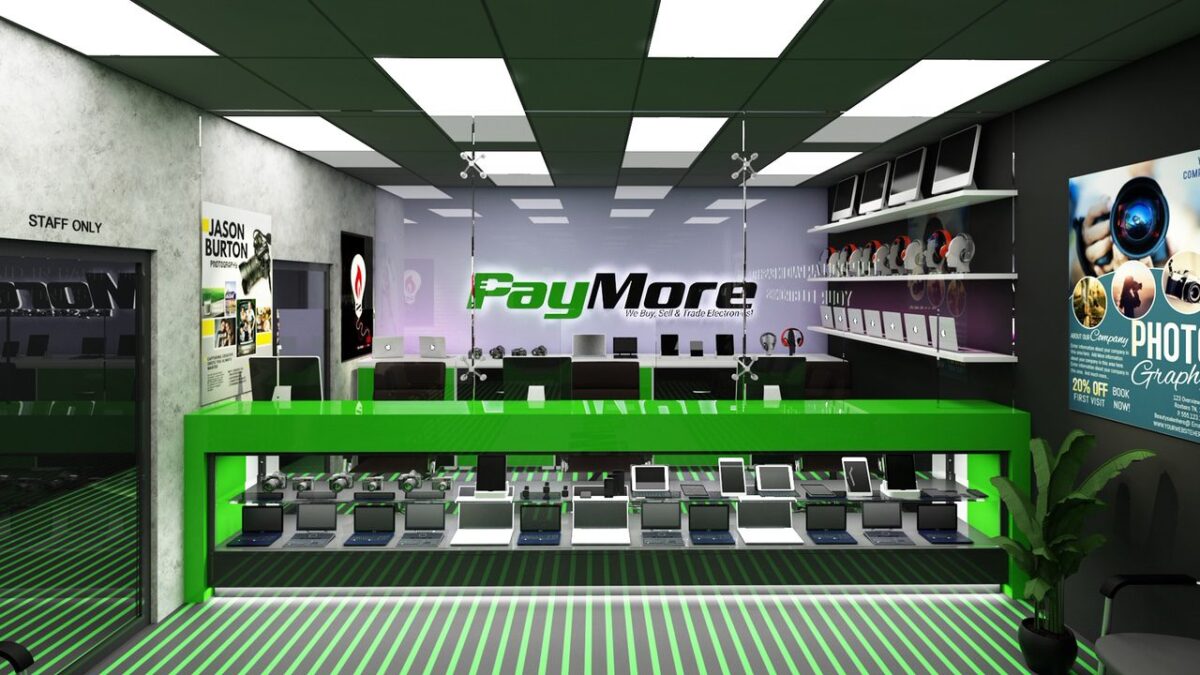
“It’s a retail format where people come in. They have optionality in electronics which is not available anywhere else besides us. It got to the point where people were looking for different options outside of going to an Apple store and paying $3000 for a phone or going to Best Buy and having to buy something new off the shelf. We have really opened up the channels of optionality in the second-hand electronics space and we’ve also, one of our big missions when we started this, was to really revolutionize the second-hand industry as a whole which is highly stigmatized. When you think of second-hand industry you think of a pawn shop. And that’s not what we are. We are a clean, regimented, franchise business where people are comfortable coming in in better shopping centres. We have beautiful stores and our technology allows our customers that are interfacing with our staff to be highly educated on what they can pay for that item and we believe in giving a fair deal so customers come back. Overall, we’ve really changed the concept, the feel and the execution of the second-hand store.”
He said customers return 70 per cent of the time which is highly extraordinary compared to other second-hand stores that customers only come back about seven per cent of the time.
Preuss said Canada is the brand’s first international exposure.
“The Canadian market is very similar to the U.S. market. But not only that, there is the understanding of what a second-hand market is there. As well, the retail and the real estate is very similar. And also there’s not a lot of differences between the technology stack that we use in the U.S. as opposed to some of the other places that we’re looking into internationally,” he said.
“So it was a natural progression for us. Everywhere we put one of our stores in the U.S. we’ve become the highest grossing second-hand store in that specific market. Now we have so much exposure in the U.S. it was a natural progression for us in Canada. It really took a long time. It took about a year and a half to find the right first mover for us in Canada which we’ve found with our franchisee that’s doing five stores in the Ontario area.”
Image: PayMore
Preuss said the first store will open in August with a second store to follow before the end of the year in the Greater Toronto Area.
“We have mapped out the entirety of Canada. Real estate is my background. So we’ve worked with some local folks there to map it out. We’re looking at 120 stores in Canada over the next 10 years, coast to coast,” he said.
Image: PayMore
Spearheading this deal for the brand is Ontario native Richard Price, who brings over 20 years of experience as a director of sales, selling and managing teams from SMB to enterprise in multiple successful SaaS Businesses.
“I wanted more freedom in my career and as a first-time entrepreneur, I also wanted to see a proven concept that will help each community that it’s a part of,” said Price. “The market for buying and selling electronic devices is huge not only in Canada, but around the world. Seeing PayMore’s growth and success in the United States, on top of its mission to pay people for their unused tech and to safely recycle unwanted tech, made this the perfect opportunity for us and this market.”
The recent move by Canada’s Competition Bureau to investigate the parent companies of grocery giants Loblaws and Sobeys marks a significant step in addressing anticompetitive behavior in the retail grocery sector. This investigation, initiated on March 1, focuses on the alleged use of property controls by these firms, which purportedly restrict competition through their lease agreements and control over land vacancies. With these two companies holding a combined market share of over 50% in the Canadian food retailing market, the potential implications are substantial.
According to Federal Court records, the Commissioner of Competition’s inquiry centers on suspicions that Loblaws and Sobeys are using their property controls to limit the activities of potential tenants, thereby reducing competition. This is particularly concerning in rural areas where communities often have limited grocery options, making them especially vulnerable to such practices. The allegations suggest that these companies are not only controlling who can lease space in shopping centers but also holding onto vacant lands to prevent competitors from entering the market.
Sobeys’ parent company has responded by calling the inquiry “unlawful,” reflecting the tension and defensiveness within the industry. However, many observers are not surprised by these developments, as the grocery sector has long been criticized for its market control tactics. The investigation underscores a broader issue: the control of market access and the strategic importance of location in the grocery business. These companies have mastered the art of location optimization, ensuring their dominance by strategically positioning and protecting their stores.
The public’s frustration with the grocery industry has been building, partly due to the long-running bread price-fixing scandal that has plagued both the industry and the Competition Bureau. After nine years, the investigation remains unresolved, eroding public trust. The current investigation into Loblaws and Sobeys is a crucial opportunity for the Bureau to demonstrate its commitment to protecting consumers and ensuring fair competition.
Within the grocery industry, there is a prevailing belief among executives that their practices are justified, driven by the need to maximize profits and serve customers. These practices have become normalized over decades, making it challenging to shift industry culture. However, the current food security crisis in Canada, highlighted by a poor rating from Food Banks Canada, has made the public less tolerant of actions that limit their access to affordable food options.
The Competition Bureau’s role is akin to law enforcement in ensuring market fairness. Just as speed limits and police patrols keep roads safe, the Bureau’s oversight is essential to prevent anticompetitive practices in the grocery sector. For the Bureau to regain public trust, it must complete this investigation swiftly and transparently, with clear recommendations made public. This will signal to both the industry and consumers that the Bureau is actively policing the market.
While the public needs to be educated about the complexities of the food industry, it is equally crucial for grocers to recognize that they are dealing with a more informed and less tolerant consumer base. The Competition Bureau’s investigation is a necessary step in aligning industry practices with public expectations and ensuring a fair and competitive market. This shift begins with robust oversight and decisive action from the Bureau.
Retail Insider is streamlining its Canadian retail news from around the web to include a handful of top news stories that can be viewed quickly during the day. Here are the top stories from the past 24 hours.
777 Ste-Catherine Street West in Montreal. Photo supplied
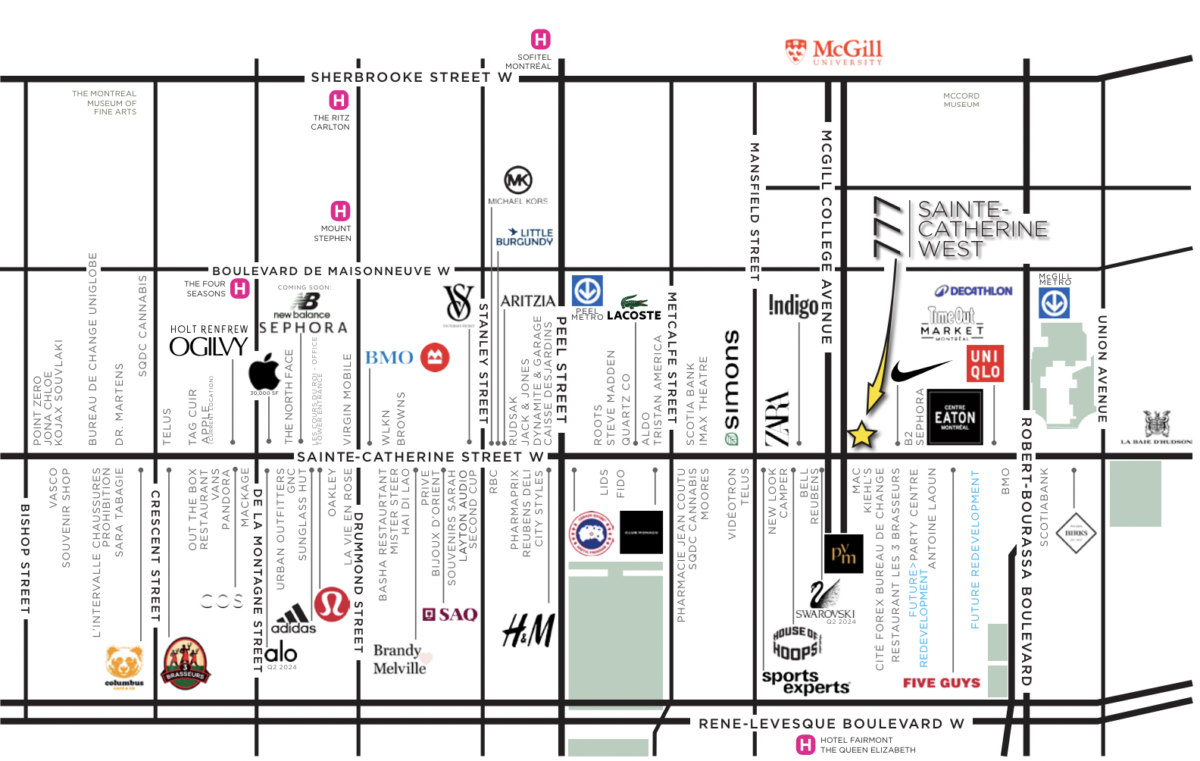
A premier flagship retail space at the bustling intersection of Sainte-Catherine Street West and McGill College Avenue in downtown Montreal is available for lease. Located at 777 Sainte-Catherine Street West, the retail opportunity is ideal for retailers and other businesses looking to establish a high-profile presence in one of the city’s most coveted locations.
Often dubbed Montreal’s “Champs Élysées,” McGill College Avenue provides a distinguished setting for the retail space. The building’s architecture combines classic elements with contemporary design, featuring intricately detailed moldings and ornate light fixtures throughout its grand interior. This striking aesthetic creates an appealing atmosphere for retailers seeking a unique and luxurious environment for their operations, with the opportunity to modify the space to make it appear more contemporary. McGill College Avenue is seeing updates that will turn it into a pedestrian promenade.
Main floor. Photo: Darwin Doleyres
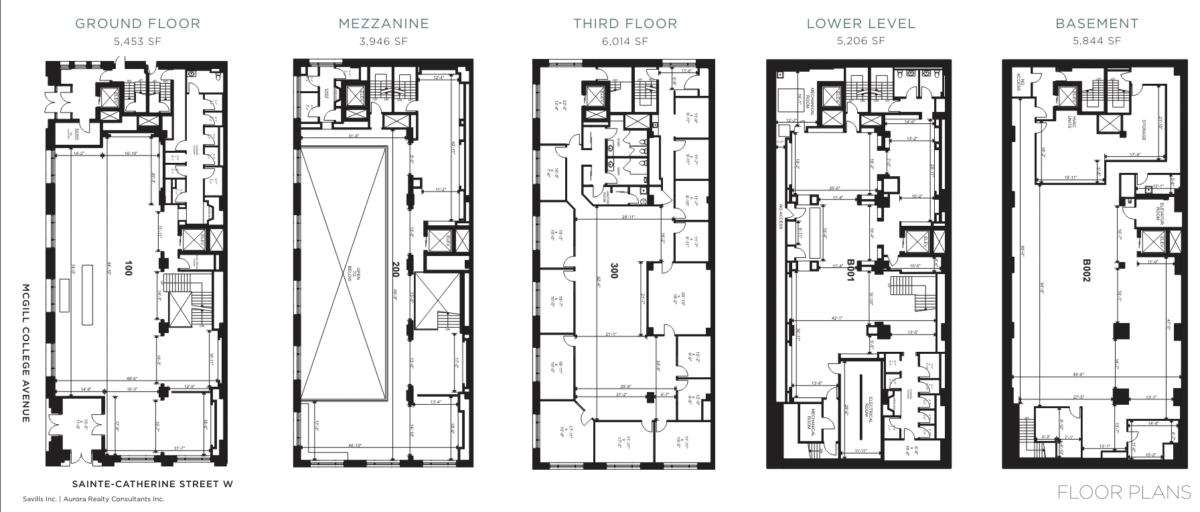
Spanning 26,463 square feet across five levels, the space at 777 Sainte-Catherine Street West offers ample room for a variety of retail configurations. The ground floor boasts a substantial 30-foot ceiling and 5,453 square feet of open retail space, perfect for large displays or flagship operations. The mezzanine provides 3,946 square feet, while the third floor and lower levels add additional flexibility for various retail concepts. With a frontage of 54 feet on Sainte-Catherine Street West and 120 feet on McGill College Avenue, this retail space ensures high visibility and excellent foot traffic.
Looking from the mezzanine level to the main floor. Photo: Darwin Doleyres
Its central location near major landmarks like the Montreal Eaton Centre and McGill University makes the retail space an attractive proposition for both businesses and customers. Additionally, its proximity to Peel and McGill metro stations, both within a five-minute walk, offers convenient public transportation access for staff and visitors.
Looking from the mezzanine level to the main floor. Photo: Darwin Doleyres
As part of Phase 1 of the Sainte-Catherine Street West Revitalization Project, the space is positioned in a key area experiencing significant growth and investment. Leasing the retail space provides a unique opportunity to be at the forefront of downtown Montreal’s transformation, with the potential to attract both local residents and tourists.
One can take a virtual walk through the space via a Matterport tour.
Anyone interested in leasing 777 Sainte-Catherine Street West can contact:
Jordan Karp, EVP, Savills Canada: 1-416-922-2223, jkarp@savills.ca
Anatomy of a Leader: Sarah Segal, CEO of DAVIDsTEA
The entrepreneurial spirit has been in Sarah Segal’s blood since she was a child.
Today, the well-known Canadian businesswoman is CEO of DAVIDsTEA since December 2020 and President of Squish Candy since January 2014.
Segal was born and raised in Montreal. She has a B.A. in Environmental Health from McGill University. Her junior year was spent at the London School of Economics.
She took a job out of university and went to China, working with the Junior Professional Consultants Program with the Canadian government. At the time, Segal worked within the United Nations organization. While working there, her boss recommended she do a Masters at Oxford University and she ended up doing a Masters in Water Science, Policy and Management.
“I had the pleasure of growing up in a retail family, both my grandparents’ side and my parents as well. We’re very entrepreneurial in our own way. My parents directly ran a couple of businesses. So from a very young age, my earliest job was working in my mom’s toy store which was a beloved toy store in Westmount here in Montreal. It was called Oink Oink,” said Segal. “She became known for free gift wrapping.”
Image: Sarah Segal
The store was open throughout Segal’s life growing up. It closed about a year or so ago.
“I really loved it. I grew up in a store. You learn a lot being around customers. I really loved wrapping. I loved gifting. I loved helping people find the perfect gift. I loved the full environment of that store which was pure joy. Now I have kids and I understand the whole toy dynamic,” she said.
“You learned through osmosis. Like merchandising and display. I would get to do the window. And I learned to work with customers and work with cash at a very young age. I don’t think you study that necessarily.”
As she grew up, her father founded Le Chateau and her mother helped run that retailer since 1959.
Segal also worked in many clothing stores.
“That was really my exposure to customers and customer service and helping customers. It was a very enjoyable line of work for me. It just felt like something you did. I gravitated towards it.
“I love talking to people. At the end of the day, I feel maybe shy in other situations but when I’m working in a retail environment I’m not shy. And I think as I grew older and more self aware I realized what kind of energy it gives you.”
Image: Sarah Segal
After graduating with her Masters, Segal joined DAVIDsTEA in 2010 in the area of product development. She became CEO in December 2020.
“I had this desire to do a similar concept as DAVIDsTEA with candy. And I saw this opportunity at a certain point. I remember wanting the vibe of opening stores and trying that entrepreneurial spirit and just so excited about the candy space and discovering this world of gummy bears,” she said of how Squish was created.
When Segal looks back at her family background and its entrepreneurial spirit, she said she learned that it takes hard work.
“I really do think (her parents) led by example. They worked 24/7. I don’t know if that’s a generational thing or a cultural thing. I’m sure a lot of people can speak to it in their own ways but for my parents they worked 24/7. I never really saw them turn off. Even on our family vacations, they would be on buying trips. It was their whole life,” said Segal. “I guess I just knew that from a very young age that it’s very involved.”
Segal said it’s definitely a time of change and evolution today in the retail industry.
“But I think retail has been evolving for quite a number of years. There are some things that haven’t changed. I still think that people want to connect in a very real way with the brand, have discussions, learn about the products, have an experience. We’re seeing such great energy in our stores. It’s still really relevant to have that human connection and to smell, touch, taste,” she said.
“I think the things that are changing are how many stores you need to have that impact, how far people are willing to displace or go to have an experience. That’s been changing for 10 plus years and kind of accelerated at this point. So I think being very, very thoughtful of where you go and how you reach your customers now with all the data we have with online sales and everything you can be very thoughtful about where you pop up or where you open. It can change and has changed.
“But I don’t think stores and in person activation is declining in any way. It’s even more relevant as a complement to a digital experience.”
Image: DAVIDsTEA
Segal said she tries to lead by example. She’s very involved in the business.
“I believe authenticity and trust is something that you build over time. I was lucky enough to come into an organization where a lot of people already knew me. That really helped in terms of me getting feedback, having that trust and open communication,” said Segal. “I believe that’s what allowed us to survive through such a big transition. It’s been our ability to communicate openly in our organization. I’ve had two children since I’ve been in this role. I’ve been a working mom. I didn’t even take a mat leave. There’s other parents in the company who were very collaborative.
“It’s a very honest and open communication and it is something that prioritizes flexibility. I hope the team feels they can talk to me about the real life struggles they face because I live it every day and share with them that you can be fully committed and work a lot but also not at the expense of your family. That’s something we’re all aligned on internally.”
Her children are two and five years old. How does she manage to juggle that, being a parent of young children and running a company?
“A lot of support. I have support here at the office. So much understanding . . . I think everyone understands when I go home for dinner. I’m going to cook for my kids, I’m going to drop them off for school. If my daughter is with me, they know why. I think it’s really normalizing those two roles. I’m not alone. Everybody aligns here and has the same situation and appreciates my values around that.”
Beyond family time and work, Segal loves playing tennis. She’s a long-time tennis lover.
“I’m very active. I played a lot of sports in the past. Team sports don’t translate into adult life so easily because of the time restrictions . . . So tennis is what I’ve been able to keep going. And I walk a lot. It’s my life hack, my pandemic habit, that continues. It’s something I can do while pushing a kid or having them on my back,” she said.
“That’s the one thing I’ve been able to maintain that doesn’t have a schedule. With work and kids, I’m at the stage where scheduling is almost impossible.
“I’ll walk in the rain or the snow, whatever. I’m very Montrealer like that. My other hack I started a few years ago was restorative yoga . . . Twenty minutes at night changed my whole alignment. It’s so enjoyable . . . It’s been a way for me to process the day and when you’re with so many people in the day, that time has been a big win for me.”
Apple has launched Tap to Pay on iPhone in Canada which it says allows businesses to seamlessly and securely accept payments from contactless credit and debit cards, Apple Pay, and other digital wallets using only an iPhone and a partner-enabled iOS app.
The retailer said no additional hardware or payment terminal is required.
Jennifer Bailey
“Canadians increasingly rely on a variety of digital and contactless payment options, so we’re excited to partner with payment platforms to offer merchants across Canada a private, secure, and easy-to-use capability that meets customers where they are,” said Jennifer Bailey, Apple’s vice president of Apple Pay and Apple Wallet, in a statement.
“We’ve seen how merchants and customers around the world appreciate the versatility of Tap to Pay on iPhone, and in a region as diverse as Canada’s, we look forward to making it easy for businesses of any size to transact from coast to coast with just an iPhone.”
Image: Square
Apple said payment platforms and developers can integrate Tap to Pay on iPhone into their iOS apps, making it easy for merchants to enable this secure and convenient capability. Starting today, Adyen, Moneris, Stripe, and Square are the first payment platforms in Canada to offer Tap to Pay on iPhone.
In the coming months, Aurus; Chase Payment Solutions, a part of J.P. Morgan Payments; Fiserv; and Helcim will enable Tap to Pay on iPhone for customers in Canada. Tap to Pay on iPhone will also be available at merchants such as Sephora, as well as Apple Store locations across the country later this year. Tap to Pay on iPhone works with contactless credit and debit cards from leading payment networks, including American Express, Interac, Mastercard, and Visa, said the company.
“With Tap to Pay on iPhone, merchants can unlock contactless payment acceptance through a supporting iOS app on an iPhone Xs or later running the latest iOS version. At checkout, the merchant will simply prompt the customer to hold their contactless credit or debit card, iPhone, or Apple Watch, or other digital wallet near the merchant’s iPhone, and the payment will be securely completed using NFC technology. No additional hardware is needed, so merchants can accept payments from wherever they do business. Contactless payments such as Apple Pay are already accepted at more than 90 per cent of Canadian retailers, and with this new capability, virtually every business, big or small, can use Tap to Pay on iPhone at checkout,” said Apple.
“Privacy is fundamental in the design and development across all of Apple’s payment features. With Tap to Pay on iPhone, customers’ payment data is protected by the same technology that makes Apple Pay private and secure. All transactions made using Tap to Pay on iPhone are encrypted and processed using the Secure Element, and as with Apple Pay, Apple doesn’t know what is being purchased or who is buying it.”
Tap to pay on iPhone (Image: Shopify)
In a statement, Stefan Jensen, Sephora’s vice president treasurer, said a focus on innovation and the customer journey is central to Sephora’s business, and delivering Tap to Pay on iPhone is another example of how Sephora is continuing to offer an elevated experience to consumers.
“We’re thrilled to soon expand Tap to Pay on iPhone to our Canadian market after introducing it to our stores in the U.S. last year and seeing how the beauty community has embraced this new way to pay. Today, our Beauty Advisors use their iPhone to provide shoppers with curated beauty recommendations, and thanks to this new flexible payment acceptance solution, they will soon be able to seamlessly complete contactless transactions on that same iPhone — wherever they are in the store,” he said.
In February 2022, Apple announced plans to introduce Tap to Pay on iPhone in the U.S.
“As more and more consumers are tapping to pay with digital wallets and credit cards, Tap to Pay on iPhone will provide businesses with a secure, private, and easy way to accept contactless payments and unlock new checkout experiences using the power, security, and convenience of iPhone,” said Jennifer Bailey, Apple’s vice president of Apple Pay and Apple Wallet, at the time.
“In collaboration with payment platforms, app developers, and payment networks, we’re making it easier than ever for businesses of all sizes — from solopreneurs to large retailers — to seamlessly accept contactless payments and continue to grow their business.”
“Whether you’re a salesperson at an internet-first retailer or an individual entrepreneur, you can soon accept contactless payments on a device that’s already in your pocket: your iPhone,” added Billy Alvarado, Stripe’s chief business officer, at the time. “With Tap to Pay on iPhone, millions of businesses using Stripe can enhance their in-person commerce experience by offering their customers a fast and secure checkout.”
Retail Insider is streamlining its Canadian retail news from around the web to include a handful of top news stories that can be viewed quickly during the day. Here are the top stories from the past 24 hours.
The Ottawa Board of Trade has collaborated with the Canadian Urban Institute to launch a new initiative to help transform and revitalize the city’s downtown core.
The Downtown Ottawa Action Agenda aims to reimagine and rejuvenate Downtown Ottawa, making it more diverse, resilient, and vibrant for generations and challenges to come.
Under the plan, Downtown Ottawa will see the addition of 40,000 new residents and the creation of 50,000 jobs by 2034, transforming the cityscape into a bustling hub of activity and innovation. The plan proposes creating a joint $500 million fund to kick-start a series of catalytic projects, including significant enhancements to the public realms of Sparks Street and ByWard Market, and the establishment of a new Business Incubation District and an Arts/Culture Corridor.
Sueling Ching
“This is more than a plan; it’s a renaissance for Ottawa’s downtown,” said Sueling Ching, President & CEO, Ottawa Board of Trade. “By fostering a live-work-play environment, we are not only boosting the local economy but also creating a culturally rich, inclusive, and accessible downtown for all to enjoy. And a Capital City all Canadians can be proud of.”
Mary W. Rowe
“Downtown Ottawa’s revitalization is a blueprint for how cities can harness urban space to meet the challenges of the 21st century,” said Mary Rowe, President & CEO, Canadian Urban Institute. “By focusing on inclusivity, resilience, and vibrant public spaces, Ottawa is setting a standard for urban innovation.”
The Downtown Ottawa Action Agenda
Rowe said downtowns around North America are reinventing themselves and Ottawa is no exception to that.
She said the pandemic exacerbated a number of issues downtowns already had but became more obvious and more critical during the pandemic.
“The Board of Trade came to us and said they wanted to do something. We’ve got to figure out what the future of the downtown is. It’s too important. The commercial tax base. So we started working with them and a whole bunch of partners,” said Rowe.
“Historically, downtowns were places you went for excitement, to see something you didn’t see in your neighbourhood, to have an experience . . . Downtowns were destinations. They were really lively places. Over time they became more dominated by office uses, office workers. And in many ways that sort of changed the composition of downtowns. Suddenly you were going downtown to work. Hasn’t always been the case.”
Today, the office landscape has changed with more remote workers and hybrid workers. This has given downtowns an opportunity to rethink what downtowns should be.
“Downtowns are for people. The main ingredient for any downtown is people. Lots of people. Different kinds of people. People coming into a physical environment for some kind of extraordinary shared experience. And that’s what we’re rediscovering now. We’re rediscovering how do we do that? How do we attract residents to live downtown? How do we attract more visitors to experience downtown and also how do we accommodate workers who may be coming in and out and commuters? These are all part and parcel of the challenge as we reinvent downtowns.
“It’s happening around the country and Ottawa is Canada’s living room. So it’s important that they get it right. The rest of the country is watching.”
Image: Ottawa Board of Trade
Here’s the Top Five Immediate Actions outlined in the Ottawa plan:
Prioritize Housing: Streamlining processes to increase downtown residency through higher density and use of public land.
Invest in the Future: Establishing financial mechanisms for ongoing downtown investment.
Address Homelessness, Addiction, and Mental Health: Implementing focused programs with multi-level government funding.
Improve Regional Mobility: Enhancing transit options to make downtown more accessible.
Position Downtown Nationally and Internationally: Marketing efforts to boost economic activity and enhance downtown’s image.
Ching said that as the voice of business the Board of Trade advocates for priorities and policies that create a competitive business environment.
“We are also representing the interests of the business community as it pertains to economic development in our community. So from that perspective, we have been mindful of the impact of the changes in workforce strategy for both the private and the public sector since the beginning of the pandemic because as you know our downtown in Ottawa we’ve been very fortunate with our business district in that a high majority of it is coming from the public sector,” she said.
“During the pandemic at one point we realized that the hybrid workforce strategy was not something that was going to go away and we were all going to go back to normal. So because of that we knew that the footfall in the downtown core was going to change. It was going to change the dynamic of the economy. We know that the downtown is an important part of the economy and also that there are many businesses there that were built up for that market and that it’s also a great asset for tourism.
“We knew that it would have to transform to become more diverse, more resilient, more vibrant and that’s why we declared it last year a top priority.”
Byward Market in Ottawa (Image: Dustin Fuhs)
Ching said Ottawa is not alone in the issues downtowns face today in Canada and the United States.
“But Ottawa is a poster child, I’ll tell you that. All downtowns of the large cities across Canada, they were disproportionately impacted during the pandemic. But Ottawa has remained the slowest to recover its downtown and therefore its economy among the larger cities,” said Ching.
“And it has everything to do with the fact that we are the seat of government and that the footprint of the public sector in our downtown core is significant and that the return to office, not work, for that sector is significantly impacting our ability to recover.”
Ching said safety in downtown areas is critically important because it directly impacts the ability to attract people to the core.
“During the pandemic what happened was that many of those issues became highlighted if you will. Maybe even accelerated and so we have to ensure the safety and security of the people that we want to work in the city core, live in the city core, and visit the city core but also for the people who are the most vulnerable and come up with a solution to serve those people as well. It’s critically important. It has the ability to discourage people from investing in the core or in the city. It needs to be addressed. And it needs to be addressed in a very multi-faceted, trilateral way for all levels of government.”
Image: Ottawa Board of Trade
The action plan was developed by the Canadian Urban Institute, in partnership with the City of Ottawa, Ottawa Tourism, Invest Ottawa, BOMA Ottawa and the National Capital Commission.
Brendan McGuinty
“Our collaborative approach ensures that the transformation of Downtown Ottawa not only meets the economic and cultural needs of today but paves the way for future generations,” said Brendan McGuinty, Board Chair, Ottawa Board of Trade.
“We’re taking a Team Ottawa approach to our downtown. By coming together as a community, we’re not just revitalizing our core, but also setting the stage for a dynamic and resilient future for all Ottawa residents,” said Ottawa Mayor Mark Sutcliffe.
Mark Sutcliffe
The Ottawa Board of Trade is the voice of business and a key economic partner in the National Capital Region. Its mission is to cultivate a thriving world class business community. One that drives affordable, inclusive, and sustainable city building. It is a champion of Ottawa as the best place to live, work, play, learn, visit and invest. For information, visit www.ottawabot.ca.
The Canadian Urban Institute is a national platform where policy makers, urban professionals, civic and business leaders, community activists and academics can learn, share, and collaborate with one another from coast to coast to coast. Through research, engagement, and storytelling, CUI’s mission is to support vibrant, equitable, livable, and resilient cities in Canada. For information, visit https://canurb.org/.